
Air Quality Index Study Guide for Environmental Science Exams
A focused review of the Air Quality Index for environmental science exams, covering AQI categories, criteria pollutants, health impacts, and calculation basics with mnemonics and practice questions to turn understanding into test-day recall.
Updated:
Most Air Quality Index exam questions are not trying to make you derive atmospheric chemistry from scratch. They usually want one of four things: put the AQI categories in order, recognize which pollutants count, match a health warning to the right category or pollutant, or explain why one pollutant sets the reported AQI for the day.
That is good news if you are cramming. It means an air quality index study guide can be compact, but it cannot be fuzzy. If you know that Orange comes before Red but cannot say what changes at Orange, you are still exposed. If you remember that particles matter but forget the difference between PM2.5 and ozone, you are exposed again. And if you treat the AQI like an average, a calculation-style question can punish you even when your definition sounds perfect.
The Six AQI Categories You Need in Order
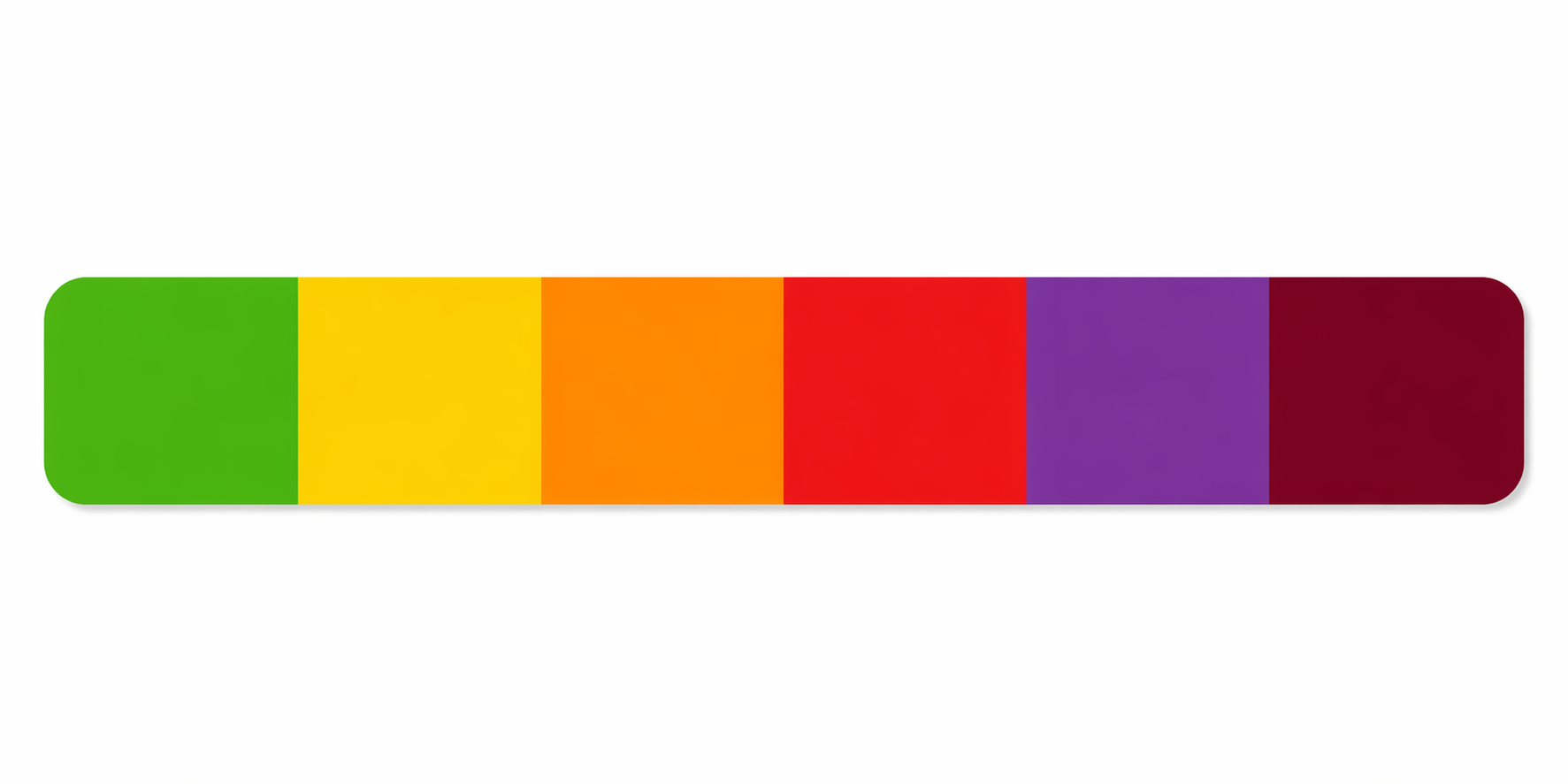
Start here because this is the easiest place to lose cheap points. The AQI has six color-coded categories: Green, Yellow, Orange, Red, Purple, and Maroon. Their ranges run from 0 to 500, with each category tied to a health message.[1][2]
| Color | AQI range | Category | Exam-facing meaning |
|---|---|---|---|
| Green | 0-50 | Good | Air quality is satisfactory. |
| Yellow | 51-100 | Moderate | Air quality is acceptable, but some unusually sensitive people may need caution. |
| Orange | 101-150 | Unhealthy for Sensitive Groups | Sensitive groups are the focus; the general public is less likely to be affected. |
| Red | 151-200 | Unhealthy | Health effects can reach members of the general public; sensitive groups may have more serious effects. |
| Purple | 201-300 | Very Unhealthy | Health alert level; risk of health effects increases for everyone. |
| Maroon | 301-500 | Hazardous | Emergency conditions; the whole population is more likely to be affected. |
The category that causes the most exam mistakes is Orange. Orange is not simply “bad air for everyone.” It is “Unhealthy for Sensitive Groups.” Red is the first category in this sequence labeled “Unhealthy” without that qualifier.[1]
A fast mnemonic for the color order is: Green Yaks Often Run Past Mountains. Green, Yellow, Orange, Red, Purple, Maroon. It is a little ugly, which helps. The point is not poetry; the point is not reversing Purple and Maroon when the clock is running.
For category matching, memorize three anchor numbers: 50, 100, and 150. Green ends at 50. Yellow ends at 100. Orange ends at 150. After that, the severity labels become easier to reconstruct: Red is 151-200, Purple is 201-300, and Maroon is 301-500.[1]
Sensitive Groups Is a Testable Phrase, Not Decoration
When a question says children, older adults, people with heart disease, people with lung disease, or people who are active outdoors, it is often steering you toward the “sensitive groups” part of the AQI. Do not flatten every warning into “pollution is unhealthy.” Exams like the distinction between a limited warning and a general-population warning.
| If the prompt says... | Think... |
|---|---|
| Air is acceptable, but a few unusually sensitive people may react | Yellow / Moderate |
| Children or people with asthma should reduce prolonged outdoor exertion | Orange / Unhealthy for Sensitive Groups |
| Everyone may begin to experience health effects | Red / Unhealthy |
| Health alert; risk increases for everyone | Purple / Very Unhealthy |
| Emergency conditions | Maroon / Hazardous |
The cleanest way to drill this is to cover the color column and identify the category from the warning language. Then reverse it: cover the warning language and say who is affected. If you can only recite the colors forward, you are not done.
The Five Pollutant Groups Behind the AQI
For exam purposes, the AQI is built around five major pollutant groups: ground-level ozone, particle pollution including PM2.5 and PM10, carbon monoxide, sulfur dioxide, and nitrogen dioxide.[3] Notice what is not on that short list: every possible air pollutant. You are studying the daily AQI, not all air pollution.
| Pollutant group | What to recognize | Common exam association |
|---|---|---|
| Ground-level ozone | Ozone near the ground, not the protective stratospheric ozone layer | Smog, sunny-day photochemical pollution, breathing irritation |
| PM2.5 | Fine particles 2.5 microns or smaller | Small particles that can penetrate deeply into the lungs |
| PM10 | Coarser inhalable particles | Dust and larger particle pollution |
| Carbon monoxide | Colorless gas from incomplete combustion | Reduced oxygen delivery in the body |
| Sulfur dioxide | Sulfur-containing gas | Fossil fuel combustion and respiratory irritation |
| Nitrogen dioxide | Nitrogen oxide pollutant | Traffic and combustion-related air pollution |
The Minnesota Pollution Control Agency describes PM2.5 as particles 2.5 microns or smaller, roughly 30 times smaller than a human hair.[3] That tiny-size detail is worth memorizing because it explains why fine particles are treated as a serious health concern: they can move deeper into the respiratory system than larger particles.
Ozone and particulate matter deserve extra attention because students mix them up. Ground-level ozone is a gas associated with smog and photochemical reactions near the surface. PM2.5 and PM10 are particles. If the prompt mentions fine particles, smoke, soot, or particle size, do not answer ozone. If it mentions ozone near the ground, do not drift into the ozone layer.
A compact pollutant mnemonic is: O Particles Can Sometimes Numb. Ozone, Particles, Carbon monoxide, Sulfur dioxide, Nitrogen dioxide. It is not a chemical mechanism. It is a recall hook for the list.
AQI 100 Is Not Random
AQI 100 is an important threshold because it generally corresponds to the short-term National Ambient Air Quality Standard for the pollutant being measured.[1] That turns the Yellow-to-Orange boundary into more than a color change. It marks the point where the category moves from Moderate into Unhealthy for Sensitive Groups.
On an exam, that usually matters more than the full interpolation formula. If a question asks what AQI value corresponds to the standard, think 100. If it asks what category begins above 100, think Orange, Unhealthy for Sensitive Groups. If it asks whether AQI values are unitless index values or pollutant concentrations, remember that AQI is the index, while the pollutant measurement has its own units.
The Reported AQI Is the Highest Sub-Index
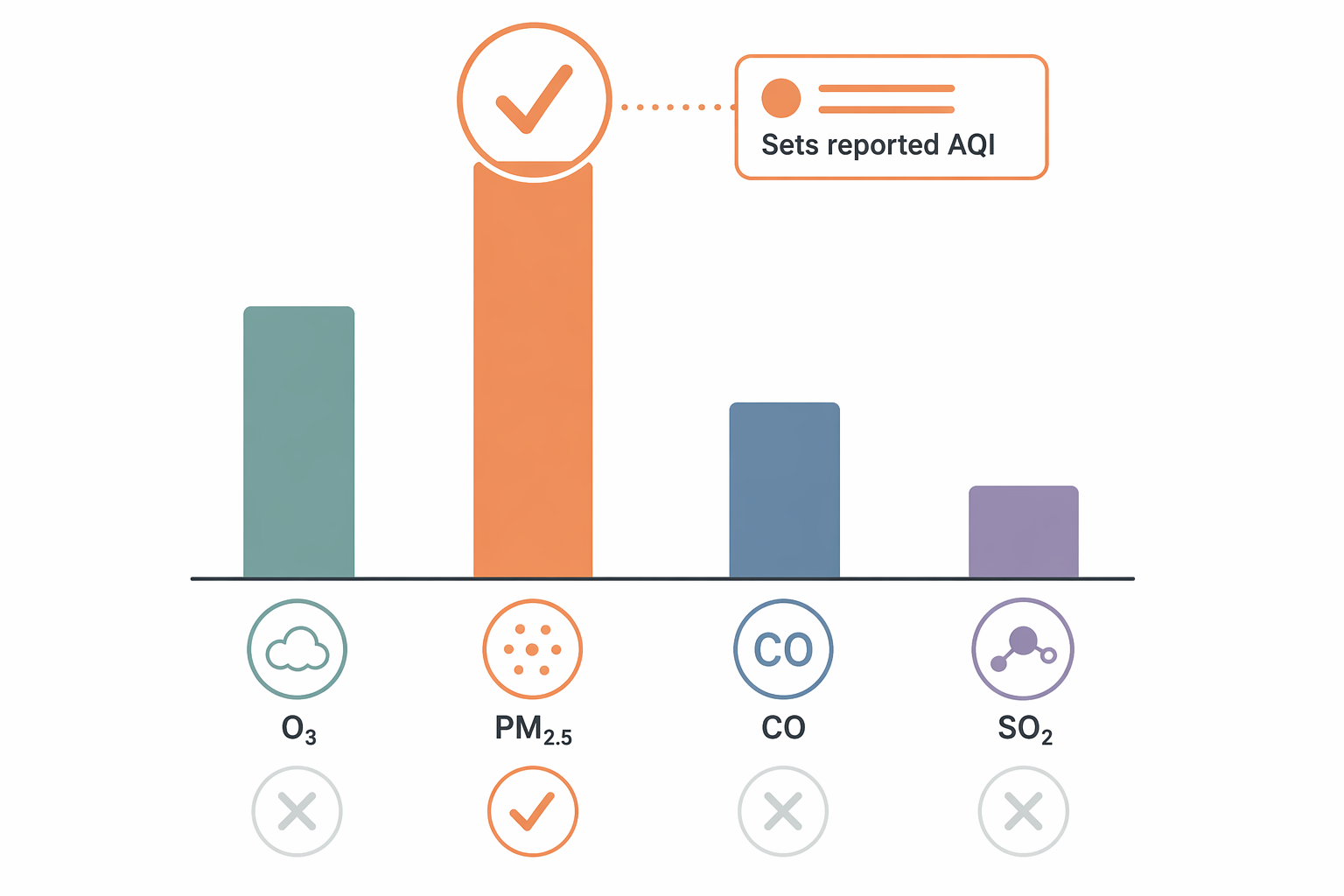
Here is the calculation trap: the reported AQI is not an average of all pollutant scores. EPA explains that AQI is calculated for individual pollutants, and the highest pollutant-specific value becomes the reported AQI for that area and time.[4]
So if ozone has an AQI sub-index of 82, PM2.5 has 137, carbon monoxide has 41, and sulfur dioxide has 56, the reported AQI is 137. The responsible pollutant is PM2.5. You do not average the four numbers. You do not choose the pollutant with the highest concentration in raw units. You choose the highest AQI sub-index.
That last sentence is the one to rehearse: highest sub-index sets the AQI. It is the difference between understanding the concept and surviving the multiple-choice version of the concept.
| Pollutant | AQI sub-index |
|---|---|
| Ozone | 88 |
| PM2.5 | 154 |
| Carbon monoxide | 37 |
| Sulfur dioxide | 72 |
Also notice the category. An AQI of 154 falls in Red, Unhealthy, because Red covers 151-200.[1] A question can stack the skills: identify the dominant pollutant, report the AQI, and name the category.
PM2.5 Breakpoints Changed in 2024
If your practice packet is old, check the PM2.5 breakpoints before trusting it. EPA updated the PM2.5 AQI breakpoints in May 2024, lowering the Good-category ceiling for PM2.5 from 12.0 micrograms per cubic meter to 9.0 micrograms per cubic meter.[4] That means older quizzes, flashcards, and answer keys can train the wrong cutoff.
This does not mean you need to memorize every breakpoint table unless your instructor assigned calculations. It does mean you should be suspicious of any PM2.5 calculation practice that uses pre-2024 values. For recognition-level exam work, keep the rule simple: AQI uses pollutant-specific breakpoints, and current PM2.5 breakpoints matter.
Advanced note: lead
Lead may appear in broader lists of criteria air pollutants, but it is not part of the daily AQI in the same way as ozone, particle pollution, carbon monoxide, sulfur dioxide, and nitrogen dioxide. If a question asks why, the usual explanation is that lead’s health effects are cumulative rather than suited to a daily index format. Treat this as a trick-detail note, not the center of your review.
What Real Exam Questions Tend to Ask
Envirothon sample questions show the pattern clearly: students are expected to identify AQI categories, connect pollutants to air-quality concepts, and recognize health-related implications.[5] That is the right level of practice for AP Environmental Science, Envirothon review, or an introductory college environmental science exam unless your instructor has specifically assigned numerical AQI calculations.
| Question type | What it tests | How to answer fast |
|---|---|---|
| Category recall | Color, range, and label | Recite Green-Yellow-Orange-Red-Purple-Maroon with the boundary numbers. |
| Health warning match | Sensitive groups vs. everyone | Orange is sensitive groups; Red expands concern to the general public. |
| Pollutant identification | Which pollutants are included in AQI | Use Ozone, Particles, CO, SO2, NO2. |
| Dominant pollutant | Which sub-index sets the reported AQI | Pick the highest AQI sub-index, not the average. |
| Calculation recognition | Breakpoints and AQI 100 | AQI 100 aligns with the short-term standard; current PM2.5 breakpoints matter. |
The mistake pattern is predictable too. Students often know the AQI is “about air pollution” and still miss the item because they answer at the wrong scale. A pollutant question is not asking for a health category. A category question is not asking for a pollutant source. A calculation-recognition question is not asking for an average.
A 12-Minute AQI Drill
Use this as a short retrieval drill, not as passive rereading. Cover the table while you answer. If you look every time, you are practicing recognition, not recall.
- Minute 1-2: Write the six colors in order from memory: Green, Yellow, Orange, Red, Purple, Maroon.
- Minute 3-4: Add the AQI ranges: 0-50, 51-100, 101-150, 151-200, 201-300, 301-500.
- Minute 5-6: Add the labels: Good, Moderate, Unhealthy for Sensitive Groups, Unhealthy, Very Unhealthy, Hazardous.
- Minute 7-8: List the five pollutant groups: ground-level ozone, PM2.5/PM10, carbon monoxide, sulfur dioxide, nitrogen dioxide.
- Minute 9-10: Say the dominant sub-index rule out loud: the highest pollutant-specific AQI sets the reported AQI.
- Minute 11-12: Answer five mixed questions without notes, then correct only after finishing.
If you miss one item, do not reread the whole guide. Repair the exact link that broke. Orange means what? PM2.5 is how small? AQI 100 connects to what? The smaller the repair, the more likely you are to remember it under pressure.
Practice Questions
Answer these before looking at the explanations. They are written to hit the common exam moves, not to show off obscure details.
- An AQI value of 132 falls into which color and category?
- Which category comes immediately after Moderate?
- A city reports pollutant AQI sub-indexes of 67 for ozone, 119 for PM2.5, 44 for carbon monoxide, and 58 for sulfur dioxide. What is the reported AQI, and which pollutant sets it?
- A question describes fine particles 2.5 microns or smaller. Which pollutant category is being described?
- At which AQI category does the warning first focus on “sensitive groups”?
- What does AQI 100 generally correspond to?
- If one pollutant has a very high AQI sub-index and the others are low, do you average them to report the AQI?
- Why should you be cautious with an older PM2.5 AQI worksheet?
Answers
- 132 is Orange, Unhealthy for Sensitive Groups.
- Orange, Unhealthy for Sensitive Groups, comes immediately after Moderate.
- The reported AQI is 119, set by PM2.5, because 119 is the highest sub-index.
- PM2.5, a fine particle pollution category.
- Orange, Unhealthy for Sensitive Groups.
- AQI 100 generally corresponds to the short-term National Ambient Air Quality Standard for that pollutant.
- No. The highest pollutant-specific AQI sub-index sets the reported AQI.
- EPA updated PM2.5 breakpoints in May 2024, so older worksheets may use outdated cutoff values.
Last Check Before the Exam
Before you close your notes, you should be able to produce this from memory: six AQI colors and ranges, five pollutant groups, AQI 100 as the short-term-standard marker, PM2.5 as particles 2.5 microns or smaller, and the dominant sub-index rule. If those come out cleanly, you are ready for the usual AQI question formats.
References
- AQI Basics, AirNow.gov.
- Air Quality Index, American Lung Association.
- Understanding the Air Quality Index (AQI), Minnesota Pollution Control Agency.
- How is the AQI calculated?, U.S. Environmental Protection Agency.
- Air Quality Sample Questions, Delaware Envirothon.
Comments
Join the discussion with an anonymous comment.