
Cuban Dissident Artists Study Guide for College Exams
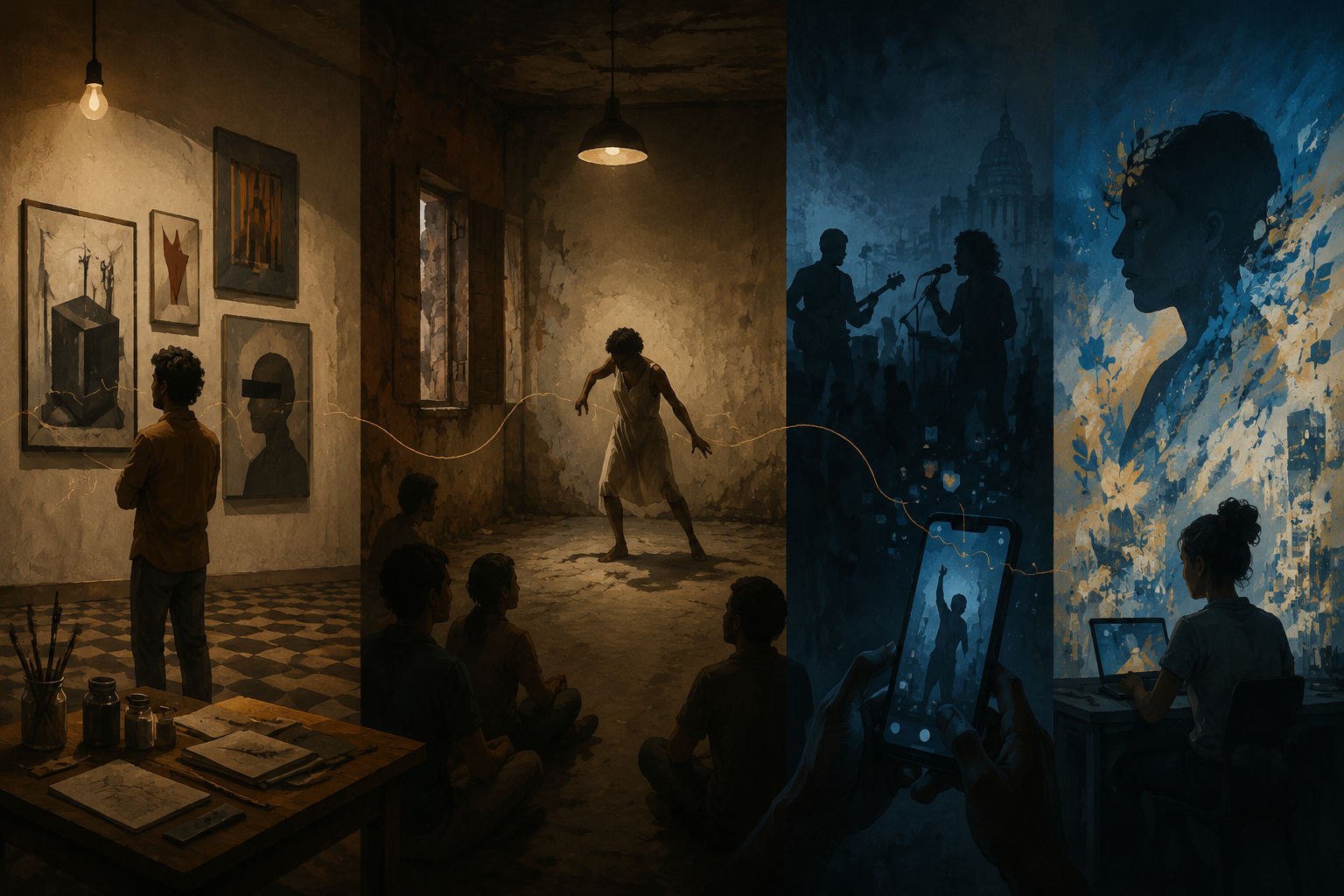
This study guide covers the major Cuban dissident artists, their historical and legal context, artistic strategies, and evolution from the 1980s Volumen Uno generation to the 2026 exile of Luis Manuel Otero Alcántara, providing a structured resource for exam preparation and paper writing.
Updated:
Luis Manuel Otero Alcántara’s reported arrival in the United States in July 2026, after five years in prison, is the kind of endpoint that can tempt a rushed exam answer into biography: artist, arrest, exile, symbol. Resist that shortcut. At the time of writing, NBC News is the source to verify for this developing status update, and the event matters less as an isolated ending than as a way to see the longer pattern behind it: Cuban dissident artists have had to change medium, venue, timing, and audience as the state changed the rules around exhibition, assembly, communication, and legitimacy.[1]
For a college exam or paper, the useful question is not simply “Who opposed the Cuban state?” It is “What changed in the conditions of making and circulating art, and how did artists adapt?” A strong answer can move from 1980s conceptual art to the economic crisis of the 1990s, then to performance, blogging, music, mobile internet, and the legal pressure surrounding Decree 349, Decree 370, and Decree 35. The names matter—Tania Bruguera, Luis Manuel Otero Alcántara, the San Isidro Movement, Yoani Sánchez, and Patria y Vida—but they matter most when attached to a medium, a constraint, and a historical moment.
A Working Timeline, Not a Hero Slideshow
The broad Cuban dissident movement includes political activists, journalists, religious figures, independent librarians, labor activists, artists, musicians, and bloggers. It has also been described by the Cuban government as a field of U.S.-backed provocation, and some opposition groups have received U.S. funding; that caveat belongs in a serious paper because it is part of the state’s counterclaim and part of the international politics around the subject.[2] It does not erase censorship, imprisonment, harassment, or exile. It does mean that students should attribute claims carefully instead of writing as if every source stands outside the conflict.
| Period | What changes | Artistic response | Exam use |
|---|---|---|---|
| 1980s, including the Volumen Uno generation | A younger generation tests the limits of official cultural institutions | Conceptual art, installation, performance, and critical exhibition practices | Use this to show that dissident art did not begin with social media or the 2020s |
| 1990s Special Period | Economic crisis changes materials, institutions, mobility, and daily survival | Works built around scarcity, improvisation, irony, and what Walker Art Center frames as an “art of necessity / necessary art” | Use this to connect form to economic conditions, not just ideology |
| Late 2000s to 2010s | Digital writing and independent online circulation become politically important | Blogs, independent journalism, documentation, and transnational attention | Use Yoani Sánchez to discuss digital voice before mass mobile internet access |
| 2018 onward | Legal and technological pressure intensifies around independent culture and online speech | Performance activism, independent artist networks, livestreams, music videos, and rapid international circulation | Use Decree 349, the 2018 3G rollout, San Isidro, and Patria y Vida together |
| 2021 to 2026 | Protest, imprisonment, exile, and online circulation become inseparable from the artwork’s public life | Songs, hunger strikes, performances, prison letters, advocacy campaigns, and forced-exile testimony | Use Otero Alcántara’s imprisonment and 2026 exile as a late chapter in a longer pattern |
That table is intentionally compressed. It is not a claim that Cuban art history advances in tidy blocks. The point is to stop treating every episode as the same brave gesture against the same abstract authoritarianism. The 1980s gallery system, the Special Period’s scarcity, the spread of independent blogs, the arrival of mobile internet, and the enforcement of culture and communications decrees created different artistic problems.
From Volumen Uno to the Special Period
Start the historical frame before the names that dominate current headlines. The Volumen Uno generation is useful because it places Cuban critical art inside the institutions of exhibition and art education rather than outside culture altogether. These artists were not simply making posters for dissent; they were testing what conceptual art, installation, performance, and institutional critique could do inside a revolutionary cultural system that officially valued art but limited political autonomy.
The Special Period then changes the stakes. Walker Art Center’s essay on Cuban art in the Special Period uses the framing of “art of necessity / necessary art” to describe how the crisis of the 1990s shaped both material conditions and artistic meaning.[3] That phrase is worth more than a quotation to drop into an introduction. It helps explain why scarcity itself becomes formal pressure: artists work with reduced materials, unstable institutions, limited mobility, and a public sphere where survival and expression are entangled.
A weak exam answer says the Special Period made artists more political. A better answer asks how crisis changed the available forms of political art. An object made with scarce materials, a performance staged in a fragile public space, or a work that depends on absence and improvisation can register economic crisis without illustrating it literally. That is the bridge from late twentieth-century conceptual strategies to the antiheroic, vulnerable gestures that become visible in contemporary dissident art.
The Legal Context: Censorship as Working Condition
Students often write about censorship as if it only means a forbidden artwork. In the Cuban dissident art context, censorship is better understood as a working condition: permission can be withheld, exhibitions can be closed, internet speech can be punished, police can interrupt a performance before it begins, and an artist can be smeared as a foreign agent. Artists at Risk Connection’s country profile on Cuba is especially useful here because it organizes censorship around legal and administrative tools rather than only spectacular arrests.[4]
Decree 349, Decree 370, and Decree 35 belong in the same analytical paragraph only if you distinguish what each helps you explain. Decree 349 is typically discussed in relation to cultural regulation and the authorization of artistic activity. Decree 370 is commonly cited in relation to online expression and communications control. Decree 35 is part of the later regulatory environment around telecommunications and digital public order.[4] Together, they show why dissident artists in the 2010s and 2020s were not simply reacting emotionally to repression; they were working under rules that affected venues, circulation, documentation, and public speech.
This is where chronology and form meet. If a state controls gallery permissions, an artist may move into the street, the home, or the body. If street action is policed, the documentation may become the circulated work. If digital speech is punished, the upload, livestream, mirror, or repost becomes a risky artistic and political act. The medium is not chosen in a vacuum.
Technology Changed the Audience
The 2018 rollout of 3G mobile internet in Cuba is a major hinge for this study guide because it altered the speed and scale at which dissident cultural work could circulate.[5] That does not mean internet access created dissent. It means digital networks changed who could see a performance, who could document police action, who could amplify a song, and how quickly a local event could become part of an international advocacy campaign.
Yoani Sánchez helps mark the earlier phase of digital opposition. Her blog-based and journalistic work became internationally visible before the later wave of mobile-first protest culture, making her useful for essays about online authorship, independent journalism, and the politics of translation and attention.[6] She is not a visual artist in the same category as Bruguera or Otero Alcántara, but leaving her out makes the digital history too thin. Cuban dissident art and writing increasingly share a field of documentation, circulation, and state response.
Major Artists and Collectives
Tania Bruguera: Performance, Institutions, and Useful Art
Tania Bruguera is the artist to use when an exam asks how performance can expose the boundary between participation and state control. Her work is associated with performance, installation, and socially engaged practice; she is also linked to the idea of “arte útil,” or useful art, where the artwork is not only an object to contemplate but a social situation that produces political consequences.[7]
The exam concept is not “Bruguera equals freedom of speech.” It is more precise: Bruguera makes the conditions of speech visible. When a performance depends on whether a public voice is permitted, interrupted, surveilled, or punished, censorship is not outside the work. It becomes part of the work’s form. That is why she is especially useful for comparing institutional critique in the art world with political control in the public sphere.
Luis Manuel Otero Alcántara: Body, Home, Nation, Prison, Exile
Luis Manuel Otero Alcántara’s importance is not just that he became internationally known or imprisoned. His work turns the artist’s body, home, neighborhood, and national symbols into sites of conflict. He is a cofounder and central figure associated with the San Isidro Movement, and his career is tied to performance, public action, and repeated confrontation with state authority.[8][9]
His imprisonment and reported July 2026 arrival in the United States after five years in prison make him an obvious late case study, but they should not flatten the earlier work. In an essay, use Otero Alcántara to ask how vulnerability becomes artistic form: the hunger strike, the police raid, the confiscated work, the watched doorway, the prison sentence, and the exile are not interchangeable symbols. Each changes what the audience can see and what the artist can do.[1]
San Isidro Movement: Collective Pressure and Networked Visibility
The San Isidro Movement formed around opposition to Decree 349 and became one of the central collective reference points for contemporary Cuban dissident art and activism.[9] It is useful because it joins several pressures that students sometimes separate too neatly: cultural regulation, police action, neighborhood-based organizing, online circulation, hunger strikes, independent journalism, and international advocacy.
Do not write about San Isidro as if it were merely an artists’ club or a political party. It is better understood as a networked cultural movement whose force came partly from the fact that artistic action, legal protest, digital documentation, and bodily risk overlapped. That overlap is why the movement is such a strong case for the 2020s: the artwork is not always separable from the record of its interruption.
Yoani Sánchez: Blogging, Independent Journalism, and Digital Witness
Yoani Sánchez belongs in this guide because the public sphere around dissident art is partly built by writers, bloggers, and independent media figures. Her work illustrates how digital authorship can create a form of witness that is not the same as gallery art but still shapes the conditions under which art is interpreted.[6] For a political science paper, she helps explain civil society and information control. For an art history paper, she helps explain how documentation and commentary become part of the circulation of performance.
Patria y Vida: Music Video as Counter-Slogan
“Patria y Vida” is a useful case because it shows music working as a compressed political medium. The song’s title reverses the official slogan “Patria o Muerte,” replacing the demand for sacrifice with a claim on life, and the song became associated with anti-government protest and Cuban dissident cultural expression.[10] In exam terms, it is a counter-slogan, a music video, a transnational collaboration, and a circulation event.
The trap is to treat the song as proof that art caused protest. The safer claim is narrower: “Patria y Vida” condensed existing grievances into a memorable cultural form and circulated through digital and diasporic networks. Its political force depended on timing, repetition, recognizability, and the ability of music to travel faster than a manifesto.
Antiheroic Resistance: Why the Gestures Are Often Small
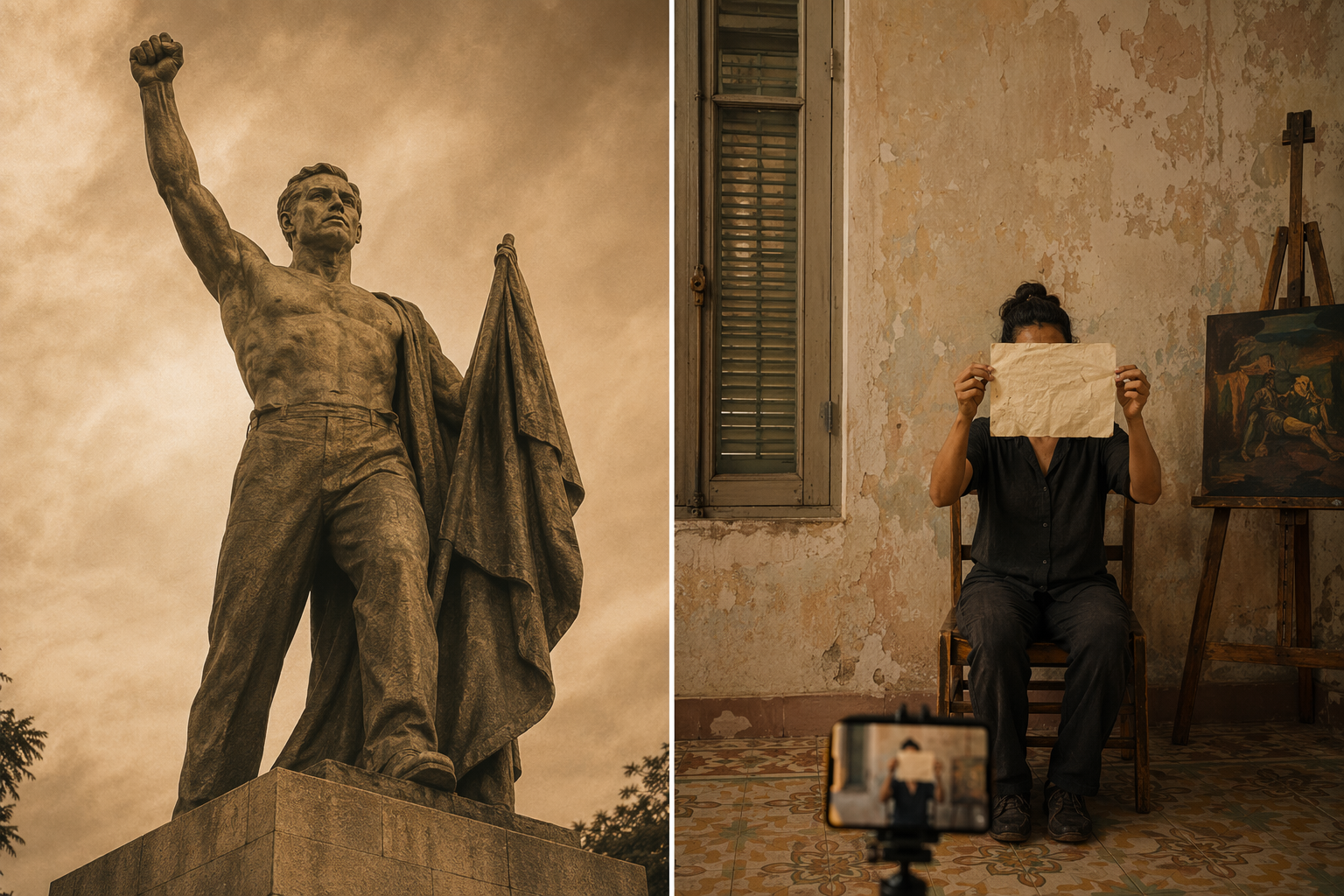
Pérez Art Museum Miami’s “Throwing Words” essay is useful because it names something students often notice but do not know how to analyze: contemporary Cuban dissident art frequently avoids monumental opposition imagery and instead uses fragile, modest, deliberately exposed gestures. The essay frames these practices as strategies of “antiheroic resistance,” which is a better analytic phrase than treating every action as a dramatic martyr scene.[11]
Antiheroic resistance does not mean weak resistance. It means the work may depend on a body sitting in a room, a phrase spoken into a phone, a hunger strike whose documentation is unstable, a song shared through networks, or a performance whose likely interruption is part of its meaning. These gestures are not monumental because monumentality may be unavailable, unsafe, or aesthetically false to the situation.
This is also where form protects an essay from becoming a human-rights inventory. Arrests, raids, and exile matter, but an art history answer has to ask how those pressures shape the work’s materials, duration, audience, and documentation. A political science answer can lean harder on law and repression, but it still needs to notice that artists do not merely “express dissent”; they design actions under constraint.
Persecution Evidence: Use It, Attribute It, Do Not Inflate It
Advocacy reports are essential for this topic because they preserve patterns that official or state-friendly accounts tend to minimize: surveillance, summonses, confiscation, imprisonment, pressure on families, travel restrictions, and forced exile. Freedom House’s “Not Even Prison Can Silence Cuba’s Artists” is especially direct about imprisoned artists and the symbolic importance of artistic expression under incarceration.[12] Artists at Risk Connection’s “Método Cuba” report gathers independent artists’ testimonies of forced exile and harassment patterns.[13]
But these sources should be cited as advocacy and human-rights documentation, not as neutral census-taking. If you use arrest counts, prison-status claims, or patterns of harassment from Freedom House, Artists at Risk Connection, Amnesty International, or Human Rights Watch, say which institution is making the claim. That does not weaken the essay. It makes the evidence usable.
The same caution applies to current events. Otero Alcántara’s July 2026 status should be checked against the most recent reporting because exile, release conditions, health, and legal status can shift quickly.[1] A student paper written after this guide should update that sentence rather than treating it as permanently settled.
Strategies to Recognize on an Exam
| Strategy | What to look for | Best examples | What not to claim |
|---|---|---|---|
| Conceptual and institutional critique | The artwork tests the rules of exhibition, speech, authorship, or official culture | Volumen Uno context; Tania Bruguera | Do not reduce it to hidden political messaging |
| Performance under surveillance | The body, timing, police interruption, or public permission becomes part of the work | Bruguera; Otero Alcántara; San Isidro actions | Do not treat the arrest as the whole artwork |
| Scarcity as form | Limited materials, improvised spaces, and survival conditions shape the work | Special Period art; Walker’s “art of necessity / necessary art” frame | Do not make poverty into aesthetic decoration |
| Digital witness | Blogs, livestreams, reposts, and independent media change who sees the work | Yoani Sánchez; San Isidro documentation; post-2018 mobile internet activism | Do not claim digital tools created dissent by themselves |
| Counter-slogan and popular music | A phrase or song condenses political feeling into repeatable form | “Patria y Vida” | Do not claim a song alone caused a protest movement |
| Forced exile as continuation | The artist’s displacement changes audience, safety, and political framing | Otero Alcántara in 2026; ARC forced-exile testimonies | Do not make exile sound like resolution |
Notice the last column. Most bad answers are not wrong because they admire the wrong people. They are wrong because they make every medium do the same work. A song, a blog, a hunger strike, a gallery intervention, and a prison letter do not produce meaning in the same way.
Comparison Points That Actually Help
If your exam gives you two artists or asks for change over time, avoid the empty contrast between “older art was symbolic” and “newer art is activist.” Older Cuban critical art could be activist, and contemporary art can be formally complex. Use a sharper comparison:
- Bruguera and Otero Alcántara: both use performance and public speech, but Bruguera is especially useful for institutional and participatory frameworks, while Otero Alcántara makes bodily vulnerability, home, neighborhood, imprisonment, and exile central to the work’s public meaning.
- Yoani Sánchez and San Isidro: Sánchez helps explain digital authorship and independent journalism; San Isidro shows how digital documentation can merge with collective performance, legal protest, and bodily risk.
- Special Period art and 2020s dissident art: both respond to constraint, but the earlier emphasis often turns on material scarcity and institutional crisis, while the later moment adds mobile circulation, communications law, and rapid international advocacy.
- Patria y Vida and visual performance: the song works through repetition, recognizability, and popular circulation; performance often works through presence, interruption, and documentation.
Paper Angles You Can Defend
A defensible paper thesis should include a time period, a medium, and a pressure point. “Cuban artists fight for freedom” is too broad. “After Decree 349 and the spread of mobile internet, Cuban dissident artists increasingly used performance documentation and networked circulation to turn censorship itself into part of the artwork’s public form” is much stronger because it can be proven with examples.
- Legal-history angle: Decree 349, Decree 370, and Decree 35 did not merely punish artists after the fact; they shaped where art could happen and how it could circulate.
- Media-history angle: the 2018 3G rollout changed the speed of visibility, making documentation and circulation central to dissident practice.
- Art-history angle: Special Period scarcity and contemporary antiheroic resistance both show artists converting constraint into form, but under different material and technological conditions.
- Collective-action angle: San Isidro matters because it links artists, writers, performers, digital witnesses, and international advocates rather than fitting neatly into one genre.
- Exile angle: forced exile should be treated as a change in the conditions of artistic production and audience, not as the narrative conclusion of dissident art.
A good paragraph will usually make one of these moves: attach a work to a law, attach a medium to a distribution system, attach a performance to the risk of interruption, or attach an artist’s public status to a changing field of surveillance and international attention. That is how the answer gets beyond memorized names.
What to Do With the Government Counterclaim
The Cuban government’s usual framing of dissident artists and activists as U.S.-funded provocateurs should not be ignored, especially in political science courses. The broad dissident movement has international funding entanglements, and some opposition groups have received U.S. support.[2] Mentioning that fact is not the same as accepting the state’s explanation for repression.
The stronger response is evidentiary: separate the state’s legitimacy claim from the documented mechanisms used against artists. If an artist is denied permission, detained, imprisoned, cut off from communication, pushed into exile, or publicly smeared, analyze that mechanism and cite the source that documents it. Do not answer propaganda with counter-propaganda. Answer it with chronology, law, form, and attributed evidence.
Exam-Ready Distinctions
| Do not blur | Useful distinction |
|---|---|
| Adoption and effectiveness | A tactic becoming common does not prove it worked politically; it may show adaptation to available media or repression. |
| Attitudes and behavior | Public sympathy for dissident art is not the same as participation in protest. |
| Correlation and causation | A song, performance, or arrest may coincide with unrest without being its sole cause. |
| Single case and general pattern | Otero Alcántara’s case can illustrate a pattern, but use advocacy reports if you claim the pattern extends to many artists. |
| State and advocacy sources | Each source has a position; attribute numbers, claims, and institutional conclusions. |
| Martyrdom and artistic form | Suffering may be part of the context, but the exam answer still has to explain medium, audience, and strategy. |
The most defensible overall argument is that Cuban dissident art is a continuous adaptive tradition. It moves from conceptual and institutional experiments in the 1980s, through the Special Period’s art of scarcity and necessity, into performance activism, blogging, music, and mobile circulation under a thickening legal framework. Otero Alcántara’s 2026 exile belongs at the end of that line for now, but not as a final moral image. It is evidence that the field of Cuban dissident art includes prison, exile, law, internet control, and public smearing as conditions artists must work through.
Write the exam answer that can explain change without losing continuity. Name the artists, but do not name-drop them. Cite the laws, but do not let legal context swallow the art. Use human-rights reports, but attribute their claims. Above all, keep asking what each artist’s medium makes possible under pressure.
References
- Cuban dissident artist arrives in U.S. after five years in prison, NBC News
- Cuban dissident movement, Wikipedia
- Double Vision: Cuban Art in the Special Period, Walker Art Center
- Censorship in Cuba, Artists at Risk Connection
- Losing the battle: Cuba's dissident artists find ways around censorship, The Art Newspaper
- Yoani Sánchez, Wikipedia
- Tania Bruguera, Wikipedia
- Luis Manuel Otero Alcántara, Wikipedia
- San Isidro Movement, Wikipedia
- Patria y Vida, Wikipedia
- Throwing Words: Strategies of Antiheroic Resistance in Contemporary Cuban Art, Pérez Art Museum Miami
- Not Even Prison Can Silence Cuba's Artists, Freedom House
- Método Cuba: Independent Artists' Testimonies of Forced Exile, Artists at Risk Connection
Comments
Join the discussion with an anonymous comment.