

Carney Speech Analysis Guide for Political Science Students
Learn to systematically analyze a major political speech by applying rhetorical analysis, discourse analysis, and IR theory to Mark Carney's 2026 Davos address. Understand how Carney uses the Vaclav Havel greengrocer metaphor and what his argument about middle powers means for Canada-U.S. relations.
Updated:
A strong Carney speech analysis for political science students should not begin and end with “Carney uses repetition.” It also should not leap from one Davos speech to a confident claim that Canada has broken with the United States. The better assignment problem is smaller, harder, and more useful: how does this speech persuade, how does it construct a political world, and what kind of international-relations argument does it make?
Mark Carney’s January 20, 2026 address at the World Economic Forum is a good case precisely because it gives students too much material for one lens. The speech itself contains a recurring Vaclav Havel greengrocer metaphor, introduced at 1:50 and returned to at 13:47 and 16:15 in the published transcript; it received a rare standing ovation at Davos and drew a direct response from President Trump.[1] Those facts matter, but they do not analyze the speech for you. They only make the method more important.
For an undergraduate paper, treat the speech as one object examined through three frameworks, not as three separate mini-essays. Rhetorical analysis shows how the language works on an audience. Discourse analysis shows how the speech defines the political situation and the actors inside it. International-relations theory helps explain what is at stake beyond the room at Davos.
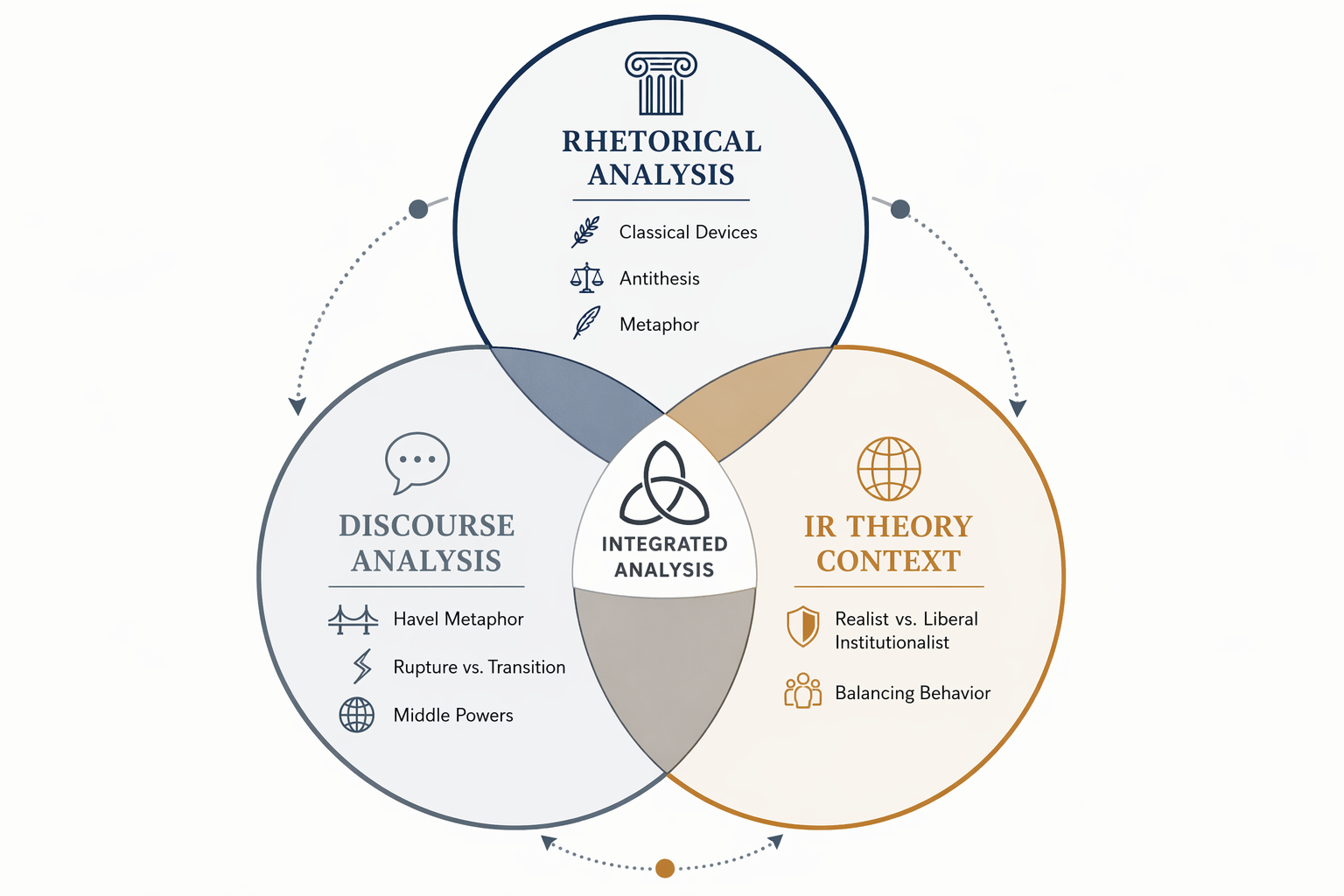
| Framework | Main question | Best evidence to use |
|---|---|---|
| Rhetorical analysis | How does the speech persuade its audience? | Devices such as antithesis, tricolon, anaphora, chiasmus, extended metaphor, inclusive language, and moral framing |
| Discourse analysis | What political world does the speech construct? | The contrast between rupture and transition, the construction of “middle powers,” and the repeated Havel greengrocer metaphor |
| IR-theory context | What does the speech imply about power, institutions, and alliance politics? | Realist and liberal institutionalist readings of Carney’s middle-power argument |
Start with the speech, not the commentary
Before using any expert interpretation, mark the transcript in three passes. First, underline the repeated phrases, contrasts, and sentence patterns. Second, circle the terms that define the political situation: crisis, transition, middle powers, democracy, sovereignty, alliance, coercion, and order. Third, note where the speech moves from moral description to strategic prescription. This sequence keeps the paper from becoming either a device list or a foreign-policy opinion column.
The Havel greengrocer metaphor should appear early in the analysis because it is not a decorative anecdote. In Havel’s original argument, the greengrocer places a political slogan in the shop window as part of a system of compelled public performance. Carney adapts that image to ask what people, governments, and states are being pressured to display, tolerate, or normalize. The speech’s later returns to the metaphor are therefore structural signals, not just callbacks.[1]

A workable thesis for a student paper might therefore sound like this: Carney’s speech uses classical rhetorical craft to make a larger discursive claim about rupture, democratic courage, and middle-power agency, while its geopolitical implications remain contested. That sentence does not settle the argument. It gives the paper a route.
Rhetorical analysis: name the device, then explain the political work
Device-spotting is useful only when it leads to interpretation. Peter Daly’s analysis of Carney’s Davos rhetoric identifies a range of classical techniques, including tricolon, antithesis, extended metaphor, anaphora, chiasmus, asyndeton, inclusive language, moral framing, and climax.[2] John Zimmer’s close reading is especially helpful for students because it counts at least 20 instances of antithesis, making the speech’s reliance on structured opposition difficult to miss.[3]
The word “antithesis” by itself earns little. The stronger move is to ask why Carney keeps building sentences around opposition. In this speech, contrast helps turn a messy geopolitical moment into a sequence of choices: courage or submission, truth or performance, transition or rupture, democratic solidarity or coerced accommodation. The device does not merely decorate the claim. It trains the listener to hear politics as a set of moral and strategic alternatives.
The same rule applies to tricolon and climax. If Carney builds a sentence in three parts, do not stop at “rule of three.” Ask whether the sequence widens the scale, increases urgency, or moves from diagnosis to action. If a passage uses inclusive language, identify who is included and who is implicitly outside the “we.” A political speech often persuades by making an audience feel already part of the responsible group.
Ann Michaelsen’s classroom lesson plan is useful here because it turns the speech into an assignment sequence rather than a pile of impressive quotations. Her materials frame the address through rhetoric, argument, and rupture politics, which is close to the path a student paper needs: observe the language, classify the argumentative move, then connect that move to the political break Carney is describing.[4]
| Weak sentence | Stronger analytical sentence |
|---|---|
| Carney uses antithesis to persuade the audience. | Carney’s repeated antitheses make the audience hear the international situation as a series of choices rather than as a gradual policy adjustment. |
| The Havel metaphor creates emotion. | The Havel metaphor turns compliance into a visible public act, allowing Carney to connect private fear, institutional weakness, and state behavior. |
| Carney uses inclusive language. | Carney’s inclusive language constructs middle powers as a collective political actor rather than as isolated states reacting separately to great-power pressure. |
Discourse analysis: track the world the speech builds
Discourse analysis is where many student papers become sharper, because it shifts attention from “beautiful sentence” to “political meaning.” The question is not only how Carney sounds persuasive. It is how the speech names the moment, assigns roles, and makes some responses seem necessary while making others seem cowardly, obsolete, or naive.
One useful starting point is Carney’s handling of rupture versus transition. A transition implies adjustment: institutions update, alliances rebalance, policy adapts. Rupture implies a break in the rules under which previous habits made sense. If a paper can show where Carney frames the moment as rupture rather than ordinary change, it can explain why the speech’s tone is urgent without simply calling it dramatic.
That distinction matters because it changes what counts as responsible behavior. In a transition, patience and reform may sound prudent. In a rupture, patience can be made to sound like complicity. The Havel greengrocer metaphor helps Carney make that shift: the problem is not just policy disagreement, but the public performance of acceptance under pressure.
Why the Havel metaphor carries so much weight
A metaphor becomes load-bearing when removing it would weaken the structure of the argument. Carney’s Havel reference does more than provide historical prestige. It gives the speech a grammar of coercion: a person or state may outwardly display consent while inwardly understanding the display as forced. That grammar lets Carney connect democratic principle to foreign-policy behavior without treating those as separate topics.
Because the metaphor appears near the beginning and returns later, students can track it across the speech instead of quoting it once. At 1:50, it introduces the problem of living with a public lie. At 13:47 and 16:15, its return signals that the earlier moral image has become a framework for judging political action.[1] In an essay, those timestamps are not trivia. They are evidence that the metaphor organizes the speech over time.
The metaphor also creates risk. If the analogy is too strong, it can make contemporary alliance politics sound like coercive communist rule. That is why the contested readings belong in the paper, not in a footnote after the real argument is over. A good paragraph can admire the metaphor’s organizing power and still ask whether it overstates the similarity between Havel’s world and Carney’s.
Zimmer’s defense, as summarized in the available commentary, is that the comparison is aimed at the present moment of compelled performance rather than at every feature of communism.[3] Antti Mustakallio’s objection moves in the other direction: the metaphor risks equating voluntary alliance behavior with coercive ideological submission. Both readings can be handled without declaring one side stupid. The student’s job is to specify what part of the comparison works, what part strains, and what evidence in the speech supports that judgment.
Middle powers as a collective actor
The phrase “middle powers” deserves more attention than a passing definition. In the speech, it is not just a label for states of a certain size. It is a political identity Carney tries to activate. Middle powers are invited to see themselves as capable of coordinated action, not merely as spectators waiting for great powers to decide the terms of order.
This is where rhetorical and discourse analysis meet. Inclusive language can make “middle powers” sound like a community. Antithesis can define what that community must resist. The Havel metaphor can turn silence or accommodation into a morally legible act. Put together, those moves construct a subject that can be praised, challenged, and mobilized.
A careful paper should not claim that Carney proves middle powers will act together. The speech argues for that possibility and tries to make it politically imaginable. Adoption, effectiveness, and future behavior are separate questions. A standing ovation shows a reception in that room; it does not prove a durable coalition.
IR theory: what the speech implies beyond Davos
Once the textual analysis is in place, the paper can widen. The Carnegie Endowment’s interpretation is the key source for this step because it reads the speech as a signal that Canada is prepared, “if need be,” to balance against the United States.[5] That is a serious claim, and it should be treated as an interpretation of the speech’s strategic meaning, not as settled proof of Canadian policy.
A realist reading focuses on power, vulnerability, and balancing behavior. From that angle, Carney’s middle-powers argument may look like a response to uncertainty about American leadership and pressure from larger states. The speech’s moral language still matters, but the underlying question becomes strategic: how do states preserve autonomy when the dominant power becomes less predictable or more coercive?
A liberal institutionalist reading emphasizes rules, cooperation, alliances, and the maintenance of an international order through institutions and shared norms. From that angle, Carney is not simply calling for balancing against a power; he is defending the conditions under which middle powers can cooperate and exercise influence through rules rather than raw coercion.
The point is not to force the speech into one theory. Its interest lies in the tension. It sounds liberal institutionalist when it defends rules, democratic norms, and collective action. It sounds more realist when it treats dependence on a great power as a strategic problem and entertains balancing behavior. A good analysis can show that the speech draws energy from both traditions.
Harvard Magazine’s analysis makes another useful contextual move by linking the speech to Joseph Nye’s concept of soft power.[6] That connection helps explain why the address itself matters as political action. Carney is not moving troops or signing a treaty in the speech. He is trying to shape legitimacy, attraction, and the terms on which others understand leadership. Soft power does not make the speech automatically effective, but it gives students a vocabulary for why language at Davos can still matter.
Use craft evidence without exaggerating authorship
Bijan Farnoudi’s speechwriter’s analysis adds an interesting craft detail: Carney wrote most of the speech himself, which Farnoudi describes as rare among global leaders.[7] This is useful evidence if the paper is discussing voice, control, or the relationship between argument and speaker. It is not a license to psychologize Carney or claim direct access to his private intentions.
International IDEA’s six messaging lessons are also helpful, especially for students thinking about democratic communication rather than only state strategy.[8] The source can support a paragraph on how the speech promotes democracy through clarity, moral contrast, and audience positioning. But here again, keep the distinction clean: messaging lessons are not evidence that the speech succeeded politically. They help explain how the message is built.
Bring in counterreadings before the conclusion
The counterarguments should not appear as a rushed “however” paragraph at the end. They are part of the analysis because they identify where the speech’s strongest moves may also create its vulnerabilities. The IP Quarterly critique argues that a “Carney doctrine” needs more realism and honesty, especially regarding China.[9] That critique does not erase the rhetorical skill of the speech. It challenges the adequacy of the strategic picture Carney offers.
This is the moment to separate three claims that students often blur. First, the speech was rhetorically admired by many observers, including those who noted the standing ovation. Second, some critics objected to its analogies and strategic omissions. Third, the longer-term policy significance remains uncertain. As of July 2026, the speech is only six months old, and peer-reviewed scholarship may not yet have caught up with the commentary cycle.
That time boundary matters. Contemporary speeches are tempting because they feel alive, but they also punish overstatement. A student can say that Carney’s address has been interpreted as a signal of possible Canadian balancing. A student should not say that the speech proves a completed break in Canada-U.S. relations. The evidence supports the narrower claim.
A practical paragraph structure for the assignment
For each major body paragraph, use a three-part movement: quote or identify the relevant passage, name the rhetorical or discursive move, then explain what that move does in context. If the paragraph is about theory, add one more step: specify whether the interpretation is realist, liberal institutionalist, or a tension between the two.
- Textual evidence: identify the phrase, metaphor, contrast, or structural return in the speech.
- Analytical label: name the device or discourse move only after the evidence is visible.
- Political function: explain how the move shapes audience judgment, actor identity, or the available choices.
- Contextual limit: state what the evidence does not prove, especially when moving from speech analysis to geopolitical claims.
Here is the difference in practice. A thin paragraph says Carney uses the Havel metaphor to make the speech emotional. A stronger paragraph says Carney introduces Havel’s greengrocer early and returns to the image later, using it to frame compliance as a visible public performance; this helps him move from democratic moral language to a strategic argument about whether middle powers should accept or resist coercive pressure. That sentence is longer because the analysis is doing more work.
The same discipline applies to the middle-powers argument. Do not write that Carney “supports cooperation” and stop. Show how the speech constructs middle powers as a collective actor, then explain why that construction can be read through both liberal institutionalist and realist frames. If using the Carnegie interpretation, make the wording careful: the speech signals possible balancing against the United States if necessary; it does not, by itself, establish that such balancing has already occurred.[5]
What the final analysis can responsibly claim
A responsible reading can say that Carney’s Davos address is rhetorically sophisticated, especially in its use of antithesis, moral framing, and extended metaphor. It can say that the Havel greengrocer image acts as a structural spine, not just an ornament. It can say that the speech constructs middle powers as agents in a moment Carney frames as rupture rather than routine transition.
It should also say that the speech’s strongest geopolitical claims require qualification. The Havel metaphor may be powerful and still inapt in part. The middle-powers argument may sound like a defense of liberal order while also hinting at realist balancing. The standing ovation shows an immediate reception, not long-term effectiveness. The Trump response confirms political salience, not the final meaning of the speech.
That is enough for a strong political science paper. Use rhetoric to show how the speech persuades, discourse analysis to show how it constructs political meaning, and IR theory to explain what is at stake beyond Davos. The result is not a bigger pile of labels. It is a clearer account of how one contemporary speech tries to turn moral language into strategic positioning.
References
- Mark Carney Speech Davos Trump Canada Full Text Transcript, Foreign Policy, January 21, 2026.
- The Craft of Leadership: Mark Carney’s Rhetoric on Display at Davos 2026, EDHEC.
- Analysis of a Speech by Mark Carney, Manner of Speaking, January 27, 2026.
- Lesson Plan: Analyzing Mark Carney’s WEF Davos Speech: Rhetoric, Argument, and Rupture Politics, Ann Michaelsen, January 22, 2026.
- Carney Middle Powers Davos Speech, Carnegie Endowment for International Peace, January 2026.
- Harvard Mark Carney Davos Joseph Nye, Harvard Magazine.
- The Secrets Behind Carney’s Davos, Bijan Farnoudi.
- What Does Carney’s Davos Speech Teach Us About Promoting Democracy?, International IDEA.
- The Carney Doctrine Needs a Dose of Realism and Honesty, IP Quarterly.
Comments
Join the discussion with an anonymous comment.