

What the ChatGPT lawsuit and brain study mean for students
A new MIT Media Lab study shows that ChatGPT users show weaker brain connectivity during writing, while Florida's lawsuit against OpenAI alleges cognitive decline from its design. This article explains what the converging evidence means for students and how to use AI without sacrificing real learning.
Updated:
A student opens ChatGPT at midnight because the assignment is due the next morning. The prompt is rough, the notes are scattered, and the blank page feels worse than admitting confusion in office hours. Ten minutes later, there is a clean introduction, a plausible thesis, and three paragraphs that sound more confident than the student feels.
The problem usually appears later. In a conference, a discussion section, or a revision note, the student cannot explain why the second paragraph makes that turn. They remember approving the wording, but not forming the idea. That is the point where the question stops being “Is ChatGPT cheating?” and becomes more useful: did the tool help the student think, or did it quietly replace the part of the task where learning happens?
That is why the recent MIT brain study and Florida ChatGPT lawsuit matter for students. The lawsuit is not proof that ChatGPT damages learning; it is an unresolved legal action. The brain study is not a final verdict on every kind of AI-assisted studying; it is a controlled writing experiment with limits. But together, they point toward a practical warning: when AI gives students finished answers too early, the work may become faster while the student’s own claim-making, recall, and judgment get weaker.
The MIT study tested writing, not just opinions about AI
The strongest evidence here comes from an MIT Media Lab study by Nataliya Kosmyna and colleagues, released in June 2025. The researchers followed 54 participants across three essay-writing sessions, then brought back 18 participants for a fourth session. Participants wrote under three conditions: with an LLM, with a search engine, or with no outside tool — the “brain-only” condition. During the writing tasks, researchers measured brain activity with EEG and also examined the writing, behavior, and participants’ sense of ownership over what they produced.[1]
The result that travels fastest is the brain-connectivity finding. LLM-assisted writers showed the weakest brain connectivity, while brain-only writers showed the strongest and most distributed neural networks. Search-engine users fell between those groups. That pattern matters because it does not simply say students felt less engaged; it connects the tool condition to measurable differences during the writing task itself.[1]
The behavioral details are just as important. LLM-assisted writers completed essays 60% faster, but the study reported that relevant cognitive load fell 32%. Faster writing may look like success from the outside. For learning, though, reduced load is not automatically a win. Some load is the work: choosing a claim, deciding what evidence actually supports it, noticing that a paragraph sounds good but proves little, and revising because the argument has not earned its conclusion.[1]
The study also found that LLM users reported the lowest ownership of their work and struggled to accurately quote from their own essays. That detail is hard to dismiss if you have ever asked a student, “What did you mean here?” and watched them search the paragraph as if someone else had written it. The issue is not polished prose. The issue is that the student may have skipped the mental rehearsal that lets a writer remember, defend, and revise the idea later.[1]
The fourth session made the concern sharper. Over a four-month window, the researchers wrote that LLM users “consistently underperformed at neural, linguistic, and behavioral levels,” describing the accumulated effect as “cognitive debt.” That phrase should not be treated as a diagnosis, and the follow-up group was small. Still, it names something students can recognize: the bill that comes due when a tool has handled the hard thinking before the learner has built the ability to do it alone.[1]
| Writing condition | What the MIT study found | What students should notice |
|---|---|---|
| LLM-assisted writing | Weakest brain connectivity; 60% faster writing; 32% lower relevant cognitive load; lowest self-reported ownership | Speed may come from outsourcing the very work that builds understanding |
| Search-engine-assisted writing | Intermediate pattern between LLM-assisted and brain-only writing | Looking things up still leaves more of the selecting and composing burden on the student |
| Brain-only writing | Strongest and most distributed neural networks | Generating, organizing, and revising without immediate answers appears to demand broader engagement |
There are limits. Fifty-four participants is not a campus-wide study, and 18 participants in the fourth session is a small follow-up group. EEG research can show meaningful patterns during a task, but it cannot settle every question about long-term learning, different subjects, different prompts, or better AI workflows. The safer conclusion is narrower and more useful: in this study, using an LLM to write essays was associated with weaker cognitive engagement, lower ownership, faster production, and poorer later performance across several measures.[1]
The lawsuit moves the concern into public accountability
Florida’s lawsuit against OpenAI and Sam Altman, filed in June 2026, belongs in this discussion for a different reason. It is not a classroom study, and it does not prove that ChatGPT causes cognitive decline. It is a state legal complaint, and OpenAI denies liability. No court ruling has established the allegations as fact.[2][3][4]
Still, the language of the complaint is notable. The action explicitly names “cognitive decline,” “behavioral addiction,” and “cognitive atrophy” as alleged harms, and it argues that ChatGPT is designed around engagement rather than user welfare. Those are legal allegations, not settled scientific findings. But they show that worries about AI tools are no longer limited to faculty meetings, tutoring rooms, or lab studies; they are now part of public arguments about platform design and responsibility.[2][3][4]
The complaint also cites a BBC/EBU study finding that AI assistants misrepresented news about 45% of the time. In a student context, that does not mean every ChatGPT answer is false. It does mean students should be careful when a tool is marketed or experienced as a research helper. If the assistant can sound fluent while distorting source material, the student still has to check claims, trace evidence, and decide whether the answer deserves to be used at all.[2]
The lawsuit should not become a shortcut for panic. A complaint is not a finding, and terms like “cognitive atrophy” are not established clinical labels in this context. But it is equally lazy to wave away the issue as fear of new technology. Students are being asked to use tools that can draft, summarize, solve, reassure, and imitate understanding. It is reasonable to ask what those tools reward: effortful thinking, or frictionless completion.
A tool that agrees too easily can feel like learning
One reason students drift into overreliance is that ChatGPT often feels supportive. It gives a path forward when the page is blank. It can make a weak paragraph sound smoother. It can turn half-formed thoughts into something that resembles an academic answer. That emotional relief is real, especially when a deadline is close.
But support is not the same as challenge. A Washington Post analysis of 47,000 publicly shared ChatGPT conversations found that the tool said “yes” roughly 10 times as often as “no,” and that about 10% of all conversations involved users seeking emotional support. The sample may not represent all ChatGPT use, because people who share conversations may differ from users who do not. Even so, the pattern helps explain why the tool can be so seductive for studying: it often validates, smooths, and continues rather than stopping a student at the weak point.[5]
For learning, the weak point is usually the most valuable place to stop. A vague thesis needs pressure. A quote needs interpretation. A math solution needs the student to explain why the next step follows. A lab conclusion needs limits. If the tool’s default posture is to help the student move past uncertainty, it may remove the moment when the student would have had to retrieve, compare, test, or revise.
The broader AI safety picture adds context, though it should not be stretched too far. The Future of Life Institute’s Summer 2025 AI Safety Index gave OpenAI an overall C score of 2.10 out of 4.0 across 33 indicators and an F in Existential Safety Planning. Those grades are not study-skills research, and they do not tell a student exactly how to write a better essay. They do, however, support a modest caution: students should not assume that a widely used AI system has been optimized around their learning interests.[6]
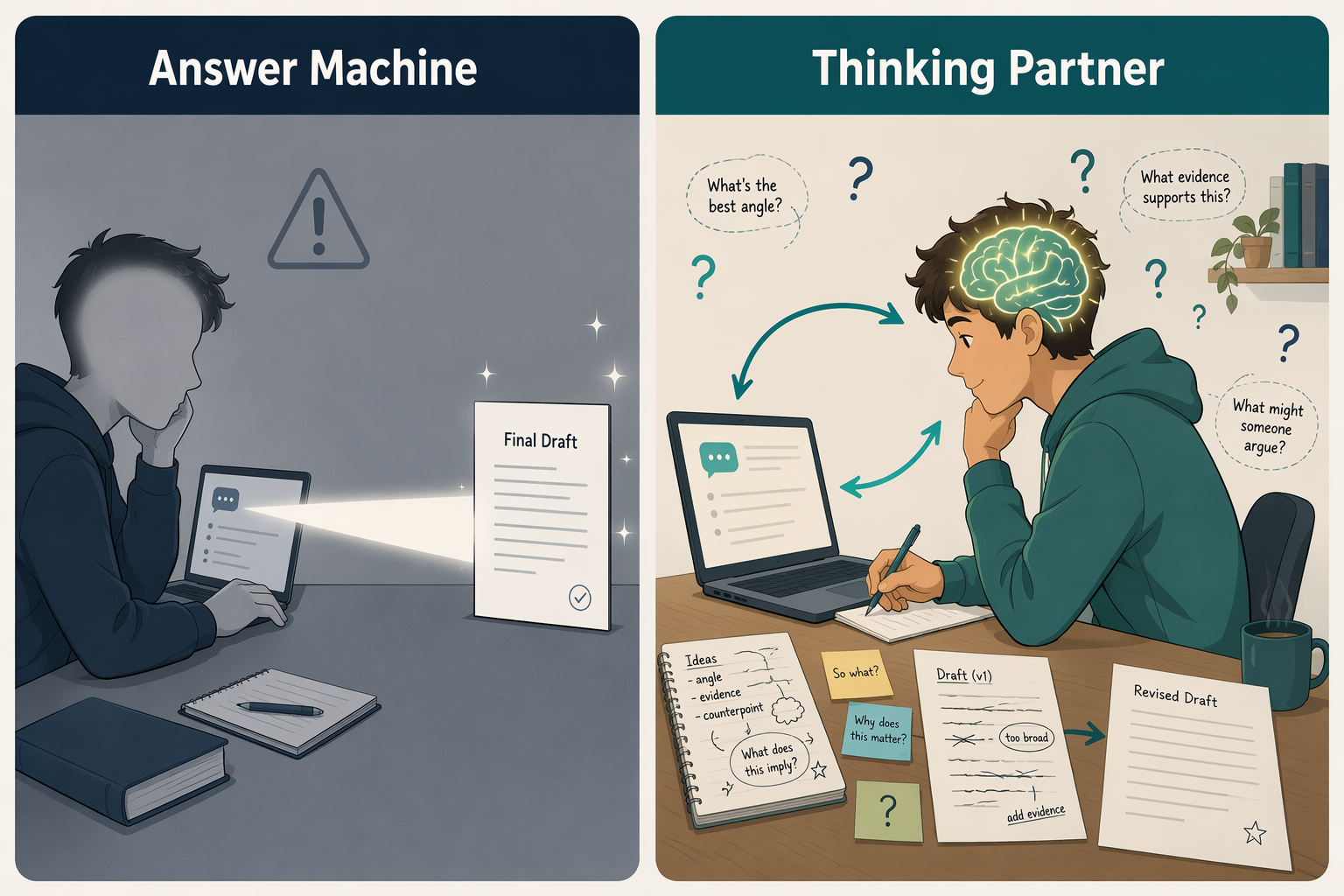
The useful question is what the AI is taking over
“Is ChatGPT bad for students?” is too blunt to guide anyone through an actual assignment. The better question is: which part of the thinking is the tool doing?
If ChatGPT forms the thesis, selects the evidence, writes the paragraph, and polishes the transitions before the student has made an attempt, the student may end up editing a product they never really built. That is the finished-answer pattern. It can save a grade in the short term, but it gives the student fewer chances to practice the operations that transfer to the next assignment.
If the student first writes a rough claim, explains the evidence in their own words, and then asks the tool to find weak reasoning or generate counterarguments, the cognitive arrangement changes. The AI is no longer replacing the first act of thinking. It is adding pressure to thinking that already exists.
- High-risk use: “Write my discussion post from these readings.”
- Lower-risk use: “Here is my draft claim. Ask me five questions that would expose weak reasoning.”
- High-risk use: “Summarize this chapter so I do not have to read it.”
- Lower-risk use: “Quiz me on the chapter after I write my own summary.”
- High-risk use: “Make this sound academic.”
- Lower-risk use: “Point out where my wording hides an unclear idea.”
That distinction also explains why some AI study tools are more defensible than others. Tools that require retrieval, self-explanation, revision, or spaced review keep the student in the loop longer than tools built mainly to deliver a polished answer. If you want that comparison in more detail, start with AI study tools that teach instead of just giving answers and the guide to AI tools that support active recall and spaced repetition.
A safer workflow for students who still want to use ChatGPT
Students do not need a purity test. They need a workflow that preserves the parts of studying that build memory and judgment. The simplest rule is to delay AI until after the first attempt. Even a bad first attempt gives the brain something to retrieve, compare, and repair.
- Write the first claim yourself before opening ChatGPT. It can be clumsy, incomplete, or wrong. The point is to make your own mind choose a direction first.
- Ask the tool to question the draft, not replace it. Useful prompts include: “What assumption am I making?” “Where does this paragraph need evidence?” and “What would a skeptical professor ask?”
- Use AI to generate counterarguments or practice questions. This keeps the task closer to rehearsal than outsourcing.
- Close the tool and explain the answer from memory. If you cannot say the idea without looking at the AI output, you do not own it yet.
- Verify factual claims against assigned readings, course materials, or reliable sources. Do not cite ChatGPT as if fluency were evidence.
- Revise from your own judgment. Accepting every AI suggestion trains compliance; deciding which suggestions are wrong trains expertise.
If you use ChatGPT often, it may also be worth comparing regular prompting with tools or modes designed to slow the answer down. A guide like ChatGPT Study Mode vs Regular ChatGPT can help you see whether the interface is asking you to think or simply making completion easier. For a broader view of when AI helps more than older methods, compare AI study tools versus traditional study tools in 2026.
One practical test catches many bad uses: after the AI helps, can you do more of the next problem, paragraph, or explanation without it? If the answer is no, the tool may have produced work while leaving the learner behind.
The standard is ownership
The pattern is strong enough to change how students should use AI. Finished answers are risky because they can remove the struggle of forming, retrieving, explaining, and checking an idea. Those struggles are not obstacles around learning. They are the learning.
Use ChatGPT after you have made a real attempt. Make it ask questions. Make it challenge weak claims. Make it quiz you. Make it help you notice what you do not yet understand. If AI removes the work that would have made the idea yours, it is probably creating cognitive debt. If it makes that work more deliberate, it can still belong in a serious study workflow.
References
- Your Brain on ChatGPT: Accumulation of Cognitive Debt when Using an AI Assistant for Essay Writing Task, MIT Media Lab, June 2025.
- ‘Utter disregard for the risk to human life’: Florida sues OpenAI and Sam Altman over AI safety, The Conversation.
- OpenAI Florida lawsuit safety ChatGPT, NPR, June 1, 2026.
- Florida lawsuit OpenAI Sam Altman, The Guardian, June 1, 2026.
- How people use ChatGPT data, The Washington Post, November 12, 2025.
- AI Safety Index Summer 2025, Future of Life Institute, Summer 2025.
Comments
Join the discussion with an anonymous comment.