
AI Study Tools That Teach Instead of Just Giving Answers
Many AI study tools simply hand over answers, leaving students without real understanding. This guide examines tools deliberately designed to teach through Socratic questioning, active recall, and source grounding, and explains how to choose one that actually builds lasting knowledge.
Updated:
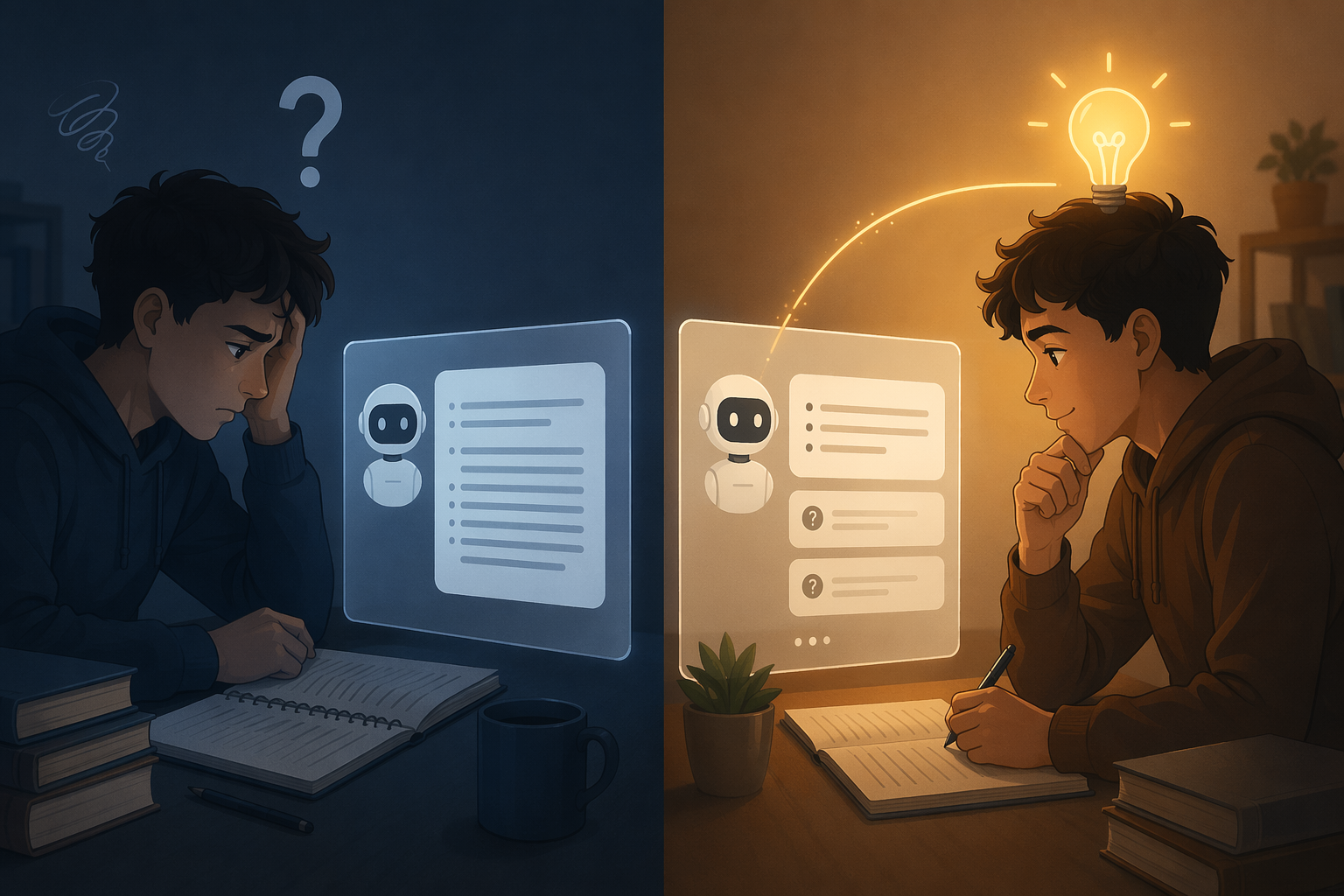
The most dangerous AI study session is the one that feels successful too early. A student pastes in a homework problem, gets a clean explanation, nods through the steps, and closes the laptop feeling rescued. The next day, the same idea appears with different numbers or a slightly different wording, and nothing comes back.
That failure is not a moral flaw. It is a design problem. A chatbot that gives a finished answer can help with speed, but speed is not the same as learning. AI study tools that do not just give answers have to change what the student does: retrieve from memory, explain a step, test a guess, connect the question to sources, and try again after forgetting has had a chance to do its work.
Students are already using AI often enough that this distinction matters. In 2026, Lumina Foundation and Gallup reported that 57% of U.S. college students use AI at least weekly, while many still default to general-purpose chatbots rather than tools designed around learning behavior.[1] The question is no longer whether students will ask AI for help. The better question is whether the tool makes them think before it makes them feel finished.
The Difference Is Teaching Behavior, Not AI Branding
A tool can call itself a tutor and still behave like an answer machine. The useful dividing line is more concrete: does it ask the student to do the next piece of thinking, or does it remove that thinking from the session?
In an answer-delivery workflow, the student’s job is mostly recognition. The explanation looks familiar, the algebra appears to move correctly, the thesis statement sounds polished. Recognition is comfortable, but it is a weak test of whether the student can reproduce the method later. Teaching behavior is different. It asks for a prediction before revealing the next step. It withholds the final answer long enough for the student to commit to a reason. It turns a solved example into a new practice question. It points back to the student’s own notes instead of inventing a confident-sounding summary.
That is why the best AI study tools in this category are not always the flashiest ones. Some are deliberately slower. Some refuse direct answers. Some are strongest when they are boring in exactly the right way: they make you recall, check, and revise.
The Strongest Evidence Points To Active AI Tutoring
The most useful evidence here is not a product demo. It is a randomized controlled trial published in Nature Scientific Reports in June 2025. Harvard researchers studied 194 students and compared an AI tutor built on active learning principles with in-class active learning. The AI tutoring condition produced learning gains with effect sizes from 0.73 to 1.3 standard deviations, and students spent a median of 49 minutes with the tutor compared with a 60-minute class session.[2]
Those numbers deserve attention because they are not measuring whether students liked the tool or whether it produced prettier explanations. They measure learning gains. In education research, a standard deviation effect size is a way to describe how far one group’s performance moved relative to another group’s distribution. A gain of 0.73 to 1.3 standard deviations is not a tiny preference signal. It suggests that, in this study setting, the AI tutor helped students learn substantially more than the comparison condition.[2]
The phrase “active learning principles” is doing real work. It does not mean the tutor simply explained more enthusiastically. Active learning asks students to participate in the cognitive work: answer questions, make predictions, identify mistakes, apply a concept, and receive feedback while the idea is still unstable. A tired human tutor will often try to do this: “Before I solve it, what do you think the first move is?” The research tutor was designed to keep doing that instead of sliding into full-solution mode.
There is an important limit. The Harvard system was a custom research tutor, not a commercial app that any student can open tonight. The study supports the design principle: AI tutoring can work very well when it is structured around active learning. It does not prove that every app with “AI tutor” on its homepage produces the same gains.
A 2026 study in the Journal of Computer Assisted Learning points in the same direction. It compared generative-AI scaffolded learning using Socratic dialogue with direct-answer AI support and found significantly better learning outcomes for the Socratic approach.[3] That result matches what many students discover the hard way: getting the answer can end the task before the learning has begun.
Bloom’s taxonomy gives students a plain language for this. Answer-getting often sits near the lower levels: remembering or recognizing something after it is shown. Strong studying climbs toward explaining, applying, analyzing, and creating. All Day TA uses that framing to argue that the best AI study tool is not the one that merely gives answers, but the one that pushes the student into higher-order thinking.[4]
Socratic Tutors: Best When You Are Stuck On A Concept
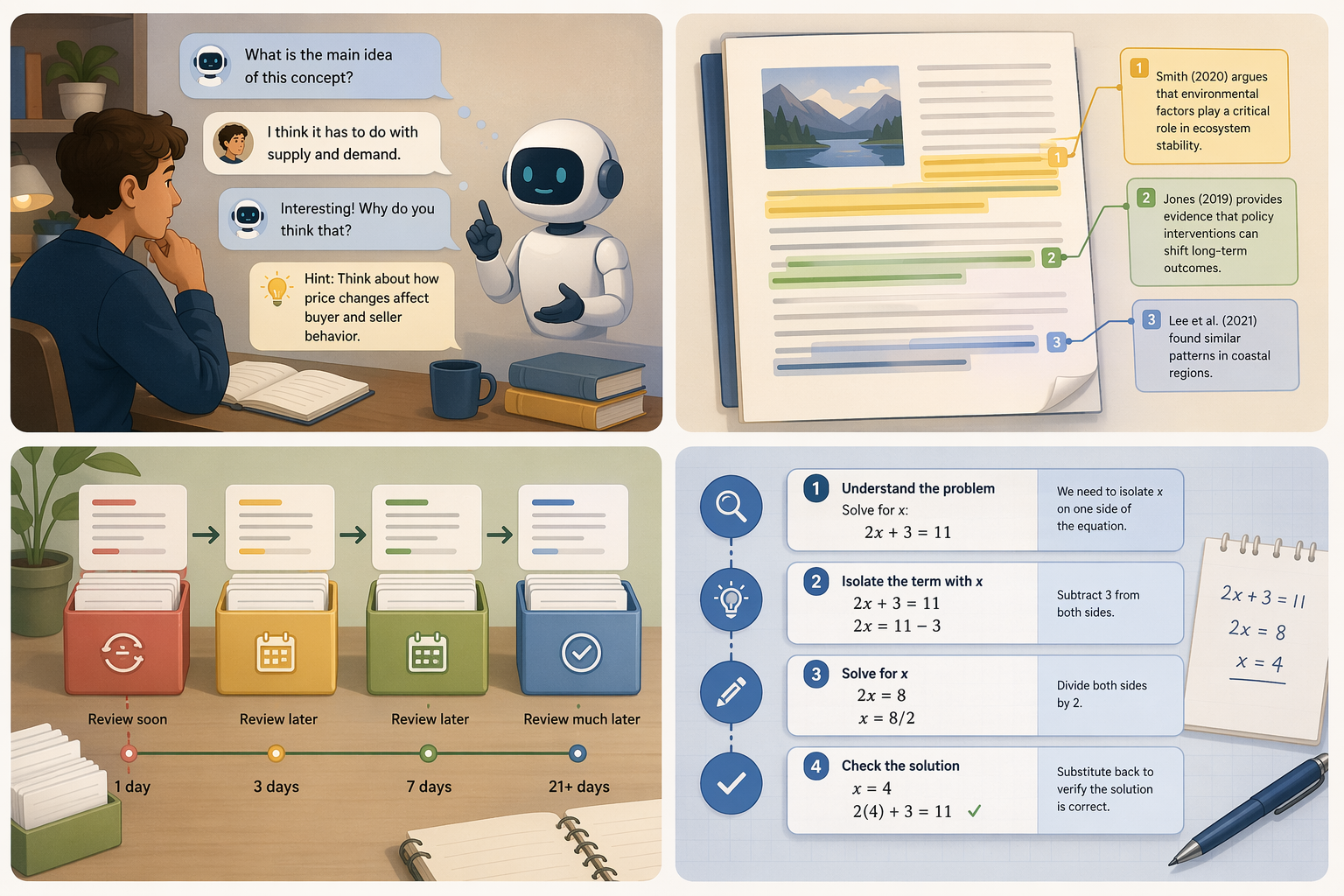
Socratic AI tutors are the clearest answer to the phrase “AI study tools that do not just give answers.” Their job is to create friction at the exact moment a normal chatbot would remove it. They ask what you already know, request your next step, give a hint, and push back when your reasoning is thin.
Khanmigo is one of the most explicit examples. Khan Academy says Khanmigo does not give the answer directly and instead uses Socratic questioning. In internal testing across more than 15 million tutoring threads from October 2025 through April 2026, Khan Academy reported a 6.1% improvement in next-item correctness when Khanmigo had structured student learning history.[5] That is promising, especially because the improvement is tied to context about the learner, not just a better-written explanation. It is still vendor evidence, not an independent RCT, so it should be treated as useful but not final.
Khanmigo’s refusal behavior matters. If a student asks for the answer to a math problem and the tool insists on working through the idea, that design supports academic integrity and learning at the same time. It also reduces the awkward burden on the student who wants help at 11 p.m. but does not want to cross a line. At the time of writing, Khanmigo was listed at $4 per month, but pricing changes often enough that students should verify the current plan before choosing it.[5]
ChatGPT Study Mode is a different kind of option because it lives inside a general-purpose chatbot. OpenAI launched Study Mode in July 2025 with teacher-designed system instructions intended to refuse direct answers and use Socratic prompts and hints.[6] For students who already use ChatGPT, that makes the learning-oriented path easier to reach. The weakness is just as obvious: Study Mode can be switched off.[6] A mode that depends on the student not bypassing it is helpful, but it is not the same as a tool built from the ground up to prevent answer-copying.
For students trying to use it responsibly, the practical move is to make Study Mode the default for homework help and ask for hints, checks, and practice problems rather than finished solutions. A deeper walkthrough is available in the ChatGPT Study Mode homework guide, and students who want the mechanics of the mode can use the hands-on Study Mode guide.
Socra AI Tutor also frames itself around Socratic questioning. Its described modes include goal-oriented dialogue, active recall, the Feynman technique, and adaptive learning, and it says it refuses to give finished answers.[7] That combination is pedagogically sensible: goal-setting keeps the session from becoming a wandering chat, active recall checks memory, and the Feynman technique makes the student explain an idea plainly enough to reveal gaps. The evidence available here is a product description rather than an independent outcomes study, so the safest conclusion is about design intent, not proven effectiveness.
The best use case for Socratic tutors is not “do my assignment.” It is “make me solve the next one.” A good request sounds like: “I am allowed to get tutoring help, not a final answer. Ask me one question at a time until I can solve this type of problem myself.” If the tool gives away the ending too quickly, the student should push it back into tutor mode: “Do not solve it yet. Ask me what I would try first.”
Source-Grounded Tools: Best When The Reading Matters
Not every study problem is a tutoring problem. Sometimes the danger is not that the student needs a hint; it is that the AI invents a source, misstates a reading, or blends three concepts into a confident mush. For research-heavy classes, source-grounded tools can be more useful than a Socratic tutor.
NotebookLM is the cleanest example in this group. The University of Chicago’s Academic Technology team describes it as grounding answers in user-uploaded sources and saying “I don’t know” rather than fabricating when the material does not support an answer.[8] That is not the same as teaching a student to solve a calculus problem, but it is valuable when the assignment depends on lecture notes, PDFs, articles, or a course packet.
Used well, NotebookLM can turn a messy set of readings into a studyable environment. A student can ask where a concept appears, compare two assigned texts, generate review questions from uploaded materials, or check whether a claim is actually in the source. The free tier was available at the time of writing, but students should still confirm current access and limits before relying on it.[8] For a fuller student workflow, see the NotebookLM Deep Research guide.
Perplexity belongs near this category because it is built around searching and citing web sources rather than only generating a conversational answer. That can help students compare explanations or locate background material. It should not be mistaken for an automatic tutor, though. A cited answer can still leave the student passive if all they do is read it. The learning move is to use the sources to build questions, test claims, and return to the course material.
Active Recall And Spaced Repetition Tools: Best When You Need Memory To Last
Some tools teach less like a tutor and more like a disciplined study partner. Anki, RemNote, and Quizlet can all support active recall: the student sees a prompt, tries to retrieve the answer from memory, then checks. Spaced repetition adds timing, bringing cards back after intervals so the student practices before forgetting becomes permanent.
AI features can make these systems faster, but speed is not automatically an upgrade. Auto-generating fifty flashcards from a chapter may feel productive while producing shallow cards the student never had to think about. The better workflow is to generate possible cards, edit them, delete weak ones, and make sure each card asks for one retrievable idea. “Explain why demand shifts left in this hypothetical market” is usually more useful than “Define demand.”
These tools are strongest for quiz and exam preparation when the target is durable recall: vocabulary, formulas, historical sequences, anatomy, language learning, core theories, and common problem types. They are weaker if the student treats them as a substitute for solving full problems or writing full explanations. A flashcard can check a component skill; it cannot always prove that the student can assemble the whole performance.
Process-Showing Tools: Useful, But Easy To Misuse
Wolfram Alpha step-by-step and Photomath sit in a more delicate category. They can show a process, which is better than a bare final answer. But seeing steps is still not the same as generating steps. A student can stare at a beautiful solution and learn almost nothing if the session ends there.
The useful pattern is reconstruction. First, look at only the next step. Then close or cover it and explain why that step is valid. Then solve a similar problem without looking. Finally, compare the method, not just the final number. If the tool becomes a path to copy, it has stopped being a study tool and started being a shortcut with a receipt.
| Tool Type | Best Use | Main Risk |
|---|---|---|
| Socratic tutors | Getting unstuck on concepts while still doing the reasoning | Bypassing the tutor behavior or accepting hints passively |
| Source-grounded tools | Studying from readings, notes, PDFs, and research sources | Mistaking sourced summaries for personal understanding |
| Active recall and spaced repetition tools | Building memory for quizzes, exams, and cumulative courses | Generating too many weak cards without editing or retrieval |
| Process-showing tools | Checking steps and reconstructing methods in math or technical subjects | Copying the path without being able to reproduce it |
A Five-Criteria Test For Any AI Study Tool
Once the categories are clear, the choice becomes less brand-dependent. Before paying for a tool or trusting it with a hard course, test what it makes you do. YouLearn’s 2026 evaluation framework emphasizes active recall, spaced repetition, use of your own materials, practice tests, and price, and compares tools such as YouLearn, Khanmigo, NotebookLM, and default ChatGPT against those criteria.[9] That framework is useful, though it comes from a vendor blog and should not be treated as neutral research.
The stronger version of the test puts pedagogy ahead of price. Cost matters, especially for students, but a cheap answer machine is still an answer machine. At the time of writing, YouLearn was listed at $20 per month, Khanmigo at $4 per month, and NotebookLM had a free tier; those figures are volatile and should be checked before making a decision.[5][8][9]
- Does it require active recall? A good tool asks you to produce an answer, prediction, explanation, or next step before showing too much.
- Does it support spaced repetition? For material you must remember later, the tool should bring ideas back over time instead of treating one correct answer as mastery.
- Can it work from your own materials? For source-based classes, the safest study help is anchored in assigned readings, notes, slides, or uploaded documents.
- Can it generate or support practice tests? Practice questions reveal whether you can use the idea without the original question sitting in front of you.
- Does it have explicit pedagogical design? Look for refusal of direct answers, Socratic prompts, feedback, scaffolding, and opportunities to revise.
A simple stress test works well: give the tool a homework-style question and ask for help without the final answer. If it immediately solves the problem, it is not behaving like a tutor. If it asks what you know, gives a hint, checks your reasoning, and then offers a similar practice problem, it is much closer to the kind of AI help that can build skill.
Students comparing options can use a broader AI study tools comparison for feature-level details, but the feature list should never replace the behavior test. The real question is not how many buttons the tool has. It is whether those buttons lead to retrieval, explanation, source-checking, and practice.
Which Tool Should You Actually Choose?
There is no single winner because students get stuck in different ways. A student preparing for a biology quiz may need Anki, RemNote, or Quizlet more than a chatbot. The win is not that AI can generate cards; it is that the student has to retrieve the answer tomorrow, three days from now, and again before the exam.
A student reading dense sources may be better served by NotebookLM-style grounding. If the exam or paper depends on assigned material, a tool that can point back to uploaded sources is safer than a general chatbot that may sound right while drifting away from the text.
A student stuck on a concept should start with a Socratic tutor: Khanmigo, Socra, or ChatGPT Study Mode used with strict boundaries. The tool should withhold the final answer long enough for the student to reason. That delay is not inefficiency. It is the part where learning has a chance to happen.
Instructors have a parallel reason to care about this distinction. A tool that only outputs finished work invites answer-copying and makes academic-integrity enforcement harder. A tool that asks students to explain, defend, and revise can be used more like tutoring support. Georgia Tech’s Socratic Mind project, for example, focuses on AI-powered oral assessment that challenges students to explain and defend answers; it was piloted with about 2,000 students and received a $50,000 Catalyst Award.[10] That is assessment rather than ordinary study help, but it points toward the same standard: the student’s reasoning has to become visible.
Pick the tool that makes you retrieve, explain, check sources, and practice again. Be suspicious of any tool that lets you feel finished before you can reproduce the thinking yourself.
References
- State of Higher Education, Lumina Foundation and Gallup, 2026.
- AI tutoring outperforms active learning, Nature Scientific Reports, June 2025.
- GAI-scaffolded learning, Journal of Computer Assisted Learning, 2026.
- The Best AI Study Tool Isn’t the One That Gives You Answers, All Day TA.
- How Khan Academy is building a better AI tutor: our most recent learnings, Khan Academy Engineering Blog.
- ChatGPT Study Mode, OpenAI, July 2025.
- Socra AI Tutor, Socra.
- Google NotebookLM: An AI Tool for Research and Studying, UChicago Academic Technology, 2026.
- Best AI Study Tools for Students 2026, YouLearn.
- AI Oral Assessment Tool Uses Socratic Method to Test Students’ Knowledge, Georgia Tech.
Comments
Join the discussion with an anonymous comment.