
GRE Planner
How to Read Scientific Research Using Greenland Shark Studies
A hard science passage on the GRE or MCAT often looks more intimidating than it is. The animal is unfamiliar, the technique sounds specialized, and the numbers arrive with symbols that make the conclusion feel slippery. The useful move is not to become a Greenland shark expert in three minutes. It is to mark five things before the answer choices start pulling you around: hypothesis, sample, method, result range, and limitation.
The Greenland shark lifespan research sequence is a strong practice case because it does not let a careful reader be lazy. One paper estimates age from radiocarbon in eye lenses. Another sequences a genome and proposes longevity mechanisms. A third asks whether very old sharks still retain a particular visual capacity. All three are impressive. None gives permission to treat every claim as equally settled.

Start with the 2016 radiocarbon study: what was actually measured?
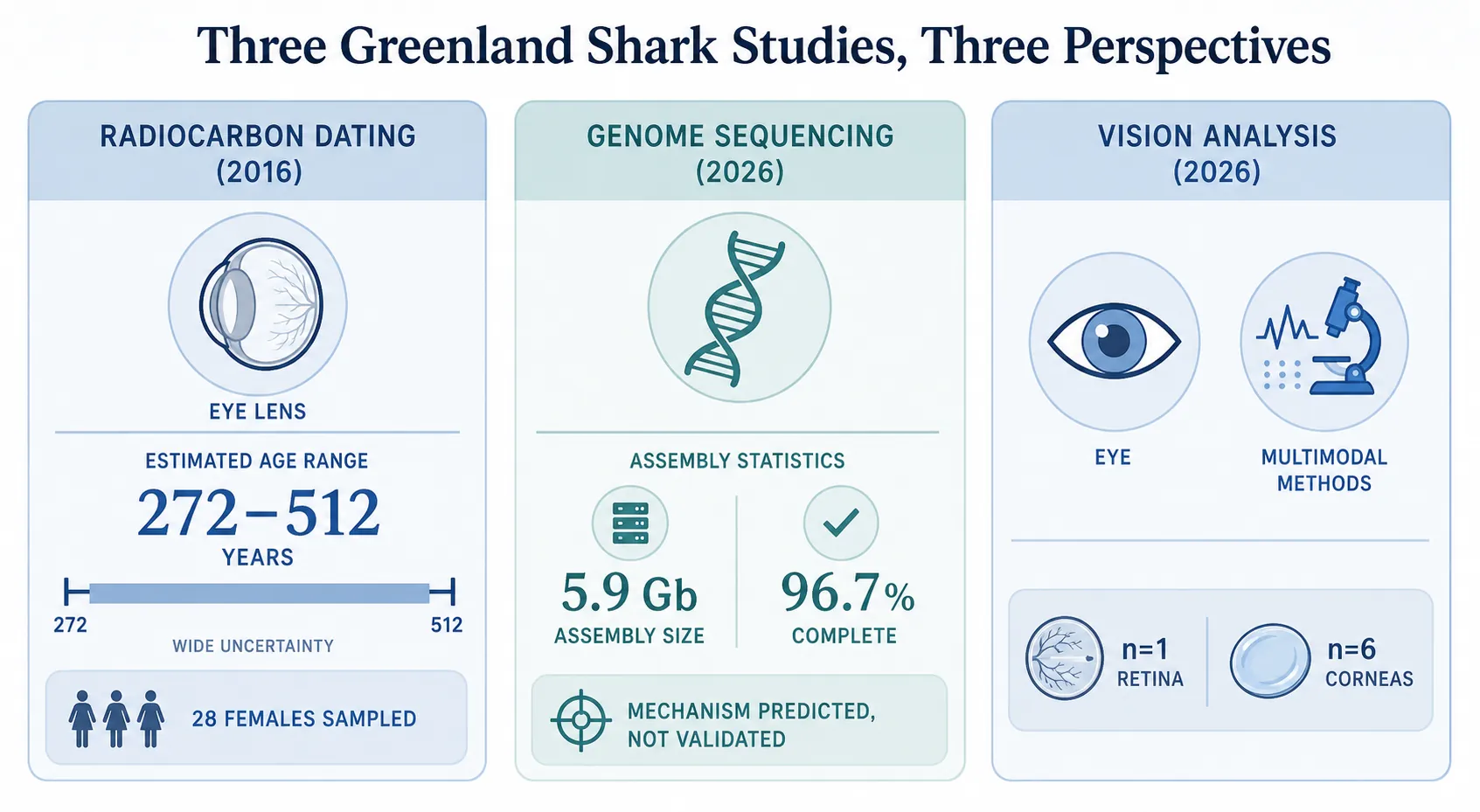
The famous number from the 2016 Science paper is easy to remember and easy to misuse. Nielsen and colleagues analyzed 28 female Greenland sharks, ranging from 81 to 502 cm, and estimated that the oldest individual was 392 ± 120 years old, which gives a range of 272 to 512 years.[1]
A test passage would not reward you for stopping at “the shark was about 400 years old.” That sentence has already blurred three different things: the sample, the method, and the uncertainty. The study did not observe a shark living for four centuries. It estimated age from radiocarbon signals in tissue with a special developmental property.
| Passage item | What to mark in Nielsen et al. |
|---|---|
| Research question | How old can Greenland sharks be, and how slowly do they grow? |
| Sample | 28 female sharks, 81–502 cm in length |
| Method | Radiocarbon dating of eye lens nuclei |
| Key result | Oldest estimated age: 392 ± 120 years, or 272–512 years |
| Limitation | The estimate depends on radiocarbon interpretation; the midpoint is less secure than the lower bound |
The eye lens matters because it is not just a dramatic place to take a sample. Lens nucleus proteins are formed early and are metabolically inert, so they can preserve a chemical signal from the time when the tissue was formed. That is the methodological hinge of the paper. If the tissue kept turning over like many other tissues, it would be far less useful for age estimation.
The carbon-14 part also matters for passage reading. The researchers used bomb-pulse radiocarbon logic: atmospheric nuclear testing changed carbon-14 levels, and that change can serve as a time marker in biological material. The same broad principle has been used in forensic dating of human remains, but in this study it is applied to Greenland shark eye lens material.[1]
For a standardized test, this is where many students lose points. They read a clever method and unconsciously upgrade it into certainty. But the paper’s own number resists that. “392 ± 120” is not a decorative detail. It tells you that the estimate has a large uncertainty band: 272 to 512 years.[1]
So if an answer choice says the study proved that the oldest shark was exactly 392 years old, it is too strong. If it says the data are consistent with an age somewhere in the range of 272–512 years for the oldest sampled individual, it is much safer. If it says the species always lives more than 500 years, it has moved from one estimated individual to a broad species claim the study did not establish.
There is also an active interpretive concern around the radiocarbon estimate. Aaron MacNeil of Dalhousie has publicly argued that ocean mixing rates in deep Arctic waters could inflate the apparent age; in that view, the minimum 272-year figure is more secure than the 392-year midpoint. That objection is not a cheap debunking move. It is the kind of counterclaim a passage can use to test whether you know what a method assumes.
Notice the exam logic. The counterclaim does not force you to say the radiocarbon study is useless. It asks you to separate the conclusion that is strongly supported—Greenland sharks can be extraordinarily long-lived—from the more specific midpoint estimate, which depends on assumptions about radiocarbon baselines and mixing.
The same species, three different evidence rules
Once the radiocarbon paper gives you the template, the next move is comparison. Do not read the later genome and vision studies as if they are simply “more proof” of the same claim. They answer different questions with different methods.
| Study type | What the method can support | What it cannot support by itself |
|---|---|---|
| Radiocarbon dating | An age estimate for sampled individuals, with an uncertainty range | An exact age for every Greenland shark |
| Genome sequencing | Candidate genetic mechanisms associated with longevity | Experimental proof that those mechanisms cause long lifespan |
| Functional vision analysis | Evidence that very old sharks can retain rod-based visual function | A fully population-level estimate of vision across all ages and individuals |
Genome sequencing proposes mechanisms before it proves them
The 2026 PNAS genome paper is strong in a different way from the radiocarbon study. Yang and colleagues reported a 5.9 Gb genome assembly that was 96.7% complete by BUSCO score, with an N50 of 233 Mb.[2] Those are assembly-quality details, not trivia. On an exam, they tell you the authors are building a molecular argument from a relatively complete genome rather than from a fragmentary sketch.
The paper’s more interesting claims concern possible longevity mechanisms. The authors identified unique H1.0 histone substitutions predicted to enhance chromatin stability and an expansion of ferritin genes suggesting a role for ferroptosis-mediated longevity.[2] That is exactly the kind of sentence that tempts a rushed reader into overclaiming.
The disciplined version is narrower: the genome study identifies sequence-based candidates that may help explain exceptional longevity. It does not, by sequence data alone, show that those substitutions or gene expansions functionally cause the shark’s lifespan. The limitation matters here because it is explicit: these are predictions from sequence data, not yet functionally validated mechanisms.
If an MCAT-style passage gives you this study and then asks which follow-up experiment would strengthen the claim, the answer would probably involve functional testing: changing the relevant gene or protein context, measuring chromatin stability, testing ferroptosis resistance, or otherwise connecting genotype to cellular outcome. More sequencing alone might improve confidence in the sequence pattern, but it would not automatically validate the proposed mechanism.
The vision paper shows why converging methods still need sample-size attention
The 2026 Nature Communications vision study asks a more functional question: do extremely old Greenland sharks retain visual capacity? Fogg and colleagues combined genomics, transcriptomics, histology, in vitro opsin analysis, and corneal transmittance testing.[3] That multi-method design is stronger than a single isolated observation because several lines of evidence point toward the same broad conclusion.
The reported findings are also concrete. The study found intact rod vision past 130 years, described TUNEL-negative retinal evidence, measured an opsin λmax of 458 nm, and reported corneal transmittance of 70–100% despite the presence of a copepod parasite.[3]
Here, the mistake would be different from the mistake in the radiocarbon study. The issue is not mainly a huge uncertainty band around one age estimate. It is uneven sample strength across assays. The retinal histology evidence came from n=1, and the corneal transmittance assay used n=6 corneas.[3] That does not erase the study. It tells you which part of the conclusion should be treated as promising but sample-constrained.
This is a useful MCAT reading lesson because “multimodal” does not mean “unlimited.” A passage can present genomics, tissue analysis, in vitro protein work, and optical measurements in the same study, and you still have to ask how many individuals or samples support each subclaim.
How to annotate a research passage without getting lost
When a passage gives you unfamiliar marine biology, do not spend your working memory on the wrong nouns. “Greenland shark,” “eye lens nuclei,” “H1.0 histone,” and “λmax” may all be new. The repeatable task is older and simpler: identify what role each term plays in the argument.
- Name the hypothesis or question. Is the study estimating age, proposing a molecular mechanism, or testing retained function?
- Mark the sample. Look for the number of individuals, tissues, corneas, trials, or datasets. Do not let a large-sounding conclusion hide a small n.
- Identify the method’s output. Radiocarbon dating produces an age estimate. Genome sequencing produces sequence patterns and predictions. Opsin and corneal assays produce functional or optical measurements.
- Keep the result range attached to the result. A midpoint with a wide interval is not the same as a precise measurement.
- State the limitation in the same dimension as the claim. For radiocarbon, ask about dating assumptions and uncertainty. For genome work, ask about functional validation. For vision work, ask which assays are sample-constrained.
That last point is where stronger readers separate themselves. Weak limitation statements sound generic: “more research is needed.” Strong limitation statements are matched to the method: “The sequence pattern suggests a mechanism, but the study has not yet shown that the predicted mechanism changes cellular function.” That is the level of precision answer choices often test.
What a test question might try to make you overclaim
A GRE Reading Comprehension question might ask for the “primary purpose” of a paragraph describing eye lens radiocarbon. The answer is unlikely to be “to describe Greenland shark anatomy.” More likely, the paragraph is explaining why a tissue sample can preserve an age-related chemical signal.
An MCAT biology question might ask which conclusion is best supported by the genome paper. “The shark genome contains candidate features associated with longevity” fits the evidence. “Ferritin expansion definitively causes Greenland shark longevity” goes beyond the evidence because the proposed mechanism still needs functional validation.
A data interpretation question might give the age estimate as 392 ± 120 years and ask which statement follows. The safe answer preserves the uncertainty range. The unsafe answer treats the midpoint as exact, ignores the lower and upper bounds, or generalizes from one estimated individual to all members of the species.
A methods question might describe the vision study’s use of several techniques and then ask about the main caveat. The answer should not dismiss the paper because it used multiple methods, and it should not accept every conclusion uncritically because the methods converged. It should notice that some assays were supported by very small samples.
Use the Greenland shark studies as a passage-reading drill
Before checking answer choices, try writing a one-line evidence map for each study:
- Radiocarbon study: 28 female sharks; eye lens carbon-14; oldest estimated at 392 ± 120 years; exact midpoint debated.
- Genome study: high-quality assembly; candidate histone and ferritin features; possible longevity mechanisms; no functional validation yet.
- Vision study: multiple methods; evidence for retained rod vision in very old sharks; some assays limited by very small n.
That is enough. You do not need a full lecture on Arctic ecology to answer most exam questions built from this material. You need to know which claim belongs to which method.
For the same style of practice in other passage types, compare this approach with the GRE Reading Comprehension: Defamation Law Case Study, the RASolute 302 clinical-trial interpretation article, and the Likweli monkey MCAT biology article. If you need a broader plan for Reading Comprehension work, start from the GRE Prep Hub.
The score-building habit is simple: when a study looks exotic, slow down until you can say what was sampled, what was measured, what range was reported, and what the method still cannot prove.
References
- Eye lens radiocarbon reveals centuries of longevity in the Greenland shark (Somniosus microcephalus) — Science — 2016
- The Greenland shark genome provides insights into extreme longevity — PNAS — 2026
- Functional vision in the long-lived Greenland shark — Nature Communications — 2026
Fill in this timeline
This is a skeleton schedule, not a performance claim — for section-by-section strategy to fill in each slot, read the exam hub. For evidence that a similar timeline worked, compare against real outcome logs.
How to Read the '1 in 4 NFL Players CTE' Study
- When to Do HIIT for Better Memory and Exam Focus
- Can NYT Strands Daily Actually Build Vocabulary?
- A Sleep-First Routine to Stop Falling Asleep While Studying
- Does Air Quality Affect Study Focus? Yes — by How Much?
Compare each outcome's duration against this planner's 8 weeks length manually.