SAT Planner
Best Time to View the Perseids 2026 for Astronomy Students
The answer: midnight to 1 AM, Aug. 12 and Aug. 13
For astronomy students trying to protect a final SAT prep plan, the best time to view the Perseids 2026 is the early morning of Aug. 12 and the early morning of Aug. 13, with midnight to 1 AM as the most manageable study-break window. Stay outside for 20–30 minutes, watch with your eyes only, and do not let the meteor shower become an all-night event. The American Meteor Society lists the 2026 Perseid peak for Aug. 12–13 with 0% moon illumination, and College Board lists the August SAT for Aug. 22, placing the shower 9–10 days before test day.[1][2]
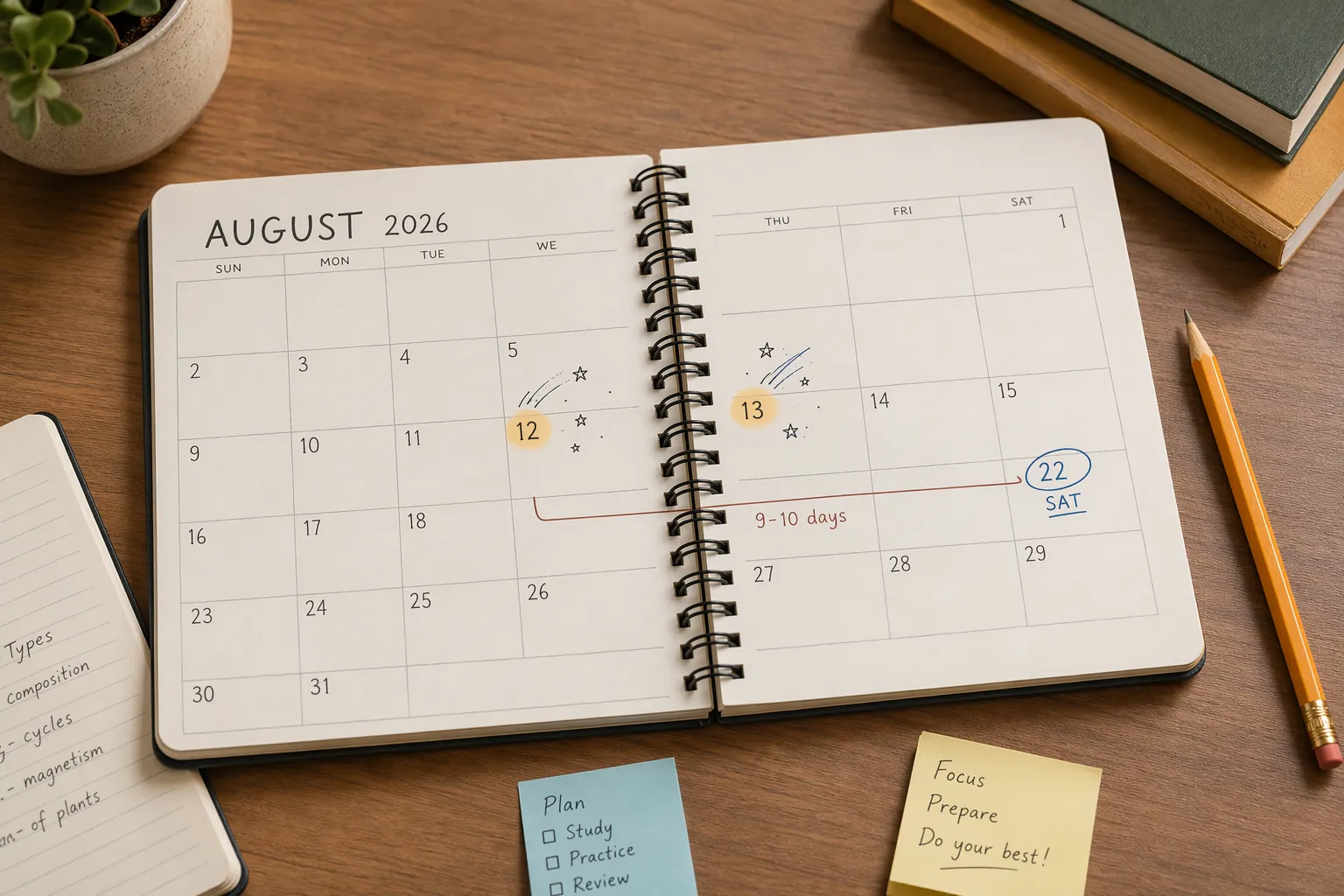
That is the useful part first. If you are already in the last two-week SAT window, the decision is not whether meteor showers are beautiful in the abstract. It is whether this one can fit into the calendar without taking a bite out of sleep, review time, or emotional steadiness. In 2026, it can, as long as it is scheduled like a break instead of treated like a spontaneous midnight adventure.
| Date window | Best use | Keep it bounded |
|---|---|---|
| Early morning of Aug. 12 | First peak attempt; useful because shower forecasts are not exact to the minute. | 20–30 minutes outside, ideally sometime between midnight and 1 AM. |
| Early morning of Aug. 13 | Second peak attempt; protects you if the stronger activity favors the other side of the listed peak. | Same limit: naked-eye viewing, then back inside and back to sleep. |
| Aug. 22 | SAT test date. | Do not trade sleep in the final week for a longer skywatching session. |
Why both mornings belong on the plan
Meteor shower peaks are forecasts, not appointments. The Perseids are listed for Aug. 12–13, and peak timing can shift by 6–12 hours, which is enough to make one morning noticeably better than the other from a specific backyard, campus, or park.[1] The practical answer is not to stay up for two full nights. It is to reserve two short chances.
The early morning matters because meteor showers generally improve after midnight as the viewing location turns more directly into the stream of debris. For a student schedule, that creates a tradeoff: the mathematically strongest viewing may come later, but the responsible SAT-prep window is earlier and shorter. Midnight to 1 AM is a compromise. It gives the shower a better chance than evening viewing without pushing a student into the kind of sleep loss that makes the next day’s practice test useless.
The 0% moon illumination is the rare part worth caring about. Moonlight washes out faint meteors. A new-moon Perseid peak means the sky itself is not adding a bright background at the exact time students are trying to watch.[1] That does not guarantee a dramatic show from a suburban driveway, but it removes one of the biggest predictable obstacles.
Use the conservative number when setting expectations: the American Meteor Society lists a Perseid zenithal hourly rate, or ZHR, of about 100.[1] ZHR is an ideal-condition figure, not a promise that one student will count 100 meteors in one hour from home. It assumes a dark sky, good viewing geometry, and the radiant high enough to cooperate. Streetlights, haze, trees, buildings, tired eyes, and the fact that you are only staying out 20–30 minutes all reduce what you actually see.
That is why a good Perseids plan should sound less like “watch 100 meteors” and more like “give yourself a short, dark-sky window during the best lunar conditions the shower is going to offer.” If you see several meteors, the break worked. If clouds cut the count down, the break can still work as a reset.
The SAT constraint changes the viewing advice
For a general astronomy article, the advice could be simple: go somewhere dark, stay out late, and wait. For an SAT student, that is not good enough. The Aug. 12–13 Perseid peak falls close enough to the Aug. 22 SAT to matter psychologically, but far enough away that a controlled break should not interfere with final review.[1][2] The danger is not the meteor shower. The danger is turning it into a sleep-debt event and then calling that “balance.”
If you can handle both peak mornings without damaging sleep, check both. If you have an early obligation, pick one morning and protect the next day. If the sky is cloudy on Aug. 12, try Aug. 13. If both nights are cloudy, do not chase the shower into the rest of the week at the expense of the final prep rhythm. The point is to place a rare event inside the plan, not let it rewrite the plan.
- Set the break before the night starts: choose Aug. 12, Aug. 13, or both, and decide the stop time in advance.
- Keep the session naked-eye. Binoculars and telescopes narrow the field of view and make the break fussier than it needs to be.
- Step away from direct lights. A darker yard, field, driveway, or safe open area is more useful than a perfect compass direction.
- Lie back or sit comfortably enough that you are not craning your neck for 30 minutes.
- Do not turn the session into a phone session. If you check the time, keep the screen dim and brief.
- For astronomy students, a simple observation note is fine: time outside, sky clarity, approximate meteor count. Do not build a full lab report at 1 AM.
What the break science actually supports
There is no serious reason to claim that watching the Perseids has been proven to raise SAT scores. That is too specific, and the evidence does not say it. What the evidence does support is narrower and still useful: purposeful breaks, especially nature-based ones, can help attention, stress, mood, and subsequent focus.
Cornell Health advises students to take purposeful study breaks of 5–60 minutes and states that such breaks can increase energy, productivity, and ability to focus; its recommendations include reconnecting with nature.[3] A 20–30 minute Perseids session fits inside that range. It is long enough to separate the brain from a practice set, and short enough that it does not quietly become procrastination.
The adolescent evidence is especially relevant because many SAT takers are high school students, not adults reading productivity books. Wallner and colleagues studied 64 adolescents and found that study breaks in green spaces improved cognitive performance on a timed attention test.[4] That study was about green-space breaks, not meteor showers. Still, the mechanism is close enough to be useful for planning: stop forcing attention at the desk, enter a calmer outdoor setting, then return to work with less mental drag.
The American Psychological Association’s summary of nature-exposure research points in the same direction, linking contact with nature to improved attention, lower stress, better mood, and reduced anxiety.[5] Those are exactly the variables that tend to wobble during final SAT prep. A student who has been redoing missed math problems for two hours does not need a mystical experience. They need a break that reduces agitation without scattering the rest of the night.
| Evidence source | What it supports | What it does not prove |
|---|---|---|
| Cornell Health | Purposeful 5–60 minute breaks can support energy, productivity, and focus; nature is one recommended break option.[3] | It does not test the Perseids or SAT outcomes. |
| Wallner et al. | In a controlled study of 64 adolescents, green-space study breaks improved performance on a timed attention test.[4] | It does not show that meteor viewing directly improves test scores. |
| American Psychological Association | Nature exposure is associated with attention, stress, mood, and anxiety benefits.[5] | It does not guarantee that every outdoor break will help every student equally. |
So the claim here is a synthesis, not a direct intervention result: a short Perseids viewing session can function as an evidence-backed nature break during final SAT prep. The evidence supports the break structure and the outdoor setting. The meteor shower supplies the timing, novelty, and reason a guilty student may actually step away from the desk.
A little astronomy context, only as much as you need
The Perseids are reliable enough to plan around, but not reliable enough to script. Meteors appear as quick streaks, often gone before a person can point them out. The shower is named for the constellation Perseus because the meteors appear to radiate from that part of the sky, but you do not need to stare at Perseus. A wide, relaxed view of the darkest open sky you can safely access is better than obsessing over a single point.
This is also why naked-eye viewing matters. Astronomy students sometimes want to bring equipment because equipment feels serious. For meteors, equipment usually gets in the way. The useful instrument is a dark-adapted eye and enough patience to let the sky do something irregular.
The Aug. 12 eclipse is interesting, but not the main event for this plan
There is also a total solar eclipse on Aug. 12, 2026, which makes the date feel even more crowded astronomically. For most U.S.-based SAT students, it should remain a side note. NASA describes the path of totality as crossing places including Greenland, Iceland, Spain, and parts of Russia; North America gets partial visibility, not the central total-eclipse experience.[6] Do not let eclipse headlines distract from the more usable planning fact: the Perseids are the night-sky event that can realistically fit into an SAT weeknight break.
The bounded plan
Put the Perseids on the calendar before the week gets messy: Aug. 12 morning, Aug. 13 morning, or both if your sleep schedule can absorb it. Aim for midnight to 1 AM, stay outside 20–30 minutes, and go back in when the time is up. Keep the next day’s SAT work ordinary: review mistakes, run a timed section if that was already planned, and do not compensate for the break by studying later into the next night.
Handled that way, the 2026 Perseids are not a guilty distraction from the August SAT. They are a rare, well-timed reset inside the final push: dark moon, peak shower, short outdoor break, then back to the plan.
References
- Meteor Shower Calendar, American Meteor Society.
- SAT Dates and Deadlines, College Board.
- Study breaks & stress-busters, Cornell Health.
- Reloading pupils’ batteries: Impact of green spaces on cognition and wellbeing, International Journal of Environmental Research and Public Health, 2018.
- Nurtured by nature, American Psychological Association, April 2020.
- Total Solar Eclipse on August 12, 2026, NASA.
Fill in this timeline
This is a skeleton schedule, not a performance claim — for section-by-section strategy to fill in each slot, read the exam hub. For evidence that a similar timeline worked, compare against real outcome logs.
How to Read the '1 in 4 NFL Players CTE' Study
- When to Do HIIT for Better Memory and Exam Focus
- Can NYT Strands Daily Actually Build Vocabulary?
- A Sleep-First Routine to Stop Falling Asleep While Studying
- Does Air Quality Affect Study Focus? Yes — by How Much?
Compare each outcome's duration against this planner's 2 days length manually.