
SAT Planner
How High School Athletes Can Balance Sports and Studying
The first rule for how high school athletes balance sports and studying is boring, but it matters: do not build the SAT or ACT plan out of stolen sleep. In one study of high school student-athletes, 79% got less than the minimally recommended 8 hours of sleep per night during the semester.[1] That means “just wake up earlier” is not a neutral study tip for most athletes. It is often a way of taking recovery from a teenager who already has practice, homework, travel, family responsibilities, and a body trying to adapt to training.
If your schedule already feels too full, that is not a character flaw. BSN Sports cites Untapped Learning data reporting that 80% of student-athletes feel overwhelmed by responsibilities at some point during the academic year, though the original methodology is not independently verified, so it is best treated as moderate evidence rather than a hard universal rule.[2] Still, the number matches what many athletes recognize immediately: the problem is not laziness. The problem is that the calendar is crowded before test prep even enters the room.

So the in-season answer cannot be a heroic Saturday where you try to make up for five exhausted weekdays. During the season, a realistic SAT/ACT plan is closer to athletic training: short, repeatable work, enough weekly volume to improve, and no fake toughness about recovery. A commercial test-prep provider focused on student-athletes argues that 3–5 focused hours per week can be sufficient during the season for score maintenance and incremental improvement; that is useful guidance, but limited evidence because it comes from a prep company rather than independent research.[3]
The most useful scheduling principle is the 30-minute daily session. Summit Scholar Prep reports that a focused 30-minute daily SAT session produces more improvement than longer irregular sessions.[4] Treat that as a strong planning rule, not a guaranteed score formula. Thirty minutes works because it is small enough to survive a school night after practice, but long enough to complete one real task: review a missed question pattern, drill one grammar rule, complete one math set, or practice one reading passage under pressure.
The in-season weekly plan
The season plan has one job: keep test prep moving without turning every week into a debt you have to repay on Sunday. Most athletes do better with a baseline week, then adjust around games and travel. The exact times can move, but the structure should stay recognizable.
| Day type | Best SAT/ACT prep target | What to do |
|---|---|---|
| Normal practice day | 30 minutes | One focused task: timed mini-set, error review, vocabulary or grammar pattern, or math concept |
| Heavy practice or late lift day | 15–25 minutes if needed | Review missed questions or flashcards; avoid starting a brand-new hard topic at night |
| Game day or meet day | 0–15 minutes | Optional light review only; do not schedule your hardest prep after competition |
| Travel day | 10–30 minutes | Use portable review: missed-question log, formulas, grammar rules, or one short passage |
| Weekend | 60–120 minutes when recovery allows | Timed section, mixed practice, or full-length practice during a lighter weekend |
A clean in-season week usually lands between 3 and 5 focused hours: four or five short weekday sessions, plus one longer weekend block if the schedule allows. If you have a Thursday away game and get home late, that day does not need to be “made up” with a punishment block. Move the work to a lighter day or let the weekly total come in closer to 3 hours. The point is to protect the streak of learning, not to pretend every day has the same energy available.
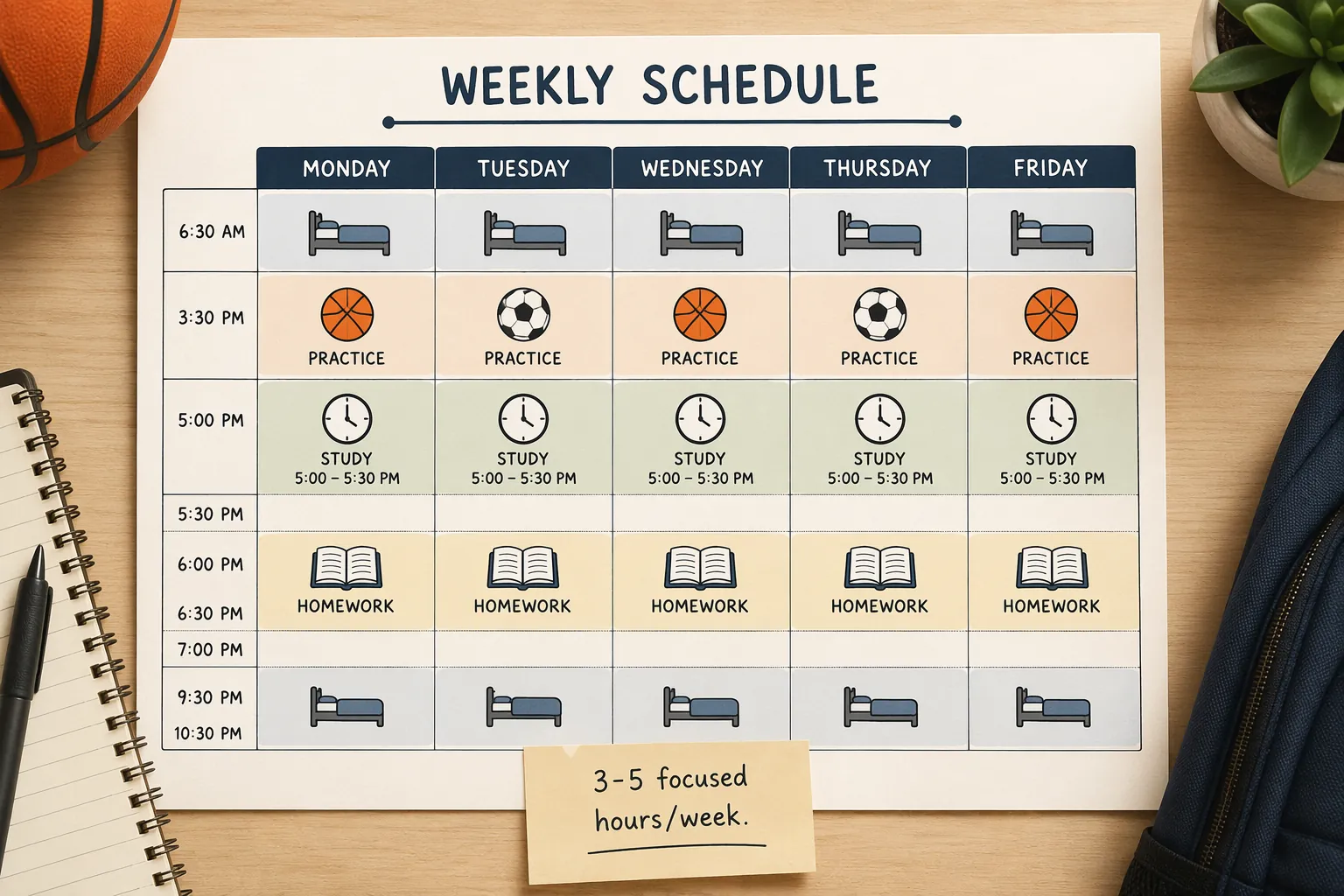
What a 30-minute weekday session actually contains
Thirty minutes is too short for wandering around a prep book deciding what to study. It needs a job before the timer starts. A good weekday session looks like this:
- 3 minutes: Open your error log and choose one target, such as linear equations, punctuation, command-of-evidence questions, or ACT science graph reading.
- 18–20 minutes: Complete a small timed set. Keep it narrow enough that you can finish and check it.
- 7–9 minutes: Review every miss and every guess. Write the reason, not just the correct answer.
- 1 minute: Pick tomorrow’s target before you close the book or app.
That last minute matters more than it looks. After a long practice, decision-making gets expensive. If tomorrow’s task is already chosen, you are not negotiating with yourself at 8:45 p.m. about whether you “feel like” studying. You are just starting the next rep.
The review portion is where a lot of score improvement hides. Doing 20 more questions without understanding why you missed the last 5 is like taking extra swings with the same mechanical flaw. Your missed-question log can be simple: question type, why you missed it, what rule or strategy fixes it, and whether you need to see that topic again this week.
A sample week with practice and a Thursday away game
Here is a realistic in-season pattern. It does not assume the athlete has a quiet two-hour study hall every afternoon or a Sunday with no family plans.
| Day | Sports reality | SAT/ACT prep |
|---|---|---|
| Monday | Practice after school | 30 minutes after dinner: math mini-set and review |
| Tuesday | Longer practice or lift | 25–30 minutes: grammar or reading passage; choose Wednesday’s task |
| Wednesday | Normal practice | 30 minutes: review missed math problems from Monday and redo similar questions |
| Thursday | Away game | 0–10 minutes: only light review on the bus if it does not interfere with rest |
| Friday | Shorter practice or recovery | 30 minutes: timed passage or ACT science set |
| Saturday | Game, meet, or training | Flexible: 30–60 minutes if energy is good; skip if competition runs late |
| Sunday | Homework and recovery | 60–90 minutes: timed section plus review, not a six-hour guilt session |
This week gives the athlete roughly 3 to 4 hours of focused prep without treating the away game as a failure. In a lighter week, the weekend block can stretch. In a tournament week, it may shrink. The weekly range matters more than forcing identical daily output.
Why short sessions beat weekend cramming for athletes
Athletes already understand distributed practice. You would not expect one massive Sunday workout to replace a week of skill work, conditioning, and recovery. SAT and ACT prep behaves the same way for most students: repeated exposure builds recognition, timing, and decision-making. Long irregular blocks often become a mix of fatigue, panic, and low-quality review.
The daily 30-minute block also lowers the startup cost. A student who knows they only need to do one passage or one math set is more likely to begin after practice. A student staring at a three-hour Sunday plan is more likely to delay, then rush, then call the whole week a loss.
There is also a recovery issue adults sometimes ignore. A hard practice day is not the best time to force a full practice test. Your brain may be present, but your attention is dragging. Use heavy training days for lower-friction review. Save timed sections for days when you can sit down alert enough for the score to mean something.
Prep Expert’s student-athlete SAT guidance also emphasizes planning around the athletic calendar rather than pretending sports are an inconvenience that can be ignored.[5] That is the correct framing. The schedule has to fit the season you are actually living.
Where timed practice fits
Short daily work cannot be the entire plan. At some point, you need timed practice because the SAT and ACT reward pacing, endurance, and test-day decision-making. The mistake is putting every timed practice session on the worst possible day.
In season, use three levels of timed work:
- Mini-timed sets during the week: 10–20 minutes of focused pacing practice inside a 30-minute session.
- One longer timed section most weeks: reading, math, English, science, or another section depending on your exam.
- Full-length practice tests during lighter weekends or off-season windows, followed by review before you take another one.
Do not waste full-length tests by taking them when you are wiped out and then never reviewing them. A practice test without review mostly tells you that you were tired for several hours. The useful part is the post-game film: which question types cost time, which misses came from content gaps, which came from rushing, and which guesses were actually avoidable.
Adjusting around games, travel, and bad weeks
A schedule that breaks the first time the bus gets home late is not a schedule; it is a fantasy. Build rules for predictable chaos before the week starts.
| If this happens | Do this instead |
|---|---|
| Practice runs late | Switch from new content to error-log review or stop at 15 minutes |
| Away game night | Count it as a recovery day; optional light flashcards only |
| Tournament weekend | Move the longer timed section to Friday or the following lighter day |
| Major homework night | Protect classwork first, then do a short review block if sleep is still safe |
| You miss two prep days | Restart with the next planned 30-minute task; do not create a punishment marathon |
The most common mistake is trying to “catch up” by stacking too much prep onto Sunday. Sunday still has to hold homework, laundry, family time, recovery, and maybe another practice. A 60- to 90-minute timed section with review can be valuable. A six-hour guilt session usually produces sloppy work and a worse Monday.
What changes off-season
Off-season is where a stronger score-push phase can make sense. If practices are shorter, travel is lighter, and homework is manageable, you can add longer timed sections, more full-length practice, and deeper content review. This is the better time to attack a stubborn score gap because the schedule has more room for concentration and recovery.
The daily block still helps off-season. Keep the 30-minute habit on weekdays, then add one or two longer sessions when your body and calendar can handle them. The difference is that longer work becomes an addition, not a rescue mission after weeks of avoidance.
A practical off-season push might include daily short sessions, one midweek timed section, and one longer weekend practice-and-review block. If a test date is close, full-length practice becomes more important. If the test is months away, content repair and consistent review may matter more than repeatedly sitting for long exams.
Choosing what to study first
When time is limited, do not study every section equally just because the book is arranged that way. Start with the highest-return problems: the topics you miss often, the question types that drain time, and the sections most connected to your target score. If your math score is already near your goal but reading timing is costing you, the week should reflect that.
For SAT prep, many athletes benefit from alternating math and reading/writing skills so the week does not become one-note. For ACT prep, the rotation often needs to include science pacing because that section can punish slow graph and table reading. The exam you choose should shape the drills, but the calendar principle stays the same: small daily work, timed practice when alert, and review before more volume.
NCAA eligibility is a real stake, but it does not replace school
For athletes hoping to compete in college, SAT and ACT prep can feel tied to recruiting pressure. That pressure is real, but it should not crowd out the basics. NCAA Division I initial eligibility requires 16 NCAA-approved core courses and a minimum 2.3 core-course GPA; current NCAA initial eligibility requirements do not make SAT or ACT scores a substitute for those academic requirements.[6]
That means class grades and core courses remain non-negotiable. Test scores may still matter for admission, merit aid, and scholarship conversations, but they do not fix a transcript that is missing required coursework. If NCAA eligibility is part of your planning, start with the core-course and GPA rules, then build test prep around the academic load rather than on top of it.
For a deeper breakdown, see NCAA eligibility rules for student-athletes in 2026 and what the NCAA eligibility requirements mean for student-athletes. If you are trying to organize schoolwork, training, and eligibility benchmarks together, college athlete study tips for NCAA eligibility benchmarks can help with the planning side.
The rule that makes the plan defensible
Balance is not doing everything every day. It is deciding what belongs on each kind of day. A normal practice day can hold 30 minutes of focused SAT/ACT prep. A game day may only hold recovery and classwork. A lighter weekend can hold timed practice and review. A brutal week may only hit the low end of the 3–5 hour range, and that is still a plan.
Protect sleep first. Keep in-season prep short enough to repeat. Use longer sessions only when they do not sabotage recovery. That is how high school athletes balance sports and studying without turning test prep into one more adult-approved way to run themselves into the ground.
References
- Sleep habits of high school student-athletes and nonathletes during a semester — Ungaro & De Chaves, NIH, 2022
- Academic Athletic Balance: Thriving in High School — BSN SPORTS
- ACT Prep for Student Athletes: A Realistic 12-Week Plan — Carpe Diem Academics
- Best SAT Study Schedule for Athletes — Summit Scholar Prep
- How To Prepare For The SAT As A Student Athlete — Prep Expert
- NCAA Eligibility Center — NCAA Eligibility Center
Fill in this timeline
This is a skeleton schedule, not a performance claim — for section-by-section strategy to fill in each slot, read the exam hub. For evidence that a similar timeline worked, compare against real outcome logs.
How to Read the '1 in 4 NFL Players CTE' Study
- When to Do HIIT for Better Memory and Exam Focus
- Can NYT Strands Daily Actually Build Vocabulary?
- A Sleep-First Routine to Stop Falling Asleep While Studying
- Does Air Quality Affect Study Focus? Yes — by How Much?
Compare each outcome's duration against this planner's in-season length manually.