
How to Focus on What You Can Control When Studying
Feeling like your study efforts don't pay off? Learn how the circle-of-control framework can help you focus on what you can actually change—study strategies, scheduling, and environment—to reduce anxiety and improve grades.
Best for: general academic subjects, exam preparation
When studying feels pointless, it is usually not because a student is lazy. More often, the student is staring at a pile of real uncertainties: the exam may be harder than the homework, the grading curve may be rough, classmates may seem impossibly calm, and the final score may not reflect how many hours went into preparing.
That is the right place to start. Some parts of school are outside your control. Pretending otherwise just makes students blame themselves for everything. The better question is smaller and more useful: while those outcomes remain uncertain, what can you actually do this week that changes the quality of your studying?
The circle-of-control framework gives that question a shape. In its common form, it separates what you control, what you can influence, and what you can only be concerned about; versions of this model are used in well-being and positive psychology resources, including the University of Michigan Well-Being Collective and PositivePsychology.com.[1][2]
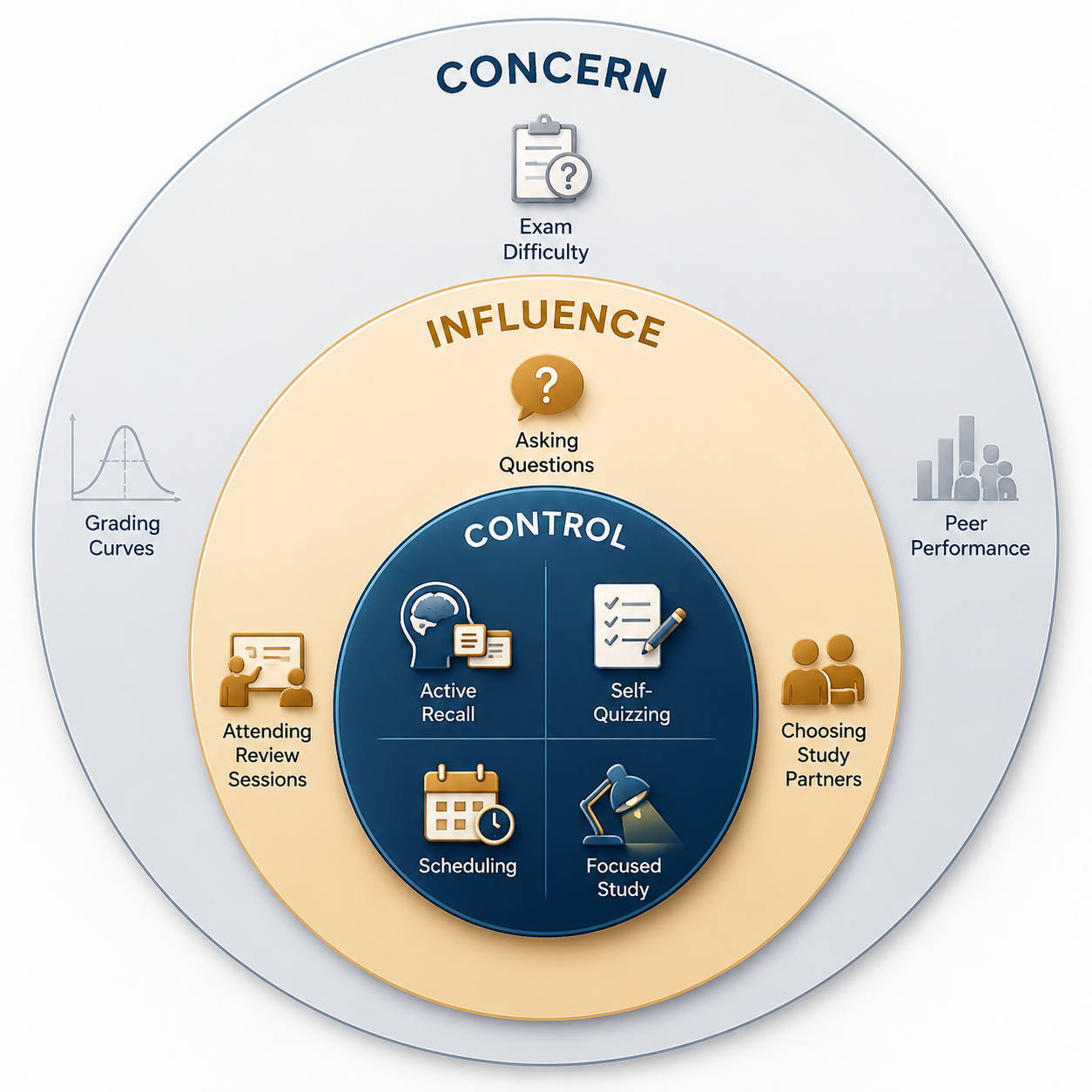
The Study Version of the Circle of Control
For studying, the circles are not abstract. They separate the parts of school that deserve your work from the parts that deserve, at most, a quick plan and then less attention.
| Circle | What Belongs There | What To Do With It |
|---|---|---|
| Control | Active recall, self-quizzing, problem sets, schedule blocks, distraction removal, environment setup, post-session reflection | Turn it into a specific study action |
| Influence | Asking questions, attending review sessions, choosing study partners, clarifying expectations | Take the available step, then stop rehearsing the uncertainty |
| Concern | Exam difficulty, grading curves, peer performance, the final score itself | Name it, but do not let it become the study plan |
The oldest version of this idea is often traced to Stoic writing on the difference between what is up to us and what is not. That history matters only because it shows the idea has lasted: a student cannot command the outcome, but can choose the next practiced behavior.[3]
Used badly, the circle becomes a poster that says “focus on what you can control” while the student keeps rereading notes until midnight. Used well, it becomes a sorting tool. You write down the worry, place it in the right circle, and convert anything in the control circle into an action you can prove you did.
Start by Sorting the Worry, Not Arguing With It
A student who says, “I studied for hours and still bombed,” does not need a lecture about attitude. They need a closer look at what those hours contained. Before changing the routine, separate the worry from the behavior.
- “What if the test is nothing like the review?” belongs mostly in concern, with one influence action: ask what topics, formats, or practice materials are fair game.
- “Everyone else understands this faster than I do” belongs mostly in concern, unless it points to a control action such as doing more retrieval practice on the weak topic.
- “I keep losing time on my phone” belongs in control because the study environment can be changed before the next session.
- “I don’t know whether I actually know the material” belongs in control because self-quizzing can answer it better than rereading can.
This does not mean the concern-circle items are fake. Exam difficulty and grading policies can matter. The point is that worrying about them usually does not produce the next study behavior. Sorting protects the limited energy you still have.
Use Active Study Strategies as the Core of the System
The most important controllable choice is not how long you sit near the material. It is what your brain has to do during that time.
In a study of 502 students in an introductory biology course at a selective U.S. institution, Walck-Shannon and colleagues found that each additional active study strategy students reported using predicted exam scores that were 1.9 to 2.8 percentage points higher. Students who reported using 100% active strategies scored 5.5 to 10 percentage points higher than students who reported using 0% active strategies.[4]
That does not mean every student in every course should expect the same increase. The study was conducted in one course, at one institution, and the strategy data were self-reported. Still, the direction is useful because it matches what many struggling students discover too late: exposure to notes is not the same as retrieval, explanation, or problem solving.
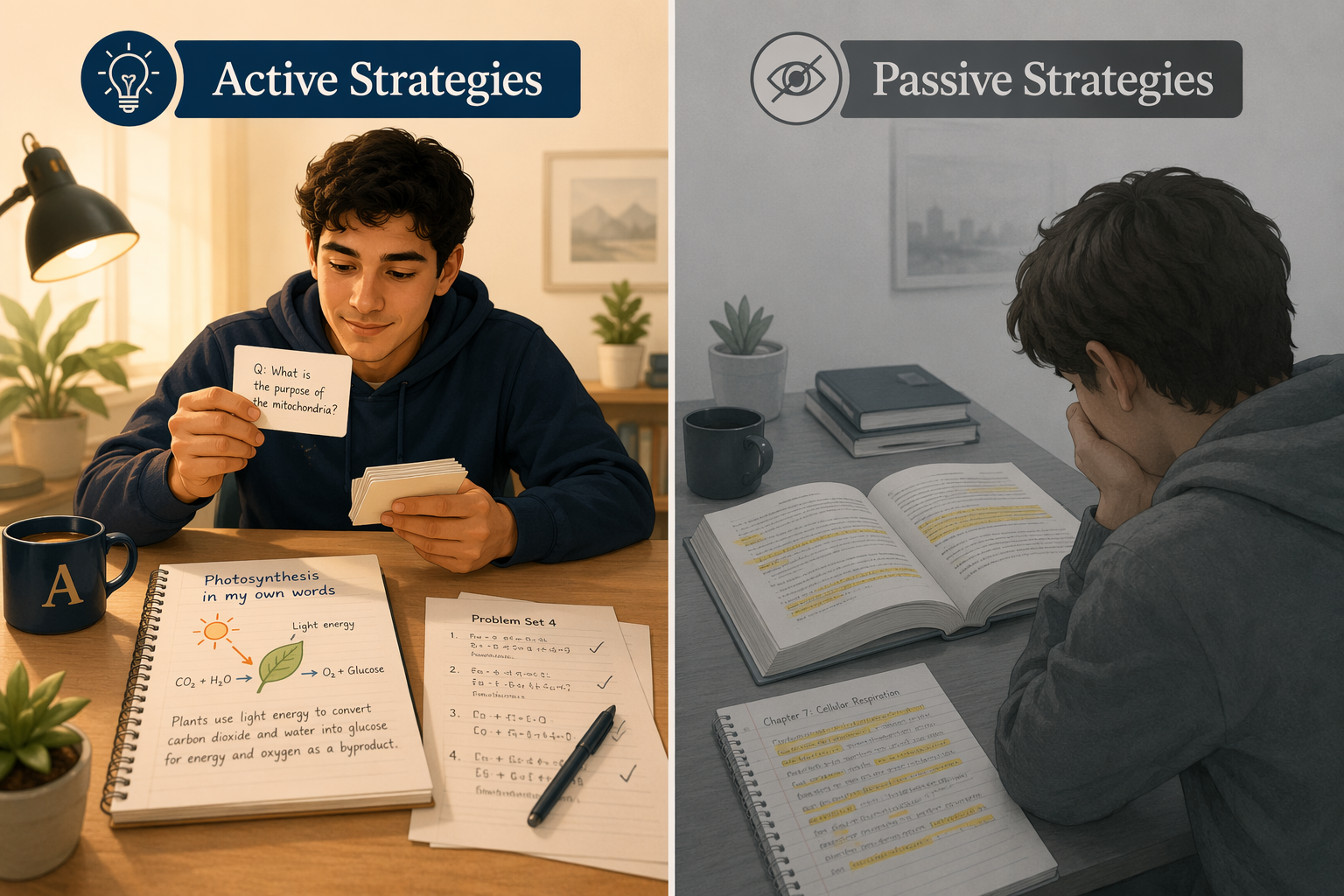
Active studying means the session produces evidence. You answer without looking. You explain a process from memory. You solve a problem before checking the solution. You find the blank spot while there is still time to fix it.
| Passive Exposure | Active Replacement |
|---|---|
| Rereading a chapter | Close the book and write the main process from memory |
| Highlighting notes | Turn headings into questions and answer them without looking |
| Watching a solution video | Pause before each step and attempt the next move yourself |
| Reviewing flashcards by recognition | Say or write the full answer before flipping the card |
| Looking over old homework | Redo missed or representative problems on a blank page |
A tired student can do this without rebuilding their whole life. For the next study block, choose one active strategy and record the result: number of practice questions attempted, number correct without notes, concepts explained from memory, or mistakes that need a second pass.
Build a Repeatable Control-First Study Block
The steps below are intentionally plain. They are meant for the student who has an exam coming, an anxious brain, and no extra appetite for an elaborate productivity system.
- Write the worry in one sentence.
- Place it in control, influence, or concern.
- Choose one controllable study behavior for the next block.
- Schedule the block with a start time, end time, and task.
- Study actively and remove the obvious distraction before starting.
- Spend two minutes recording what happened.
Here is what that might look like in practice. The worry is, “My teacher writes trick questions.” That sits mostly in concern. The influence action is to ask whether old quizzes or sample problems reflect the exam style. The control action is to complete a mixed set of practice questions without notes, mark every missed question by error type, and redo the missed ones the next day.
The difference is not cosmetic. “Study biology” is too vague to protect a tired student from drifting. “7:00–7:40, do 20 genetics problems without notes, mark misses, phone outside room” gives the session a job.
If weekly planning is where your routine usually breaks, it helps to give assignments, exams, and study blocks a visible home. A simple weekly routine like How to Build a Weekly Assignment Planning Routine That Actually Sticks can turn “I should study sometime” into scheduled decisions. Students managing attention issues may need a more specialized version, such as How to Build a Study Planner That Actually Works for ADHD College Students.
Make the Block Measurable
A controllable study block should leave behind a trace. Not a beautiful notebook page. A trace that tells you whether the session did what it was supposed to do.
| Study Goal | Evidence to Record |
|---|---|
| Memorize key terms | Cards attempted; cards answered correctly without looking |
| Prepare for math or chemistry | Problems attempted; misses sorted by concept, setup, algebra, or careless error |
| Understand a reading | Main claims written from memory; questions still unresolved |
| Prepare for an essay exam | Possible prompts outlined without notes; weak evidence spots identified |
| Review a lecture | Lecture headings converted into questions; answers checked afterward |
This kind of record matters because anxiety often edits memory. After a bad quiz, many students remember only a blur of effort and disappointment. A log gives a more honest picture: what was practiced, what was avoided, what improved, and what still needs another pass. If you already track assignments in a spreadsheet, a homework tracker like How to Build a Homework Tracker in Google Sheets can be adapted to include study evidence, not just due dates.
Treat Distraction as a Study Variable, Not a Character Flaw
Distraction is one of the most controllable parts of studying, and also one of the easiest to moralize. Students call themselves undisciplined when the simpler explanation is that they tried to do hard cognitive work next to an open invitation to leave it.
Walck-Shannon and colleagues found that students reported being distracted for about 20% of their study time, and every 10% increase in distraction predicted about a 1 percentage point decrease in exam scores.[4]
Within the limits of that finding, it is still enough to make distraction removal part of the study method rather than an optional bonus.
- Put the phone outside arm’s reach before the block starts, not after the first interruption.
- Open only the tabs needed for the task named in the study block.
- Use a timer to create a clear stopping point, especially when motivation is low.
- Keep a scrap page for intrusive tasks or worries so they can be handled after the block.
- Choose a location based on the behavior it supports, not on whether it feels like an ideal study aesthetic.
Tools can help, but only if they reduce friction instead of becoming another place to tinker. If your apps, notes, calendar, and flashcards are scattered, a deliberate setup like The Ultimate Guide to Building a Study Tool Stack in 2026 can help you decide what belongs in your system and what is just digital clutter.
Use Influence Without Waiting for Permission to Study
The influence circle is where many students either do too little or stay too long. Asking a teacher what to prioritize is useful. Waiting to study until the teacher gives perfect certainty is not.
Influence actions are usually short and external. Send the email. Attend the review session. Ask which problem types are most representative. Compare answers with a serious study partner. Visit office hours with two specific questions rather than a general confession that you are lost.
After that, return to the control circle. If the teacher answers, use the answer. If the teacher is vague, use the best available evidence: syllabus topics, homework patterns, quiz mistakes, practice problems, and lecture emphasis. The absence of perfect information is not a reason to give the whole evening to panic.
Review the Session Before You Judge Yourself
A post-session review should be brief enough that you will actually do it. Two minutes is enough.
- What active task did I complete?
- What did I get wrong or fail to retrieve?
- What distracted me, if anything?
- What is the next controllable action?
This review is where the circle becomes a routine. If the session was weak, the answer is not automatically “I am bad at this.” Maybe the task was passive. Maybe the block was too long. Maybe the phone stayed on the desk. Maybe the topic needs a different strategy. Those are fixable in a way that “be smarter” is not.
The Mindset Piece Is Real, But It Is Not Magic
There is evidence that students’ sense of control relates to achievement. In a study of 200 MBA students in India, ages 21 to 27, Suraj and colleagues reported that self-esteem and internal locus of control together predicted 41% of the variation in academic achievement.[5]
That is not proof that the same percentage applies to U.S. high school students, community college students, or every undergraduate course. It also does not mean a student can think their way into a better grade without changing how they study. The useful takeaway is narrower: believing your actions matter is academically relevant, and it becomes more credible when your routine gives you repeated evidence that your actions are specific, active, and trackable.
It is also important to draw a boundary. The circle-of-control model can help with cognitive reframing and study behavior. It is not a substitute for professional support if test anxiety is severe, persistent, or part of a diagnosed anxiety disorder. If panic symptoms, sleep disruption, avoidance, or distress are interfering with daily life, a school counselor, therapist, physician, or campus mental health service belongs in the plan.
A One-Week Control-First Study Plan
For the next week, do not try to fix every study habit at once. Run a small version of the system and make it visible.
| Day | Action |
|---|---|
| Day 1 | List your biggest course worry and sort it into control, influence, or concern |
| Day 2 | Replace one passive review session with self-quizzing or practice problems |
| Day 3 | Remove one major distraction before the study block starts |
| Day 4 | Take one influence action, such as asking a specific question or attending a review session |
| Day 5 | Redo missed problems or missed recall items without notes |
| Day 6 | Complete a mixed active review session that resembles the exam format as closely as possible |
| Day 7 | Review your study evidence and choose the next week’s highest-value control action |
The final score is still not directly controllable. Neither is the curve, the exact exam difficulty, or how prepared everyone else is. What you can protect is the part of studying that most often gets blurred by anxiety: active work, done on purpose, with fewer distractions, repeated long enough to give your effort a fair chance to matter.
References
- Circles of Control, Influence and Concern — University of Michigan Well-Being Collective — wellbeing.umich.edu/tools-resources/the-well-being-toolkit/circles-of-control-influence-and-concern/
- Circle of Influence: Focusing on What You Can Control — PositivePsychology.com — positivepsychology.com/circles-of-influence/
- Stoicism for Students — Lewis Cooper — lewiscooper.net/blog/stoicism-for-students
- To What Extent Do Study Habits Relate to Performance? — PMC8108503
- Self-esteem and internal locus of control — PMC11744600
Apply This Method
Related Methods
- The Student Impact of Provo Canyon School's License Revocation
Utah's revocation of Provo Canyon School's license forces both campuses to close within weeks, leaving nearly 200 students facing urgent questions about credits, transcripts, and re-enrollment. This article outlines the key educational risks and what families should know to navigate the transition.
- How to Analyze a Settlement Case Study for Law Students
Most civil cases settle before trial, yet law school curricula focus almost exclusively on appellate opinions. A five-part framework for analyzing settlement case studies — covering negotiation dynamics, leverage, and economic incentives — gives law students a crucial advantage in exams and clinic preparation.
- Student placement options after Provo Canyon School closes
With Provo Canyon School's campuses closing in August 2026, families need clear guidance on the three main placement pathways — transfer to another licensed residential program, return to a home school district, or step-down to outpatient care. This article documents the exact steps for transferring academic records, preserving credits, and reactivating IEPs or 504 plans.
Comments
Join the discussion with an anonymous comment.