
Interleaving Study Method Examples for Math: 7 Sequences from Research
See how to apply the interleaving study method to math with seven concrete example sequences drawn from cognitive science research. Learn why mixing similar problem types—rather than practicing one skill at a time—produces stronger long-term retention for high school and college math students.
Best for: math
A math student sits down with a worksheet and sees ten problems in a row. If all ten are area problems, the first question is the only real choice: “Which formula do I use?” After that, the page quietly tells the student what to do. Multiply the same kinds of quantities. Repeat the same move. Get faster.
Interleaving changes that moment. The next problem might ask for area, perimeter, a missing side length, a simplified expression, or an inequality solution. The student still has to calculate, but first they have to decide what kind of problem they are looking at. That decision is the part many blocked worksheets never train.
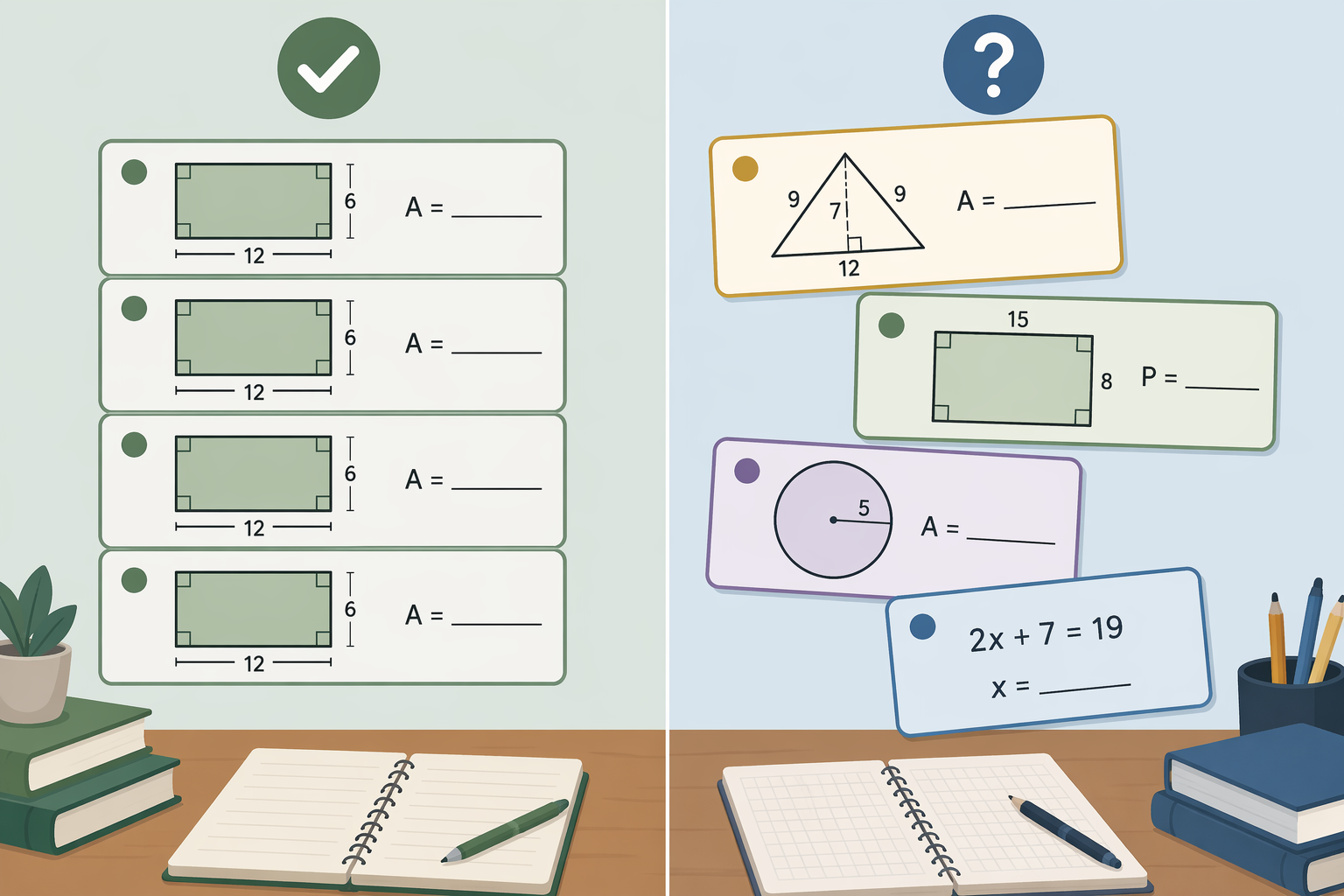
For math, the useful rule is simple: mix problem types that look or feel similar enough that the student must choose the right strategy. Interleaving is not random variety. It is not doing two algebra problems, one Spanish vocabulary card, a chemistry definition, and then a geometry proof. The mix has to create a real discrimination problem: “Is this asking me to combine like terms, solve for x, reverse an inequality, find area, or find perimeter?”
That small change in order can matter a lot. In one randomized classroom study with seventh-graders, students who received interleaved math practice scored 74% on a delayed test one month later, compared with 42% for students who practiced the same kinds of problems in blocked order.[1] In an earlier experiment, students who practiced related geometry problems in an interleaved order scored 77% after 24 hours, compared with 38% for students who had practiced in blocks.[2]
Those numbers are not a promise that every shuffled review sheet doubles a score. They are a warning about something more ordinary: same-day fluency can be misleading. Blocked practice often makes students look better while they are practicing, because the page has already supplied the category. Interleaving removes that label.
What an interleaved math set looks like
A good interleaved set does not have to be long. It does have to be deliberate. The point is to arrange neighboring skills so the student cannot coast on the most recent procedure.
| Sequence | Skills being mixed | Decision the student practices |
|---|---|---|
| 1. Multiplication and division | Products, quotients, missing factors | Do I combine groups, split groups, or undo multiplication? |
| 2. Area and perimeter | Area formulas, perimeter totals, missing side lengths | Am I covering space or measuring around the edge? |
| 3. Fractions, decimals, and percentages | Equivalent forms, comparison, conversion, percent of a quantity | Which representation makes the relationship easiest to see? |
| 4. Algebra expressions, equations, and inequalities | Simplifying, solving, graphing or interpreting inequalities | Am I rewriting an expression, finding a value, or describing a range? |
| 5. Geometry bug-fly style problems | Surface paths, straight-line distances, net diagrams, three-dimensional reasoning | What model of the shape actually matches the path? |
| 6. Derivatives and integrals | Rates of change, accumulation, antiderivatives, interpretation | Is this asking for change at a point, total change, or a function that produced the rate? |
| 7. Four operations with measurement conversions | Add, subtract, multiply, divide, convert units | Should I convert first, and which operation fits the situation? |
Agarwal and Agostinelli’s classroom examples in American Educator are useful here because they are not decorative “mix it up” advice. They show problem sequences where the student has to notice the kind of problem before choosing a procedure.[3]
1. Multiplication and division: stop letting the symbol do all the work
At the elementary level, interleaving can be as plain as mixing multiplication and division problems after students can already perform each operation in isolation. A blocked version gives a page of products, then a page of quotients. The student learns the rhythm of the page: multiply until the heading changes, then divide.
An interleaved sequence instead places related structures near each other: a product problem, a quotient problem, a missing-factor problem, and a word problem where the operation is not named. The arithmetic may be simple. The choice is not. A student has to decide whether the situation is joining equal groups, splitting a total into equal groups, or finding the size of one factor.
- Blocked version: practice ten multiplication facts, then ten division facts.
- Interleaved version: alternate product, quotient, missing factor, and short word problems using the same fact families.
- What it trains: recognizing the relationship among multiplication, division, and unknown factors.
This is a good place to start only after the child is not counting through every fact from scratch. If the component skill is still shaky, the interleaved set becomes noise. The student needs enough control to have something to choose from.
2. Area and perimeter: the classic worksheet trap
Area and perimeter are perfect candidates for interleaving because the diagrams can look almost identical. A rectangle with side labels can ask for square units or linear units. A blocked page removes that distinction too early. If the heading says “Area of Rectangles,” the student may never ask what is being measured.
A better sequence might place a rectangle area problem beside a rectangle perimeter problem, then a missing-side problem where the area is given, then a composite figure where perimeter is the target. The diagrams are visually similar, but the actions differ.
- Area problem: identify the region being covered.
- Perimeter problem: trace the outside boundary.
- Missing-side problem: work backward from a given area or perimeter.
- Composite figure: decide whether to decompose the shape or follow the boundary.
The important part is not that the problems alternate in a cute pattern. The important part is that the student cannot rely on the previous answer method. They have to read the prompt, inspect the diagram, and decide whether the units should be squared or not.
3. Fractions, decimals, and percentages: mix representations, not random difficulty
Fractions, decimals, and percentages belong together because they often describe the same relationship in different clothing. Students who can convert 0.25 to 25% on a conversion worksheet may still miss that one-fourth, 0.25, and 25% are interchangeable in a comparison or word problem.
An interleaved set can ask students to compare quantities, convert forms, find a percentage of a quantity, and choose which representation makes a problem easier. The sequence should keep the numbers friendly at first. The goal is not to make the arithmetic punishing; the goal is to make the representation choice visible.
| Blocked practice tends to ask | Interleaved practice can ask |
|---|---|
| Convert these fractions to decimals. | Which is larger: a fraction, a decimal, or a percentage? |
| Convert these decimals to percentages. | Which form would make this comparison quickest? |
| Find each percent of a number. | Is this problem asking for a part, a whole, or a rate? |
This is also where math flashcards can help if they are built around decisions, not just formulas. A card that asks “Convert 3/8 to a decimal” is useful for retrieval. A stronger study set also asks “Which form would you use to compare these two quantities?”
4. Algebra: expressions, equations, and inequalities should not all feel the same
Older students often say they are “bad at algebra” when the real problem is narrower: they treat every line with variables as if it must be solved for x. That habit is easy to build with blocked practice. A page titled “Solving Equations” rewards equation behavior. A mixed page asks whether equation behavior is even appropriate.
A useful algebra interleaving sequence puts expressions, equations, and inequalities close together. One item asks the student to simplify an expression. Another asks them to solve an equation. Another asks them to solve an inequality and remember when the inequality sign changes direction. Another asks for equivalent forms rather than a single value.
- Expression: simplify or rewrite; there may be no single value for x.
- Equation: perform legal moves on both sides to find value(s) that make the statement true.
- Inequality: solve for a range and preserve the direction of the comparison.
- Interpretation problem: decide what the variable or solution set means in context.
The blocked version fails because it gives away the category. Ten inequalities in a row train inequality mechanics. They do not train the student to notice that this line is an inequality rather than an equation, or that this expression is not asking to be solved at all.
5. Geometry bug-fly problems: when similar diagrams require different plans
The geometry “bug-fly” style problem deserves special attention because it captures the whole point of interleaving. In the classroom examples discussed by Agarwal and Agostinelli, geometry problems can look closely related while requiring different solution strategies, such as reasoning about a path across the surface of a three-dimensional object rather than treating the picture as a simple flat distance problem.[3]
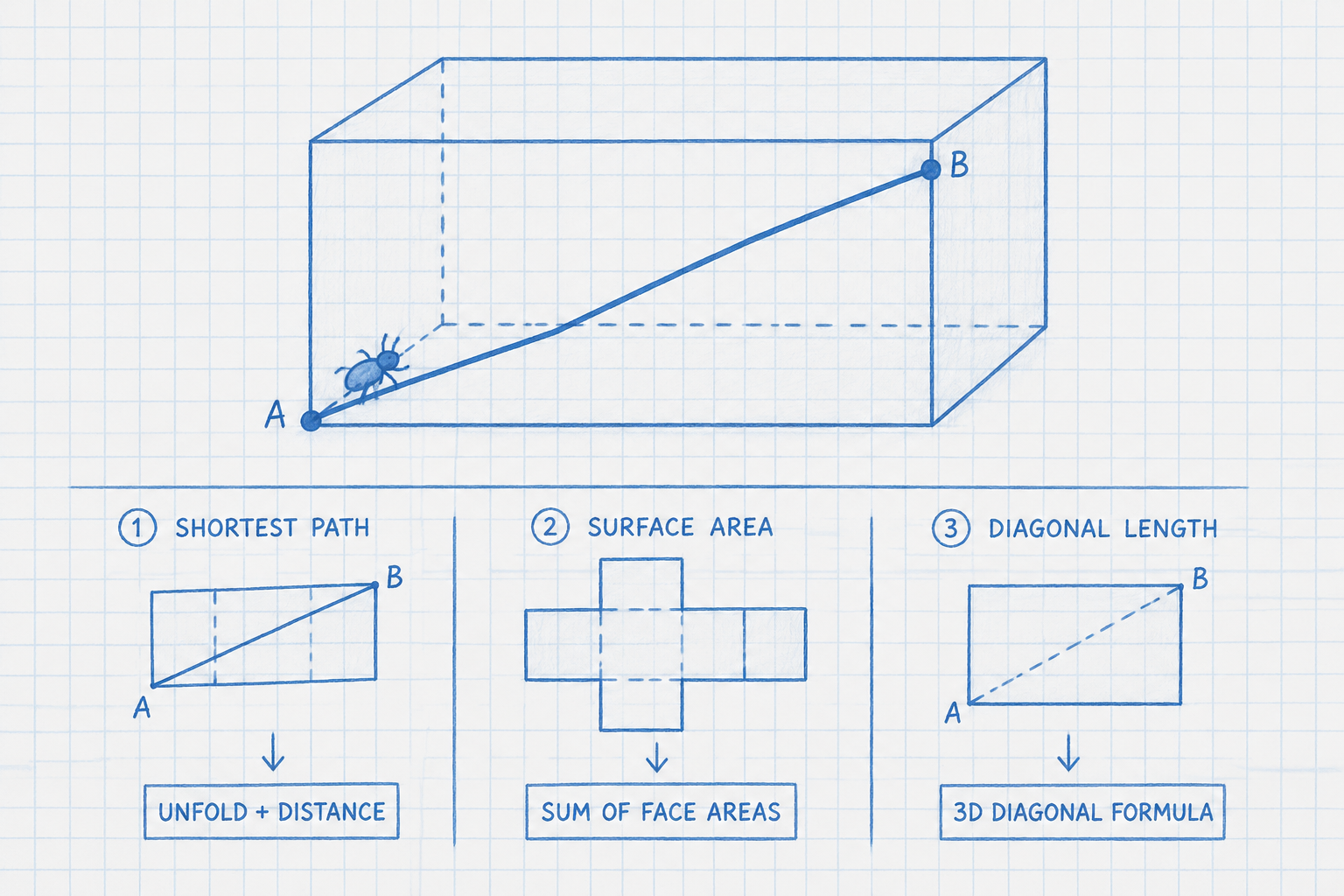
A blocked geometry set might give several surface-path problems in a row. Once the first one is explained, the student knows to unfold the solid or think in terms of a net. That can be necessary early practice. But if every problem in the set uses the same hidden model, the student may learn the move without learning when the move applies.
An interleaved sequence can place the bug-fly style item near other geometry problems that look similarly spatial: a direct distance question, a surface-area question, a net-matching question, and a volume question. The student has to ask whether the path travels through space, along a surface, around an edge, or across a flattened representation.
| Problem appearance | Possible strategy | Question the student must ask |
|---|---|---|
| A path is drawn on a prism. | Unfold a net or reason across surfaces. | Is the path constrained to the surface? |
| Two points are marked in a diagram. | Use a distance relationship if the path is direct. | Is this a straight-line distance or a route? |
| Faces of a solid are shown. | Add areas of relevant faces. | Am I measuring surface coverage? |
| A three-dimensional object is labeled. | Use volume reasoning. | Am I measuring space inside? |
This is the kind of mix that makes interleaving worth doing. The problems belong together because a student could plausibly confuse them. The work is not just harder; it is more diagnostic. If the student chooses the wrong model, the mistake tells you something useful.
6. Calculus: derivatives and integrals are neighbors, not opposites on separate islands
By calculus, many students have learned to ask a dangerous first question: “Which chapter are we in?” If the worksheet sits under the derivative section, they differentiate. If it sits under the integration section, they integrate. Tests are less polite.
A calculus interleaving sequence should mix problems that are close enough to be confused: derivative computation, derivative interpretation, definite integrals as accumulation, antiderivatives, and word problems where the units reveal whether the answer should be a rate or an accumulated amount.
- Derivative item: find or interpret an instantaneous rate of change.
- Definite integral item: find accumulated change over an interval.
- Antiderivative item: recover a family of functions or use an initial condition.
- Graph item: decide whether the graph represents a function, its rate, or accumulated change.
The blocked version can make a student fast at the power rule or substitution while leaving the larger choice untouched. The interleaved version slows them down in a productive way: before doing any calculus, they have to identify what the problem is asking a calculus tool to measure.
7. Four operations with measurement conversions: convert because the situation demands it
Measurement problems are another place where blocked practice quietly does too much of the thinking. A page titled “Unit Conversions” tells the student to convert. A page titled “Multiplying Decimals” tells them to multiply. Real word problems are usually less generous.
An interleaved sequence can mix addition, subtraction, multiplication, division, and unit conversion in the same measurement context. The student has to decide whether quantities are compatible, whether a conversion should happen before the operation, and whether the result should be larger or smaller than the starting number.
- Add or subtract measurements only after checking that the units match.
- Multiply when repeated groups or scaling is involved.
- Divide when sharing, finding a rate, or finding how many groups fit.
- Convert when the units prevent a meaningful comparison or operation.
This is a good sequence for students who can perform conversions when prompted but do not yet notice when conversion is necessary. The hard part is not moving a decimal or applying a conversion factor. The hard part is seeing that two quantities cannot be combined in their current forms.
How to build your own interleaved math set
Start with a blocked set if the skill is brand new. A student who has never learned perimeter needs a few clean perimeter problems before perimeter is mixed with area. A student who cannot yet solve a linear equation does not benefit from being asked to distinguish equations from inequalities under pressure.
Once the component skills are minimally secure, build the mix from nearby confusions. Do not ask, “How can I make this worksheet more varied?” Ask, “Which problems does this student confuse because they look alike, use similar symbols, or appear in the same unit?”
- Choose two to four related problem types that students can already attempt separately.
- Keep early numbers or algebraic expressions manageable so the main challenge is choosing the method.
- Remove headings that reveal the category of each problem.
- After each problem, have the student name the type before checking the answer.
- Review wrong answers by separating calculation errors from strategy-selection errors.
This pairs well with a broader math note-taking workflow. Notes can hold the worked examples and decision cues; interleaved practice tests whether the student can use those cues when the page stops announcing the lesson.
Why mixed practice feels worse at first
Blocked practice feels reassuring. Students get several similar problems in a row, answers start coming faster, and the page begins to feel under control. That feeling is not fake; immediate performance often is better during blocked practice. The problem is that immediate performance is not the same as durable learning.
Samani and Pan describe this as a metacognitive problem: learners can misjudge what helps them because the practice that feels smoother can produce weaker later performance, while the practice that feels harder can support better retention or transfer.[4] That matches the tutoring-table version of the same problem. A student finishes a blocked worksheet quickly and thinks, reasonably, “I know this.” Then the test mixes the topics and the first step disappears.
The discomfort of interleaving is not proof that it is too hard. It is also not proof that it is automatically working. If the student is missing every problem because the underlying skills are not ready, go back to shorter blocked practice. If the student can do the skills separately but chooses the wrong method when they are mixed, the interleaved set is doing its job.
Students who already use spaced repetition can combine it with interleaving, but the two ideas are not identical. Spacing controls when practice returns; interleaving controls what appears next to what. For the spaced-repetition side, the research discussion in Is Anki Effective? is the more relevant next layer.
What not to interleave
The most common bad version of interleaving is random shuffling. Mixing unrelated school tasks does not create the kind of discrimination math students need. Hausman and Kornell found that mixing topics while studying did not necessarily improve learning, which is an important boundary for anyone tempted to turn interleaving into general multitasking.[5]
Do not interleave a derivative problem, a Spanish vocabulary word, a history date, and a chemistry symbol and call that a math strategy. Nothing in that mix helps the student decide between neighboring mathematical procedures. It only interrupts attention.
The better test is whether the problems share a meaningful decision point. Area and perimeter share diagrams. Equations and inequalities share algebraic moves but differ in solution meaning. Derivatives and integrals share functions and notation but answer different questions. Those are useful neighbors.
Interleaving is not making studying messy. It is deliberately arranging similar math problems so the student practices choosing the method, not just executing the last method taught.
References
- A Randomized Controlled Trial of Interleaved Mathematics Practice, Journal of Educational Psychology, 2020.
- The Effects of Interleaved Practice, Applied Cognitive Psychology, 2010.
- Interleaving in Math, American Educator, Spring 2020.
- Learning and Retention in Cognitive Science: Interleaving, Spacing, and Retrieval Practice, npj Science of Learning, 2021.
- Mixing Topics While Studying Does Not Enhance Learning, Memory & Cognition, 2014.
Apply This Method
Related Methods
- Cornell Notes Adaptation Guide: How to Make the Method Work for Any Subject
Struggling to make Cornell notes work for math, science, or language classes? This guide shows you how to adapt the cue and notes columns for any subject's unique demands, with concrete examples and a quick-reference table.
- 3 Math Note-Taking Methods That Actually Work (3-Column, Cornell, and Scaffolded Notes)
Most note-taking advice treats all subjects the same, but math requires a different structure. This guide compares three proven methods — the 3-Column Method, Cornell adapted for math, and Scaffolded Notes — with examples, a decision guide, and templates to help you choose the right one.
- The Science of Note-Taking: Why Handwriting Beats Typing (and When to Use Both)
Discover the latest research on handwriting versus typing for note-taking, including key studies from 2014 to 2025. This guide explains the cognitive benefits of each method and provides a practical hybrid strategy for college and high school students.
Comments
Join the discussion with an anonymous comment.