
How to Master Stroke Symptom Recognition for Medical Training
This guide outlines evidence-based study methods for learning and retaining stroke symptom recognition, combining mnemonic practice with awareness of recall trade-offs, active-recall spaced repetition, and simulation training. Readers will learn how to build a deliberate study strategy that outperforms passive review and prepares them for exams and clinical practice.
Best for: Medical training, clinical stroke assessment
The hard part of learning how to recognize stroke symptoms in medical training is not memorizing that facial droop, arm weakness, and speech trouble matter. Most learners can say that after one pass through a lecture. The hard part is still noticing the clue when the case is timed, the patient is dizzy instead of weak, the exam stem is crowded with distractors, or the bedside team is already moving faster than your thinking.
That is why stroke symptom recognition has to be studied as a retrieval problem, not just a content problem. A mnemonic can get the first signs into memory. Active recall and spaced repetition keep them available after the first week. Simulation tests whether recognition survives noise, sequencing, handoff pressure, and the need to act before the case feels tidy.

Start With FAST and BEFAST, but Do Not Pretend They Solve the Same Problem
FAST is easy to teach because it is compact: Face, Arm, Speech, Time. BEFAST adds Balance and Eyes, which matters because posterior-circulation strokes are exactly where learners often get trapped. A patient with sudden vertigo, gait instability, diplopia, or visual disturbance may not announce themselves with the classic anterior-circulation pattern. The extra letters are not decoration; they widen the net.
The trade-off is that wider coverage can be harder to retain. Preliminary ASA/ISC 2025 data summarized by MedCentral reported 30-day letter recall of 50% for FAST and 40% for BEFAST in a general-population study, while also noting that BEFAST captures more posterior-circulation symptoms through the balance and eye components.[1] That does not prove medical trainees should abandon BEFAST. It means they should stop treating “I learned the longer acronym once” as evidence that it will be retrievable later.
| Mnemonic | What It Helps You Retrieve Quickly | What Can Go Wrong in Training |
|---|---|---|
| FAST | Face droop, arm weakness, speech difficulty, urgency | Easier recall can leave balance, eye, and other posterior-circulation clues under-practiced |
| BEFAST | FAST signs plus balance and eye symptoms | Broader coverage can decay unless the added letters are repeatedly retrieved, not merely recognized |
A useful way to train is to keep both mnemonics in play, but assign them different jobs. FAST is the fast screen you should be able to produce when tired. BEFAST is the coverage check you use to force posterior-circulation symptoms back into the case. If a practice question describes sudden gait instability and double vision, and your mind only searches for facial droop or arm drift, the problem is not that you “forgot stroke.” The problem is that your retrieval pathway is too narrow.

For exams, that narrow pathway costs points. At the bedside, it can delay escalation. So the study task is not to choose a favorite acronym and move on. It is to build retrieval drills that make the common signs automatic while making the less obvious posterior-circulation clues hard to skip.
Turn Stroke Signs Into Retrieval Prompts, Not Highlighted Notes
Passive review feels productive because every line looks familiar while it is in front of you. That feeling is a poor substitute for recall. A learner who rereads a stroke chapter can recognize the words “aphasia,” “neglect,” and “ataxia” without being able to pull the right exam maneuver or vascular concern from memory when the patient description changes.
The better unit of study is a prompt that requires an answer before the explanation appears. For example: “Sudden diplopia plus truncal ataxia: which mnemonic letters protect you from missing this?” Or: “Patient follows commands but produces fluent nonsensical speech: which NIHSS domain are you testing?” The point is not to make flashcards pretty. The point is to make the brain do the retrieval work that the clinical situation will later demand.
The best evidence in the research set for this active-over-passive distinction comes from NIHSS training. In a randomized controlled trial of 39 paramedics, an interactive e-learning group scored 36 out of 50 compared with 33 out of 50 for a video-only group, with p=0.04. Satisfaction also differed sharply: 90% in the e-learning group versus 37% in the video-only group.[2] This was not a study of every possible stroke curriculum, and it does not guarantee bedside mastery. But it does support a practical conclusion: interaction beats watching when the learner has to apply neurologic assessment content.
What to Put in the Deck
A stroke recognition deck should not be only a list of symptoms. It should make you move between symptom, exam domain, likely miss, and next action. That is where the NIHSS framework is useful. NIHSS certification through Apex Innovations is fully online and uses 11 categories on a 42-point scale, with a 93% passing threshold and unlimited retakes.[3] The retakes are helpful, but they can also hide weak learning if a student simply repeats the same material until it feels familiar.
- LOC: prompts that separate alertness, questions, and commands instead of collapsing them into “mental status.”
- Gaze and visual fields: prompts that make eye deviation, field loss, diplopia, and neglect distinct.
- Facial palsy and motor arm or leg: prompts that ask for observation, drift timing, and side-to-side comparison.
- Ataxia and sensory testing: prompts that prevent posterior-circulation or sensory findings from being treated as minor extras.
- Language, dysarthria, and extinction: prompts that force the learner to distinguish aphasia, slurred articulation, and inattention.
A weak card asks, “What does B stand for in BEFAST?” A stronger card asks, “A patient has sudden severe imbalance, vomiting, and trouble focusing both eyes; what stroke screen element would FAST miss, and what should you do next?” The second version trains recognition under variation. It also makes the learner admit whether the posterior-circulation clue was actually available from memory.
How to Space the Practice
Spaced repetition is not just “review later.” It is planned retrieval after enough delay that recall requires effort. A practical sequence for stroke recognition is same-day retrieval after lecture, next-day retrieval without notes, several short reviews across the week, and then mixed practice after the material no longer feels fresh. The mixed phase matters because real cases do not arrive labeled “NIHSS,” “posterior circulation,” or “mnemonic review.”
When a card fails, the fix should be specific. If you missed aphasia versus dysarthria, write a contrast prompt. If you forgot that visual symptoms belong in BEFAST, create a case stem with sudden vision change and no arm weakness. If you remembered the symptom but not the urgency, add a prompt that ends with the action: activate stroke response, establish last known well, or escalate according to the local protocol you are being trained to follow.
This is also where learners should be careful with certification-style repetition. Unlimited retakes can support mastery when each miss becomes a targeted retrieval card. They can also become a way to memorize a testing interface. The difference shows up when the wording changes.
Use Cases That Punish Shallow Recognition
Stroke study should include cases where the obvious clue is absent. If every practice stem starts with facial droop and unilateral arm weakness, the learner becomes good at recognizing the teaching example, not the clinical problem. Posterior-circulation practice should be deliberate: sudden imbalance, new visual disturbance, dysarthria, vomiting with neurologic findings, limb ataxia, or a patient who looks “dizzy” until the exam is done carefully.
A useful case set can be small if it is mixed well. Include classic FAST cases, BEFAST-only cases, mimics, and incomplete presentations. Ask for the finding, the screen element, the NIHSS domain if relevant, and the next step. Do not let yourself answer only “stroke possible.” That answer may be true, but it is too vague to improve performance.
| Practice Stem | What the Learner Must Retrieve | Common Failure |
|---|---|---|
| Sudden facial droop and right arm drift | FAST signs, lateralized weakness, urgent stroke response | Recognizing the symptom but failing to connect it to time-sensitive escalation |
| Sudden diplopia and severe gait instability | BEFAST eye and balance components, posterior-circulation concern | Waiting for facial droop or arm weakness before taking the case seriously |
| Fluent speech that does not make sense | Language domain rather than simple confusion or dysarthria | Labeling all abnormal speech as slurring |
| Slurred speech with intact comprehension | Dysarthria distinction and associated stroke screen findings | Calling it aphasia without testing language |
The table is not a substitute for patient assessment. It is a way to expose whether the recognition pathway is flexible enough to survive a changed presentation. If a learner only succeeds when the symptom list is arranged in textbook order, the study method is still too passive.
Simulation Comes After Retrieval, Because It Tests the Whole Chain
Simulation should not be the first place a learner tries to remember what gaze deviation means. That wastes the scenario. The value of simulation is that it adds the parts flashcards cannot: time pressure, role assignment, patient communication, incomplete information, interruptions, documentation, handoff, and the discomfort of acting before every detail is resolved.
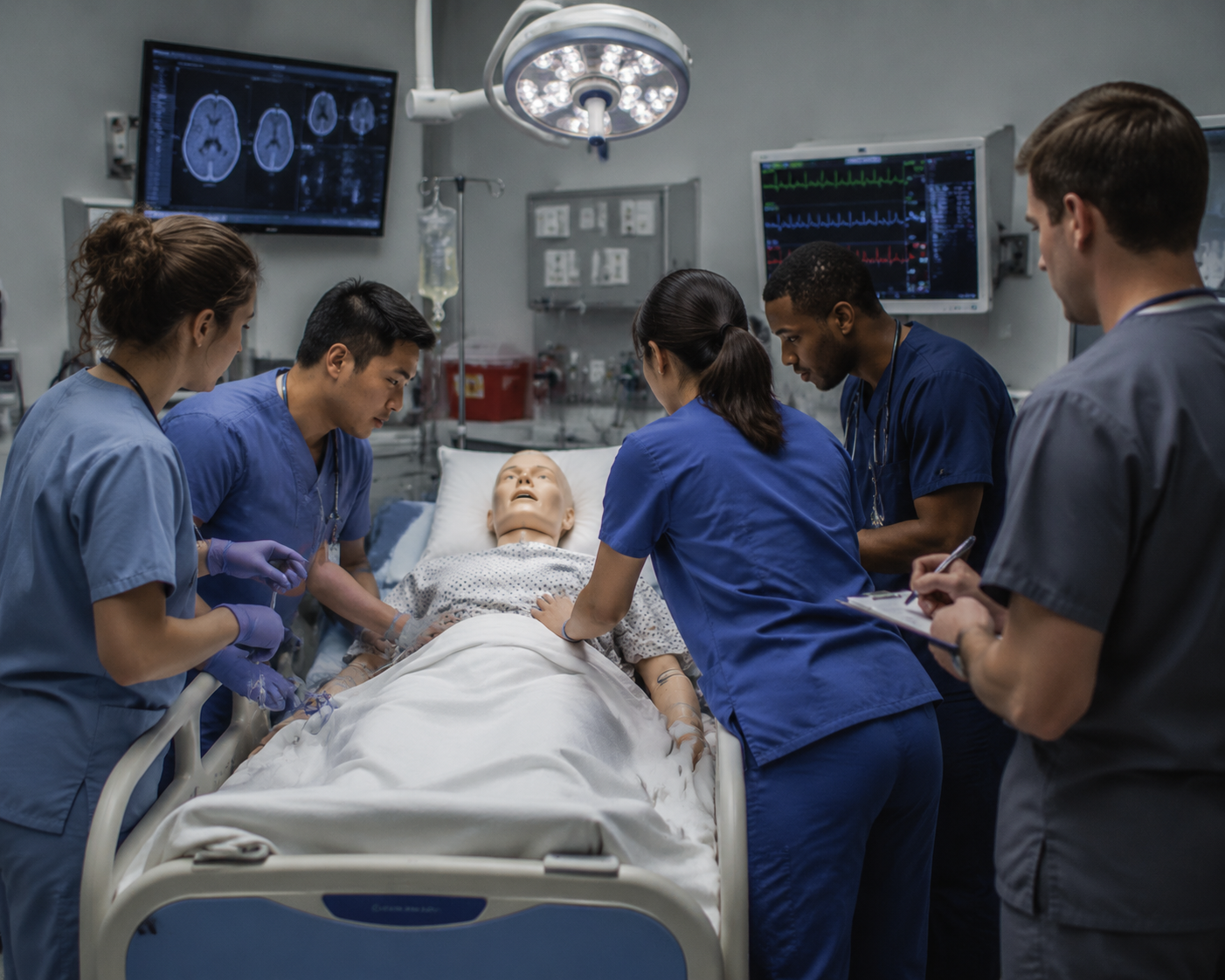
The strongest clinical-process evidence in the research set comes from a single-center retrospective study with historical controls. Stroke simulation training was independently associated with a 9.64-minute reduction in door-to-needle time for IV-tPA among 448 patients, with p=0.001.[4] That finding should not be inflated into proof that simulation alone caused the improvement everywhere. It does show why performance practice is taken seriously: the measured outcome was not a learner’s feeling of confidence, but a time interval in acute stroke care.
Learner perception points in the same direction, though it is a different kind of evidence. AHA/ASA data cited by Lumeto reported that 77.8% of participants rated simulation as the most effective form of acute stroke instruction they received.[5] That is useful, but it should be read as a training preference and perceived effectiveness measure, not as proof that every simulation program improves patient outcomes.
The debrief is where simulation becomes learning instead of theater. After a scenario, the team should reconstruct the timeline: when the first stroke clue appeared, who recognized it, what was missed, when last known well was established, when escalation happened, and which communication step slowed the response. A vague “good job, review posterior circulation” does not repair anything. A useful debrief identifies the exact failure point and turns it into the next retrieval drill.
- If the team missed sudden imbalance, add BEFAST posterior-circulation prompts to spaced repetition.
- If the NIHSS sequence broke down, drill the specific domain rather than repeating the whole scale blindly.
- If escalation was delayed, practice the verbal trigger phrase and local activation process.
- If communication failed, rehearse the handoff with last known well, deficits, glucose status if available, and immediate concerns.
A good stroke simulation makes the learner feel the gap between knowing a sign and using it in sequence. That gap is uncomfortable, but it is much cheaper to find it in a lab than during a real patient encounter.
A Study Plan That Holds Up Under Pressure
For most trainees, the workable plan is simple but not passive. Learn FAST until it is automatic. Add BEFAST deliberately so balance and eye symptoms are not treated as optional extras. Convert NIHSS domains and posterior-circulation presentations into active-recall prompts. Space those prompts until they can be retrieved after delay. Then use simulation to test whether the recognition, exam sequence, escalation, and handoff still work when the case is moving.
The learner who only rereads stroke symptoms may feel prepared because the material looks familiar. The learner who repeatedly retrieves, misses, repairs, and then performs in simulation is doing the harder work that recognition actually requires. Mnemonics are useful footholds. They are not the whole staircase.
References
- Stroke Mnemonic FAST Wins Out in Symptom Recall, MedCentral, 2025.
- A Randomized Controlled Trial Comparing the Effectiveness of an Interactive E-Learning Module With a Video-Based Module for NIH Stroke Scale Training, JMIR, 2020.
- NIH Stroke Scale, Apex Innovations.
- Simulation Improves Door-to-Needle Times for Acute Ischemic Stroke, Journal of Graduate Medical Education.
- Stroke Simulation Training, Lumeto.
Apply This Method
Related Methods
- Turn the 2026 Perseid Meteor Shower Into an Astronomy Study Session
Learn how to use the 2026 Perseid meteor shower peak (Aug 12–13) as a hands-on astronomy study session. Apply concepts like radiant geometry, ZHR, magnitude estimation, and atmospheric entry physics while collecting real observational data with standard reporting forms.
- Use the Perseid Meteor Shower Peak as an Astronomy Lesson
Turn the 2026 Perseid meteor shower peak into a structured astronomy study session. Learn how hands-on observation of the shower can reinforce orbital mechanics, atmospheric physics, and celestial coordinate skills more effectively than reading alone.
- How to Analyze a Settlement Case Study for Law Students
Most civil cases settle before trial, yet law school curricula focus almost exclusively on appellate opinions. A five-part framework for analyzing settlement case studies — covering negotiation dynamics, leverage, and economic incentives — gives law students a crucial advantage in exams and clinic preparation.
Comments
Join the discussion with an anonymous comment.