
Turn the 2026 Perseid Meteor Shower Into an Astronomy Study Session
Learn how to use the 2026 Perseid meteor shower peak (Aug 12–13) as a hands-on astronomy study session. Apply concepts like radiant geometry, ZHR, magnitude estimation, and atmospheric entry physics while collecting real observational data with standard reporting forms.
Best for: Astronomy
On Aug. 12–13, 2026, the Perseid meteor shower gives astronomy students something better than a pretty night out: a clean observing problem. The peak arrives under a new moon, with 0% lunar illumination at 17:37 UTC on Aug. 12, so moonlight should not be the factor that blurs the lesson before it starts.[1] With about three weeks to prepare, this is the rare meteor shower where the study plan can be as deliberate as the observing.
That does not mean every student will count 100 meteors in an hour. Published Perseid rates are often quoted in the 50–100, 80, 90-plus, or 100-per-hour range depending on the source and measurement context.[1][2][3][4] Those figures are useful only if you keep the laboratory distinction straight: an idealized zenithal hourly rate is not the same thing as the number your tired eyes, from your local sky, during your actual watch, will record.
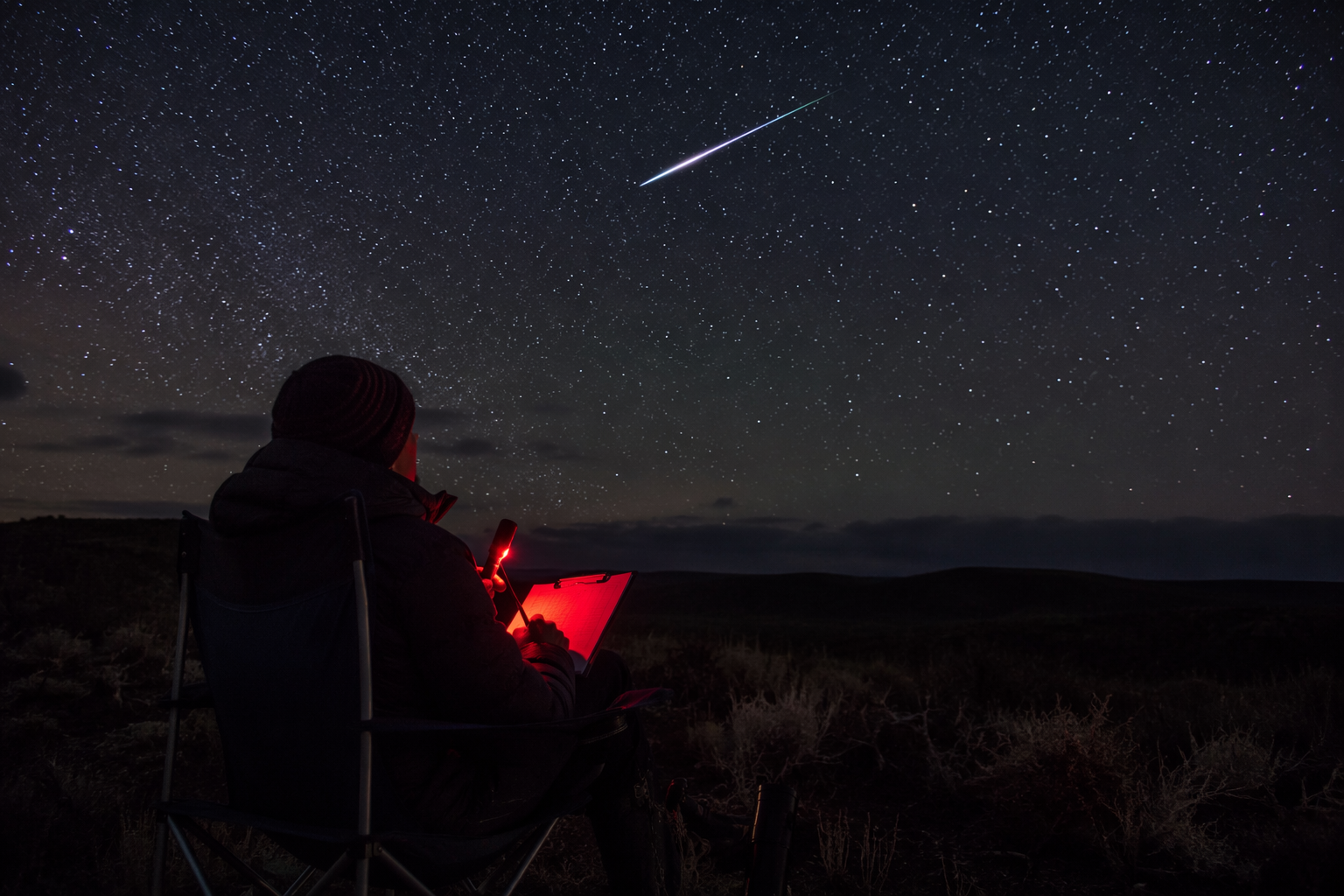
Use the shower as a field lab, not a wish
The useful question is how to turn watching into studying. The answer is not to bury the night in paperwork. It is to decide before dark which concepts you will test against the sky, then collect enough notes that your memory the next morning is not just “I saw a bright one.”
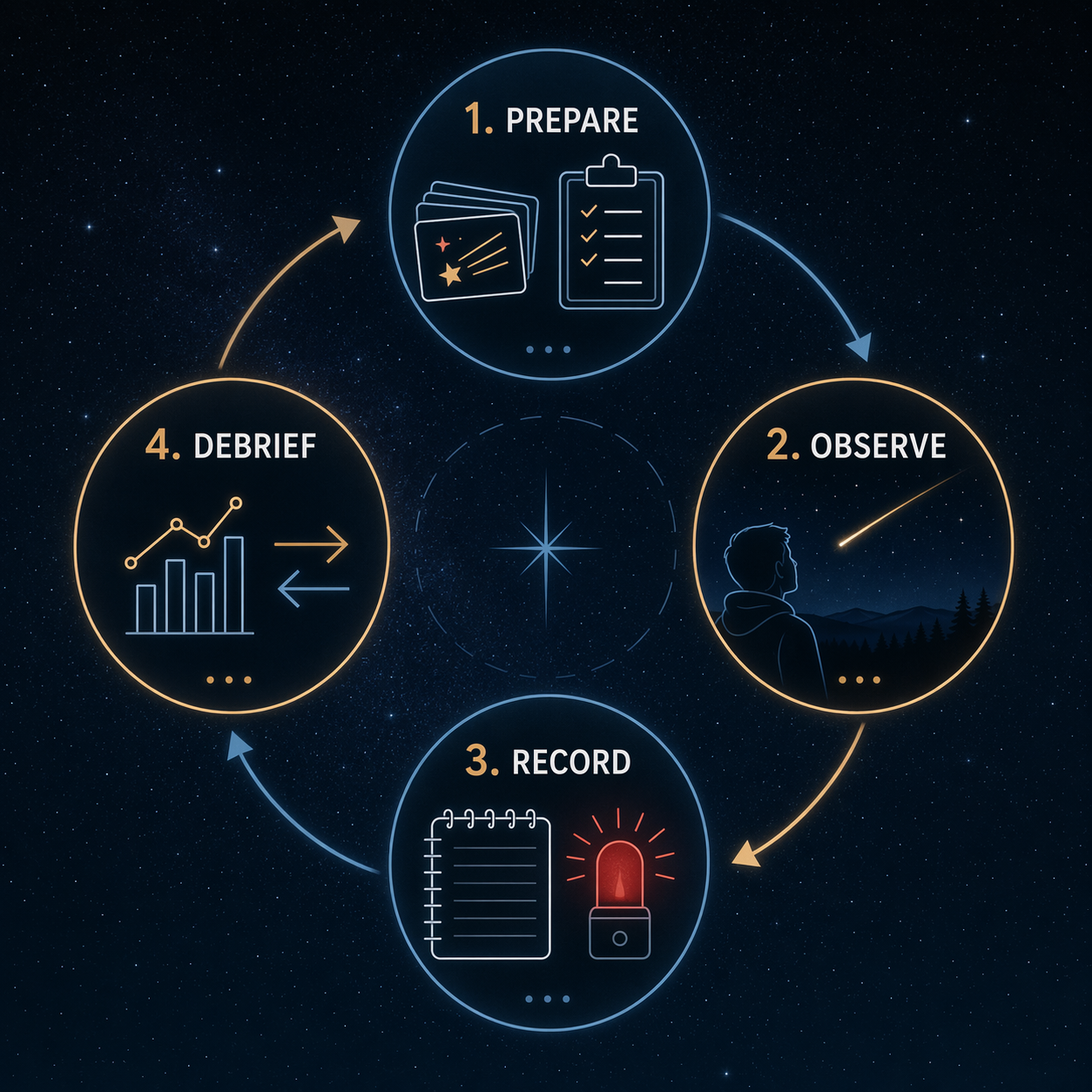
A useful session has four movements. Prepare the concepts while you are warm, awake, and near a lamp. Observe after your eyes have adapted. Record enough detail to separate Perseids from other meteors. Debrief the notes later, when you can compare what you expected with what the sky actually allowed.
| Phase | Student action | Concept being trained |
|---|---|---|
| Prepare | Review radiant, ZHR, magnitude, Swift-Tuttle, and atmospheric entry | Vocabulary becomes usable before the observing pressure starts |
| Observe | Watch a wide area of sky away from direct glare and let your eyes adapt | Limiting magnitude and field of view become real constraints |
| Record | Write time, brightness, path, train, and likely shower membership | Raw impressions become comparable data |
| Debrief | Compare counts, directions, and brightness estimates with the concepts | Definitions turn into corrections to your own assumptions |
Prepare the concepts before you prepare the chair
The Education Corner study cycle of recall, comprehend, apply, and practice maps neatly onto this night.[5] Use recall to test whether you can define the radiant, magnitude, ZHR, and parent comet without looking. Use comprehension to explain them in plain language. Use application when you decide what you will record. Use practice by running through a pretend observation indoors before you are outside in the dark.
Start with the radiant because it is the word students most often know and still misuse. The Perseids appear to radiate from the direction of Perseus, but that does not mean you should stare only at Perseus. A meteor can flash far from the radiant and still belong to the shower if its path, traced backward across the sky, points plausibly toward that area. The radiant is a geometry test, not a target.
Then review ZHR with discipline. Zenithal hourly rate assumes a radiant near the zenith, a very dark sky, and an observer who is effectively watching without interruption. Your own count will be reduced by light pollution, haze, blocked horizons, breaks in attention, and the simple fact that your eyes cannot cover the entire sky. A lower count is not a failed night; it may be the most honest result your conditions could produce.
Magnitude deserves the same preparation. Before the shower, identify a few reference stars you can actually find: Vega at magnitude 0 and Polaris around +2 are common anchors for visual meteor estimates.[4] You are not trying to produce laboratory photometry from a lawn chair. You are training your eye to say whether a meteor was brighter than Vega, roughly like Polaris, or much fainter than both.
Add the parent body only after those observing concepts are in place. The Perseids come from debris associated with Comet Swift-Tuttle, whose nucleus is about 16 miles, or 26 kilometers, across; it follows a 133-year orbit, was discovered in 1862, and was connected to the Perseids by Giovanni Schiaparelli in 1865.[2] That history matters because the streaks are not random fireworks. They are Earth crossing a debris stream.
If flashcards help, use them sparingly. A card that asks “What is the radiant?” is less useful than one that asks “A meteor appears near Cygnus but traces backward toward Perseus. Could it be a Perseid?” Students who already use spaced repetition can adapt that habit here; the point is not the app, but retrieval before the cold, dark version of the exam begins. For more on active recall tools, see AI study tools that teach instead of just giving answers or flashcard app comparisons if you want a pre-observation review system.
Copy the observing form before you need it
The American Meteor Society’s Visual Observing Program has collected amateur meteor observations since 1911, shares reports with the International Meteor Organization, and notes that these data are used by professional researchers.[6] You do not have to submit anything to benefit from the method. A standard-style form simply reminds you what a usable observation contains.
- Observer name and site, including anything that affects the sky such as streetlights, haze, trees, or nearby buildings
- Watch start and end times in UT, not “around midnight”
- Breaks in observing, because attention gaps change the denominator
- Meteor time, estimated magnitude, path through constellations, color if obvious, and train duration if a persistent trail remains
- Likely shower membership: Perseid, sporadic, or uncertain
The British Astronomical Association style of meteor reporting uses the same kind of discipline: time in UT, magnitude, constellation path, persistent train duration, and shower membership.[4] Even if the form never leaves your notebook, it changes the night from “I watched meteors” to “I observed under stated conditions.”
Set up the observing site for eyes, not equipment
The Perseids are active from July 17 to Aug. 24, but the Aug. 12–13 peak is the cleanest study target in 2026 because the Moon is out of the way.[1][2] Choose the darkest safe site you can reach without making the night complicated. A mediocre but calm observing site often beats an ambitious site that costs you half the night in logistics.
Gear should serve the record, not become the project. Bring a reclining chair or ground pad, warm layers, insect protection if needed, a clipboard, pencils, a printed or copied form, and a red-light torch. If you use a phone for timekeeping or a planetarium app, set it up before dark and make sure the screen will not throw white light into your face or anyone else’s.
Dark adaptation takes about 20–30 minutes and is disrupted by white light.[2][4][6] That is not a decorative tip. It determines how faint a meteor you can detect, which directly affects your count and your sense of the shower’s activity. The first half hour is part of the experiment, not the waiting room.
Do not aim your attention straight at Perseus for the whole session. Look at a broad, comfortable area of sky where the radiant is off to one side and your horizon is not badly blocked. Longer meteor paths are easier to see away from the radiant, and the backward trace gives you the test for shower membership.
Record each meteor while the memory is still fresh
During the watch, keep the procedure boring on purpose. When a meteor appears, mark the time first. Then estimate brightness, path, and membership. If you wait until three meteors have gone by, the dramatic one will overwrite the ordinary one, and the ordinary one may be the data point that teaches you the most about your limiting magnitude.
- Write the time in UT or record your local time with the offset clearly noted before the session starts.
- Estimate magnitude against reference stars: brighter than Vega, near Vega, near Polaris, fainter than Polaris, or uncertain.
- Sketch or describe the path by constellation, even roughly, so you can trace it backward later.
- Note whether a persistent train remained and, if so, estimate how long it lasted.
- Mark the meteor as a likely Perseid only if the backward path points plausibly toward the Perseus radiant.
- Use “uncertain” without embarrassment when clouds, distraction, or an awkward viewing angle make the classification weak.
A good field note preserves uncertainty. “Bright, fast, crossed Aquila to Delphinus, train about 1 second, maybe not Perseid” is more valuable than forcing every streak into the shower because it happened on Perseid night. Sporadic meteors still occur. Classification is a judgment, not a loyalty test.
If two students are observing together, split roles for short intervals. One watches continuously while the other writes, then switch. If both people look down at the same time, the count has a hidden gap. If one person quietly calls “time, path, brightness,” the record improves without turning the whole night into dictation.
Let magnitude estimation stay approximate
Meteor magnitude is hard because the object moves, flares, and disappears. That is exactly why the comparison-star habit is useful. Vega and Polaris are not magic standards for all purposes; they are anchors bright enough for many students to find quickly. If the meteor was clearly brighter than Vega, say so. If it was somewhere between Vega and Polaris, write that. If you only know it was faint, write faint.
The skill transfers. Once a student has made ten imperfect brightness estimates under real sky conditions, the magnitude scale stops being a tidy backward number line on a page and starts behaving like an observing language.
Connect the streak to the physics, carefully
A Perseid meteor is a visible atmospheric event caused by a small meteoroid entering at high speed. Perseid particles enter Earth’s atmosphere at about 37 miles per second, or 59 kilometers per second, and can reach temperatures above 3,000 degrees Fahrenheit, or 1,650 degrees Celsius, around 60 miles altitude.[3] Many are only about the size of sand grains, yet the speed makes them visible.[3]
One meteor does not let you prove the full physics of atmospheric entry from your lawn chair. It does let you attach the chapter vocabulary to an event your eyes caught: a tiny particle, a high entry speed, heating and ionization in the upper atmosphere, a short-lived luminous path, and sometimes a train that lingers after the particle itself is gone.
This is where the Swift-Tuttle fact stops being trivia. Earth is not running into one large object. It is passing through a stream of debris left along a comet’s orbit. The shower’s annual regularity, the radiant geometry, and the range of meteor brightness all fit better once the parent comet is treated as the source of a distributed trail rather than as a single object you are looking at.
Treat citizen science as the advanced version
Submitting a report is optional. The night is still educational if the notes stay in your class notebook. But formal visual observing programs exist because many careful amateur observations, taken together, can be useful. AMS describes visual observing as one of its major programs and explains that reports are shared with the International Meteor Organization and used by researchers.[6]
If you plan to submit, read the current AMS instructions before the peak rather than trying to reverse-engineer them afterward. If you prefer a lower-pressure version, use an AMS- or BAA-style form for your own practice. The same habits matter either way: clear timekeeping, honest limiting conditions, consistent magnitude estimates, and uncertainty where uncertainty belongs.
Debrief the next morning, not at 3 a.m.
The next morning, separate your notes into three piles: likely Perseids, likely non-Perseids, and uncertain meteors. Then calculate your effective observing time by subtracting breaks, phone interruptions, clouded intervals, and any period when you were writing instead of watching. That number matters more than the clock span between arrival and departure.
Now compare your count with the public rate claims, but do it like an observer rather than a disappointed spectator. Ask what your sky looked like, how much of it you could see, whether the radiant was well placed, how long you were dark-adapted, and how many faint meteors you probably missed. The gap between your count and an idealized rate is where ZHR becomes a useful concept instead of a promotional number.
Look again at the path sketches. Do the likely Perseids trace backward toward the same region? Did any bright meteor fail that test? Did uncertain cases become clearer once you were rested? This is the geometry lesson students often need: the meteor appears somewhere in the sky, but shower membership is judged by the direction its path implies.
Finally, write a short observing conclusion in ordinary language: where you observed, when you watched, what the conditions allowed, how many likely Perseids you recorded, how reliable your classifications felt, and which concept changed most once it had to survive contact with the sky. One well-recorded Perseid night will not make anyone a meteor physicist. It can make the meteor chapter stop floating above reality.
References
- Perseid meteor shower 2026: All you need to know, EarthSky.
- Perseids, NASA Science.
- Perseid meteor shower 2026 — When, where and how to see it, Space.com.
- Astronomer's top tips for the 2026 Perseid meteor shower, Sky at Night Magazine.
- How To Effectively Study Astronomy, Education Corner.
- Visual Observing, American Meteor Society.
Apply This Method
Related Methods
- Use the Perseid Meteor Shower Peak as an Astronomy Lesson
Turn the 2026 Perseid meteor shower peak into a structured astronomy study session. Learn how hands-on observation of the shower can reinforce orbital mechanics, atmospheric physics, and celestial coordinate skills more effectively than reading alone.
- Where Students Can Watch the Perseid Meteor Shower in 2026
The 2026 Perseid meteor shower peaks on August 12–13 under a new moon, creating the best viewing conditions in years. This guide helps students find dark-sky spots near campus — on foot, by transit, or on a weekend trip — without expensive gear.
- How to Analyze a Settlement Case Study for Law Students
Most civil cases settle before trial, yet law school curricula focus almost exclusively on appellate opinions. A five-part framework for analyzing settlement case studies — covering negotiation dynamics, leverage, and economic incentives — gives law students a crucial advantage in exams and clinic preparation.
Comments
Join the discussion with an anonymous comment.