
Use the Perseid Meteor Shower Peak as an Astronomy Lesson
Turn the 2026 Perseid meteor shower peak into a structured astronomy study session. Learn how hands-on observation of the shower can reinforce orbital mechanics, atmospheric physics, and celestial coordinate skills more effectively than reading alone.
Best for: astronomy, physics
The 2026 Perseid meteor shower peak is a rare case where the sky gives students fewer excuses. The moon is new on Aug. 12, the predicted peak falls around 14:53 UTC on Aug. 13, and the best observing windows are the mornings of Aug. 12 and 13, when North American observers can work under moonless skies rather than trying to subtract glare from every judgment they make.[1][2][3] There is also a total solar eclipse on Aug. 12, visible along a separate path through Greenland, Iceland, and Spain, with partial phases across parts of North America; it is worth noticing the calendar coincidence, but it has nothing to do with why Perseid meteors appear.[2]
That combination makes the night more than a chance to watch meteors. A student can go outside, count streaks, and come back with a pleasant memory. Or the same student can prepare a few predictions, observe with a simple protocol, and end the session able to explain radiant geometry, comet debris streams, atmospheric entry, and why a published meteor rate is not the same thing as a personal count.
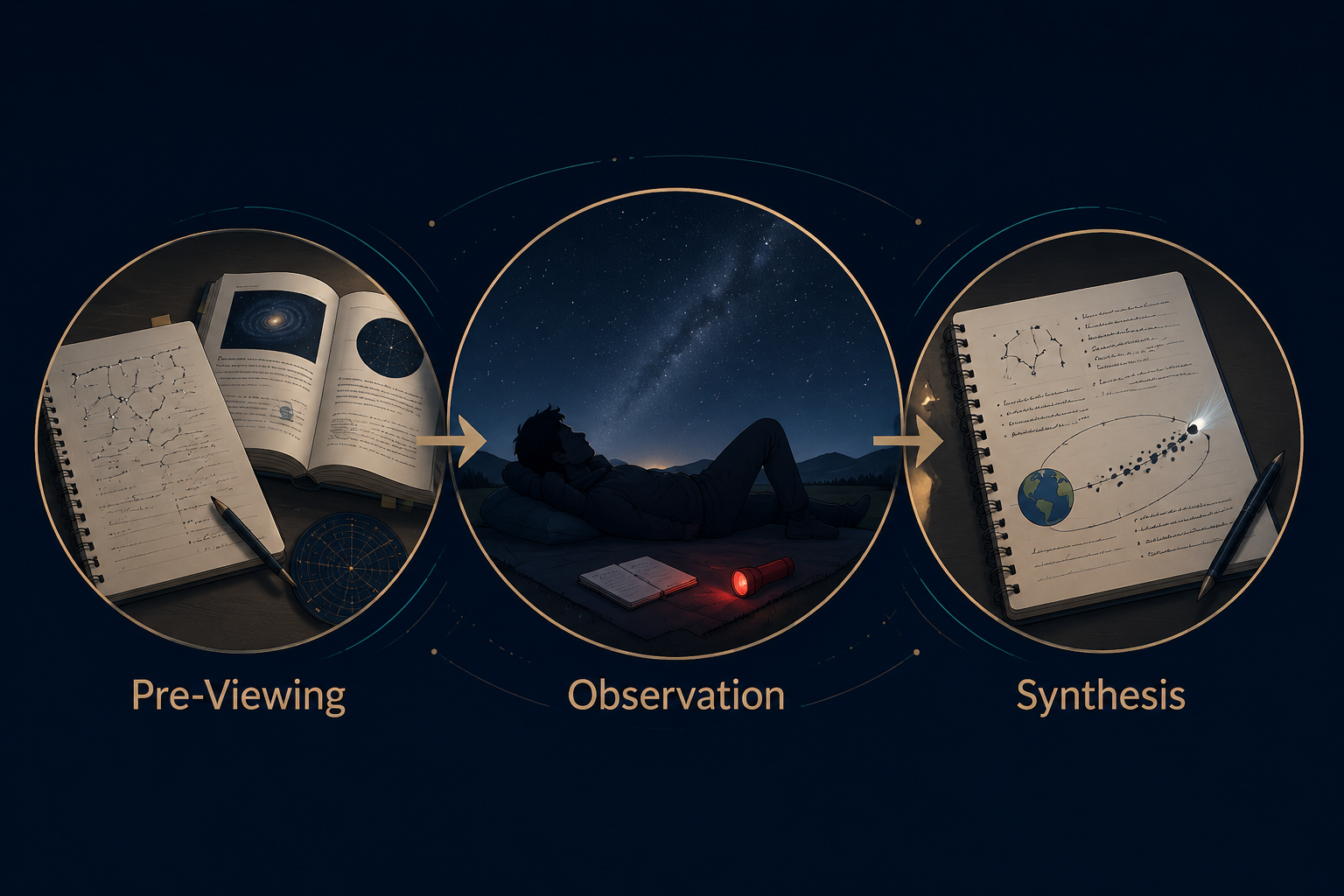
The logistics still matter: dark adaptation, a safe site, a reclining chair, warm layers, and enough patience to let the sky work. But those are the conditions for the lesson, not the lesson itself. The learning comes from what the student has decided to look for before the first meteor appears.
Start Before Dark: Turn Vocabulary Into Predictions
The weakest way to study a meteor shower is to memorize the word “radiant” and then never use it under the sky. Before observing, the student should write a short prediction in plain language: if the Perseids are real members of one shower, their paths should appear to trace backward toward a common area in Perseus, even when individual meteors streak far from that point. That prediction gives the night a testable shape.
The physical cause is not the constellation. The Perseids happen because Earth crosses the debris stream of comet 109P/Swift-Tuttle each year. Swift-Tuttle has a 133-year orbit and a nucleus about 26 kilometers across, and the particles responsible for most visible meteors are commonly described as roughly sand-grain-sized.[4] When Earth runs into that stream, the geometry of our motion makes the meteors appear to diverge from the same patch of sky, the way parallel snowflakes seem to rush from a point ahead of a moving car.
That is the first exam-worthy distinction: the radiant is an apparent direction, not a place where meteors are born. A meteor may flash across Pegasus, Andromeda, or Cygnus and still be a Perseid if its path, extended backward, points toward the radiant. A streak that does not trace back there may be a sporadic meteor or a member of another shower.
| Term | Use It During The Observation |
|---|---|
| Meteoroid | The small body in space before it enters the atmosphere. |
| Meteor | The visible streak produced as the particle enters the atmosphere. |
| Meteorite | Material that reaches the ground; this is not what students should assume they are seeing during the Perseids. |
| Radiant | The apparent sky direction from which shower meteors seem to originate. |
| ZHR | An idealized shower rate under excellent conditions, not a promise of what one observer will count. |
| Fireball | A meteor brighter than Venus, roughly brighter than magnitude -4. |
| Persistent train | A glowing trail that remains briefly after the meteor itself disappears. |
| Sporadic meteor | A meteor not associated with the shower being studied. |
Those terms are not decorative. They prevent sloppy notes. A student who writes “meteorite crossed the sky” has recorded the wrong phenomenon. A student who writes “bright meteor, path did not point back toward Perseus, likely sporadic” has started doing observational astronomy. SDSU’s Perseid guidance highlights these same distinctions as basic vocabulary for understanding the shower rather than merely naming it.[7]
Make the rate a question, not a promise
The published activity numbers need handling before the student is tired, cold, and tempted to feel cheated. Sources do not present one neat value for the 2026 Perseids: Sky at Night Magazine cites about 80, EarthSky reports 90 or more, Space.com and the American Meteor Society list 100 for the shower’s zenithal hourly rate, and some public listings go higher, up to 150.[1][2][3][5] The useful lesson is not which number wins. The useful lesson is that ZHR is an idealized rate: it assumes excellent sky conditions, the radiant placed favorably, and an observer able to see faint meteors. A real student’s hourly count will usually be lower.
So the pre-viewing note should not say, “I will see 100 meteors per hour.” It should say something closer to: “Published ZHR values are idealized. I will record my own count, sky conditions, time interval, and whether each meteor appears to trace back to Perseus.” That one sentence protects the lesson from the worst kind of astronomy disappointment: confusing a model rate with a field measurement.
Find Cassiopeia, Then Let the Radiant Do Its Job
Students do not need to stare directly at Perseus. In fact, many Perseids are easier to appreciate some distance away from the radiant, where their visible paths look longer. But they do need to know where the radiant is. Lowell Observatory describes Cassiopeia’s W shape as a reliable pointer toward the Perseid radiant in Perseus, and Cassiopeia is bright enough to remain useful even under moderately light-polluted skies.[6]
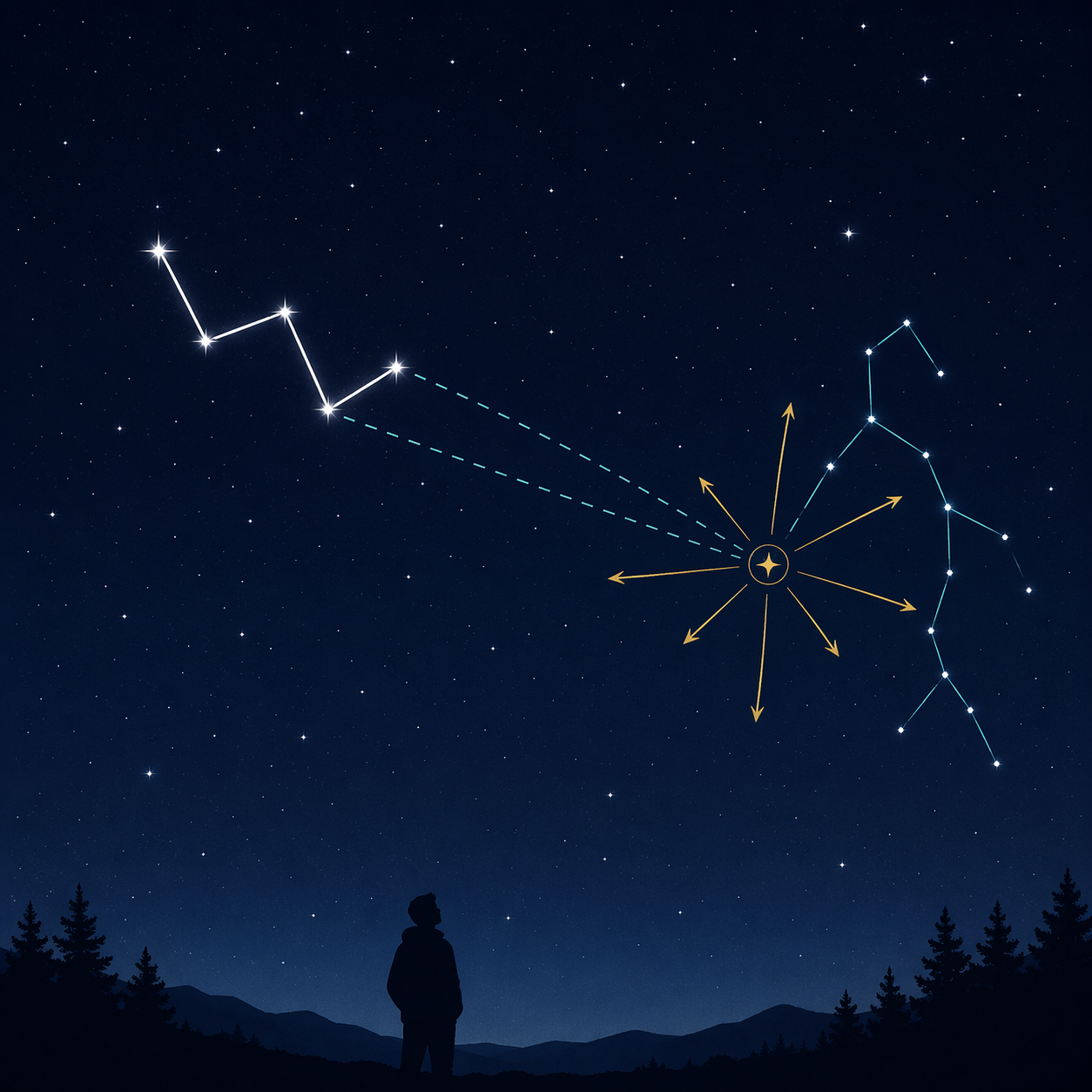
The first field task is simple: locate Cassiopeia, identify the general Perseus radiant area, and sketch a rough horizon-to-zenith map in the notebook. The sketch does not have to be beautiful. It has to be useful enough that the student can mark meteor paths as arrows and later ask whether those arrows, extended backward, converge near Perseus.
That act is where celestial coordinates stop being a grid in a diagram. The student is no longer saying “radiant” as a definition. They are using an apparent sky direction to classify moving events. A meteor that streaks from northeast to southwest may be a Perseid if its backward path points toward the radiant. Another meteor of similar brightness, crossing at the wrong angle, may not be.
Observe With a Protocol, Not a Wish
A useful Perseid session can be run with eyes, a notebook, a dim red light, and discipline. The student should divide the session into timed blocks, perhaps 20 or 30 minutes each, and keep the same basic record for every meteor. The point is not to produce professional data from a backyard. The point is to make each fleeting streak answer a concept question.
| What to Record | What It Teaches |
|---|---|
| Time block | Observed activity changes with time, radiant altitude, sky conditions, and attention. |
| Path direction | A shower meteor should trace back toward the radiant. |
| Likely Perseid or not | Classification depends on geometry, not just brightness. |
| Brightness estimate | Magnitude is an observational scale, not a decorative label. |
| Color, flare, or persistent train | Atmospheric entry can produce brief physical effects worth separating from the main streak. |
| Sky condition notes | Counts mean little without cloud, haze, light pollution, and obstruction context. |
A sample notebook line can stay compact: “12:48–1:08 a.m.; 6 meteors; 4 likely Perseids; brightest about mag 0, crossed west of Cassiopeia, backward path near Perseus; one faint sporadic southbound.” It is not a lab report yet. It is raw material with enough structure to be interpreted later.
Brightness estimates force careful looking
Meteor brightness is easy to exaggerate in memory. The cure is comparison. Sky at Night Magazine recommends estimating Perseid brightness against familiar reference stars, and notes that observers can work to about plus or minus 0.5 magnitude with practice. Useful anchors include Vega at magnitude 0, Deneb at magnitude 1, Polaris at magnitude 2, and the brightest stars of Cassiopeia around magnitude 2 to 3.[5]
That turns a gasp into a measurement. If a meteor looks about as bright as Vega, the student records roughly magnitude 0. If it is closer to Polaris, magnitude 2 is the better estimate. If it is brighter than Venus, it qualifies as a fireball; NASA and EarthSky use the Venus comparison, about magnitude -4, for that category.[1][4]
This is also where students learn that the magnitude scale is backward: smaller or negative numbers mean brighter objects. That fact is much easier to remember after trying to rank a fast meteor against Vega and Polaris in the dark than after copying a scale from a textbook.
Speed and altitude belong in the notebook too
The Perseids are fast. NASA gives their entry speed as 37 miles per second, or 59 kilometers per second, and describes the visible meteor as occurring around 60 miles, or 100 kilometers, above Earth’s surface.[4] Those numbers should be in the pre-viewing notes, then revisited after the student has actually seen how abruptly a meteor appears and disappears.
The speed explains why such small particles can produce visible streaks. Earth is not gently collecting dust; it is plowing through Swift-Tuttle’s debris stream at encounter speeds high enough to heat the incoming material and surrounding air intensely. NASA describes Perseid meteors reaching temperatures above 3,000 degrees Fahrenheit, or about 1,650 degrees Celsius.[4]
A good post-observation explanation should therefore avoid the cartoon version in which a rock simply “catches fire.” The visible meteor is an atmospheric-entry event high above the ground. Most Perseid particles are far too small to become meteorites, and the lesson should keep those words separate.
Use the Count Carefully
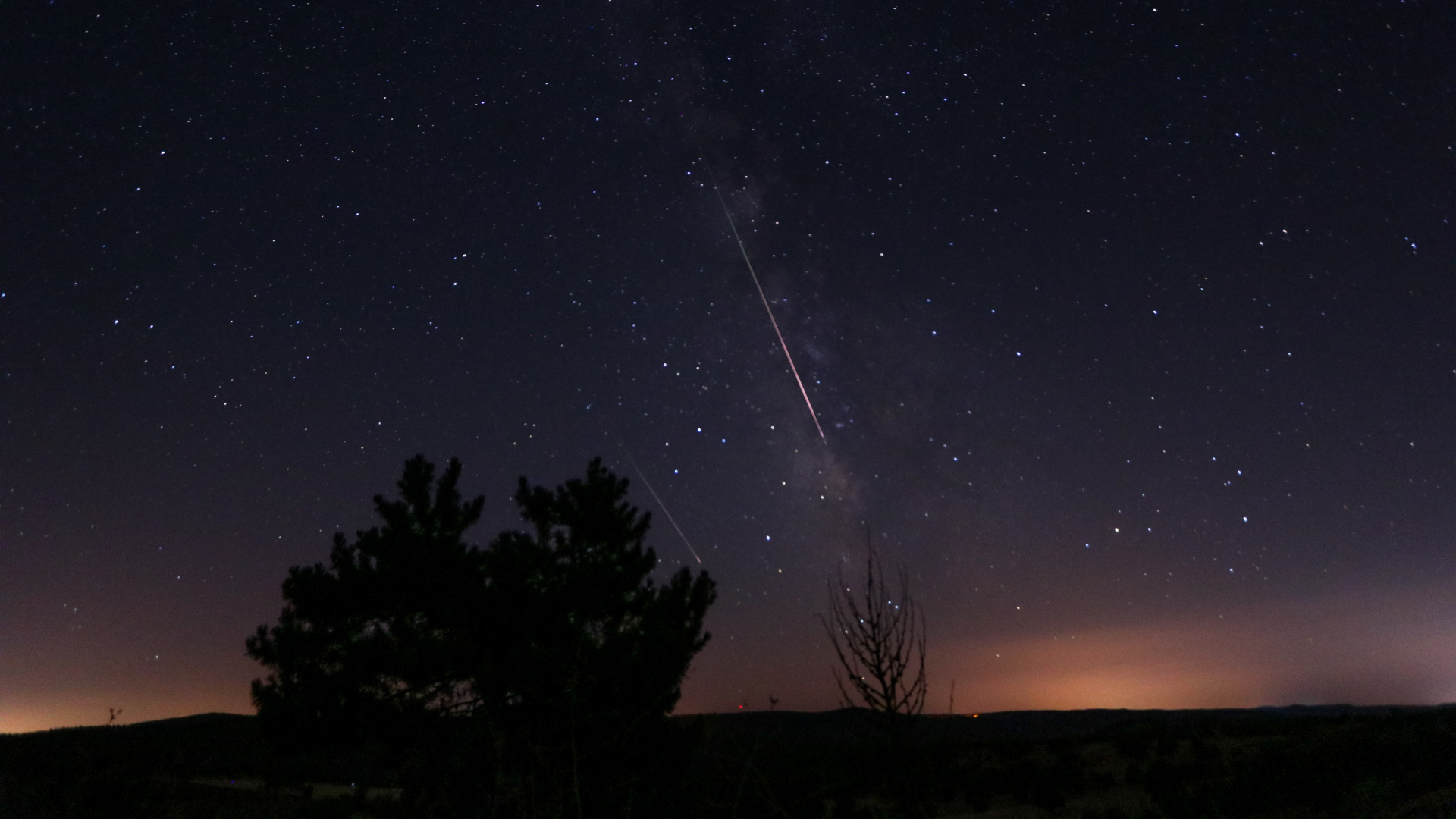
Counting meteors is worthwhile, but only if the student records what the count actually measures. A personal count is the number of meteors one observer noticed during a particular time interval from a particular site under particular sky conditions. It is not the shower’s global activity rate. It is not ZHR. It is not a failure if it falls below the headline number.
The student should separate at least three quantities after observing: total meteors seen, likely Perseids, and non-Perseids or uncertain meteors. If two students are observing together, they should keep independent counts for at least one time block before comparing. Differences are not merely mistakes. They may reflect blocked sky, attention, field of view, or one observer writing while another was looking.
This is where a meteor shower becomes a lesson in measurement limits. The sky may be generous, but the observer is still an instrument with blind spots, fatigue, reaction time, and a horizon. Writing that down is not an apology for weak data. It is part of the data.
Afterward, Build the Explanation While the Night Is Still Fresh
The post-viewing work should happen soon, ideally the same morning after sleep or the next day. Waiting a week turns observations into impressions. The student should begin by rewriting the raw notes into a short account of what happened: observing interval, sky conditions, number of meteors, number classified as likely Perseids, brightest estimate, and whether the paths supported the predicted radiant pattern.
Then comes the synthesis. A useful paragraph might read, in substance: “The meteors did not come from the stars of Perseus. They appeared to radiate from that direction because Earth was moving through the debris stream of comet Swift-Tuttle. The visible streaks occurred high in the atmosphere as small particles entered at high speed. My observed rate was lower than published ZHR values because ZHR is idealized and my count depended on local conditions, radiant altitude, and attention.”
That paragraph does more than summarize a night outside. It corrects several common misconceptions at once: constellations are not physical sources of meteors, meteor showers are tied to Solar System debris streams, meteors are atmospheric phenomena, and rate predictions are model-dependent rather than personal guarantees.
A brief historical anchor is enough
The Perseids also give students a way to see astronomy as cumulative rather than merely current. EarthSky notes that Chinese annals recorded Perseid observations in 36 AD, and Lowell Observatory describes Giovanni Schiaparelli’s 1865 connection between the Perseids and comet Swift-Tuttle.[1][6] The point is not to turn the lesson into a history lecture. The point is continuity: people saw the annual display long before they understood the debris-stream mechanism, and later astronomy connected repeated sky patterns to orbital motion.
What the Student Should Be Able to Explain
A successful Perseid lesson does not require a perfect meteor count or a spectacular fireball. It requires that the student can connect what they saw to the mechanism that produced it. After the session, they should be able to explain four things without leaning on memorized phrasing.
- Why Perseid meteors appear to radiate from Perseus even though the particles are moving through the Solar System, not out of the constellation.
- How Earth’s annual crossing of Swift-Tuttle’s debris stream produces a recurring shower.
- Why a tiny incoming particle can create a bright atmospheric streak at high altitude.
- Why their observed count is not expected to equal a published ZHR value.
If the student can do that, the night has done real academic work. The 2026 Perseid peak is not educational because it is famous, photogenic, or conveniently placed on a calendar with a solar eclipse. It is educational because the moonless peak gives a prepared observer enough clean evidence to practice astronomy as reasoning from the sky itself.
References
- Everything you need to know: Perseid meteor shower, EarthSky,
- Perseid meteor shower 2026 guide, Space.com,
- Meteor Shower Calendar, American Meteor Society,
- Perseids, NASA Science,
- Top tips for observing the Perseid meteor shower, BBC Sky at Night Magazine,
- Raining Fire in the Sky: Perseid Meteor Showers, Lowell Observatory,
- What You Need to Know About the Perseid Meteor Shower, SDSU Astronomy,
Apply This Method
Related Methods
- Turn the 2026 Perseid Meteor Shower Into an Astronomy Study Session
Learn how to use the 2026 Perseid meteor shower peak (Aug 12–13) as a hands-on astronomy study session. Apply concepts like radiant geometry, ZHR, magnitude estimation, and atmospheric entry physics while collecting real observational data with standard reporting forms.
- Where Students Can Watch the Perseid Meteor Shower in 2026
The 2026 Perseid meteor shower peaks on August 12–13 under a new moon, creating the best viewing conditions in years. This guide helps students find dark-sky spots near campus — on foot, by transit, or on a weekend trip — without expensive gear.
- How to Analyze a Settlement Case Study for Law Students
Most civil cases settle before trial, yet law school curricula focus almost exclusively on appellate opinions. A five-part framework for analyzing settlement case studies — covering negotiation dynamics, leverage, and economic incentives — gives law students a crucial advantage in exams and clinic preparation.
Comments
Join the discussion with an anonymous comment.