
How to Analyze a Settlement Case Study for Law Students
Most civil cases settle before trial, yet law school curricula focus almost exclusively on appellate opinions. A five-part framework for analyzing settlement case studies — covering negotiation dynamics, leverage, and economic incentives — gives law students a crucial advantage in exams and clinic preparation.
Best for: law, legal studies
The first mistake in a lawsuit settlement case study for law students is usually the most understandable one: opening the file and trying to brief it like an appellate opinion. Facts, issue, rule, application, conclusion. Find the holding. Extract the reasoning. Move on.
That works when a court has written an opinion. A settlement agreement is doing something else. It is not announcing what the law is. It is recording what the parties were willing to accept instead of finding out what the law would become after more motions, more discovery, trial, appeal, delay, cost, publicity, and risk.
The usual classroom shorthand is that “over 95%” of civil cases settle before trial. The direction is right, but the number deserves more care than it usually gets. Court Review has described the empirical problem: fewer than 3% of federal cases reach trial verdict, but settlement rates vary by jurisdiction, case type, and method of measurement; state courts also do not systematically track settlement dispositions. A Cornell empirical study of two federal districts found a 66.9% aggregate settlement rate, which is still high, but not the same thing as a universal 95% rule.[1]

The caveat matters because settlement analysis is not a slogan about cases disappearing before trial. It is a way of reading legal work that never becomes a neat opinion. Brian Farkas has described teaching a Cardozo Law of Settlement course with checklists because many students graduate without ever seeing a settlement agreement.[2] That gap shows up fast in clinic and summer work. A student can recite the elements of a claim and still be lost when asked why a defendant pays now, why a plaintiff accepts less than the complaint demanded, or why both sides leave a contested legal issue unresolved.
Why IRAC Starts to Break Down
IRAC is not useless. It is useful for what it was built to do: organize legal reasoning when a decision-maker applies a rule to facts and produces a conclusion. A settlement does not have that structure. The parties may disagree about the rule, disagree about the facts, disagree about damages, and disagree about what a court would do. The agreement still binds them because each side prefers the settlement package to the available alternatives.
So the central question changes. In an appellate opinion, the student asks: what did the court hold, and why? In a settlement case study, the better question is: what pressures made this resolution rational for these parties at this procedural moment?
That question pulls in doctrine, but it does not stop there. It asks about leverage, information, timing, transaction costs, insurance, reputational exposure, public policy goals, claimant participation, and the risk of creating precedent. Negotiation scholars often describe settlement as bargaining “in the shadow of the law,” meaning legal rights shape the negotiation without fully determining the result.[3]
A Five-Part Framework for Reading a Settlement
Before getting lost in the dollar figure, build the file in this order:
- Procedural posture and jurisdictional context: where was the case, and what was about to happen next?
- Each side’s BATNA and risk tolerance: what was the best alternative to settlement, and how much uncertainty could each side absorb?
- Negotiation inflection points: what changed the bargaining range?
- Settlement structure: how did the agreement move money, behavior, risk, and participation?
- Unresolved legal questions: what did the settlement prevent a court from deciding?
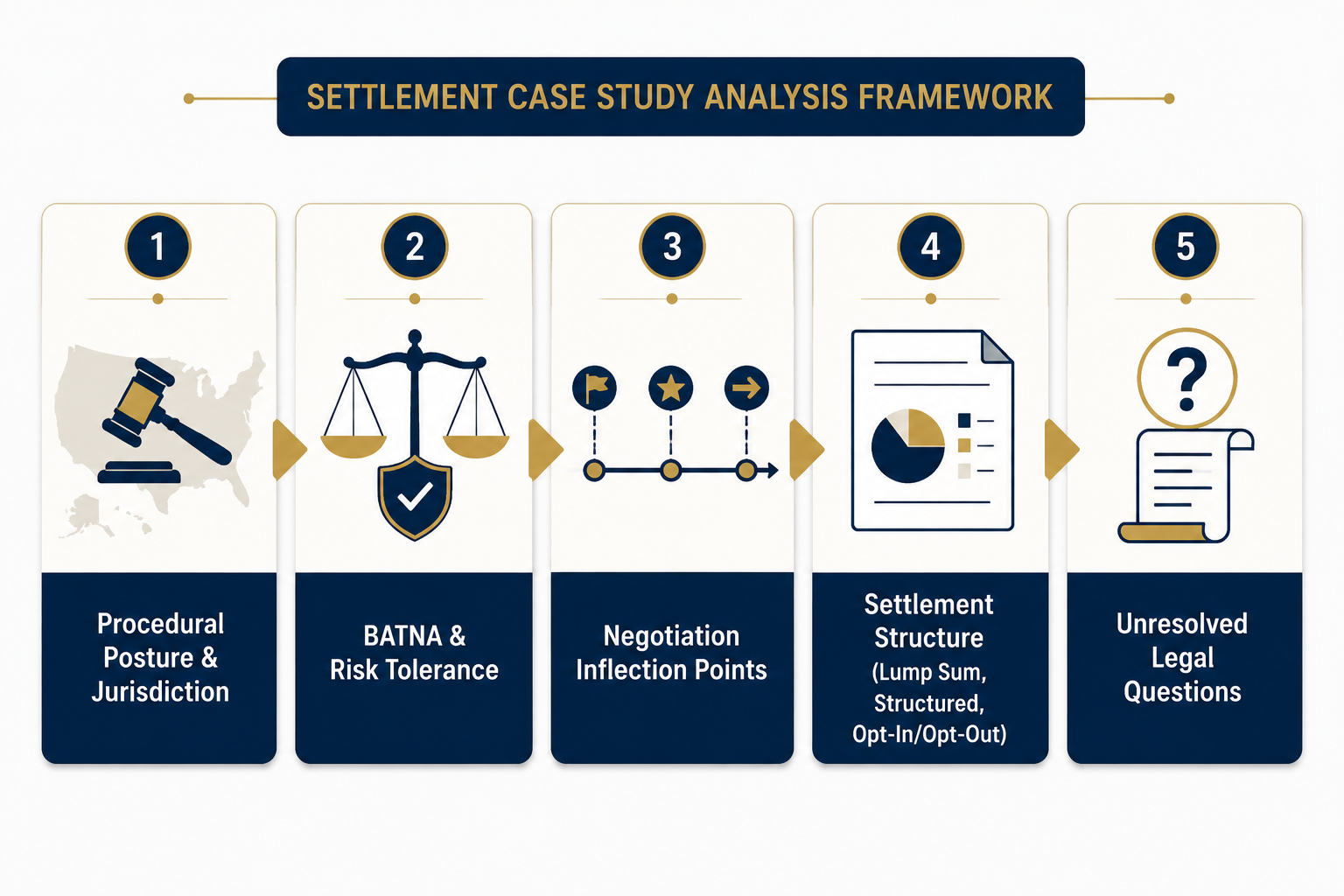
This is not a replacement for knowing the law. It is a replacement for pretending the only legally relevant thing is a holding.
1. Start With Procedural Posture, Not the Merits in the Abstract
A settlement reached after a complaint is filed does not mean the same thing as one reached after class certification, after summary judgment briefing, after a trial verdict, or while a certiorari grant is pending. The same legal claim can have different settlement value depending on what the next procedural event threatens to reveal or decide.
For a student, the posture paragraph should be almost mechanical. Identify the court, the claims, the parties, the stage of litigation, the next scheduled litigation event, and whether the case sits in individual litigation, class action, multidistrict litigation, agency enforcement, or public consent decree territory. Only then ask what the settlement avoided.
That last phrase matters. Settlement is often timed around procedural risk. A defendant may settle before class certification to avoid aggregate exposure. A plaintiff may settle after surviving a motion to dismiss because the bargaining position has improved. A public defendant may settle before appellate review because a narrow local dispute could become a national rule.
2. Read Leverage Through BATNA and Risk Tolerance
The most useful settlement analysis usually begins when the student stops asking who was legally right and starts asking what each side could afford to risk. BATNA means the best alternative to a negotiated agreement. In litigation, that alternative is rarely just “go to trial.” It may be more discovery, another motion, appellate review, delay, adverse publicity, bankruptcy pressure, regulatory attention, or the chance that similarly situated claimants organize.
Risk tolerance is different from legal merit. A party with a strong claim may still need money quickly. A party with a plausible defense may still fear discovery. A defendant may care less about one damages award than about a precedent that changes every future case. An institutional plaintiff may accept nonmonetary terms that an individual plaintiff would not value the same way.
Mount Holly v. Mount Holly Gardens Citizens in Action is a clean example because the case settled at the Supreme Court level. The dispute involved Fair Housing Act disparate-impact liability, and settlement meant the Court did not decide the issue in that case. SCOTUSblog’s law-student discussion of the settlement uses it to show why parties may settle even when a Supreme Court decision is within reach: the risk of an adverse national precedent can outweigh the value of winning one dispute.[4]
That is the kind of sentence an exam answer needs. Not “the parties compromised.” Not “settlement saved costs.” Those may be true, but they are generic. The sharper point is that the procedural setting changed the stakes. The litigation no longer threatened only a local remedy; it threatened a rule with consequences beyond the immediate parties.
| Question | What It Reveals |
|---|---|
| What happens if the plaintiff refuses to settle? | Trial prospects, delay, collection risk, litigation cost, and possibility of a broader ruling |
| What happens if the defendant refuses to settle? | Discovery exposure, damages risk, precedent risk, business disruption, and reputational cost |
| Who is more harmed by time? | Cash-flow pressure, public pressure, claimant health or age, insurance limits, and administrative burden |
| Who needs certainty more? | Risk tolerance rather than doctrinal strength |
In clinic, this is where students become useful. A supervising attorney usually does not need a lecture on the elements of negligence. She may need a quick read on whether the client can live with another year of litigation, whether the other side has insurance limits, whether a motion deadline is creating pressure, or whether an apology, release, payment plan, confidentiality clause, or policy change is doing more work than the headline amount.
3. Mark the Negotiation Inflection Points
Settlement value moves when information changes. A complaint being filed, a motion surviving dismissal, class certification being granted or denied, damaging documents surfacing, expert reports narrowing damages, a trial date approaching, or appellate review becoming likely can all change the bargaining range.
Do not turn this part into a full litigation history unless the history explains the deal. The task is to identify the moments that changed expected value or bargaining power. If nothing in the materials shows why the number changed, say that the public record does not reveal the negotiation path. Settlement agreements are often confidential, and even public settlements rarely disclose every bargaining move.
A useful case note can be brief: “The settlement followed certification risk,” “The agreement came after discovery increased reputational exposure,” or “The deal arrived before appellate review could produce a broader rule.” The point is not to dramatize negotiation. It is to connect timing to leverage.
4. Treat Settlement Structure as Substance
The structure of a settlement is not administrative detail. It determines who actually receives relief, what behavior changes, how risk is allocated, and whether the agreement solves the problem that produced the litigation.
Start with the form of relief. Is the defendant paying a lump sum, creating a claims process, funding future monitoring, changing business practices, buying back products, offering vouchers, or agreeing to injunctive terms? Is relief automatic, or must claimants opt in? Are payments fixed, tiered, individualized, capped, or dependent on proof? Who administers the fund? Who reviews rejected claims? What happens to unclaimed money?
The Tobacco Master Settlement Agreement is useful here because its importance was not only monetary. The 1998 agreement involved 46 states and a reported $206 billion, but it also embedded public-health policy terms, including advertising restrictions and marketing changes.[5] For settlement analysis, that means the agreement should not be reduced to a damages figure. The states were bargaining for money and conduct constraints.
The Volkswagen Dieselgate settlement shows a different structural mix. The 2016 settlement was reported at $14.7 billion and combined vehicle buybacks, environmental mitigation, and direct consumer compensation.[5] That kind of package matters because different pieces answer different injuries. A buyback addresses consumer ownership of affected vehicles. Mitigation addresses environmental harm. Direct compensation addresses consumer loss. A single total dollar figure hides the allocation choices.
This is also where class action triumphalism needs brakes. Aggregate settlement value can sound enormous while individual recovery is modest or participation is low. A Talli discussion citing FTC data reports a 9% median claims rate in class actions and median per-person recovery under $35.[6] Those figures do not mean class settlements are useless. They mean a student has to ask whether the settlement design makes relief reachable.
The 3M Combat Arms Earplugs settlement is striking for exactly that reason. Talli reports a $6 billion ongoing MDL settlement with 99.9% participation across 293,000 claimants, with individualized notice and meaningful per-person recovery ranging from $7,000 to $700,000.[6] The point is not simply that the number is large. The point is that participation design changed whether the settlement reached the people it was supposed to reach.
| Structural Choice | Why a Law Student Should Care |
|---|---|
| Claims-made relief | Eligible people may receive nothing unless they submit a valid claim |
| Automatic distribution | Participation barriers decrease, but identifying recipients may be harder |
| Tiered payments | The agreement values injuries differently and may require proof categories |
| Conduct changes | The settlement may pursue deterrence or policy goals beyond compensation |
| Release language | Claimants may give up future claims, including claims whose value is uncertain |
Release language deserves special attention because it is where the defendant often buys peace. A plaintiff may receive payment now while giving up the right to sue later. In a class or aggregate settlement, the release may bind people who did not negotiate personally. On an exam, that is not a footnote. It is part of the exchange.
5. Name the Legal Questions the Settlement Avoided
A settlement can be legally important precisely because it leaves law unsettled. No holding means no binding answer on liability, causation, damages, statutory interpretation, class certification, constitutional limits, preemption, or remedy. The parties may have strong arguments, but the agreement prevents a court from choosing among them.
That should change the way a student writes the conclusion. Do not say the settlement “established” a rule unless the materials show a court or statute did that. A settlement may signal litigation risk, reveal bargaining priorities, create private obligations, or influence institutional behavior. It does not, by itself, decide the legal question the way an appellate opinion does.
Mount Holly is again a useful warning. The settlement mattered partly because it prevented Supreme Court resolution in that case.[4] That is not doctrinal emptiness. It is strategic legal significance. Sometimes the most important thing a settlement does is keep a question open.
How to Turn This Into an Exam or Clinic Answer
For an exam, the answer should still be organized. It just should not pretend to be an appellate brief. A strong settlement analysis can move in five compact paragraphs:
- Identify the posture: court, claims, stage, next litigation event, and settlement context.
- Compare alternatives: what each side faced if no agreement was reached.
- Explain leverage: cost, delay, precedent risk, damages uncertainty, publicity, and information asymmetry.
- Analyze structure: payment design, nonmonetary terms, participation mechanics, releases, and administration.
- State what remains unresolved: legal issues avoided because no court produced a merits ruling.
For clinic work, the same framework becomes more practical. The client usually cares less about whether the memo has elegant headings and more about consequences: how much money arrives, when it arrives, what must be signed, what future claims disappear, whether confidentiality limits speech, whether tax or benefit issues are implicated, and what happens if the other side breaches.
If the case study involves a public settlement, stay alert to the limits of the public record. Tobacco, Volkswagen, and 3M are unusually visible because of public filings, consent-decree features, or aggregate litigation reporting. Many ordinary settlements are confidential. A careful student does not fill those gaps with invented negotiation facts.
A Worked Mini-Template
A clean answer does not need to be long. It needs to account for the bargain. A student analyzing a settlement might write something like this, adapting the details to the actual case materials:
The settlement occurred after [procedural event], when [party] faced [specific litigation risk] and [opposing party] faced [specific counter-risk]. Continued litigation offered [possible benefit] but also threatened [cost, delay, precedent, discovery, damages, or collection problem]. The agreement’s structure matters because it provides [payment / conduct change / claims process / buyback / monitoring] while requiring [release / opt-in / confidentiality / proof / administrative review]. The settlement resolves the dispute between the parties, but it leaves unresolved [legal issue] because no court reached a merits ruling.That paragraph does more legal work than a forced IRAC answer. It shows why settlement was rational, what the parties traded, how the agreement operates, and what law remains undecided.
The Standard for a Good Settlement Case Study
A law student has analyzed a settlement case study well when the answer can explain why settlement was preferable to continued litigation at that moment, what each side gave up or protected, how the agreement’s structure shaped real outcomes, and which legal questions remain unanswered because the case never produced a ruling.
References
- The Vanishing Trial: The College of Trial Advocacy, Court Review, https://digitalcommons.unl.edu/ajacourtreview/22/
- Brian Farkas: Using Checklists in My Course on the Law of Settlement, Indisputably, December 2023, https://indisputably.org/2023/12/brian-farkas-using-checklists-in-my-course-on-the-law-of-settlement/
- Negotiating in the Shadow of the Law, Program on Negotiation at Harvard Law School, https://www.pon.harvard.edu/daily/dispute-resolution/negotiating-in-the-shadow-of-the-law-nb/
- SCOTUS for law students: Why cases settle, SCOTUSblog, November 2013, https://www.scotusblog.com/2013/11/scotus-for-law-students-sponsored-by-bloomberg-law-why-cases-settle/
- Notable Class Action Lawsuit Examples, Zalkin Law, https://zlk.com/learn/notable-class-action-lawsuit-examples
- Settlement Campaigns Statistics, Talli, https://blog.talli.ai/settlement-campaigns-statistics/
Apply This Method
Related Methods
- Switched at Birth: Legal Steps and Study Guide for Torts
A case-based study guide for law students exploring how switched-at-birth litigation tests negligent infliction of emotional distress, the independent duty exception, multi-party standing, and statute-of-limitations issues across multiple jurisdictions.
- Where Students Can Watch the Perseid Meteor Shower in 2026
The 2026 Perseid meteor shower peaks on August 12–13 under a new moon, creating the best viewing conditions in years. This guide helps students find dark-sky spots near campus — on foot, by transit, or on a weekend trip — without expensive gear.
- Turn the 2026 Perseid Meteor Shower Into an Astronomy Study Session
Learn how to use the 2026 Perseid meteor shower peak (Aug 12–13) as a hands-on astronomy study session. Apply concepts like radiant geometry, ZHR, magnitude estimation, and atmospheric entry physics while collecting real observational data with standard reporting forms.
Comments
Join the discussion with an anonymous comment.