
Learn the Offside Rule in 20 Minutes with Self-Test Scenarios
This guide breaks down soccer's offside rule into four learnable conditions and tests your knowledge with real-match scenarios — helping you master Law 11 in about 20 minutes.
Best for: soccer rules
The offside rule in soccer is not a vibe check. Under Law 11 for the 2026-27 season, an attacker is only penalized for offside if two things are both true: first, they are in an offside position at the moment a teammate plays or touches the ball; second, they then become involved in active play in one of the ways the law names.[1]
That first sentence fixes most sideline arguments. Being in an offside position is not, by itself, an offence. A forward can stand beyond the defensive line, wave for the ball, look wildly suspicious, and still not be guilty of anything until the next part happens. The assistant referee is not judging whether the player looks sneaky. The assistant referee is judging position, timing, involvement, and exceptions.
| Question | What You Check |
|---|---|
| 1. Where is the attacker? | Are they in the opponents' half, nearer to the opponents' goal line than both the ball and the second-last opponent? |
| 2. When do you freeze the picture? | At the moment the teammate plays or touches the ball, not when the attacker receives it. |
| 3. Do they become involved? | Do they interfere with play, interfere with an opponent, or gain an advantage from a rebound, save, or deflection? |
| 4. Is the restart exempt? | No offside offence can come directly from a goal kick, throw-in, or corner kick. |
If you can run that checklist at game speed, you understand the offside rule better than most people shouting from behind a folding chair.
The Three Position Conditions
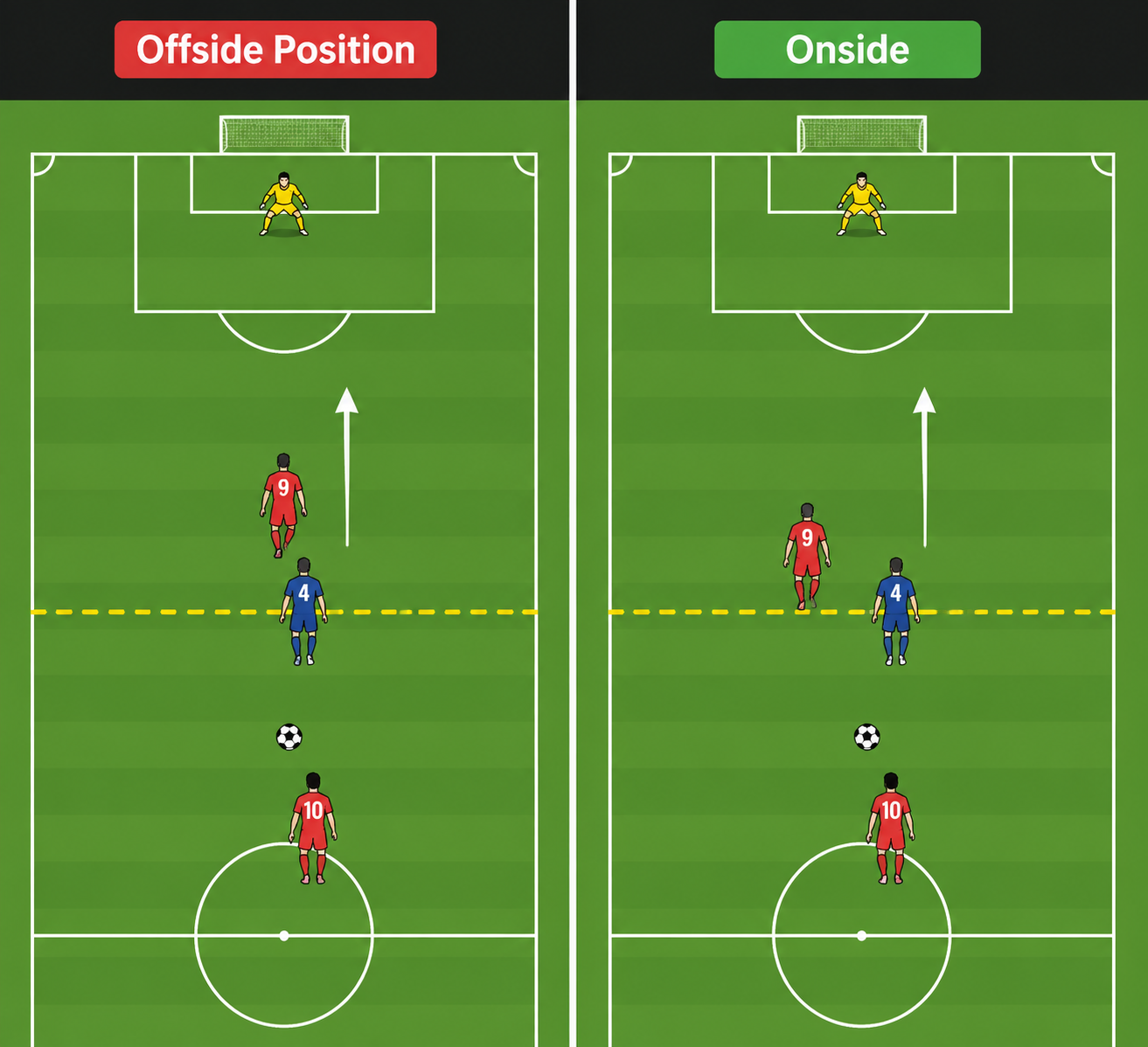
Start with position. A player is in an offside position only if all three position conditions are met at the same time: they are in the opponents' half, they are nearer to the opponents' goal line than the ball, and they are nearer to the opponents' goal line than the second-last opponent.[1]
Miss one condition and the player is not in an offside position. If the attacker is still in their own half, no offside position. If the ball is closer to the goal line than the attacker, no offside position. If the attacker is level with the second-last opponent, no offside position. Level is onside under the current law, not a generous interpretation by a friendly referee.[1]
The phrase "second-last opponent" matters because the goalkeeper is not always the last defender. Usually the goalkeeper is the deepest player, so people say "last defender" casually. That shortcut causes bad calls in the brain. The law looks at the second-last opponent, whoever that happens to be.
The body parts that count are also narrower than people think. For offside position, the law considers the head, body, and feet — the parts that can legally play the ball. The hands and arms of all players, including goalkeepers, are not counted. The upper boundary of the arm is in line with the bottom of the armpit.[1]
Freeze the Moment the Ball Is Played
The offside snapshot is taken when a teammate plays or touches the ball. Not when the pass arrives. Not when the attacker starts sprinting. Not when the crowd notices the run. If the attacker is level when the pass is made and then outruns the defender to collect it, that is onside.
This is why offside can look wrong from the sideline. Parents often watch the ball because the ball is interesting. Assistant referees have to watch the defensive line, then catch the exact touch by the passer, then track whether the attacker gets involved. That is the hard part. The flag is not supposed to go up because someone is standing in a suspicious zip code.
Offside Position Is Only Half the Call
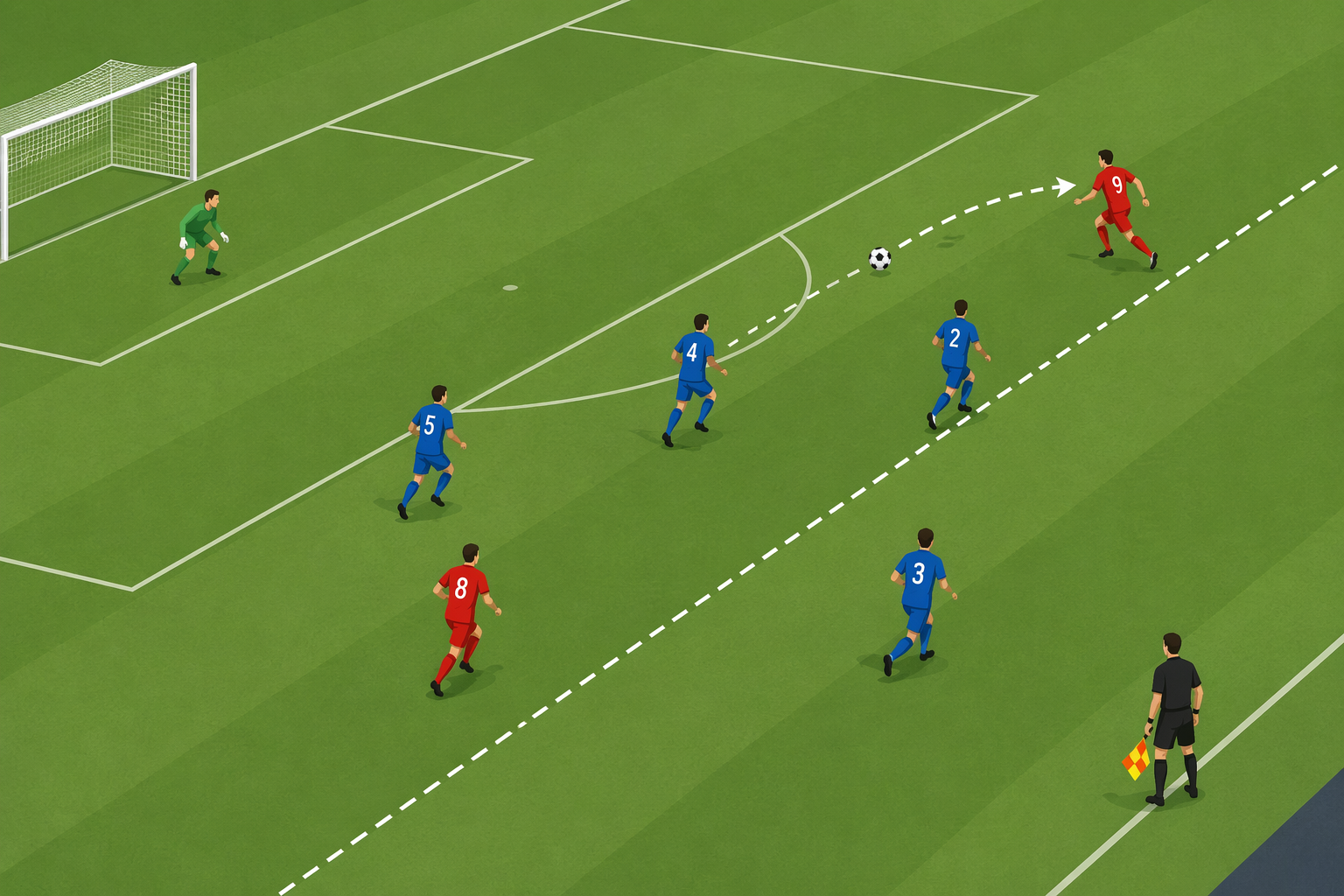
Once a player is in an offside position, the next question is involvement. Law 11 says an offside-positioned player commits an offence if they become involved in active play by interfering with play, interfering with an opponent, or gaining an advantage from the position.[1]
| Involvement Type | What It Means in Plain Language |
|---|---|
| Interfering with play | The player plays or touches a ball passed or touched by a teammate. |
| Interfering with an opponent | The player affects an opponent's ability to play or challenge for the ball, including blocking line of vision or making an obvious action that impacts the opponent. |
| Gaining an advantage | The player plays the ball or interferes with an opponent after the ball rebounds, deflects, or is saved. |
The cleanest case is interfering with play. A midfielder passes forward. A striker was beyond the second-last opponent when the pass was made. The striker receives the ball. Offside offence. Nobody needs a courtroom.
The messier cases are the ones where the offside-positioned attacker never touches the ball. If that player blocks the goalkeeper's line of vision, challenges a defender for the ball, clearly attempts to play a nearby ball and impacts an opponent, or makes an obvious action that affects an opponent's ability to play it, the offence can still happen.[1]
Then there is gaining an advantage. If a shot rebounds off the post, crossbar, an opponent, or a save, an attacker who was in an offside position when the original teammate's touch happened can be penalized for playing that rebound. A lucky bounce does not clean up the attacker's earlier offside position.[1]
Deliberate Play Is Not the Same as a Deflection
A defender's deliberate play can reset the offside phase. A deflection does not. That distinction is one of the fastest ways for a calm match to become a group debate with pointing.
If a defender has control enough to deliberately play the ball, and the ball then goes to an attacker who had been in an offside position, the old offside position may no longer matter. But if the ball merely glances, ricochets, or deflects off the defender, the offside-positioned attacker has not been rescued by that touch. IFAB's Law 11 language keeps that line clear: deliberate play is treated differently from a deflection or save.[1]
A practical way to study it: ask whether the defender played the ball, or whether the ball played the defender. That phrase is not the law, but it is a useful first filter before you go back to the exact wording.
The Three Restarts Where Offside Does Not Apply
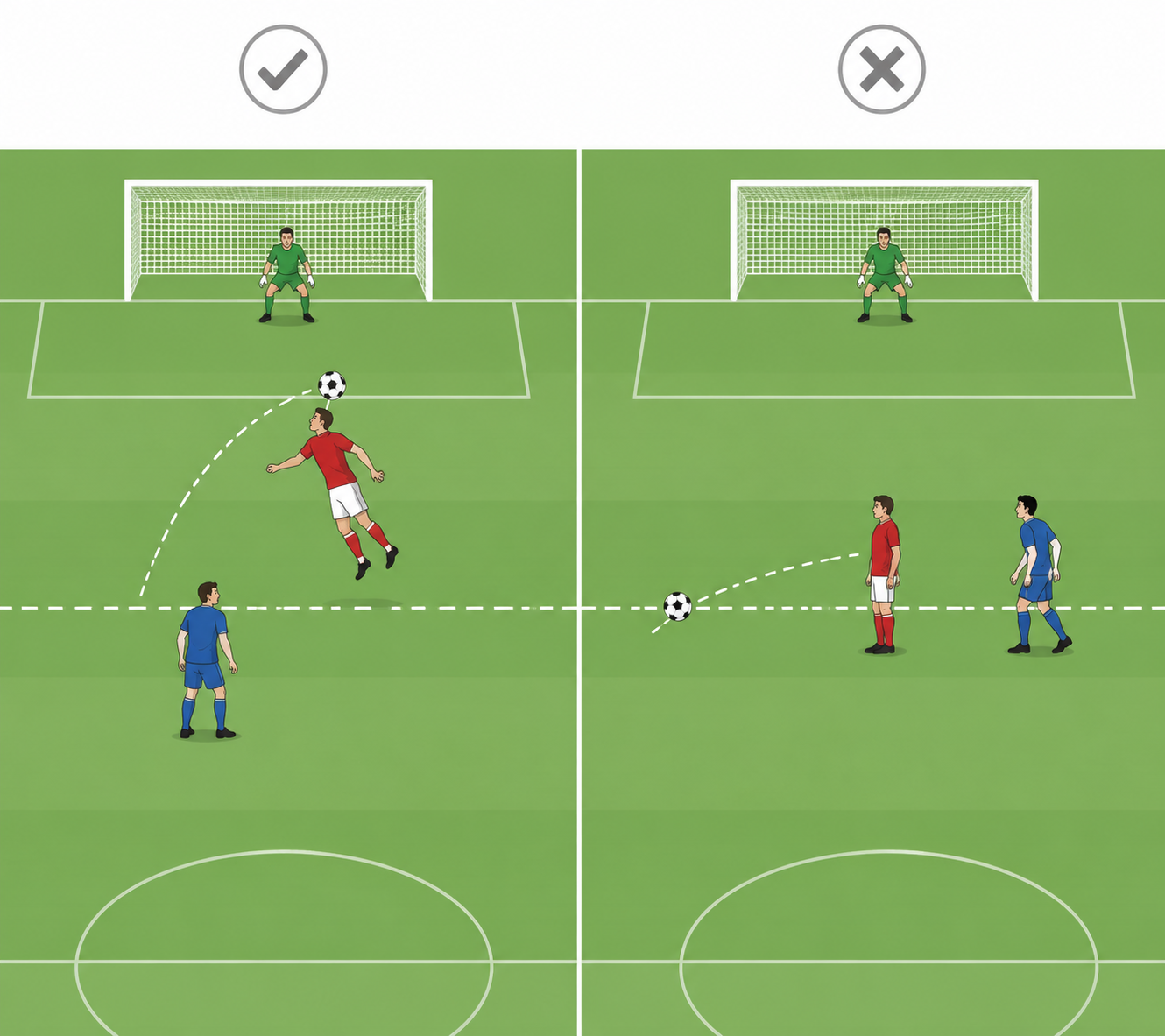
There is no offside offence if a player receives the ball directly from a goal kick, a throw-in, or a corner kick.[1]
- Goal kick: an attacker may receive directly from a teammate's goal kick without being penalized for offside.
- Throw-in: a player cannot be offside directly from the throw.
- Corner kick: no offside offence can come directly from the corner.
The word "directly" does work here. Once another teammate touches the ball after the restart, ordinary offside judgment returns. So if a corner is played short, then crossed by a teammate, freeze the picture at that second touch and judge from there.
A 20-Minute Way to Study the Rule
Do not try to memorize every weird clip first. Learn the checklist, then test it against scenarios. That is the same basic study-guide logic you would use for a class topic: reduce the rule to decision points, then practice applying them under pressure. If you use structured study tools already, the same method behind creating a study guide from a syllabus works here too.
| Time | Task |
|---|---|
| Minutes 0-4 | Memorize the three position conditions and the timing rule. |
| Minutes 4-8 | Study the three involvement types: interfere with play, interfere with an opponent, gain an advantage. |
| Minutes 8-11 | Learn the three exempt restarts: goal kick, throw-in, corner kick. |
| Minutes 11-20 | Work through live-looking scenarios and explain each answer out loud. |
Explaining the answer out loud matters. "He was offside" is not enough. The useful answer sounds like this: "He was in an offside position when the pass was made, and then he touched the ball, so it is an offside offence." Or: "She was in an offside position, but she did not interfere with play or an opponent, so no offence."
If you want to turn the scenarios into flashcards later, a quiz tool can help. The important part is that every card should force the same four checks instead of asking for a gut reaction. Guides to NotebookLM quizzes and flashcards or quiz-based apps like Quizlet are useful only if the question design keeps that discipline.
Self-Test Scenarios
For each scenario, decide first whether the attacker is in an offside position. Then decide whether there is an offence. Do not skip straight to the flag.
Scenario 1: Level With the Defender
A midfielder plays a through ball. At the moment of the pass, the striker's foot is level with the second-last defender's foot. The striker then sprints behind the defense and scores.
Decision: onside. The striker was not nearer to the opponents' goal line than the second-last opponent when the ball was played. The later sprint does not matter. This is the one that looks unfair to defenders because the attacker wins the race after the pass, but the law freezes the picture at the teammate's touch.[1]
Scenario 2: Standing Offside, Ball Goes Elsewhere
A winger crosses the ball. One attacker is beyond the second-last defender near the penalty spot, but the ball flies over everyone to a teammate arriving from an onside position at the back post. The offside-positioned attacker does not challenge anyone, block the goalkeeper, or attempt to play the ball.
Decision: no offside offence by the attacker near the penalty spot. Being there is not enough. If that player does not interfere with play, interfere with an opponent, or gain an advantage, the flag stays down.[1]
Scenario 3: Blocking the Goalkeeper's View
A shot comes from outside the box. An attacker is in an offside position between the shooter and the goalkeeper. The attacker does not touch the ball, but the goalkeeper's line of vision is blocked as the shot travels toward goal.
Decision: offside offence, if the attacker clearly obstructs the goalkeeper's line of vision. Touching the ball is not required for interfering with an opponent. This is why the assistant referee may wait a beat before signaling; the question is not only where the attacker stood, but whether that position affected the opponent's ability to play the ball.[1]
Scenario 4: Deflection off a Defender
A midfielder shoots. At the moment of the shot, a striker is in an offside position. The shot clips a defender's leg and rolls to the striker, who scores.
Decision: offside offence. A deflection off a defender does not reset the phase. The striker gained an advantage from being in the offside position when the teammate shot.[1]
Scenario 5: Defender Deliberately Plays the Ball
A defender sees a long pass coming and deliberately swings a foot to play it. The ball is misplayed and goes to an attacker who had been in an offside position when the original pass was made.
Decision: usually no offside offence from the original pass if the defender's action qualifies as deliberate play. The awkward part is judging whether the defender truly played the ball or whether the ball merely deflected off them. That is a referee judgment, not a volume contest.
Scenario 6: Rebound from the Goalpost
A shot hits the post and rebounds to an attacker who was in an offside position when the shot was taken. The attacker taps in the rebound.
Decision: offside offence. The attacker gained an advantage from the position after the ball rebounded from the goalpost. The post does not reset anything.[1]
Scenario 7: Direct From a Throw-In
A player takes a long throw-in down the line to a teammate standing behind the defensive line. The teammate receives the ball directly from the throw.
Decision: no offside offence. A player cannot be penalized for offside when receiving the ball directly from a throw-in.[1]
Scenario 8: Short Corner, Then Cross
A team takes a short corner. The first receiver is fine because offside does not apply directly from the corner. That receiver then crosses to a teammate standing beyond the second-last opponent.
Decision: judge offside at the moment of the cross, not the original corner kick. The exemption applied to the direct corner. Once the teammate plays the next ball, normal Law 11 analysis returns.[1]
Scenario 9: The Player Who Makes the Defender Panic
An attacker is in an offside position near a defender. A pass is played into the space. The attacker runs toward the ball, gets close enough to challenge, and the defender hurriedly kicks it out because of that pressure.
Decision: possible offside offence for interfering with an opponent, depending on whether the attacker challenged or clearly impacted the defender's ability to play the ball. This is not solved by saying "but he never touched it." The question is whether the offside-positioned player affected the opponent in a way Law 11 recognizes.[1]
Scenario 10: The Wait-and-See Flag
A forward is standing in an offside position when a teammate chips the ball toward the penalty area. Another attacker, who was onside, also has a chance to reach it. The assistant referee keeps the flag down for a moment.
Decision: the delay is good officiating, not indecision. The assistant referee needs to see who becomes involved. Training material for new linesmen describes this as a common "wait and see" situation: flagging too early can punish a player who was merely in an offside position while an onside teammate was the one actually playing the ball.[2]
Common Mistakes That Make Offside Look Harder Than It Is
The offside law has details, but most wrong explanations fail in predictable ways. The first is treating offside position as an automatic offence. That one creates half the yelling.
- Watching the ball instead of the defensive line: this makes a level attacker look late and guilty.
- Judging at the reception point: the correct moment is when the teammate plays or touches the ball.
- Counting arms and hands: they do not count for offside position.
- Calling every defender touch a reset: a deflection is not deliberate play.
- Forgetting the three exempt restarts: goal kick, throw-in, and corner kick are special.
The ball-watching mistake deserves special sympathy because everyone does it at first. The Offside Rule Trainer flags it as a common new-linesman error: if you stare at the pass instead of holding the defensive line in view, you lose the only snapshot that matters.[2]
What Has Not Changed for 2026-27
For the 2026-27 season, the official Law 11 wording still uses the standard offside position framework: opponents' half, nearer than the ball, nearer than the second-last opponent, with hands and arms excluded and the bottom of the armpit marking the relevant arm boundary.[1]
There has been public debate around possible changes, including so-called daylight-style approaches that would give attackers more room. The Athletic reported during the 2026 World Cup that offside remained controversial and that IFAB had not treated those trial ideas as enacted global law.[3]
So for a match today, do not apply a rumored "whole body" change unless the competition has formally adopted a specific trial or the official law text has changed. Use the law in force, not the clip caption.
World Cup Clips Are Tests, Not the Rulebook
High-profile disallowed goals at the 2026 World Cup, including incidents discussed around Cristiano Ronaldo and Davinson Sanchez, are useful study material because they force the same questions everyone faces on a youth field: where was the attacker when the teammate played the ball, which body parts counted, and did the player become involved in active play?[3]
The mistake is starting with the celebrity name or the freeze-frame graphic and then reverse-engineering outrage. Start with Law 11. If the attacker is level, they are onside. If they are beyond the second-last opponent but never become involved, no offence. If they were in an offside position and then played the ball, blocked an opponent, challenged, or gained an advantage from a rebound, save, or deflection, the flag has somewhere to go.
That is the usable version of Law 11: freeze the pass, check the line, ignore arms, remember level is onside, wait for involvement, and do not forget the three restarts. The player who merely stands in an offside position has not committed the offence. The player who turns that position into active involvement has.
References
- Law 11 — Offside, The FA Laws of the Game 2026-27.
- 7 Common Offside Mistakes New Linesmen Make, The Offside Rule Trainer.
- Why is offside proving controversial at the World Cup, The Athletic, July 2026.
Apply This Method
Related Methods
- How the Daylight Offside Rule Works in 2026
This guide breaks down the daylight offside rule — the proposed change to offside law being trialed in the Canadian Premier League in 2026. Learn how it differs from the current rule, why Arsène Wenger proposed it, and what early data from the CPL trial reveals about its real-world impact.
- Where Students Can Watch the Perseid Meteor Shower in 2026
The 2026 Perseid meteor shower peaks on August 12–13 under a new moon, creating the best viewing conditions in years. This guide helps students find dark-sky spots near campus — on foot, by transit, or on a weekend trip — without expensive gear.
- Turn the 2026 Perseid Meteor Shower Into an Astronomy Study Session
Learn how to use the 2026 Perseid meteor shower peak (Aug 12–13) as a hands-on astronomy study session. Apply concepts like radiant geometry, ZHR, magnitude estimation, and atmospheric entry physics while collecting real observational data with standard reporting forms.
Comments
Join the discussion with an anonymous comment.