
GRE Exam Hub
Build GRE Vocabulary With Strands Frocks and Smocks Answers
Learn how to turn NYT Strands puzzles like 'Frocks and Smocks' into an effective daily GRE vocabulary drill. This article shows a three-step method to log, define, and review unknown words using spaced repetition, and honestly assesses the game's limits for standardized test prep.
- gre
- mcat
- asvab
- sat
- act
- digital-adaptive
- official-material
- section-strategy
- test-date-timeline
If you came here for the Strands “Frocks and smocks” answer, the useful part is not just the finished grid. NYT Strands #874, published July 25, 2026, used the theme answer set DIRNDL, PINAFORE, MUUMUU, TUNIC, KIMONO, and GOWN, with the spangram YOUWEARITWELL.[1] That is a strangely good little vocabulary trap: familiar enough to keep you playing, specific enough to expose exactly the kind of word gap that ordinary flashcard drilling can miss.
Paul Tassi’s Forbes write-up matters here because he did what many solvers quietly do: he looked up three of the six answers.[1] That detail is oddly comforting. A fluent adult solver can know what a gown and a kimono are, then still have to pause on DIRNDL, MUUMUU, or PINAFORE. For a GRE or SAT student, that pause is the whole opportunity.

But let’s be protective of your test date. Solving Strands is not automatically vocabulary study. Looking up “strands frocks and smocks answer vocabulary learning” can become study only if the unknown words leave the puzzle and enter a review system you will actually revisit.
The answer list is the raw material, not the lesson
Here is the “Frocks and smocks” answer set in the form a test-prep brain should see it:
| Strands answer | What to notice for vocabulary study |
|---|---|
| DIRNDL | A culturally specific clothing word; memorable shape, unfamiliar spelling, narrow meaning |
| PINAFORE | A garment word that may be vaguely familiar but easy to define imprecisely |
| MUUMUU | A culturally associated garment word with distinctive spelling |
| TUNIC | More likely to be known; still useful for passage vocabulary |
| KIMONO | Probably familiar, but culturally specific enough to reward exactness |
| GOWN | Common word; useful mostly as a category anchor |
| YOUWEARITWELL | Idiomatic spangram; useful for phrase-level fluency |
DIRNDL is the kind of word I would absolutely stop on, partly because it looks like someone removed the vowels from a more cooperative word. That delight is real. It is also not, by itself, a study plan.
For GRE Verbal, the relevant question is not “Will DIRNDL be on my exam?” There is no evidence in the provided research that these exact garment terms appear on an official GRE or SAT. The better question is whether this kind of puzzle trains you to tolerate unfamiliar words inside a passage, infer from surrounding clues, and then convert the useful unknowns into retrievable knowledge.
That is where Strands has a legitimate role. GameStrands’ own category analysis describes recurring vocabulary domains in Strands such as animal and nature terms, geography, food, pop culture, and idioms.[2] I would treat that source with some distance because it is game-adjacent, not an independent testing lab. Still, the pattern matches what regular solvers see: Strands often sends you into words that are concrete, theme-bound, and outside the tidy academic register of a GRE list.
The 15-minute routine that turns Strands into vocabulary work
If you are using Strands for GRE or SAT vocabulary, keep the playing portion short. A reasonable ceiling is about 10 minutes solving and 5 minutes extracting words. The extraction is the study portion.
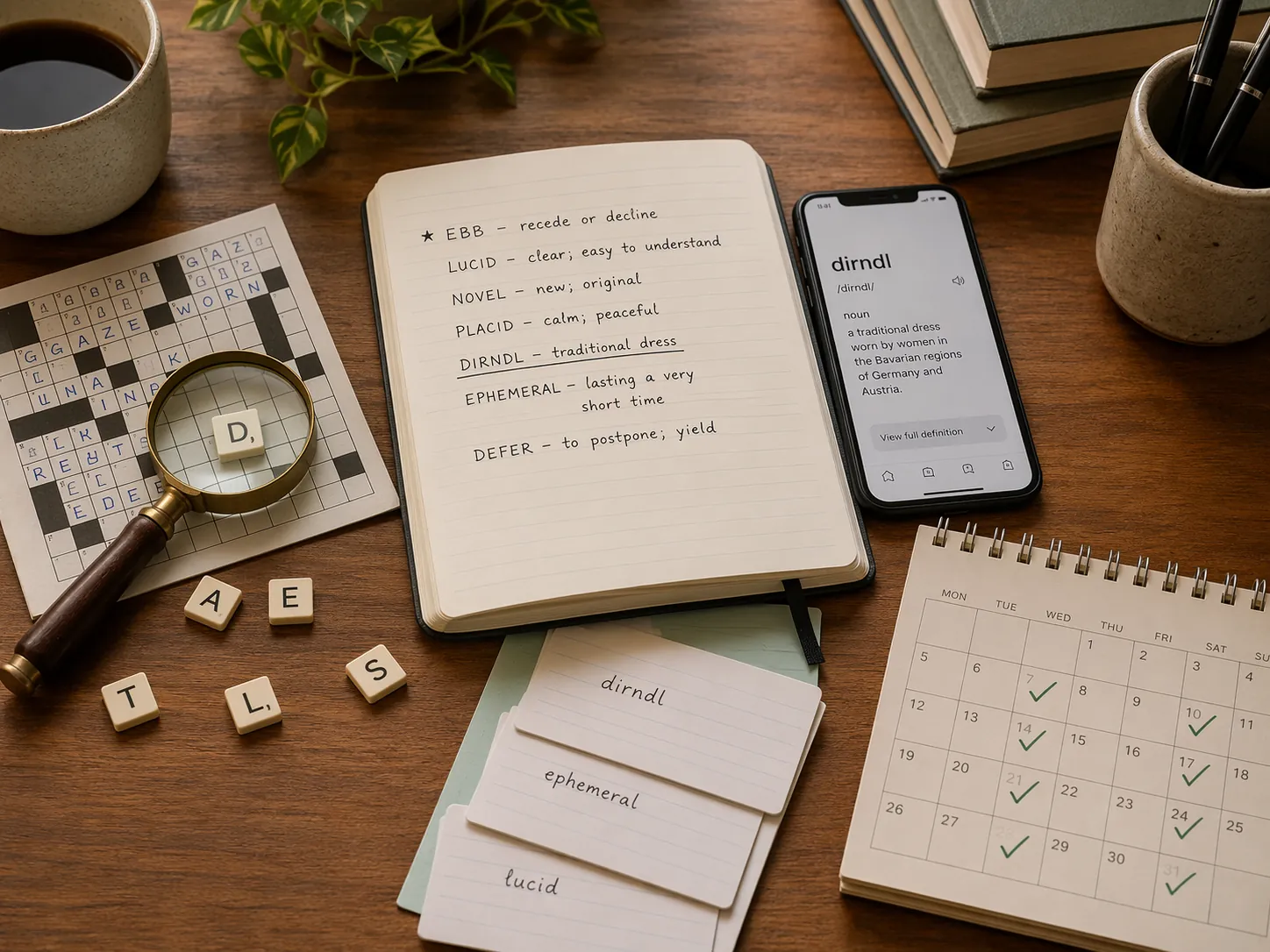
Use a plain three-step routine:
- Log every word you could not define cleanly before checking the answer.
- Write an accurate definition and enter the word into a spaced-repetition system.
- Create one academic or test-relevant sentence, not just a decorative sentence about clothing.
Notice the standard: “could not define cleanly.” If you saw PINAFORE and thought, “some kind of old-timey dress thing,” that counts as unknown for test purposes. On a timed verbal section, fuzzy recognition often feels like knowledge until an answer choice depends on the exact boundary of the word.
Step 1: Log the words while they are still annoying
Do not wait until the end of the day. The best moment to capture a word is when it is still bothering you. For “Frocks and smocks,” a useful log might include DIRNDL, MUUMUU, and PINAFORE, while leaving out GOWN if you already know it securely.
| Word | Quick log entry |
|---|---|
| DIRNDL | Alpine-style dress; log spelling and cultural context |
| MUUMUU | Loose Hawaiian dress; log pronunciation and double-u spelling |
| PINAFORE | Sleeveless apron-like garment worn over clothing; log exact garment relationship |
A word log does not need to be pretty. It needs to prevent the common puzzle-player failure mode: “I looked it up, I nodded, and tomorrow I will look it up again.”
Step 2: Put the word somewhere that will ask you again
A notebook list is fine for capture, but weak for retention unless you review it. Put the word into Anki or another spaced-repetition tool, or fold it into the review system you already use for GRE vocabulary. If you are still choosing a tool, a comparison like our guide to spaced repetition apps for GRE vocabulary is more relevant than trying to build a separate Strands-only ritual.
The cognitive-science argument for word games is not that every puzzle magically raises verbal scores. Wordela’s synthesis points to active recall, spaced repetition, and emotional engagement as mechanisms that can support vocabulary retention.[3] Life Beyond High School also discusses broader cognitive benefits associated with word puzzles for adult learners, drawing on Harvard and Scientific American research.[4] Those mechanisms help explain why a weird word found in a game can stick better than a sterile list item — if you actually bring it back for review.
Step 3: Write one sentence that could live near an exam passage
Do not write, “She wore a dirndl.” That sentence proves almost nothing. It lets the word sit in the easiest possible slot.
Write a sentence that forces the word to carry context, contrast, or implication. For example, as a hypothetical practice sentence: “The museum label treated the dirndl not as a quaint costume but as a garment shaped by regional identity, tourism, and class performance.”
That sentence is not claiming an official GRE passage used DIRNDL. It is doing something more useful: making you practice the kind of cultural-history context in which an unfamiliar concrete noun might appear. The SAT’s Words in Context questions and GRE reading passages often reward this exact tolerance for partial unfamiliarity. You do not need to know every noun cold if you can keep the sentence logic intact.
For MUUMUU, a better sentence might be: “The critic’s description of the muumuu shifted from fashion commentary to a discussion of how imported observers flatten local clothing traditions into stereotypes.” For PINAFORE: “The child’s pinafore, initially presented as a domestic detail, becomes evidence of the period’s assumptions about gender, labor, and respectability.”
Those are deliberately more academic than the puzzle. That is the point. Strands gives you the word; your study routine has to move it into the register where test makers operate.
What Strands helps with on GRE and SAT verbal
Strands is most useful for lexical range: the breadth of words you have at least met, sorted, and made less scary. It is also useful for interpretive flexibility. In “Frocks and smocks,” you can solve some answers by seeing the clothing category before you know every term precisely. That is not so different from keeping your footing in a dense reading passage when one noun is unfamiliar but the paragraph structure is clear.
The spangram YOUWEARITWELL is a smaller but nice example. It is not a single dictionary word you need to memorize. It is an idiomatic phrase, and idiomatic fluency matters because GRE Sentence Equivalence and Text Completion often test how words behave in context, not merely whether you can recite definitions.
For SAT students, the value is a little different. The modern SAT is not asking you to parade obscure garment names. It is more likely to test whether you can infer a word’s function in context, track tone, and choose a precise meaning. A daily puzzle can strengthen the habit of using category clues, neighboring words, and phrase logic. If you want the same idea applied to another NYT game, our guide to turning NYT Connections into SAT vocabulary practice follows a similar exam-first approach.
For GRE students, Strands can be a pleasant supplement to Text Completion and Sentence Equivalence practice. It makes you retrieve, classify, and revise guesses. Those are useful behaviors. They are just not the same as mastering high-frequency GRE vocabulary.
Where the game stops being enough
PrepScholar’s evaluation of GRE vocabulary games is the necessary cold water here: most vocab games lack high-frequency GRE word focus, do not teach tertiary meanings of common words, skip example sentences, and do not simulate the multiple-choice format of the exam.[5] That critique lands hard because it names exactly what Strands does not promise to do.
A theme like “Frocks and smocks” is charming, but GRE vocabulary study cannot be built around charm. You still need a dedicated system for the 900+ essential high-frequency GRE words. You need to know that “qualify” can mean limit or modify, not just become eligible. You need to recognize how “equivocal,” “qualified,” “plastic,” or “sanction” can shift under academic pressure. A garment-themed Strands grid is not designed to teach that.
This is the main mistake I see students make with puzzle-based studying: they count time spent near words as time spent learning words. Those are different activities. Exposure is valuable because it gives you candidates for study. It becomes score-relevant only when you define, retrieve, compare, and apply the words later.
So use Strands for what it is good at. Let it surprise you. Let it embarrass you a little without penalty. Let DIRNDL or MUUMUU be the word you would never have chosen from a GRE deck but now cannot quite stop seeing. Then put the word into the same machinery that handles your serious test vocabulary. If you need that machinery, start with a full GRE vocabulary flashcard system rather than letting the daily puzzle become your entire plan.
A practical way to fit Strands into a GRE vocabulary plan
Here is the cleanest version for a deadline-driven student:
- Spend up to 10 minutes solving Strands.
- Circle or screenshot every word you could not define before seeing the answer.
- Spend 5 minutes adding only the useful unknowns to your spaced-repetition deck.
- Write one context-rich sentence for each added word.
- Return immediately to your high-frequency GRE list, reading practice, or official-style verbal questions.
If you are six weeks from a GRE and aiming for a 160+ Verbal score, Strands should not displace your core work. It can sit at the edge of the day: coffee, puzzle, word capture, then real review. If you are building a broader plan, connect the habit to a structured schedule such as our step-by-step GRE study plan with free tools.
For a lower-stakes vocabulary habit, a general NYT Strands vocabulary builder can be enough. For test prep, the bar is higher. A word has to become retrievable under time pressure, in a sentence whose logic is doing more than naming an object.
The verdict: Strands is a useful daily input because it catches words you would not have chosen yourself. The “Frocks and smocks” answers prove the appeal beautifully. But the score-relevant work begins only after the puzzle is over, when DIRNDL stops being an odd little grid victory and becomes a word you can define, retrieve, and use.
References
- Today’s NYT Strands Hints, Spangram, Answers, Saturday, July 25: Frocks And Smocks, Forbes, July 24, 2026.
- How to Build the Vocabulary Needed for Strands, GameStrands.
- Word Games Aren’t Just for Fun: The Science Behind Vocabulary Play, Wordela.
- Word Puzzle Benefits for Adult Learners, Life Beyond High School.
- Best GRE Vocabulary Games: Improve Your Vocab While Having Fun, PrepScholar.
Related exhibits & inventory
Verified outcomes
Planners
No planner filed for this exam yet
A downloadable timeline template for this exam hasn't been published yet.
Tool verdicts
AI-tool cautions
No AI tools tested for this exam yet
No hands-on AI-accuracy logs have been filed for this exam.
Questions about this plan
Ask a question about a specific section, timeline, or citation in this plan — or flag something that needs correcting.
Comments
Join the discussion with an anonymous comment.