
GRE,SAT,ACT Exam Hub
Does NYT Strands beat flashcards for vocab practice?
Wondering whether NYT Strands deserves any of your GRE, SAT, or ACT vocab minutes? This evidence-labeled comparison weighs it against spaced-repetition flashcards and context-based vocabulary tools to show where it honestly fits.
- gre
- mcat
- asvab
- sat
- act
- digital-adaptive
- official-material
- section-strategy
- test-date-timeline
Verdict: the NYT Strands puzzle for vocabulary practice earns, at most, a warm-up slot. It should not replace spaced-repetition flashcards or context-based vocabulary work if you are studying for the GRE, SAT, or ACT.
Evidence label: Limited/synthesis. No published study in the materials reviewed here directly measures whether playing Strands improves vocabulary acquisition or standardized-test verbal scores. The judgment below comes from comparing Strands’ mechanics with better-supported study mechanisms: tested-word coverage, retrieval difficulty, and spacing.
Last reviewed: August 5, 2026.
The fairest version of the question is not whether Strands is good or bad. It is whether a Strands minute deserves to come out of the same small daily block as deliberate vocabulary study. For a test-taker with one vocabulary session a day, that is a stricter standard than “I saw words today.”
A serious vocabulary tool has to pass three checks. First, it should cover words that resemble the words you are likely to be tested on. Magoosh’s guidance for GRE word lists is useful here because it asks whether a list reflects the current test, gives definitions that work in context, and is actively maintained; it also treats roughly 1,000 high-frequency GRE words as the relevant target range, not a random pile of interesting English words [1]. Second, the tool should force meaning-based retrieval: you should have to produce or recognize what a word means, not merely spot its shape. Third, it should bring words back over time, because retrieval and spacing are central to durable retention [2].
What Strands actually asks you to do
Strands is a 6-by-8 word grid built around a daily theme. Players find theme words and a spangram that spans the board; hints are earned after finding non-theme words, and the NYT Help Center notes that Strands stats have been tracked since July 8, 2025 [3]. A typical puzzle has about six theme words plus one spangram, though that count is not guaranteed [4].
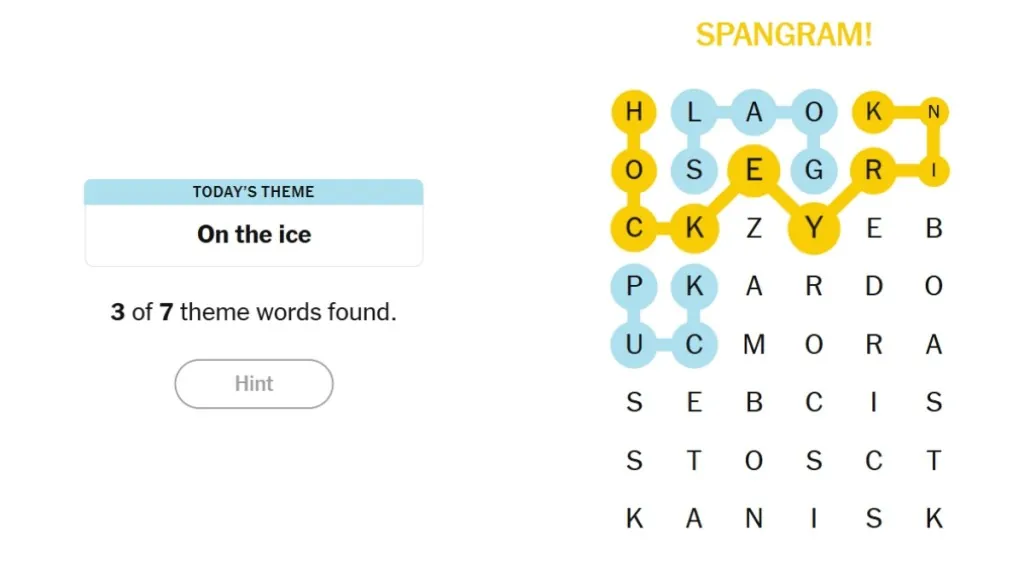
Those mechanics matter because they define the cognitive work. Strands asks you to search a grid, infer a theme, connect adjacent letters, and sometimes exploit the spangram once it gives away the puzzle’s organizing idea. That can be satisfying. It can also be verbally nimble. But the default game does not ask for a definition, does not require a context sentence, and does not schedule the same word for review later.
If the theme is obvious, a word can be found because it fits the category and appears in the grid. If the theme is not obvious, a word can still be found as a letter path before its meaning has been examined. Neither route is the same as seeing “equivocal” in a sentence and deciding whether it means ambiguous, evasive, equal, or favorable.
For a Strands-specific evidence path, the site’s earlier verdict on whether NYT Strands counts as vocabulary practice and the corpus check of 600+ Strands puzzles are the better continuation points. The short version for this comparison is simple: Strands can expose you to words, but exposure is the weakest version of vocabulary practice.
The comparison that decides the study slot
| Tool | Coverage of tested words | Retrieval difficulty | Spacing | Honest role in a vocab routine |
|---|---|---|---|---|
| NYT Strands | Low for GRE/SAT/ACT prep. Words are selected to serve a daily puzzle theme, not a maintained test-word list. | Mostly letter-path, theme, and pattern recognition. Meaning may help, but the game usually does not require it. | Low. The daily puzzle does not intentionally bring back target words on a review schedule. | Optional warm-up. |
| Spaced-repetition flashcards | High if the deck is built from a test-relevant list, such as a maintained GRE list in the roughly 1,000 high-frequency-word range [1]. | High when cards require active recall of the meaning and use of the word. | High when reviews are scheduled across intervals, matching the spacing principle [2]. | Main vocabulary engine. |
| Context-based tools such as Vocabulary.com | Moderate to high when attached to a test-specific list. Magoosh notes that Vocabulary.com’s GRE material uses example sentences from publications such as The New York Times, Forbes, and Scientific American [1]. | Moderate to high. The learner has to connect the word to meaning in sentence context. | Varies by tool and user behavior. | Transfer practice between flashcards and reading passages. |
This is where Strands loses the study-slot argument. It is not failing because it is playful. It is failing because the puzzle’s incentives point away from the work a test-taker needs most.
Coverage: a theme is not a test list
A good exam vocabulary system starts by deciding which words deserve your attention. That is dull in exactly the way test prep often needs to be dull. If you are studying for the GRE, a word list should be tied to the current exam, explain definitions in usable context, and be maintained rather than inherited from someone’s old spreadsheet [1]. For SAT and ACT students, the same principle applies even if the exact word list is different: the words should be chosen because they support the reading and verbal tasks you will actually face.
Strands does not begin there. It begins with a theme. The theme can be clever, seasonal, cultural, punny, narrow, or broad. That is good puzzle design, but it is a poor filter for exam vocabulary. A puzzle about music, weather, snacks, or idioms may contain words worth knowing; it may also spend the day on words you already know or words that are useful only because they complete the board.
Flashcards are only as good as the deck, but at least a serious deck can be audited. You can ask where the list came from, when it was updated, whether the definitions are usable, and whether the examples teach the word’s actual range. That audit is impossible with Strands because the game is not trying to be a test-word curriculum.
Retrieval: spotting a word is easier than knowing it
The cleanest test of vocabulary knowledge is not “Have I seen this word?” It is closer to “Can I recover the meaning when the word appears in an unfamiliar sentence?” Flashcards can create that moment if they are used honestly: word on one side, definition or context recall on the other, no flipping early, no counting a vague feeling as mastery.
Target Test Prep’s GRE vocabulary guidance treats flashcards as the primary tool and emphasizes daily consistency rather than cramming [5]. That advice matches the uncomfortable reality of verbal prep: vocabulary grows through repeated acts of recall, not through one impressive afternoon of looking at words.
Strands makes retrieval softer. You may retrieve a word from a theme clue. You may also notice a promising cluster of letters and then work backward into the theme. Once a spangram is found, it can narrow the remaining answers enough that the task becomes category completion. None of that is meaningless, but it is rarely the same as being forced to distinguish “prosaic” from “prolific” or “placid” from “pliant” under reading pressure.
Context-based practice fixes a different weakness. A flashcard can tell you that a word means something; a sentence makes you prove you can use that meaning when syntax, tone, and nearby words compete for attention. That is why Vocabulary.com-style practice is a useful bridge. Magoosh’s note that Vocabulary.com’s GRE examples draw from real publications matters because real sentences resist the tidy, one-word gloss that can make a flashcard feel finished too early [1].
Spacing: the calendar does more work than the vibe
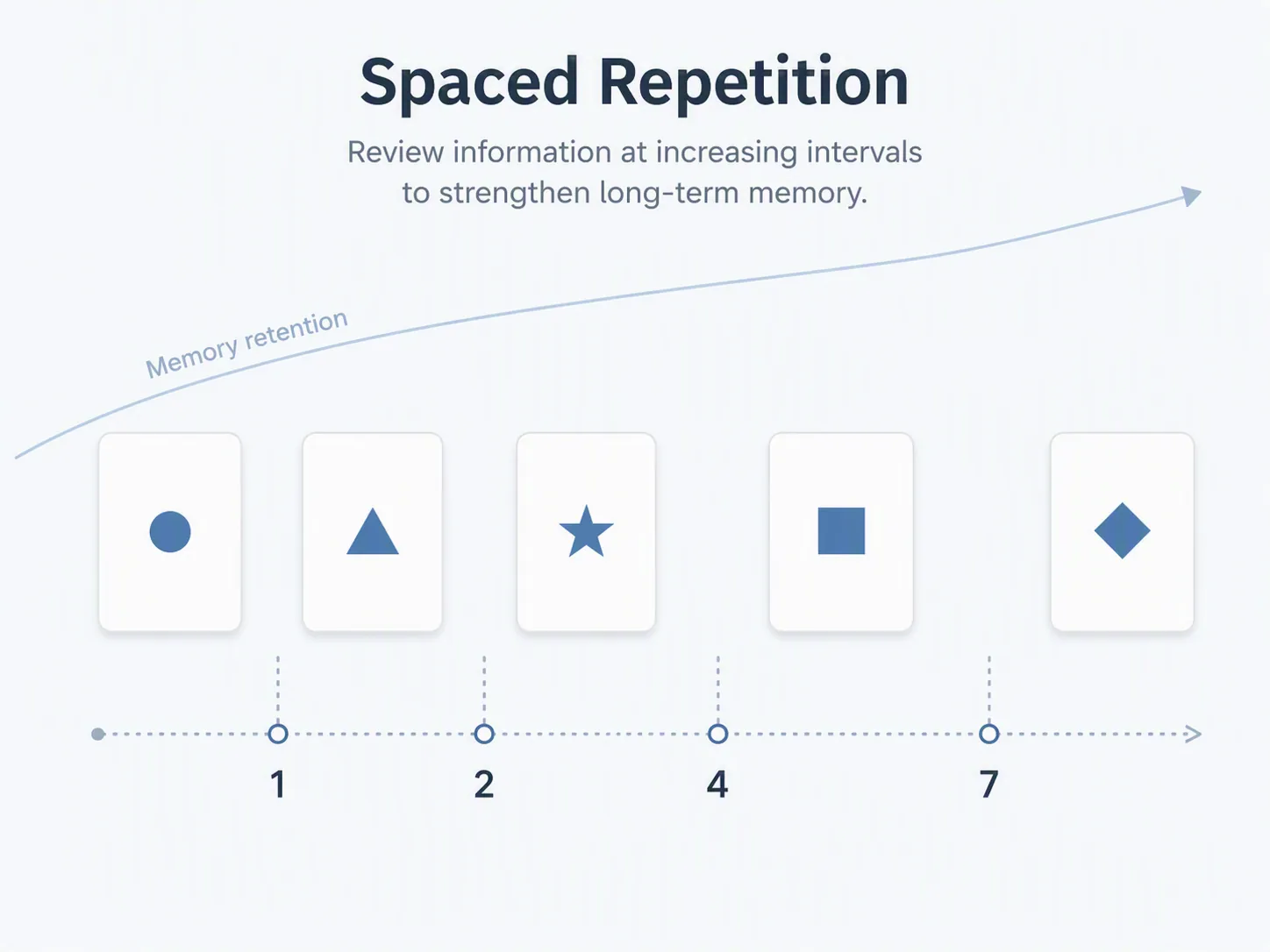
RetrievalPractice.org’s summary of spacing and retrieval is directly relevant here: practice is more durable when learners retrieve information and space that retrieval over time [2]. A decent flashcard system can make that mechanical. Missed words come back sooner. Known words return later. The student does not have to decide, while tired, which forgotten word deserves another look.
Strands has a daily rhythm, but daily use is not the same as spaced repetition. The puzzle changes; the theme changes; the target words are not intentionally reintroduced because you personally missed them. A streak can prove that you opened the game. It does not prove that the right words returned at the right intervals.
That distinction is easy to blur because Strands feels active. The board changes under your hand. Words appear. Hints unlock. A solved grid looks like progress. Ian Bogost’s critique of Strands in The Atlantic is useful on this narrow point: the game can manufacture a feeling of progress without making word meaning the thing being tested [6]. For exam prep, that feeling is not enough evidence.
Where each tool belongs
If the daily vocabulary block is fixed, the allocation should be boringly practical.
- Use spaced-repetition flashcards for the core list. This is where tested-word coverage, active recall, and review intervals can all be controlled.
- Use context-based practice after or alongside flashcards. This is where definitions become usable in sentences instead of remaining isolated labels.
- Use Strands before studying, not instead of studying. Treat it like a verbal warm-up, especially if it helps you sit down and begin.
That last concession matters. Motivation is not fake. A student who plays one puzzle and then does flashcards is in a better position than a student who avoids verbal study altogether because the whole routine feels punitive. The problem starts when the warm-up quietly eats the workout.
If you want to salvage Strands as an actual drill, the game needs extra rules layered on top. For example, after revealing a hint or a theme word, pause and define the word without looking it up, write a sentence, or add any unfamiliar word to a real deck. The site has separate pieces on whether Strands hints can count as vocabulary study and how to turn Strands hints into a vocabulary-building drill. The added drill is doing the study work there, not the default puzzle alone.
What the evidence does not prove
There is classroom research showing that structured word-game activity can improve vocabulary outcomes in a specific educational setting. One ERIC-indexed grade-8 EFL classroom study reported posttest gains after word-game use [7]. That is worth noting as a boundary, not as proof that Strands raises GRE, SAT, or ACT verbal scores.
The transfer problem is large. A structured classroom intervention is not the same as an adult or teen test-taker playing a daily NYT puzzle alone. EFL vocabulary growth is not the same target as standardized-test verbal performance. A word game designed for instruction is not the same object as Strands, which is designed as a daily puzzle.
So the honest claim is narrower: Strands may support engagement, light word noticing, and a pleasant start to a study session. The available materials do not justify counting it as a substitute for a maintained exam list, active recall, or spaced review.
The standard for any vocabulary tool
Before giving any app, puzzle, or game a real vocabulary slot, ask three questions: does it target words that matter for the exam, does it force you to retrieve meaning, and does it bring words back over spaced intervals?
Strands is enjoyable language play. It can stay, if it stays small. But for GRE, SAT, or ACT vocabulary practice, flashcards carry the main load, context tools help transfer meanings into reading, and Strands belongs before the serious work begins.
References
- Best and Worst GRE Word Lists, Magoosh, https://magoosh.com/gre/best-and-worst-gre-word-lists/
- Optimal Spacing, RetrievalPractice.org, https://www.retrievalpractice.org/strategies/optimal-spacing
- Strands, New York Times Games Help Center, https://help.nytimes.com/360011158491-New-York-Times-Games/28214352967700-Strands
- How to Play Strands, wikiHow, https://www.wikihow.com/Play-Strands
- How to Learn Vocabulary for GRE, Target Test Prep GRE Blog, https://gre.blog.targettestprep.com/how-to-learn-vocabulary-for-gre/
- The New York Times’ New Word Game Is Genius, The Atlantic, https://www.theatlantic.com/technology/archive/2024/03/strands-word-search-game/677656/
- The Effectiveness of Word Games in Teaching Vocabulary to Grade 8 EFL Students, ERIC, https://eric.ed.gov/?id=ED636308
Related exhibits & inventory
Verified outcomes
No verified outcomes on file for this exam yet
See Methodology for how outcome evidence is disclosed once logged.
Planners
No planner filed for this exam yet
A downloadable timeline template for this exam hasn't been published yet.
Tool verdicts
AI-tool cautions
No AI tools tested for this exam yet
No hands-on AI-accuracy logs have been filed for this exam.
Questions about this plan
Ask a question about a specific section, timeline, or citation in this plan — or flag something that needs correcting.
Comments
Join the discussion with an anonymous comment.