
ASVAB Exam Hub
Does NYT Strands count as vocabulary practice?
Daily NYT Strands play can sharpen the inference and semantic-flexibility skills behind SAT Words-in-Context, GRE Text Completion, and ASVAB Word Knowledge — enough to earn a spot as a short warm-up, but not as a vocabulary curriculum. Get an evidence-labeled per-exam verdict and a protocol for fitting Strands into a real study block.
- gre
- mcat
- asvab
- sat
- act
- digital-adaptive
- official-material
- section-strategy
- test-date-timeline
Last reviewed: August 3, 2026.
No spoilers: this article does not publish today’s Strands answers, spangram, or live puzzle hints.
Evidence-labeled verdict: yes, NYT Strands can count as vocabulary-adjacent warm-up practice. No, it should not count as a vocabulary curriculum. If you came here looking for NYT Strands hints for vocabulary practice, the useful answer is not “play more games.” It is: use the game to start the verbal part of your study block, then make it hand the session over to targeted exam work.

The per-exam verdict
| Exam | Verdict on Strands | Why the match is or is not there | How to use it |
|---|---|---|---|
| ASVAB Word Knowledge | Strongest fit, still only a warm-up | The section asks for direct word knowledge under time pressure: Kaplan describes 15 Word Knowledge questions in 9 minutes on the CAT-ASVAB, while Mometrix describes 35 questions in 11 minutes on the paper version [1][2]. Strands’ quick synonym-adjacent grouping and theme recognition sit closer to this task than they do for the other exams here. | Play briefly, then switch to synonym drills and missed-word review. |
| SAT Reading and Writing | Partial fit | The match is strongest for Words in Context and precision-of-meaning work. Princeton Review reports up to 8 SAT vocabulary precision questions, but prep publishers count the category differently, so do not turn any one prep-site number into an official total [3]. | Use Strands to wake up semantic flexibility, then do SAT-style context questions. |
| ACT English and Reading | Partial fit | ACT vocabulary is usually embedded in sentence and passage meaning rather than isolated flashcard recall. Strands can help with flexible association, but it does not train pacing through full passages. | Follow the puzzle with ACT passage practice, not a second puzzle. |
| GRE Verbal | Partial fit, with a sharper ceiling | GRE Text Completion and Sentence Equivalence reward precision, contrast, and semantic fit. Magoosh notes that the shortened GRE introduced in September 2023 has 27 scored verbal questions, which makes missed verbal skill gaps expensive [4]. Strands can prime the kind of flexible word search GRE verbal needs, but its word pool is far too common to replace GRE vocabulary review. | Play, then move into GRE word lists, Text Completion, or Sentence Equivalence. |
| MCAT CARS | Minimal fit | CARS is mainly a passage-reasoning task. Strands may help you settle into reading mode, but vocabulary acquisition is not the bottleneck for most CARS prep. | If you play it at all, keep it as a transition ritual before passage work. |
That table is the answer I would want before a test date. The game is not useless. It is also not magic. It earns its place when it replaces avoidance, not when it replaces the work your exam actually scores.
For routing: use the SAT hub, ACT hub, GRE hub, or ASVAB hub after the warm-up. That is where the score-moving practice belongs.
What Strands actually trains
Strands gives you a daily 6-by-8 board, so 48 letters, and asks you to find theme words plus the spangram. The game launched in beta on March 4, 2024, and its scale is not in doubt: Wikipedia relays that Strands was played 1.3 billion times in 2024, with that figure traced to an NYT spokesperson via The Verge [5][6]. That number matters for one narrow reason. A daily puzzle people actually open can be a useful ignition switch for tired students.
Stickiness is not the same as effectiveness. A game can be beloved and still fail as a curriculum. The question is whether the mental action in Strands resembles the mental action on the exam.
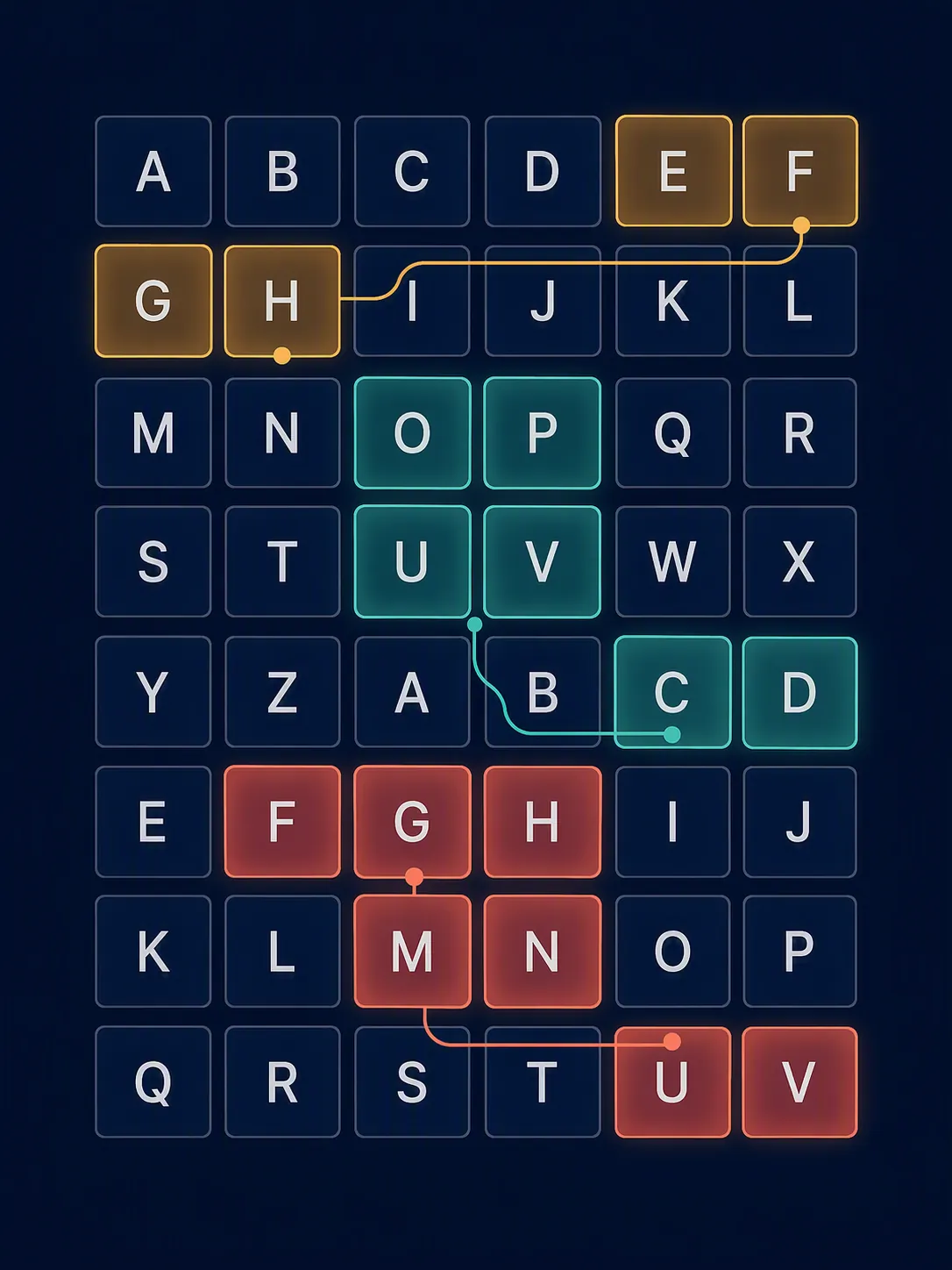
The useful actions are real. You infer a theme from partial evidence. You group words by shared meaning. You revise your first guess when a word technically fits the board but not the day’s category. You recognize a familiar word under constraint rather than in a neat flashcard row. For SAT and ACT context questions, that resembles the habit of asking, “Which meaning of this ordinary word fits here?” For GRE Text Completion and Sentence Equivalence, it resembles the search for semantic fit across clues, contrasts, and tone. For ASVAB Word Knowledge, the overlap is simpler: fast recognition of word meaning matters.
The ceiling appears as soon as you look at the word pool. WordsRated’s analysis of 3,070 unique theme words used through December 2025 found that 86% were 4 to 8 letters long. Its most repeated theme words were everyday terms: MUSIC appeared in 7 puzzles, while QUEEN, WATER, CHEESE, HEART, and BACON appeared in 6 each [7]. WordsRated’s rules guide also frames the game around finding connected theme words on the board, not mastering a sequenced academic vocabulary list [8].
That is the pencil-sharpening moment. Common words are not a flaw in the game; they are part of why it is playable over breakfast. But common words are a weak engine for GRE vocabulary acquisition, SAT precision work beyond the obvious, or systematic ASVAB synonym coverage. A solver-site blog, The Word Finder, says constructors avoid obscure vocabulary, but that should be treated as secondary solver commentary rather than an official NYT design statement [9]. The broader point does not need the stronger claim: the observed word pool is already enough to keep Strands in the warm-up lane.
What the learning evidence can and cannot prove
The best case for keeping Strands is motivational. A student who avoids verbal prep for three days but will open a puzzle today has given the study block a door handle. That is not trivial. Avoidance is expensive.
The retention evidence is less generous. Pinnock’s 2019 National Louis University dissertation studied 29 sixth graders and found that games and word play had a positive impact on motivation and vocabulary knowledge, but not on word learning and retention over time [10]. That split is almost exactly the distinction test-takers need: a game may make you more willing to work with words and may improve some immediate knowledge, while still failing to create durable command of the words you need later.
A 2025 Australian Journal of Applied Linguistics meta-analysis of 47 works reported positive findings for gamified second-language vocabulary learning [11]. Useful, yes. Transferable without limits, no. Second-language classroom vocabulary learning is not the same thing as a native-speaking GRE student trying to distinguish “equivocal,” “equable,” and “equanimous” under exam pressure, or an SAT student deciding how a common word shifts meaning inside a dense sentence.
So the evidence supports a modest claim: word games can support engagement and some vocabulary learning conditions. It does not support logging a Strands streak as proof that your exam vocabulary is handled.
How to use Strands without letting it steal the study block
Put Strands at the beginning, not the center. The cleanest version is a short warm-up, then a hard handoff to exam-specific work. The handoff matters more than the streak.
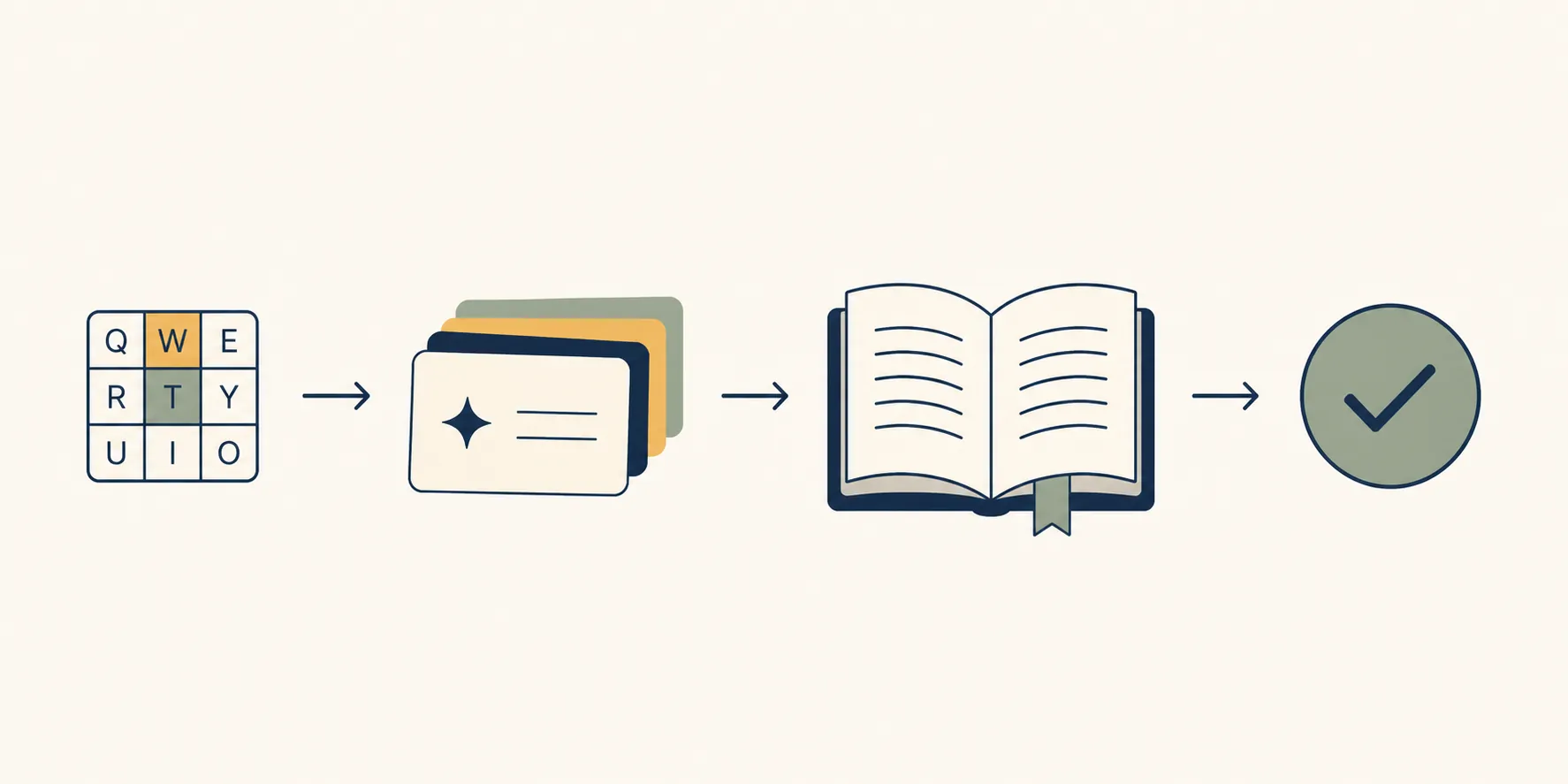
| Part of the block | What to do | What it prevents |
|---|---|---|
| Opening | Play one Strands puzzle, or stop after a short timed attempt if the puzzle is dragging. | Turning a warm-up into the session. |
| Bridge | Write down one or two useful observations: a theme shift, a misleading association, or a word whose exact meaning you were fuzzy on. | Pretending the puzzle taught more than it did. |
| Targeted vocabulary | Review your actual list: SAT/ACT context words, GRE high-yield words, or ASVAB synonym sets. | Replacing spaced review with recognition-only play. |
| Exam-format practice | Do official-style verbal questions immediately after the list review. | Knowing a word loosely but failing the scored task. |
| Missed-item review | Add missed words or traps to your review system before you leave. | Letting the same vocabulary gap reappear next week. |
If the problem is consistency, pair this with a routine that still works on bad days. The site’s guide to a study routine that survives bad mental health days is a better home for that architecture than another puzzle tab. If the problem is that you keep rereading lists and calling it study, use the guide to finding your study style without a personality quiz and pay special attention to practice testing and distributed practice.
Where hints fit
Hints are not automatically cheating, and they are not automatically learning. WordsRated reports that 18.3% of Strands players use hints, with an average of 2.46 hints per puzzle, based on its third-party analysis through December 2025 [7]. Treat those numbers as descriptive, not as a prescription.
For vocabulary practice, a hint is useful only if it keeps the warm-up from becoming a stall. If one hint helps you see the theme and move on to your real study block, fine. If you spend the next ten minutes chasing a perfect solve, you have turned the tool upside down. The exam does not care that you protected a streak.
Exam-specific playbook
ASVAB
ASVAB test-takers get the most defensible use case. Strands asks you to recognize meaningful words quickly and sort them by association; Word Knowledge asks you to recognize what words mean. The overlap is not perfect, but it is close enough to make Strands a reasonable first activity before synonym drills.
The handoff should be blunt: puzzle, then ASVAB Word Knowledge practice. If you miss a synonym, add it to review. If you recognize the word only because the answer choices helped you, add it anyway. Route the rest of the session through the ASVAB hub.
SAT and ACT
For SAT and ACT students, Strands is best treated as semantic-flexibility practice. It can make you more alert to category, connotation, and alternate meanings. That is useful before Words-in-Context or passage questions, especially when the tested word is ordinary but the sentence demands precision.
It does not replace passage work. After the puzzle, do a small set of Reading and Writing or English questions and force yourself to justify the correct answer from context. If you cannot explain why the wrong answer is too broad, too narrow, too positive, too negative, or aimed at the wrong part of the sentence, the puzzle did not finish the job. Continue through the SAT hub or ACT hub depending on your test.
GRE
GRE students should be the most suspicious of overclaiming. Strands can warm up the search for fit: theme, contrast, tone, and plausible alternatives. That is adjacent to Text Completion and Sentence Equivalence. The trouble is the word pool. GRE verbal often punishes shallow familiarity with higher-register vocabulary, and Strands is built around playable daily discovery, not a sequenced GRE lexicon.
Use the puzzle as a ramp. Then do spaced word review, then GRE verbal questions. If you only have enough energy for one of those after the puzzle, choose the GRE work and close the game. Your next step belongs in the GRE hub.
MCAT CARS
For MCAT CARS, Strands is mostly a settling ritual. It may help you start reading instead of avoiding the desk. It does not train the central CARS demand: sustained reasoning through unfamiliar passages, author attitude, structure, and inference. If CARS is the priority, a short puzzle before passage work is harmless only while it stays short.
What to log, and what not to log
Log Strands as warm-up or verbal activation. Do not log it as vocabulary review unless you actually extracted words, checked meanings, and reviewed them later. Recognition during a themed puzzle is easier than recall on a test, and both are easier than choosing the best answer under time pressure.
- Reasonable log: “Strands warm-up, then 20 ASVAB synonym questions.”
- Reasonable log: “Strands warm-up, then SAT Words-in-Context practice and missed-item review.”
- Reasonable log: “Strands warm-up, then GRE TC/SE set and spaced vocabulary review.”
- Bad log: “Vocabulary studied — did Strands.”
The useful rule is simple enough to survive a tired night: Strands may open the verbal block. It does not get to be the block. Choose your exam, use the matching verdict above, and plug the puzzle into the beginning of real practice rather than treating the streak as evidence that preparation happened.
References
- What's on the ASVAB Word Knowledge? — Kaplan.
- ASVAB Word Knowledge Practice Test — Mometrix.
- SAT Vocabulary — Princeton Review.
- Best and Worst GRE Word Lists — Magoosh.
- The New York Times Strands — Wikipedia.
- The New York Times Games — Wikipedia.
- NYT Strands Statistics — WordsRated.
- Strands NYT Game Rules and How to Play — WordsRated.
- NYT Strands Solver Guide — The Word Finder.
- A Study of the Use of Games and Word Play to Improve Students' Motivation and Retention of Vocabulary Words — National Louis University Digital Commons, 2019.
- A meta-analysis of gamified vocabulary learning in second language classrooms — Australian Journal of Applied Linguistics, 2025.
Related exhibits & inventory
Verified outcomes
No verified outcomes on file for this exam yet
See Methodology for how outcome evidence is disclosed once logged.
Planners
No planner filed for this exam yet
A downloadable timeline template for this exam hasn't been published yet.
Tool verdicts
AI-tool cautions
No AI tools tested for this exam yet
No hands-on AI-accuracy logs have been filed for this exam.
Questions about this plan
Ask a question about a specific section, timeline, or citation in this plan — or flag something that needs correcting.
Comments
Join the discussion with an anonymous comment.