
What 5 Clinical Trials Actually Found About Nutrition and Test Scores
No controlled trial in the available evidence shows that a supplement, diet pattern, or micronutrient intervention raises GRE, MCAT, ASVAB, SAT, or ACT scores. That is the boundary worth setting before anyone buys a “focus” capsule or rebuilds breakfast for test week. The strongest studies in nutrition and cognition usually measure something else: older-adult cognitive aging, dementia risk, computerized attention tasks, memory batteries, or observational exam-score differences. Some of that evidence is useful. None of it is the same as proving a higher standardized-test score.
For a test-taker with a fixed date, the question is not whether food can affect the brain. Of course it can. The useful question is how close each piece of evidence gets to the actual problem: staying alert, steady, and accurate during a timed exam. Population, intervention, outcome, and exam relevance matter more than the ingredient list on the front of a bottle.
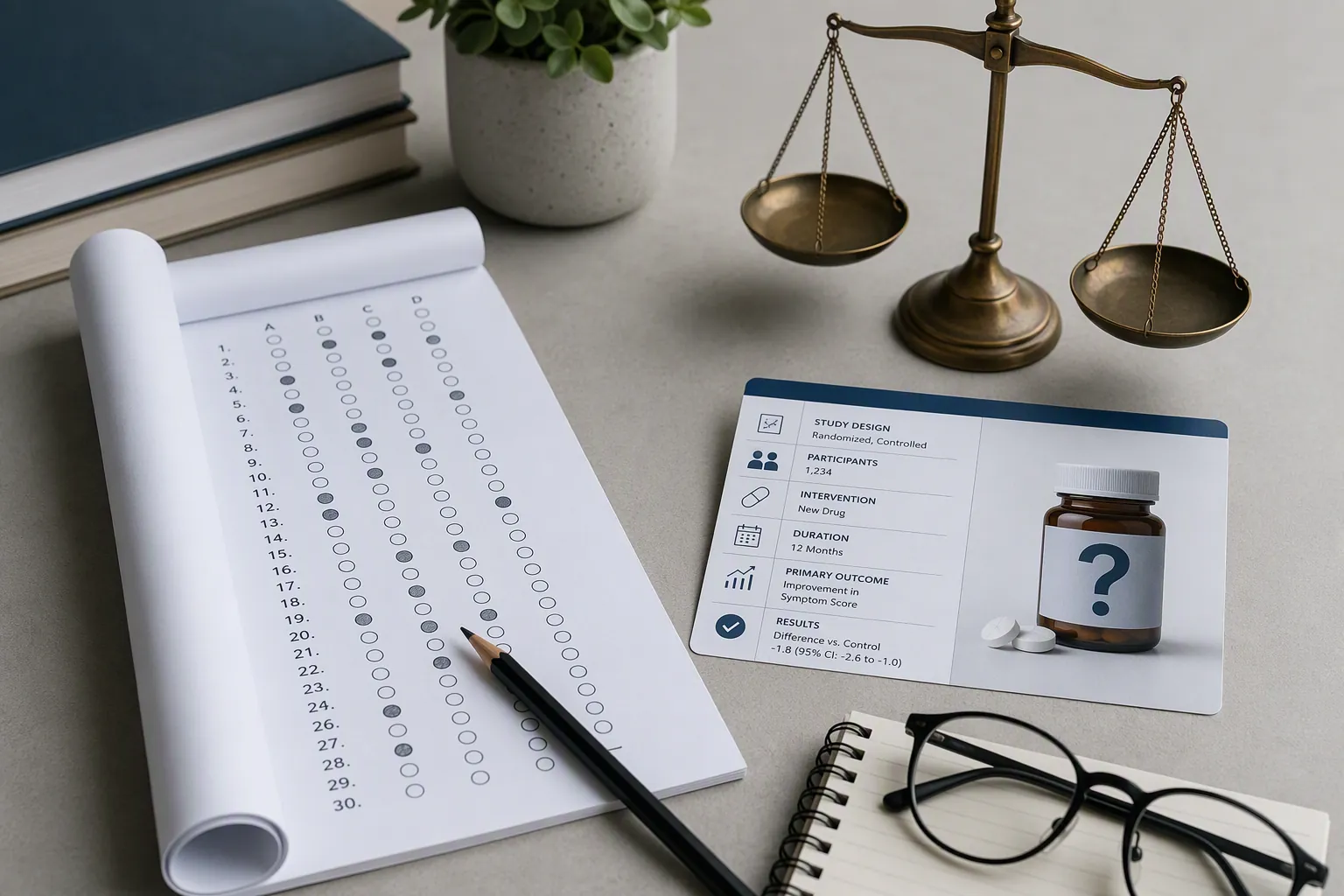
The Evidence Frame: What Each Study Actually Measured
| Evidence cluster | Population | What was measured | How close it gets to test-day scores |
|---|---|---|---|
| MIND diet randomized trial | Older adults | Cognitive change under a diet intervention | Useful warning against overreading observational diet patterns; not young-adult test performance |
| COSMOS multivitamin studies | Adults 60+ | Episodic memory and global cognition over several years | Large and serious, but age-specific and not an exam-score trial |
| IONSport young-adult nutrition study | Adults 18–33, n=98 | Visual cognitive performance on a 3D multi-object tracking task | Closest young-adult evidence here, but still a cognitive proxy, not an SAT, MCAT, GRE, ACT, or ASVAB score |
| Hydration and exam-score study | University students | Observed exam-score differences associated with water access | Closest to actual exam scores, but observational rather than randomized |
| Brain-health supplement trials and reviews | Mostly adults, often older adults; one branded RCT n=138 | Working-memory tasks, dementia outcomes, biomarkers, or broad supplement conclusions | Weak basis for healthy young test-takers buying branded cognition products |
That table is less exciting than a food list, but it is more honest. A statistically significant change on a visual tracking task is not automatically a better MCAT section score. A dementia-prevention trial is not a college entrance exam. A supplement-funded working-memory result over 42 days is not proof that a nervous test-taker should add a new pill before test day.
MIND Diet: A Good Example of Why Observational Promise Is Not Enough
The MIND diet is often discussed as if the case is settled: leafy greens, berries, nuts, olive oil, fish, and other familiar Mediterranean-style foods are associated with healthier cognitive aging. The harder test is whether assigning people to the diet in a randomized trial improves cognition more than a control condition.
In the Barnes et al. randomized trial published in 2023, the MIND diet did not produce a significant cognitive difference versus the control group in older adults. That does not mean the diet is bad. It means the randomized evidence did not confirm the stronger version of the claim: that this diet intervention, by itself, measurably improved cognition beyond control in that trial population.[1]
For test-takers, the lesson is methodological. A diet pattern can be sensible without being a proven score strategy. If a student already eats a stable, balanced version of a Mediterranean or MIND-style diet, there is no reason to panic. But turning the MIND diet into “eat these foods for a higher GRE score” skips over both the trial result and the age gap.
COSMOS: Strong Trial, Wrong Age Group for Test-Score Claims
The COSMOS multivitamin findings deserve more respect than most supplement advertising because they come from a large randomized research program rather than a tiny ingredient story. Across three COSMOS cognition substudies including more than 5,000 participants aged 60 and older, daily multivitamin use was associated with a slowing of cognitive aging estimated at about two years. In the three-year analysis, the episodic memory result was statistically significant, with p=0.011.[2]
That is meaningful for older adults. It is not a license to tell a 19-year-old SAT student or a 24-year-old MCAT student that a multivitamin will raise a score. COSMOS studied adults 60 and older. The endpoints were cognitive aging measures, not standardized-test outcomes. The plausible mechanism may involve correcting insufficiencies or supporting aging brains, but the trial does not answer whether healthy young adults with adequate diets perform better on exam day after starting a multivitamin.
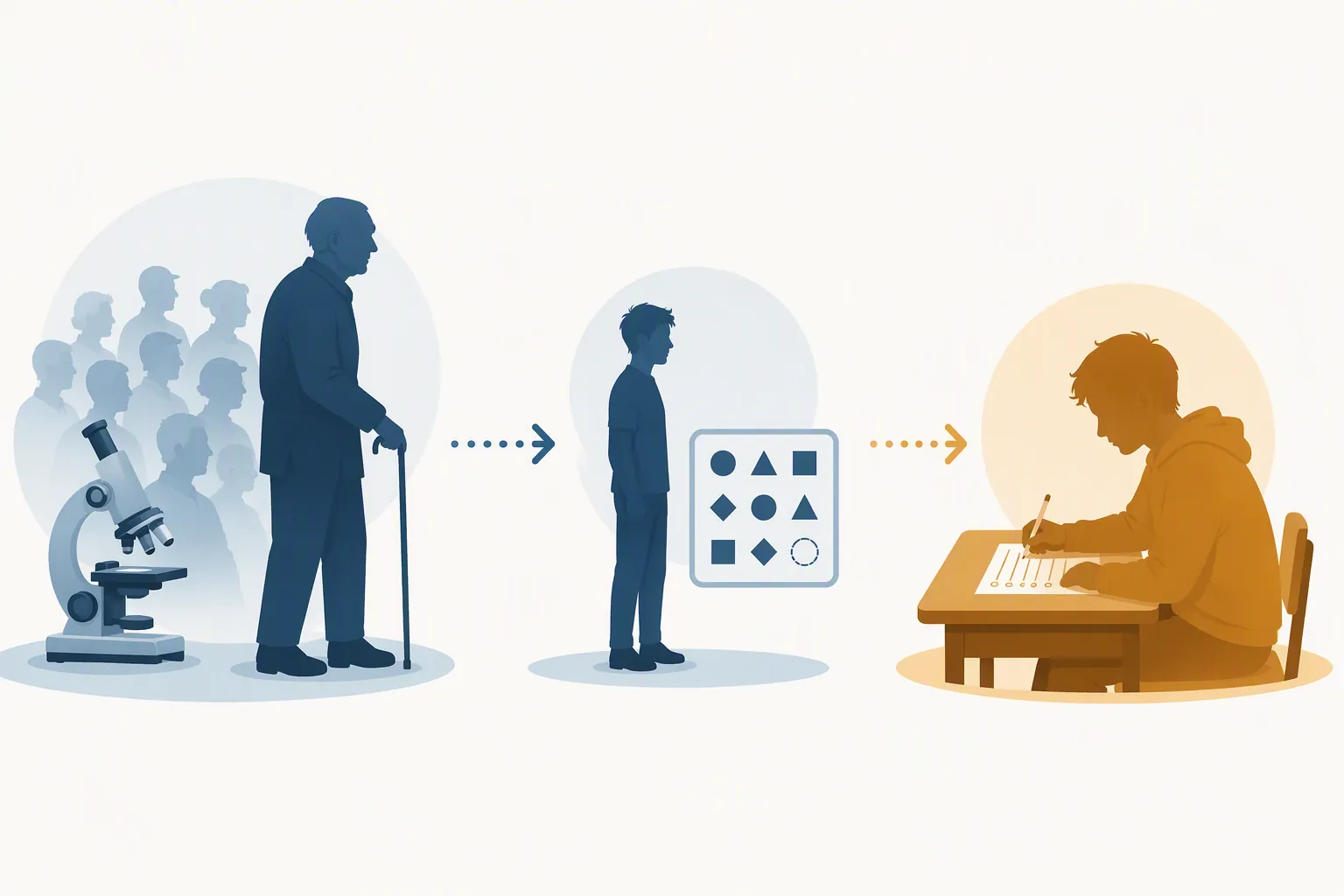
This is where many nutrition-for-cognition articles quietly change the subject. They begin with older-adult memory results, then end with advice for students taking a high-stakes exam. The inference gap is not a technicality. Age, baseline nutrient status, outcome type, and time horizon all change the practical meaning of a trial.
IONSport: The Most Relevant Young-Adult Evidence, Still Not a Score Trial
The IONSport study is the one a student should look at before the older-adult supplement trials, because the participants at least resemble many test-takers. The study included 98 young adults aged 18 to 33 and examined dietary intake in relation to visual cognitive performance, using a 3D multi-object tracking task rather than an academic exam.[3]
Its most useful finding is not a magic nutrient. It is the pattern. Better visual cognitive performance was associated with carbohydrate intake above 40% of energy and protein intake below 24% of energy. The study also identified micronutrient thresholds associated with performance: lutein/zeaxanthin above 2,000 micrograms per day was significant at p=0.004, and vitamin B2 above 1.8 mg per day was significant at p=0.017.[3]
This is closer to a test-taker’s world than a dementia-prevention study, but it still stops short of the headline most people want. The outcome was visual cognition, not a score report. A 3D tracking task may share some demands with test performance — attention, visual processing, working memory, sustained accuracy — but it does not reproduce passage reading, quantitative reasoning, science interpretation, or the fatigue curve of a long exam.
The practical value is therefore modest and real. A student does not need to interpret IONSport as a command to chase exact macro targets. It does support avoiding extremes. Very low-carbohydrate experimentation right before an exam is hard to justify if the goal is stable cognitive performance under timed conditions. So is treating protein as the only breakfast variable that matters. For most students, the safer inference is familiar balanced meals with enough carbohydrate to support attention and enough protein and fat to avoid a short-lived sugar spike.
The lutein/zeaxanthin and B2 findings are also easier to translate through food than through panic-buying. Leafy greens, eggs, dairy, fortified grains, and other ordinary foods can contribute to those intakes depending on the student’s diet. But this study does not prove that adding an isolated lutein capsule or B-vitamin pill will improve an ACT science score next month.
Hydration: Closest to Exam Scores, but Observational
Hydration has the most exam-adjacent result in the available set because it deals with actual student scores rather than only cognitive batteries. A university observational study reported that students with water access scored about 4.8% to 5% higher, with foundation-year students showing improvements up to 10%.[4]
That number gets attention because it sounds like the thing students actually care about. It also needs the label attached: observational. The study can show an association between water access and higher scores. It cannot prove that water caused the score increase. Students who bring water may differ in preparation, sleep, planning, anxiety, health, or exam habits. Any of those could contribute.
Even with that limitation, hydration is worth treating differently from branded supplement claims. It is low-cost, low-risk for most people, and directly relevant to test conditions. Dehydration can make discomfort, headache, dry mouth, and attention lapses more likely. Overhydration immediately before a long exam can create the opposite problem: bathroom urgency while the clock is running.
The sensible test-day move is boring: drink normally in the hours before the exam, know the testing center’s rules about water access, and practice the same pattern during full-length timed practice. A hydration strategy that has never been tested during a practice exam is not a strategy; it is a new variable.
Breakfast Evidence Points to Consistency and Composition, Not Miracle Foods
Breakfast is where nutrition advice often becomes theatrical: special berries, powders, “brain bowls,” nootropic coffee, fasting rituals. The evidence is more ordinary. A systematic review by Adolphus and colleagues found that breakfast consumption can benefit cognitive performance in children and adolescents, with attention, memory, and executive-function outcomes commonly discussed in the literature.[5]
That still does not prove that a specific breakfast raises SAT or ASVAB scores. Many breakfast studies use school-age samples, varied designs, and cognitive tasks rather than standardized entrance or placement exams. The cleanest test-day implication is not “eat this one food.” It is to avoid arriving underfueled, avoid unfamiliar foods, and avoid a breakfast that produces a sharp energy swing during the first timed section.
The IONSport macronutrient findings fit here. A familiar breakfast with carbohydrate plus some protein and fat is a more evidence-compatible choice than either a sugar-only breakfast or an abrupt low-carb experiment. The point is not to micromanage percentages on exam morning. It is to reduce the chance that hunger, GI discomfort, caffeine jitters, or a new diet rule becomes the thing competing with the passage in front of you.
- Use the same breakfast during full-length practice that you plan to use on test day.
- Include a familiar carbohydrate source rather than testing a very low-carb approach for the first time.
- Add enough protein or fat to make the meal last, but do not turn breakfast into a heavy digestion challenge.
- Treat caffeine as part of the routine only if you already know how it behaves under timed practice conditions.
Supplements: The Claims Are Much Stronger Than the Young-Adult Proof
Brain-health supplements are where the evidence-to-marketing distance becomes widest. Harvard Health put the broad conclusion plainly in February 2026: there is “no solid proof” that brain-health supplements work.[6] That statement is broad, but it fits the test-prep problem well. The issue is not whether an ingredient has a plausible mechanism in a dish, a cell, or an older-adult disease model. The issue is whether a healthy young person taking a branded product performs better on the task that matters.
The Neuriva randomized trial illustrates the problem. It enrolled 138 participants for 42 days and was manufacturer-funded by Reckitt. The trial reported a modest numeric working-memory improvement with p=0.024, but it did not show a change in BDNF or in the memory questionnaire outcome.[7]
That is not nothing. It is also not a basis for telling someone to buy a bottle for a higher MCAT score. The sample was small, the duration was short, the funding source matters, and the positive result was on a working-memory measure rather than an exam outcome. When the biomarker and memory questionnaire do not move, the marketing version should become quieter, not louder.
Ginkgo is another useful caution. The GEM study followed more than 3,000 adults for about six years and found that ginkgo biloba did not lower dementia rates.[8] Again, dementia prevention is not the same as test performance, but the direction of the caution is clear: long-standing supplement popularity does not guarantee clinically meaningful cognitive benefit.
Extreme Diet Experiments Are a Poor Test-Week Bet
The evidence against last-minute dietary extremism is stronger than the evidence for most fine-tuned optimization. Spencer et al. reported that a high-fat diet could impair hippocampal function within days, a finding often discussed in relation to memory systems.[9] A broader 2025 review of dietary interventions and cognition also reinforces the same general caution: nutrition effects depend on population, baseline health, intervention design, and outcome choice, not on isolated claims pulled from a single mechanism.[10]
For a test-taker, the practical conclusion is not that fat is bad or that one macronutrient should be feared. It is that test week is the wrong time to run a metabolic experiment. Abrupt fasting, ketogenic starts, supplement stacks, very high-fat meals, or new “brain fuel” routines can introduce sleep disruption, stomach issues, mood swings, headaches, or simple distraction. Those consequences matter even when the nutrition theory sounds sophisticated.
A Test-Day Hierarchy That Matches the Evidence
If the goal is better cognitive performance under exam conditions, the evidence supports a hierarchy rather than a shopping list. Put the most exam-adjacent, lowest-risk actions first. Put older-adult extrapolations and branded supplement claims much lower.
- Practice with the same breakfast and hydration pattern you will use on test day. This is the most practical way to prevent nutrition from becoming a new source of uncertainty.
- Favor a familiar balanced meal over extremes. The young-adult IONSport data points toward adequate carbohydrate and moderate protein, but it does not justify precise macro obsession.
- Plan water access and timing. Hydration is the closest evidence to actual exam scores, but the data are observational, so treat it as friction reduction rather than a guaranteed score increase.
- Use multivitamins for age, deficiency, or clinician-guided reasons, not as score tools. COSMOS is impressive in adults 60+, not proof for healthy young test-takers.
- Be skeptical of branded brain supplements. A small, sponsored working-memory result is not the same as demonstrated improvement on the GRE, MCAT, ASVAB, SAT, or ACT.
This hierarchy also helps decide what deserves attention during prep. A student studying for the MCAT has a long test-day stamina problem. A recruit preparing for the ASVAB needs steady performance across subtests. An SAT student working through a score-gap method should care more about removing avoidable test-day errors than about chasing a supplement effect that has never been shown in that exam.
The Practical Verdict
Nutrition can help a test-taker by removing friction: hunger, dehydration, energy crashes, GI discomfort, and last-minute routine changes. The best-supported moves are familiar breakfast composition, normal hydration timing, and avoiding extreme dietary experiments close to the exam. The evidence for these is not perfect, but it is closer to the conditions students actually face.
The evidence for supplements is weaker for this purpose. COSMOS gives a serious older-adult multivitamin signal. Neuriva gives a small sponsored short-term working-memory result with important null findings. Ginkgo’s large dementia-prevention trial did not show benefit. None of those results proves a higher score for a healthy young person taking a standardized exam.
For actual score outcomes, nutrition belongs below exam-specific prep, timed practice, sleep planning, and pacing strategy. It is still worth doing sensibly because a bad test-day routine can cost attention. But the promise should stay narrow: eat and drink in a way that lets your preparation show up. Then put most of your remaining bandwidth back into the exam plan that actually determines the score.
References
- Trial of the MIND Diet for Prevention of Cognitive Decline in Older Persons, New England Journal of Medicine, 2023.
- Daily multivitamin improves memory in older adults, study finds, Mass General Brigham, 2024.
- Dietary intake is associated with visual cognitive performance in young adults, Frontiers in Nutrition, 2023.
- How hydration impacts exam performance, Concordia Clinic, 2025.
- The effects of breakfast on behavior and academic performance in children and adolescents, Frontiers in Human Neuroscience, 2013.
- Can supplements help boost brain health?, Harvard Health Publishing, 2026.
- A randomized, double-blind, placebo-controlled study to evaluate the effects of a coffee cherry extract and phosphatidylserine supplement on cognitive performance in healthy adults, PubMed, 2023.
- Ginkgo biloba for prevention of dementia: a randomized controlled trial, JAMA, 2008.
- High-fat diet and hippocampal-dependent memory, Nature, 2017.
- Dietary interventions and cognitive outcomes: a comprehensive review, PMC, 2025.
Related case links
How to Read the '1 in 4 NFL Players CTE' Study
- 夏休みの読書感想文にゲーム原作はOK?選び方と書き方のコツ
- Summer Screen Time Isn't the Enemy of SAT Study Time
- Build a Chess Study Plan That Improves Your Rating
Compare each planner's length against this plan's —-week duration manually.
Did a similar plan work for you?
Share whether a comparable timeline and starting point produced a similar result — this is verification discussion, not general commentary.
Comments
Join the discussion with an anonymous comment.