
MCAT Exam Hub
Why Airplane Windows Are Round – Engineering Explained for Students
This engineering case study explains why airplane windows are round, tracing the physics of stress concentration and metal fatigue to the 1950s De Havilland Comet crashes. It connects these concepts directly to MCAT, ASVAB, SAT, and ACT exam topics for better test-day recall.
- gre
- mcat
- asvab
- sat
- act
- digital-adaptive
- official-material
- section-strategy
- test-date-timeline
The short answer to why airplane windows are round is that sharp corners are bad places to put in a pressurized metal shell. A square window does not merely look different from an oval one. It changes how stress flows through the fuselage skin, especially when the cabin is pressurized, depressurized, and pressurized again across thousands of flights.
That is the useful version for students: square corners concentrate stress; pressurized cabins expand under a pressure differential; repeated loading produces fatigue cracks; a crack that starts at a high-stress corner can grow until the structure fails. The De Havilland Comet disasters made that chain of ideas painfully concrete. In three crashes across a 13-month period from May 1953 to April 1954, 99 people died; the later investigation tied the fatal structural failures to metal fatigue in the pressurized fuselage of the early jet airliner.[1]
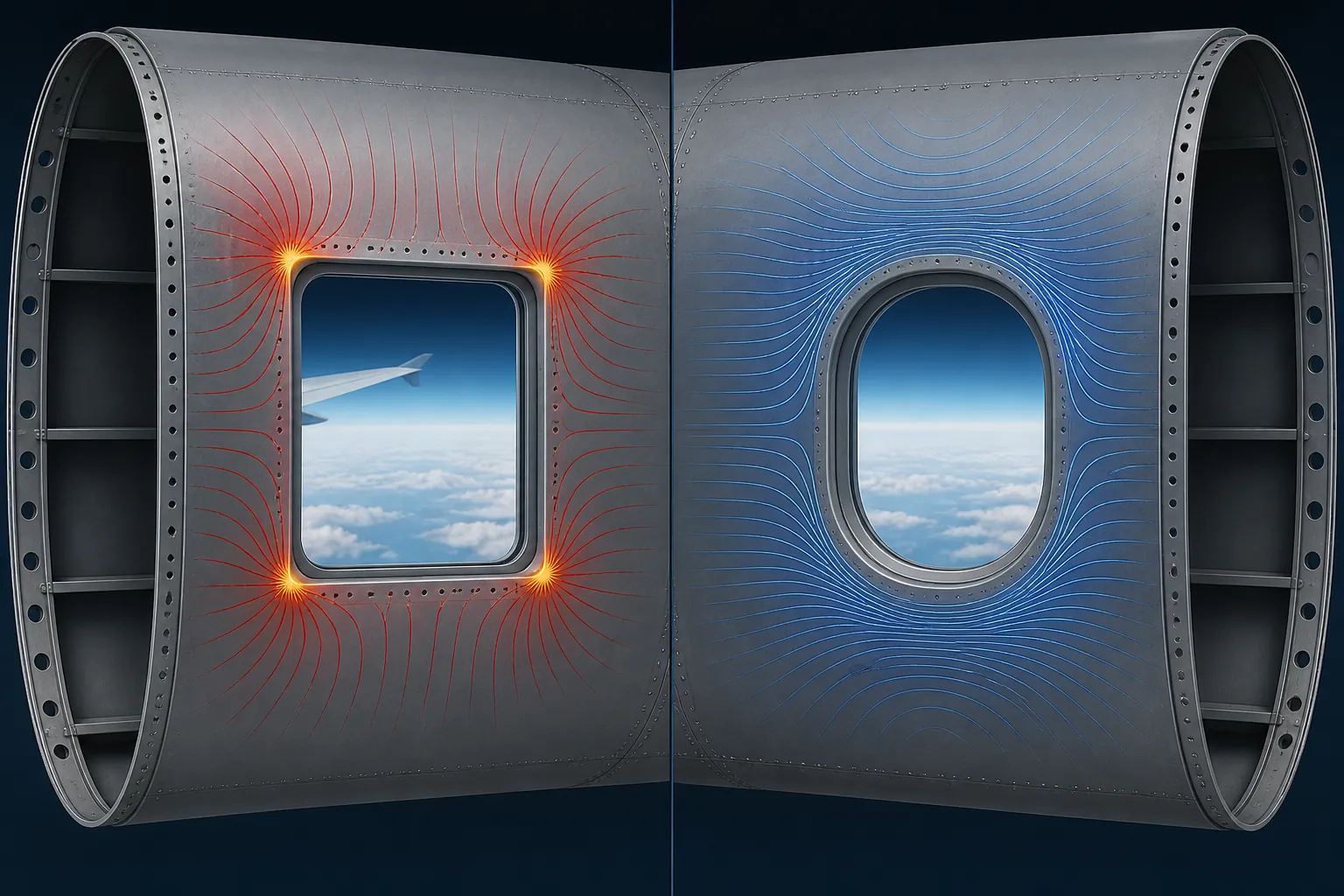
The Geometry Problem Hiding in the Window
Imagine a sheet of metal being pulled evenly. If the sheet is unbroken, the load spreads through it. Cut a hole in it, and the load has to flow around the edge of that hole. If the cutout has a sharp corner, the stress lines crowd near that corner. That local crowding is stress concentration.
For an exam, the important move is to separate average stress from local stress. The fuselage may have a tolerable average stress, while a small region near a corner experiences a much higher local stress. The FAA’s Comet accident review describes the square window corners as areas where pressure was “two or three times greater” than in the rest of the fuselage.[1] Secondary summaries of the Royal Aircraft Establishment-linked investigation describe the window-corner concentration as carrying roughly 70% of the fatigue stress; that figure is useful, but it should be treated as a secondary-source explanation rather than a number directly reported by the FAA page.[2]
Rounded windows do not magically remove stress from an airplane. They remove the abrupt corner that acts as a focal point. The load still has to travel around the cutout, but a smooth curve gives it a smoother path. That is why “round windows spread pressure better” is only half an answer. The better answer is that curved window geometry reduces the stress concentration at the perimeter of the opening.
Why Cabin Pressure Turns Shape Into a Fatigue Problem
A pressurized airplane fuselage is closer to a pressure vessel than to an ordinary passenger compartment. At cruise altitude, the air outside is much thinner than the air passengers breathe inside. The Comet operated with a cabin pressure differential of about 8.25 psi, meaning the inside pressure exceeded the outside pressure by that amount during flight.[1]
A pressure differential acts over area. Even a pressure difference that sounds small in pounds per square inch becomes a large outward load when applied across the broad skin of a fuselage. On each flight, the cabin is pressurized as the aircraft climbs and depressurized as it descends. The fuselage expands slightly, relaxes, and then repeats the process on the next flight.
That repetition is the fatigue part. A material can fail under repeated cyclic loading even when a single load cycle is below the level that would immediately tear it apart. A tiny crack begins where the local stress is highest. With each cycle, the crack can lengthen. Eventually the remaining intact material is no longer enough to carry the load.
That is why this case is so good for MCAT, ASVAB, SAT, and ACT reasoning passages. Pressure differential gives you the load. Window geometry gives you stress concentration. Repeated flights give you cyclic loading. Crack growth gives you fatigue life. The failure is not explained by one formula; it is explained by connecting the formulas in the right order.
What Happened to the Comet
The De Havilland Comet was the first commercial jet airliner in service. Its cabin was pressurized for high-altitude jet flight, and its passenger windows were much squarer than the rounded windows now associated with modern aircraft. The failures did not announce themselves in a classroom-clean way. Investigators had to work backward from wreckage, flight history, and tests.
In May 1953, Comet G-ALYV crashed after departing Calcutta; the accident was initially attributed to severe storm turbulence. In January 1954, G-ALYP broke up near Elba. In April 1954, G-ALYY crashed near Naples. The FAA’s accident review treats the second and third events as the ones traced to metal fatigue in the pressure cabin, with the three-crash sequence totaling 99 fatalities.[1]
The Elba investigation supplied the kind of diagnostic fact that matters more than the headline. Investigators recovered about 70% of the G-ALYP wreckage from the Mediterranean seabed, using underwater television in what the FAA describes as a first for aviation accident investigation.[1] The recovered structure let investigators identify where the failure began rather than merely infer that the aircraft had broken apart.
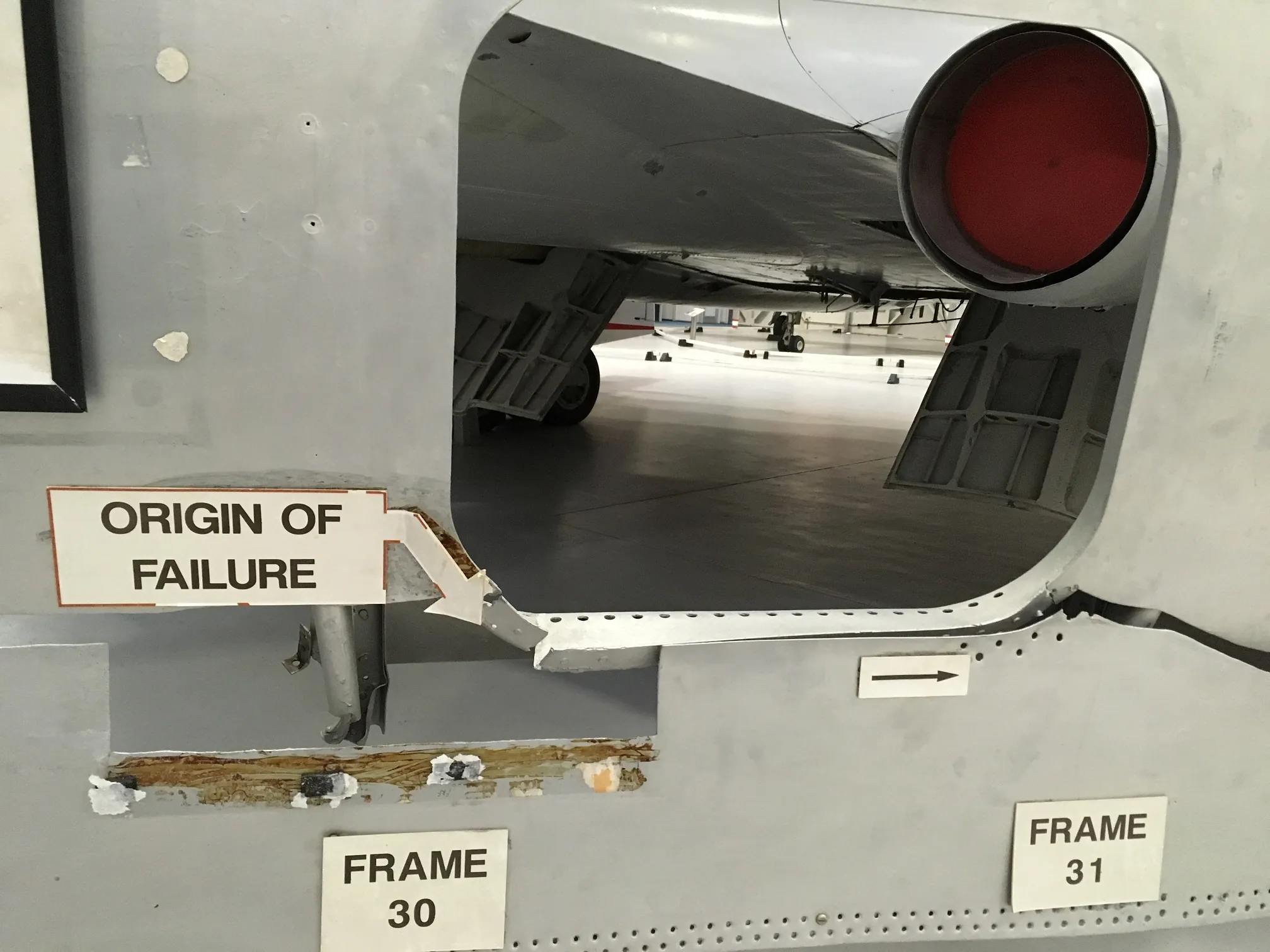
The first fracture origin on the Elba aircraft was traced to the rear Automatic Direction Finder, or ADF, window cutout in the roof. That opening had a squarish geometry with sharp corners. From a failure-analysis point of view, that detail matters: the fracture did not begin at a random attractive-looking feature. It began at a local stress raiser in a repeatedly pressurized shell.[1]
The Testing Lesson Is Almost as Important as the Window
The Comet story is sometimes told as if engineers simply forgot that corners are sharp. The more useful lesson is subtler: the testing program produced reassuring fatigue results that did not represent the production aircraft as well as the engineers believed.
De Havilland fatigue-tested a prototype fuselage, but that same structure had previously been subjected to 2P overpressure strength testing. According to the FAA review, those overpressure tests cold-worked the metal around critical areas. Cold-working can locally strengthen material by plastically deforming it. In this case, it meant the fatigue-test article was not equivalent to a fresh production fuselage.[1]
The misleading result was large enough to hide the danger. The tested prototype reached about 16,000 pressure cycles, while production aircraft failed at roughly 1,000 cycles. The FAA describes this as a gap of about a factor of ten between the test result and the service failures.[1]
This is a clean experimental-design warning. If a test article has already been altered by an earlier test, the later result may not measure the property you think it measures. For a fatigue-life passage, that means students should ask whether the sample, loading history, and test conditions match the real service condition.
How This Maps to an S-N Curve
An S-N curve relates stress amplitude, S, to the number of cycles to failure, N. Higher cyclic stress usually means fewer cycles before failure. A stress concentration changes the local S even when the overall applied loading seems acceptable. So a window corner can move a small region of metal into a much shorter fatigue-life regime than the rest of the fuselage skin.
The Comet testing flaw adds another layer. The prototype’s earlier overpressure history changed the test specimen before the fatigue test. If an exam passage asks why a lab fatigue result overestimated service life, the answer may not be that the equation was wrong. It may be that the specimen was no longer representative.
Why the Modern Window Is Rounded, Small, and Layered
The main structural reason for rounded airplane windows is the curved cutout. Oval or rounded-rectangle windows avoid the sharp-corner stress raiser that made the Comet’s window and ADF cutouts dangerous under repeated pressurization. Modern windows are also relatively small because every opening interrupts the load path of the fuselage skin.
There is also a separate passenger-window construction detail that often gets mixed into the same explanation. Modern aircraft windows commonly use multiple acrylic layers: an outer pane that carries the main pressure load, a middle pane with a small bleed hole to help equalize pressure between layers, and an inner pane that passengers can touch but that is mostly cosmetic.[3] That layered construction is interesting, but it is not the core reason the window outline is rounded.
The distinction matters. If a test asks why square windows are unsafe in a pressurized aircraft, the best answer is not “because the inner pane would crack” or “because round looks aerodynamic.” The answer is stress concentration under cyclic pressurization, leading to fatigue crack initiation and growth.
Exam Anchors: What to Remember on Test Day
A good case study earns its space by compressing several concepts into one picture. The airplane-window case does that unusually well because the shape is visible, the load is physical, and the failure mechanism is not vague.
| Exam context | What the Comet window case helps you recall |
|---|---|
| MCAT Chemical and Physical Foundations | Pressure differential, force over area, material response, and passage-based causal reasoning |
| ASVAB Mechanical Comprehension | Stress, structural weakness at corners, repeated loading, and failure modes |
| SAT or ACT Science | Interpreting an engineering passage where a design change follows from evidence rather than preference |
| Higher-level science passages | Fatigue life, S-N curves, representative samples, and why a flawed test can overestimate durability |
The fastest recall chain is this: pressurized cabin, outward load, cutout in fuselage, sharp corner, local stress concentration, repeated cycles, fatigue crack, structural failure. Once that chain is stable, the rounded window is no longer a trivia answer. It is the design correction that follows from the mechanism.
This is also the pattern used in other engineering-failure passages. A bridge collapse caused by aeroelastic flutter is not the same failure mode as a fatigue crack in an aircraft fuselage, but both reward the same reading habit: identify the load, the structure, the repeated or coupled motion, and the point where the design could no longer handle the physics. For a related example, see the site’s case study on how aeroelastic flutter brought down the Tacoma Narrows Bridge.
The Standard Changed After the Failure
The Comet investigation did not just change window shapes. It changed how pressure cabins were tested and certified. In July 1956, BCAR D3-7 required fatigue testing on a complete pressure cabin that had not previously been used for strength testing. The FAA also connects the Comet lessons to later fail-safe and damage-tolerant design requirements, including the regulatory thinking reflected in 14 CFR 25.571.[1]
That legacy is worth keeping concise because the central physics is already visible. A rounded airplane window is not an aesthetic flourish. It is a structural response to stress concentration in a pressurized shell that is loaded and unloaded every flight. The Comet case is worth remembering because it turns pressure differential, stress concentration, cyclic loading, fatigue life, and failure analysis into one causally clear picture.
References
- FAA Lessons Learned: De Havilland DH-106 Comet 1, Federal Aviation Administration.
- The Reason for Round Windows: The De Havilland Comet, BYU Design Review.
- Why Aircraft Have Small, Round Windows, Simple Flying.
Related exhibits & inventory
Verified outcomes
Planners
No planner filed for this exam yet
A downloadable timeline template for this exam hasn't been published yet.
Tool verdicts
Questions about this plan
Ask a question about a specific section, timeline, or citation in this plan — or flag something that needs correcting.
Comments
Join the discussion with an anonymous comment.