
GRE Exam Hub
Build a Study Routine That Survives Bad Mental Health Days
A study routine built only for your best days falls apart under anxiety, low mood, and missed-day guilt. This guide shows test-takers how to run a three-tier daily plan — full, reduced, and bare-minimum — with built-in slack and a re-entry step that keeps exam prep moving when functioning is hard.
- gre
- mcat
- asvab
- sat
- act
- digital-adaptive
- official-material
- section-strategy
- test-date-timeline
If your study routine only works when you are rested, calm, and unusually motivated, it is not a realistic exam-prep routine. SAT, MCAT, GRE, ACT, and ASVAB dates do not move just because anxiety spikes on Tuesday or low mood eats half of Saturday. The plan has to include those days before they happen.
The cleanest fix is a three-tier daily system: a full day, a reduced day, and a bare-minimum day. This is a practice-based planning framework, not a clinical treatment and not a research-proven formula; it has been used in medical-student planning contexts and can be adapted to other fixed-date exams when the task load changes. [1]
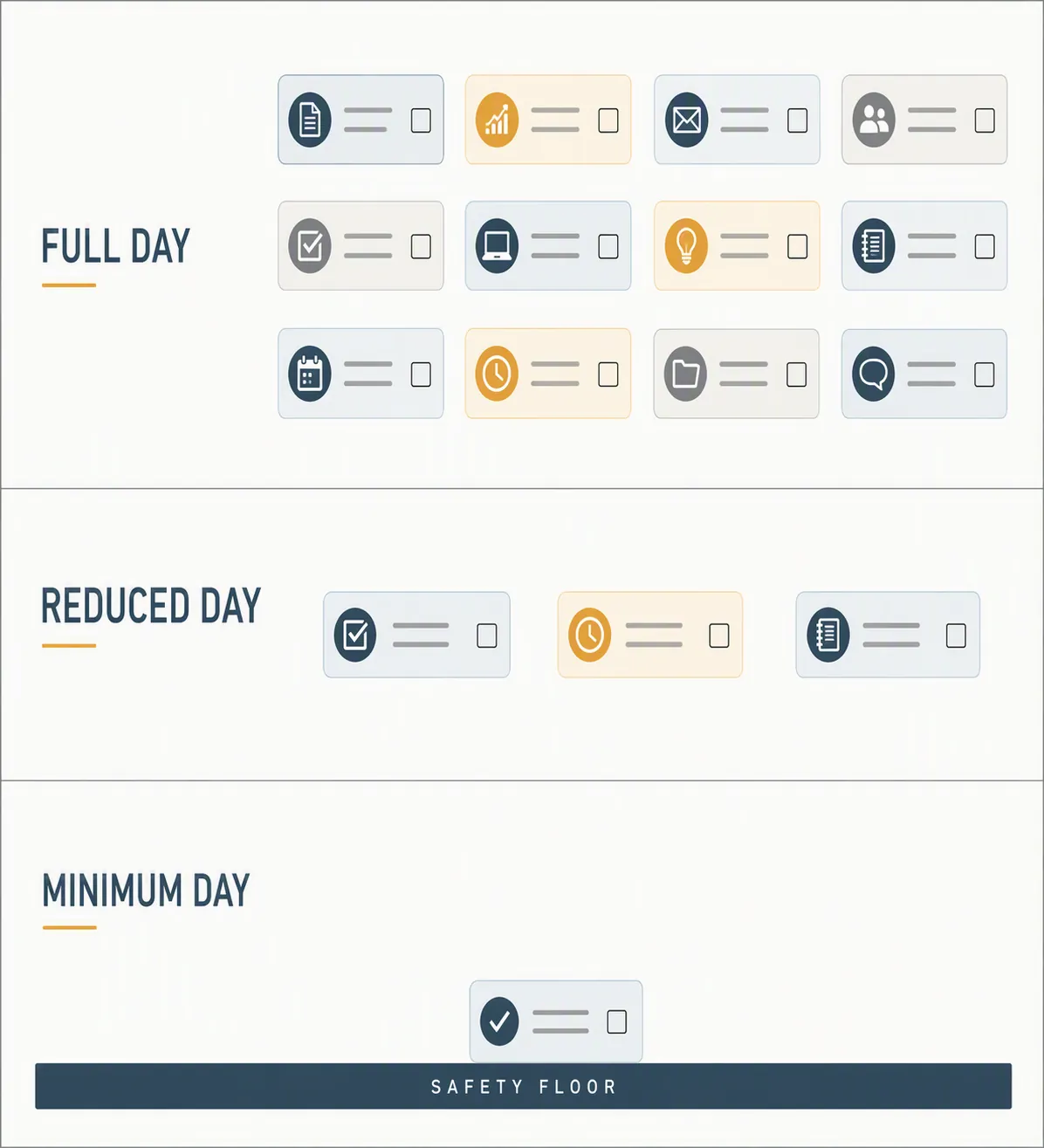
| Day type | Use it when | What counts as done | What does not happen |
|---|---|---|---|
| Full day | You have normal-enough energy and time. | The planned study block, practice work, review, and basic routines. | No borrowing from future days just because today went well. |
| Reduced day | You can function, but not at the level the original plan assumed. | One priority study block plus a smaller review or maintenance task. | No guilt-driven attempt to squeeze in the full day at midnight. |
| Bare-minimum day | Anxiety, low mood, illness, overwhelm, family stress, or exhaustion makes real studying unlikely. | The smallest action that keeps contact with the exam cycle. | No pretending this is full productivity; no doubling tomorrow. |
| Re-entry morning | The day after a missed or minimum day. | Open the plan, choose today’s tier, move only selected tasks into a repair block. | No punishment schedule and no “I ruined everything” restart. |
That table is the routine. Everything else is there to make it harder for one bad day to become a bad week.
Build the three templates before the week starts
A tiered routine is not made in the moment when you are already flooded. The bad-day version has to be written while you can still think clearly, because the whole point is to remove negotiation later.
Start with the exam date, then work backward through your actual exam plan. If you are preparing for the SAT, anchor the schedule inside your SAT exam prep guide. If the issue is uneven section performance, the SAT score-gap method gives you a cleaner way to decide which missed tasks matter. ASVAB students should build the tiers around the sequence in the ASVAB exam prep guide. MCAT students can use the tool categories in MCAT Study Tools in 2026 to decide which work belongs in content review, practice, or error review. For GRE and ACT planning, use the same tier logic inside the appropriate exam hub once your test-specific sequence is set.
The full day is not a fantasy version of you
A full day should be ambitious enough to move the prep cycle forward and ordinary enough to repeat. It might include a main study block, timed practice, error review, and a short planning reset. It should also include meals, sleep cutoff, and a stopping point. If the full-day version requires you to study until you are numb, it is already a broken template.
- Main work: the highest-value task for the exam cycle, such as a timed section, content chapter, question set, or full-length review segment.
- Review work: error log, missed-question explanations, flashcards, formula recall, vocabulary, or concept cleanup.
- Maintenance: planning tomorrow, packing materials, setting up the next practice set, or updating score notes.
- Primary routine protection: sleep cutoff, food, hygiene, and a small amount of movement before extra study is added.
The mistake is making the full day so packed that every normal interruption creates debt. A full day should still have a little air in it. That air is not laziness; it is the space where real life happens without turning the schedule into a trap.
The reduced day keeps the exam plan alive without pretending nothing is wrong
A reduced day is for the messy middle: you can do something, but the original plan is too heavy. This is the day that prevents the most damage, because many students lose time by arguing with themselves about whether they are “really” allowed to scale down.
Write the reduced version as a substitution, not a confession. Instead of “failed full-length practice test,” the reduced plan says: complete one timed passage set and review the misses. Instead of “didn’t finish math chapter,” it says: do ten representative problems and mark the three weakest skills. Instead of “too anxious to study,” it says: run one short recall set, check the next scheduled task, and stop at the sleep cutoff.
| Exam situation | Full-day task | Reduced-day replacement |
|---|---|---|
| SAT | Full timed section plus error review | One timed passage or problem set, then review only the missed items |
| ASVAB | Long arithmetic reasoning and word knowledge session | One priority subtest block plus a short vocabulary or formula review |
| MCAT | Content review, question bank, and Anki/error review | One passage set or one content subsection, then review the explanation notes |
| GRE | Timed quant/verbal set plus writing practice | One timed mini-set and one error-log update |
| ACT | Timed section practice and review | One passage group or skill cluster, then write the next action |
Reduced days should not be rare emergency exceptions. In a multi-week prep cycle, they are part of the operating system.
The bare-minimum day is a floor, not a productivity trick
A bare-minimum day is the smallest action that preserves contact with the exam-prep cycle. It is not a secret method for maintaining full output while distressed. It exists so that a day of low functioning does not also become a day of avoidance, shame, and total disconnection from the plan.
The survival floor should be almost embarrassingly small. Open the planner. Look at the next task. Do one tiny exam-related action. Write the re-entry task for tomorrow. Stop.
- SAT bare minimum: review three missed questions from your error log or do five vocabulary/card prompts.
- ASVAB bare minimum: complete five arithmetic reasoning items, five word knowledge items, or one formula recall page.
- MCAT bare minimum: review one missed passage explanation, one Anki deck subset, or one content map.
- GRE bare minimum: do five quant problems, one short verbal set, or one issue/argument outline.
- ACT bare minimum: complete one short passage group, one grammar rule review, or five math questions.
If those are still too large on a truly bad day, shrink again: open the document, mark tomorrow’s first task, and close it. That sounds too small only if the alternative is assumed to be a normal study day. Often the real alternative is disappearing from the plan for three days and returning with dread.

Write the missed-day repair protocol as a script
The morning after a missed day is where many plans collapse. Not because the lost work was impossible to recover, but because the student turns the schedule into a punishment: double the hours, skip the break, cut sleep, and prove the lapse meant nothing. That repair attempt often creates the next missed day.
The protocol should be written before you need it. Put it at the top of the planner, not buried in a notes app you will not open when you feel awful.
- Open the planner before opening the guilt story.
- Choose today’s tier: full, reduced, or bare minimum.
- Do not double today’s workload.
- Move only the most exam-relevant missed task into the next repair block.
- Drop, delay, or shrink the rest.
- End at the sleep cutoff even if the repair block is unfinished.
This is where habit evidence is useful, if it is kept in its lane. A review discussing habit formation reports that, in the underlying Lally et al. study of simple single behaviors, automaticity took about 66 days on average, with a wide range from 18 to 254 days; missing one day did not have a lasting effect on habit formation. That does not prove a complex MCAT or SAT routine becomes automatic in 66 days. It does support a smaller, practical point: one lapse does not need to be treated as a collapse, and routines should be designed for resumption. [2]

What goes into a repair block
A repair block is not a junk drawer for everything you missed. It is a limited container for the one task that would most affect the next step of the plan.
| Missed item | Repair decision |
|---|---|
| A full-length practice test | Do not squeeze it into a weekday night. Move it to the next true full-length slot or replace it with a timed section if the exam date is close. |
| Error review from completed practice | Repair this before adding lots of new questions, because the mistakes are already available evidence. |
| Flashcards or vocabulary | Shrink the set and resume; do not try to pay back every missed card in one sitting. |
| Content reading | Decide whether the topic is high-yield for your score goal. If not, compress or drop it. |
| Planning/admin work | Repair only what affects tomorrow’s first action. |
For score-driven exams, repair decisions should follow evidence, not guilt. If an SAT student misses a planned reading drill but the score gap is in algebra, algebra gets the repair block. If an ASVAB student missed a long session but the weakest line is arithmetic reasoning, repair that first. If an MCAT student missed content review but keeps losing points to passage reasoning, the repair block may need practice analysis rather than another chapter.
Protect primary routines before adding more study
When the plan starts slipping, the tempting move is to raid sleep, meals, hygiene, and movement for more study time. That looks efficient on paper and usually makes the next day harder to use.
Routine-disruption research gives a reason to be careful. In a prospective cohort of 1,318 adults, high disruption of primary routines was associated with about 3.3 times the odds of persistent probable anxiety and about 4.3 times the odds of persistent probable depression one year later, with reduced self-efficacy partly mediating the relationship. This is not an exam-prep experiment, but it does make primary-routine disruption look too important to treat as harmless collateral damage. [3]
A separate routine framework distinguishes primary routines, such as sleep, eating, and hygiene, from secondary routines, including work or study. Under stress, it recommends protecting and consolidating existing routines before adding new ones. For test prep, that means the first repair is often not another practice set. It is getting the day back into a shape where practice is possible. [4]

Use a sleep cutoff that actually cuts something off
A sleep cutoff is not a vague hope to “get more rest.” It is a rule that says when studying stops, even if the task is incomplete. If you keep overriding it, it is not a cutoff; it is decoration.
- Set the latest study-stop time before the week begins.
- Put unfinished work into the repair-block decision process, not into the hour before bed.
- Avoid scheduling full-length exams or heavy review blocks so late that they can only be finished by stealing sleep.
- If sleep timing is already a concern near the test date, plan around it deliberately rather than improvising; the daylight-saving planning discussion in Should You Schedule Your Exam Around Daylight Saving Time? is a useful adjacent example.
Medical students reflecting after USMLE Step 1 reported burnout-combat strategies that included exercise, taking days off, limiting daily study hours, breaks, support systems, and sleep. That study is based on self-reported feedback from 370 students, not an experiment proving which strategy caused better outcomes. Still, the list is a good reality check: students who survived a high-pressure exam did not describe endless daily escalation as the only path through. [5]
Routine can help, but it is not a guaranteed mental-health lever
There is suggestive evidence that consistent routines and health are connected, but the details matter. A July 2026 University of Missouri report described research in 67 older adults, including 37 with insomnia, finding that more consistent daily routines were associated with less physical pain and fewer depressive symptoms regardless of sleep quality. The sample was older adults, not test-takers, and the finding was associative, not experimental. Applying it to students requires synthesis, not copy-paste certainty. [6]
There is also a useful brake on overclaiming. In a study of 235 UK undergraduates, changes in routine timing were largely unrelated to wellbeing measures, while exercise change was the more notable correlate of anxiety. That does not make planning useless. It does mean changing the calendar alone should not be sold as a guaranteed way to improve mental health. [7]
So the routine should stay humble. It can reduce avoidable friction. It can protect sleep and meals from being quietly sacrificed. It can make re-entry less dramatic. It cannot treat depression, erase panic, or make unsafe situations safe.
Add slack where missed days usually happen
Slack is not a blank promise that you will “catch up later.” It is a named block with a job. Put it on the calendar before you need it, preferably in the places where your past plans have already shown weakness.
| Pattern you notice | Slack to build in |
|---|---|
| Sunday night panic | A short Sunday planning reset plus a lighter Monday opening task |
| Midweek exhaustion | A Wednesday reduced-day option or repair block instead of a heavy new unit |
| Full-length test hangover | The next day reserved for review setup, movement, and error sorting rather than new content |
| Work or school schedule volatility | One floating block per week that can absorb a missed high-value task |
| Heat, commute, or environment problems | A backup low-energy location or shorter block before the week falls apart |
Environmental constraints deserve the same respect as content constraints. If heat, travel, dating-app time sinks, or attention traps keep disrupting study, planning around them is not an excuse; it is the job. The guides on heat-wave study planning and dating apps and study time are useful because they treat constraints as calendar facts instead of character flaws.
A good slack block has a decision rule. If no repair is needed, it can become light review, rest, or setup for the next full day. If repair is needed, it gets one priority task, not the entire pile.
Keep study methods simple on bad days
This is not the moment to redesign your whole learning system. On bad mental-health days, the method should be obvious enough to start without a debate.
- Use active recall when you can: answer before looking, then check.
- Use practice questions when you need evidence: even a small set can show what to repair next.
- Use error review when you are too tired for new material: one missed question can still teach you something.
- Use setup tasks only when studying is truly out of reach: open the file, choose tomorrow’s first task, lay out materials.
If you do not know which methods fit your behavior, not your imagined personality, the self-audit approach in Find Your Study Style Without a Personality Quiz can help. If a brief movement or reset routine helps you transition into a block, the discussion of hot flow yoga and study focus is better treated as an optional pre-study reset than as a cure-all.
A bad-day protocol you can paste into your planner
BAD-DAY STUDY PROTOCOL

1. Check basics first:
   - Have I eaten something?
   - Have I had water?
   - Have I done basic hygiene?
   - Is my sleep cutoff still protected?

2. Choose today's tier:
   - Full day: normal plan.
   - Reduced day: one priority block + one small review.
   - Bare minimum: open planner + one tiny exam task + tomorrow's first action.

3. If I missed yesterday:
   - I do not double today.
   - I choose one task for the next repair block.
   - I drop, shrink, or delay the rest.

4. If I cannot start:
   - Set a 5-minute timer.
   - Open the exact material.
   - Do the first visible item only.
   - Stop or continue based on today's tier, not guilt.

5. End rule:
   - Stop at the sleep cutoff.
   - Write tomorrow's first action.
   - Close the plan.
A downloadable version of this belongs with your study templates and planners, not as a motivational note you have to recreate each week. The point is to make the next action visible when your executive function is not being generous.
When routine is not enough
A study routine can lower friction. It cannot be the whole answer when mental health is seriously deteriorating.
The 2024–25 Healthy Minds Study included more than 84,000 students across 135 institutions. Its reported screening data showed 37% of students with moderate-to-severe depressive symptoms, 32% with anxiety, 11% with suicidal ideation, and 52% with loneliness. These are self-report screening measures, not clinical diagnoses, but they do show that many students are carrying more than ordinary test stress. [8][9]
The same reporting identified common barriers to treatment, including lack of time at 23%, financial reasons at 22%, and a preference for handling issues independently at 18%. Those barriers are real, and they are exactly why the answer cannot be “just manage your calendar better.” [8][9]
If you are having suicidal thoughts, feel at risk of harming yourself, or feel unable to stay safe, call or text 988 in the United States and connect with the Suicide & Crisis Lifeline now. If anxiety, depression, panic, eating problems, substance use, or exhaustion is preventing basic functioning, contact campus counseling, a local mental-health clinic, a primary-care clinician, or an urgent support service. If you are outside the United States, use your local emergency number or crisis line.
Exam prep matters. It does not matter more than staying alive, getting care, or being able to function as a person.
Put the tiers inside the exam plan you are actually using
The three-tier routine is not a separate wellness project. It should sit directly inside your test plan: the SAT plan, the ASVAB plan, the MCAT tool stack, the GRE calendar, or the ACT schedule. Choose the exam path first, then write the full, reduced, and bare-minimum versions for the work that path actually requires.
- SAT: start with the SAT exam prep guide, then use the score-gap method to decide which repair blocks matter most.
- ASVAB: build the three tiers around the subtests and sequence in the ASVAB exam prep guide.
- MCAT: use MCAT Study Tools in 2026 to separate content review, practice questions, spaced review, and full-length analysis before assigning tiers.
- GRE and ACT: use the same full/reduced/minimum structure once your exam hub or prep plan confirms the sequence of sections, practice tests, and review blocks.
The plan is doing its job when a hard day has a named version, a missed day has a repair route, and tomorrow does not have to begin with punishment.
References
- Designing a Study Schedule That Survives Bad Mental Health Days, ResidencyAdvisor
- The Importance of Creating Habits and Routine, American Journal of Lifestyle Medicine, 2018
- The relationship between routine disruption during the COVID-19 pandemic and mental health outcomes: A prospective cohort study, Journal of Psychiatric Research, 2022
- Social and behavioural consequences of mask policies during the COVID-19 pandemic, Journal of Global Health, 2020
- Combatting Medical Student Burnout Through the Preparation for USMLE Step 1, Health Professions Education, 2020
- Mizzou researchers find simple habit to improve physical, mental health, University of Missouri, July 2026
- Routine change and mental wellbeing in university students during the COVID-19 pandemic, The Journal of Psychology, 2023
- College student mental health shows improvement for third consecutive year, University of Michigan School of Public Health, 2025
- Healthy Minds Study 2024–2025 Data Report, UCLA Center for Health Policy Research
Related exhibits & inventory
Verified outcomes
Planners
No planner filed for this exam yet
A downloadable timeline template for this exam hasn't been published yet.
Tool verdicts
AI-tool cautions
No AI tools tested for this exam yet
No hands-on AI-accuracy logs have been filed for this exam.
Questions about this plan
Ask a question about a specific section, timeline, or citation in this plan — or flag something that needs correcting.
Comments
Join the discussion with an anonymous comment.