
MULTIPLE Planner
How Much Study Time Are Dating Apps Costing You?
Open your weekly planner before you decide whether dating apps are “just a break.” If you are using them at the peer-reviewed median reported in a Swiss university sample, they take about 2.3 hours a week. That is not a moral problem. It is a calendar block. For a student trying to protect evening practice sets after class, work, lab, or commuting, 2.3 hours is roughly one long review session, two shorter drill blocks, or the debrief time after a full-length practice test.

That is the cleanest way to answer how dating apps affect college students’ study focus and habits: start with the time budget, then add the attention cost. The strongest evidence does not prove that Tinder, Hinge, Bumble, or any single app directly lowers a test score. It does show that app use can occupy measurable study time, arrive repeatedly during the day, and make it harder for a planned study block to stay intact.
Dating apps are common enough to belong in the planner
This is not a fringe habit to be treated like an embarrassing exception. In Pew Research Center’s 2023 U.S. survey, 53% of adults ages 18 to 29 said they had ever used a dating site or app; 42% in that age group had used Tinder, and 22% had used three or more dating sites or apps. Pew is measuring young adults, not only college students, but the numbers are enough to explain why dating-app time shows up in real student schedules rather than only in cautionary stories about phone addiction.[1]
The better planning baseline comes from Winter and colleagues’ 2025 peer-reviewed study of 923 Swiss university students. Among dating-app users in that sample, median use was 2.3 hours per week across a median of two apps. The same study reported that 68.6% had used an online dating app that day or the day before, and 74.4% had deleted and reinstalled one at some point.[2]
The Swiss sample should not be stretched into a universal estimate for every U.S. campus. Still, it is useful because it gives a planner-sized number. “I check it sometimes” is foggy. “About 2.3 hours a week” can be placed on a calendar, compared with practice work, and moved out of protected study time.
What 2.3 hours a week costs over a prep window
A weekly number becomes more useful once it is multiplied by the remaining weeks before a fixed test date. The arithmetic below is not a score prediction. It does not say that reclaiming a certain number of dating-app hours guarantees a certain score increase. It simply shows what app time is competing with inside a study plan.
| Remaining prep window | At 2.3 hours/week | What that can crowd out |
|---|---|---|
| 4 weeks | 9.2 hours | Several targeted drill sets plus review time |
| 8 weeks | 18.4 hours | Multiple evening study blocks or a full-length exam debrief cycle |
| 12 weeks | 27.6 hours | A substantial section-review buffer before the final stretch |
For a median user, the weekly block is large enough to matter but not so large that the only answer is quitting. The planning question is placement. If those 2.3 hours happen after the study block ends, they are leisure. If they are scattered through practice sets, dinner, bedtime, and every notification buzz, the same 2.3 hours becomes harder to contain.
The upper end is where the calendar starts to bend. A systematic review discussing Chin and colleagues’ Tinder-use findings reports patterns as high as 11 app openings per day and up to 90 minutes per day among Tinder users.[3] Ninety minutes a day becomes 10.5 hours a week. Across an eight-week prep window, that is 84 hours. Again, not a guaranteed score effect — but definitely enough time to displace reading, spaced repetition, full-length review, sleep, or the boring administrative work of keeping a study plan current.
There is also a softer U.S. self-report number that sounds recognizable but deserves less weight. A 2025 Forbes Health/OnePoll vendor survey reported about 51 minutes per day on dating apps and 78% reporting dating-app burnout, with a sample of 1,000 and a stated margin of error of plus or minus 3.1 percentage points.[4] That is useful as texture — many users feel the apps take energy — but it should not carry the argument the way the peer-reviewed university sample can.
Raw minutes undercount the damage inside a study block
If dating-app use only happened in one clean block, the fix would be simple: schedule it. The harder pattern is repeated opening. A student does 12 minutes of questions, checks a match, answers one message, rereads the question stem, notices another notification, and then spends the next five minutes proving to themselves that they are still studying. The app session may have taken only two minutes. The study block lost more than two.
Rosen, Carrier, and Cheever’s 2013 study of studying behavior found that students averaged less than six minutes on task before switching to a technological distractor such as texting or Facebook.[5] That study is not about dating apps specifically, and it comes from an earlier phone ecosystem. Its useful lesson is narrower: when the phone is active during studying, raw screen minutes can understate the number of times attention has to be restarted.
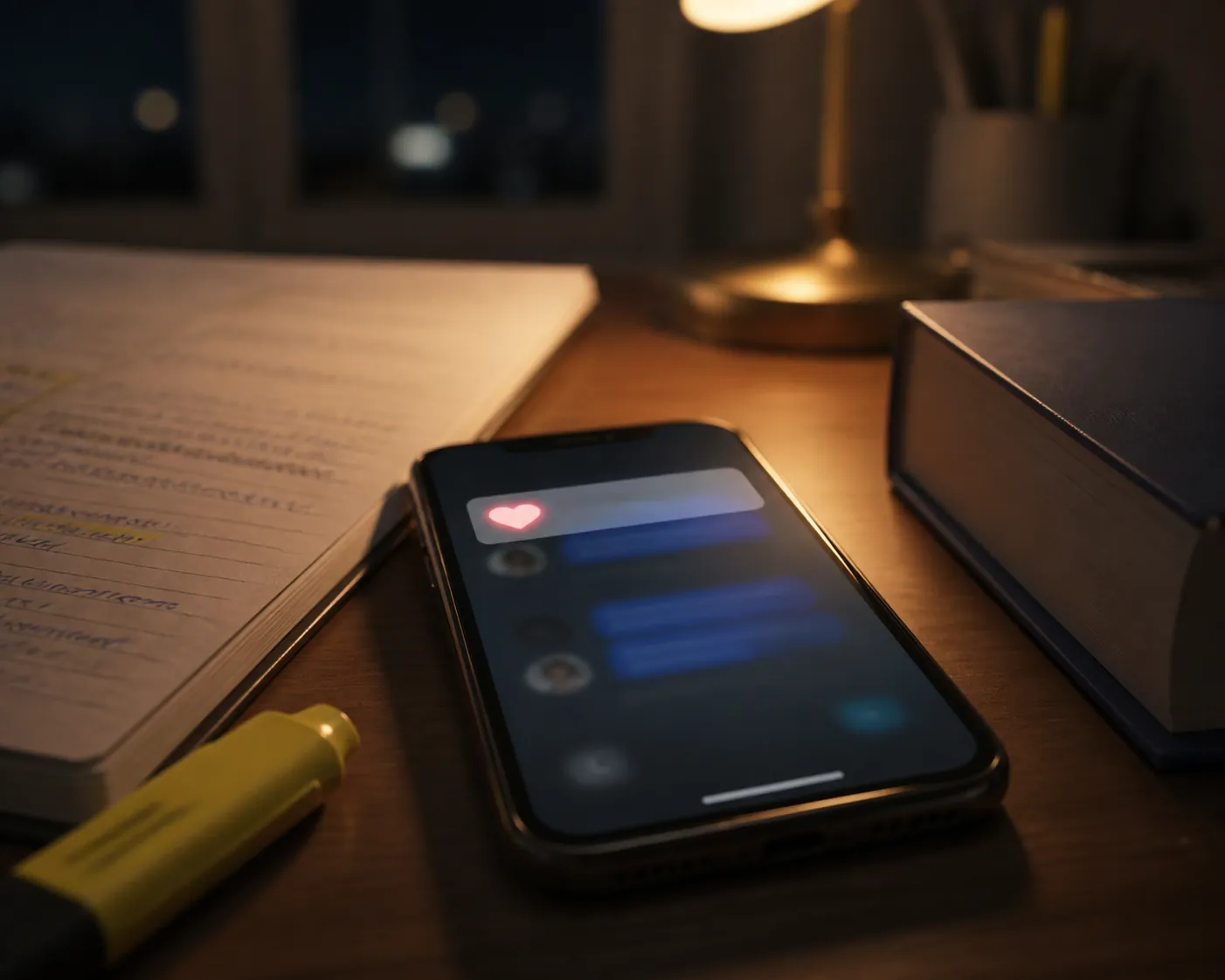
Notifications add another small but real cost. PsyPost’s report on Fournier and colleagues’ 2026 Computers in Human Behavior study describes about seven seconds of cognitive disruption per notification and notes that people may receive more than 100 notifications per day.[6] Because the original article is paywalled, that finding should be treated as reported through PsyPost rather than independently inspected here. Even with that caution, the planning implication is practical: if notifications are allowed into a study block, leave room for re-entry friction, not just app minutes.
Phone-heavy habits also correlate with academic costs more broadly. In a 2015 study of 536 U.S. college students using actual GPAs, Lepp, Barkley, and Karpinski found that cell phone use negatively predicted GPA, with high-use students averaging 2.84 compared with 3.15 for low-use students.[7] That does not prove dating apps caused a GPA drop. It supports the more modest warning that heavy phone use can travel with weaker academic outcomes, so a test-prep plan should not pretend the phone is neutral during study time.
Put app time outside the study block, not between problems
The humane answer is containment. Dating apps do not need to be treated as a character flaw, and a student with a normal social life should not have to pretend they want nothing except flashcards. But app time needs a start, a stop, and a location on the week. The structure below is a planning synthesis, not a directly tested dating-app intervention.
| Planner decision | Use this rule |
|---|---|
| When to use dating apps | Place them after a protected study block, after dinner, or on a designated leisure night — not inside question sets or review sessions. |
| How long to allow | Use a visible time box, such as one short block or one longer leisure block, instead of repeated checking across the whole evening. |
| What to do with notifications | Silence dating-app notifications during study blocks and reopen them only during the scheduled app window. |
| What buffer to add | Add a few minutes between app time and deep work so the next block does not begin with leftover message-checking. |
| What to track | Track openings, not only minutes. Eleven short checks can be more disruptive than one contained session. |
For most students, the easiest placement is after the day’s most important study block. If your MCAT passage review, GRE quant set, ACT English drill, or ASVAB arithmetic practice is scheduled for 8:30 to 10:00 p.m., the app window belongs at 10:05, not 9:10. That small move changes the app from an interruption into a reward block.
The five-minute gap matters. If you stop studying at 10:00 and immediately open an app, that is fine. If you open the app before studying and then try to begin work at 8:30 while still waiting for a reply, the study block starts with a loose end. A planner cannot remove the desire to check. It can decide when that desire is allowed to pull on your attention.
If you keep deleting and reinstalling, plan for that too
The deleted-and-reinstalled number in the Swiss university study is worth taking seriously: 74.4% of users had done it.[2] That pattern suggests many students are not simply failing to read enough productivity advice. They are trying to control something that still has emotional pull — attention, flirtation, boredom relief, hope, curiosity, or just the comfort of seeing whether someone responded.
So do not make “I’ll uninstall during finals” the whole plan unless you already know that works for you. A more durable setup is to remove the app from study time before you remove it from your life. Put it on the calendar. Turn off its study-block access. Decide in advance when it comes back.
- If you are a median-type user, budget roughly 2 to 3 hours a week and place that time outside protected study blocks.
- If you are near the heavy-use pattern, treat the app as a major leisure category, not a background habit.
- If notifications pull you back repeatedly, track the number of openings for a week, not just total screen time.
- If you use apps late at night, protect the next morning’s study block by setting a stop time, not only a start time.
A fixed test date is unforgiving about vague habits. Dating apps can stay in the week, but they need to stop floating through the parts of the week reserved for practice, review, and recovery. Schedule the app window the way you would schedule the gym, a show, or dinner with friends, then keep it out of the blocks where your score work actually happens.
References
- The who, where and why of online dating in the U.S. — Pew Research Center — February 2, 2023
- Relations of problematic online dating app use with mental and sexual health — BMJ Public Health — 2025
- Dating Apps and Their Sociodemographic and Psychosocial Correlates: A Systematic Review — 2020
- Dating App Fatigue — Forbes Health — 2025
- Facebook and texting made me do it: Media-induced task-switching while studying — Computers in Human Behavior — 2013
- New psychology research reveals the cognitive cost of smartphone notifications — PsyPost
- The Relationship Between Cell Phone Use and Academic Performance in a Sample of U.S. College Students — SAGE Open — 2015
Fill in this timeline
This is a skeleton schedule, not a performance claim — for section-by-section strategy to fill in each slot, read the exam hub. For evidence that a similar timeline worked, compare against real outcome logs.