
SAT Exam Hub
Should you schedule your exam around daylight saving time?
Spring-forward costs teens about half an hour of sleep a night and measurably slower reaction times for a full week — yet the test-score evidence stays genuinely mixed. The defensible date rule: avoid the post-transition week when you have flexibility, and engineer sleep and morning light when you don't.
- gre
- mcat
- asvab
- sat
- act
- digital-adaptive
- official-material
- section-strategy
- test-date-timeline
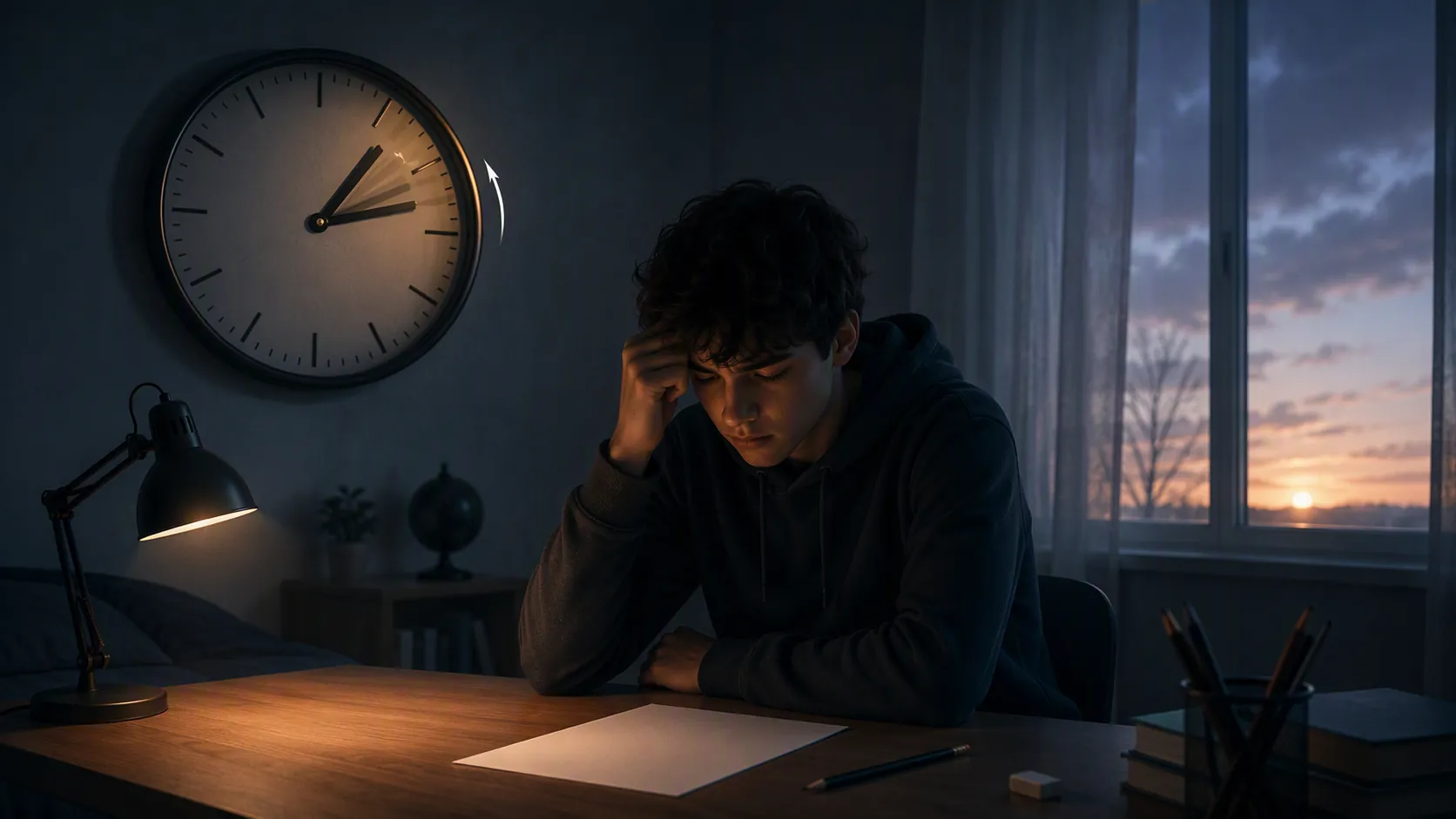
For a spring exam, how daylight saving time affects school schedules and student focus is not a mystery in the first place it matters: sleep. The week after the spring-forward clock change, adolescents in the best exam-relevant sleep study slept less and performed worse on a vigilance task. What is less settled is the next leap people usually want to make — that the clock change reliably lowers standardized-test scores.
That distinction matters if you are choosing an SAT, ACT, GRE, MCAT, ASVAB, or other spring test date. If you have several dates that fit equally well, avoiding the week immediately after spring-forward is reasonable low-cost insurance. If you do not control the date, the better-supported move is not panic or magical thinking; it is adjusting bedtime before the clock change, using morning light, and protecting enough sleep during the transition week.
| Your situation | Defensible decision |
|---|---|
| You can choose between comparable spring dates | Prefer a date outside the week immediately after spring-forward, if doing so does not disrupt the rest of your prep plan. |
| Your exam is fixed during that week | Plan the clock transition like part of test prep: shift sleep earlier, get Sunday morning light, and protect teen-level sleep time. |
| Moving the date would create travel, fee, school, or prep problems | Do not overcorrect. The evidence supports managing sleep and alertness more strongly than it supports assuming a score drop. |
The measurable risk is the whole school week, not just Monday
The most useful study for a student calendar is Medina et al. 2015 because it studied high school students with actigraphy — wrist-based sleep measurement — around the actual spring daylight saving transition. In a sample of 35 adolescents, students lost about 32 minutes of sleep per weeknight after the change, adding up to 2 hours and 42 minutes of cumulative sleep loss across the post-transition week. Their psychomotor vigilance task results also worsened: reaction times slowed, lapses increased, the slowest 10% of responses were 68 milliseconds slower, and impairment persisted through the full school week, growing by Thursday and Friday.[1]
That last part is the calendar point. The risk window is not only the bleary Monday after the clock change. If your exam is on the Thursday, Friday, or Saturday after spring-forward, the study does not let you wave the issue away as a one-day nuisance.
A vigilance task is not the SAT math section, an ACT reading passage, a GRE quant set, an MCAT CARS passage, or an ASVAB subtest. It does, however, measure exactly the kind of attention instability that timed exams punish: slower noticing, more brief misses, and less reliable response speed. On a test day, those errors do not have to look dramatic. They can look like rereading the same sentence, miscopying a value, missing a keyword, or spending 40 seconds recovering from a mistake that would not have happened on a better-rested morning.
So the cautious reading is simple: spring-forward can measurably reduce adolescent sleep and vigilance for the week after the clock change. It does not prove that every student’s score will fall, and it definitely does not prove that one strange calendar factor explains a disappointing result.
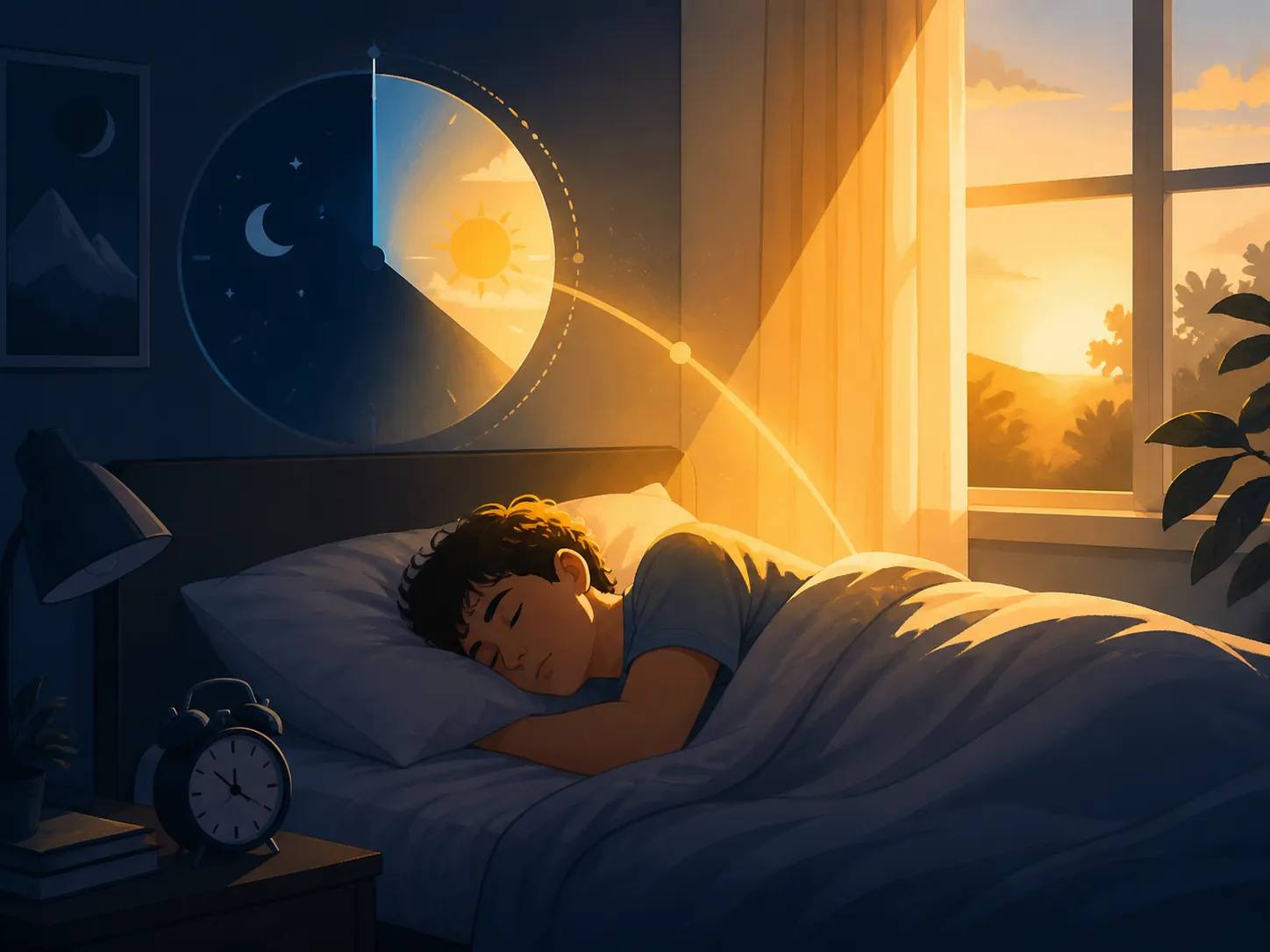
The likely channel is sleep timing and morning light
The clock itself is not the magic villain. The more plausible pathway is that the spring transition shifts social time against adolescent biology: school still starts in the morning, but the student’s body has not fully moved with the wall clock.
Heissel and Norris’s work on school start times and light helps explain why morning timing deserves attention. In their Education Next summary, one additional hour of sunlight before school was associated with math gains of about 8% of a standard deviation, which they translate as roughly three months of learning, and the effects became much larger at puberty onset. They also discuss a Florida test-day reading result as suggestive and note that differences across daylight saving regimes can include up to an hour of sleep loss.[2]
That evidence should not be read as “daylight saving time lowers your exam score by X.” It does support a narrower and more useful claim: morning light, school timing, and adolescent sleep are connected strongly enough that a spring clock change deserves a place on an exam calendar.
The score evidence is genuinely mixed
The strongest brake on an alarmist DST-and-exams story is Herber, Quis, and Heineck’s 2017 study. Looking at more than 22,000 elementary students across six countries, the authors found no statistically significant effect of daylight saving time on low-stakes math, science, and reading tests taken in the week after the transition.[3]
That is important evidence. It is also not the same setting as a U.S. teenager taking a high-stakes admissions, licensing, placement, or military aptitude exam at 8 a.m. Elementary students are not adolescents; low-stakes international assessments are not the SAT, ACT, GRE, MCAT, or ASVAB; and a null result in one testing context should not be inflated into proof that high-pressure test days are unaffected.
The Indiana SAT evidence points in the other direction, but it has to carry less weight here. As described in a 2023 Journal of Clinical Sleep Medicine editorial, Gaski and Sagarin’s Indiana analysis reported lower college-entrance scores in counties observing daylight saving time, including a 49-point gap for the lowest-income households compared with an 8-point gap for the highest-income households. Because this finding is being used here through a later editorial discussion and has been inconsistently framed across sources, it is suggestive rather than decisive.[4]
Put together, the evidence does not support either easy take. “DST tanks your score” runs past the largest score study. “DST is a non-event” ignores the adolescent sleep and vigilance findings. The useful middle is less dramatic: the clock change creates a measurable attention risk, and score outcomes are too context-dependent to treat as settled.

A spring exam date rule that does not overreact
For spring planning in 2027 and later cycles, check official exam calendars directly before making a date decision. Specific SAT, ACT, GRE, MCAT, and ASVAB dates relative to the March daylight saving transition need to be verified from the testing organizations or your school, not copied from a general article.
If two dates are otherwise equal, choose the one that is not in the week immediately after spring-forward. This is the same kind of calendar-aware planning used for other predictable disruptions: you do not redesign your academic life around one event, but you also do not pretend the calendar is neutral when evidence says sleep and alertness may be worse. If you like building prep around known calendar constraints, the approach is similar to the planning logic in Schedule Your Fall 2026 Exam Study Plan Around the Blood Moon.
Do not pay a large price to dodge the week. A worse test center, a longer drive, a conflict with school finals, or a compressed prep runway can easily matter more than the daylight saving transition. Students working from an exam-specific plan can use the SAT Exam Prep Guide, the ASVAB Exam Prep Guide, or an exam countdown study planner to compare the DST week against more ordinary constraints: review time, practice-test timing, school workload, transportation, and recovery days.
If the exam is fixed, treat the clock change as part of test prep
Many students do not really control the date. A school-day test, a scholarship deadline, a military processing schedule, or a parent’s work calendar can settle the matter before the student gets a vote. In that case, the evidence points to a transition-week protocol, not resignation.
Sleep Education guidance from the American Academy of Sleep Medicine recommends gradually moving bedtime earlier by 15 to 20 minutes before the time change, setting clocks ahead on Saturday evening, getting sunlight on Sunday morning, and making sure teens get at least 8 hours of sleep.[5]
- Start shifting bedtime earlier before the Saturday night clock change, rather than trying to force sleep one hour earlier all at once.
- Set the clock forward Saturday evening so Sunday morning runs on the new schedule instead of becoming a half-adjusted day.
- Get outdoor morning light on Sunday if possible; the point is to help the body align with the new morning, not just to feel virtuous.
- Protect the weeknight sleep window after the transition, especially Thursday and Friday, because the adolescent vigilance data did not show the problem disappearing after Monday.
- Avoid scheduling a late-night practice test, final cram session, or long drive during the same transition window unless there is no alternative.
This is also where the daylight saving issue connects to the broader sleep-and-performance evidence without becoming generic sleep advice. A hot bedroom, for example, is a different mechanism, but it belongs to the same practical category: predictable sleep loss before an exam is worth managing because attention is one of the first things to pay the bill. For that narrower sleep-performance thread, see How hot rooms sabotage sleep and exam performance.
The cleanest rule is therefore two-branch. If you can choose a comparable test date outside the week after spring-forward, do it and move on. If you cannot, spend your effort where the evidence is stronger: earlier sleep timing, morning light, and enough sleep during the whole post-transition school week.
References
- Adverse Effects of Daylight Saving Time on Adolescents’ Sleep and Vigilance, Journal of Clinical Sleep Medicine, 2015
- Rise and Shine: How School Start Times Affect Academic Performance, Education Next, 2019
- The effect of daylight saving time on students’ test scores, Economics of Education Review, 2017
- Journal of Clinical Sleep Medicine editorial on daylight saving time, Journal of Clinical Sleep Medicine, 2023
- Daylight Saving Time, Sleep Education
Related exhibits & inventory
Verified outcomes
No verified outcomes on file for this exam yet
See Methodology for how outcome evidence is disclosed once logged.
Planners
No planner filed for this exam yet
A downloadable timeline template for this exam hasn't been published yet.
Tool verdicts
AI-tool cautions
No AI tools tested for this exam yet
No hands-on AI-accuracy logs have been filed for this exam.
Questions about this plan
Ask a question about a specific section, timeline, or citation in this plan — or flag something that needs correcting.
Comments
Join the discussion with an anonymous comment.