
MULTI-EXAM Exam Hub
Find your study style without a personality quiz
The personality quizzes that promise to reveal your 'study style' rely on a matching premise that controlled research has failed to support. Use a behavioral self-audit of conscientiousness and neuroticism instead, and pair it with practice testing and distributed practice inside an exam-specific plan.
- gre
- mcat
- asvab
- sat
- act
- digital-adaptive
- official-material
- section-strategy
- test-date-timeline
If you searched for a personality test to find my study style, the real question is probably not whether you like flashcards, diagrams, podcasts, or whiteboards. It is whether a quiz result is trustworthy enough to reorganize your SAT, ACT, GRE, MCAT, or ASVAB prep when the test date is already moving toward you.
That is a reasonable thing to ask. A label can feel calming when your plan is messy. “Visual learner” sounds cleaner than “I keep rereading chapters and somehow still miss questions.” “INTJ study tips” sounds more personal than “take another timed section and review every error.” The problem is not that you want self-knowledge. The problem is that most study-style quizzes promise the wrong kind.

The short answer: do not use a personality or learning-style quiz as the basis for rebuilding your exam plan. The specific “matching” promise behind many of these tools—that students learn better when instruction is matched to a diagnosed visual, auditory, reading/writing, or kinesthetic style—has not been supported by controlled evidence. A University of Michigan teaching roundup, summarizing Pashler and colleagues’ 2008 review, states that no controlled study has shown that matching instruction to learning style improves learning outcomes; it also notes that self-report inventories mostly measure preference, not a validated learning style, and describes VARK as both highly popular and weakly validated among major frameworks.[1]
That does not mean your preferences are fake. If diagrams make a dense chemistry pathway easier to tolerate, use diagrams. If an audio explanation helps you start when you are tired, listen to one. Preference can matter for usability and motivation. It just should not become a rule that says you must study in one mode, or that a quiz label outranks practice data from the exam you are actually taking.
Why the quiz answer feels official, even when it is not
Learning-style language is not fringe. Newton and Miah’s 2017 survey of UK higher-education academics found that 58% believed learning styles work, even though 90% agreed the basic theory is conceptually flawed; only 33% had used learning styles in the prior 12 months. The same paper also notes a 2012 finding that 93% of schoolteachers believed in learning styles.[2] That mix explains why a quiz can feel familiar, respectable, and harmless all at once.
For a test-taker, the harmless part is where the trouble starts. A quiz that says “you prefer visual material” may be describing a real preference. But the next jump—“therefore, you should replace timed practice with color-coded diagrams” or “therefore, lectures are bad for you”—is not earned by that preference. The research problem is the meshing claim: the idea that matching the instructional format to the diagnosed style should improve performance. That is the part controlled studies have failed to establish.[1]
So the useful replacement is not another label. It is a smaller, more annoying, more actionable question: which study behaviors are currently making your score harder to move?
Replace “What kind of learner am I?” with a behavior audit
A study plan breaks for ordinary reasons. You start too late. You bunch work into long sessions because the calendar looks open until it suddenly does not. You avoid practice tests because they make the score gap visible. You do problems, check the answer key, and move on before you understand why the trap worked. None of that is captured well by a “visual/auditory/kinesthetic” result.
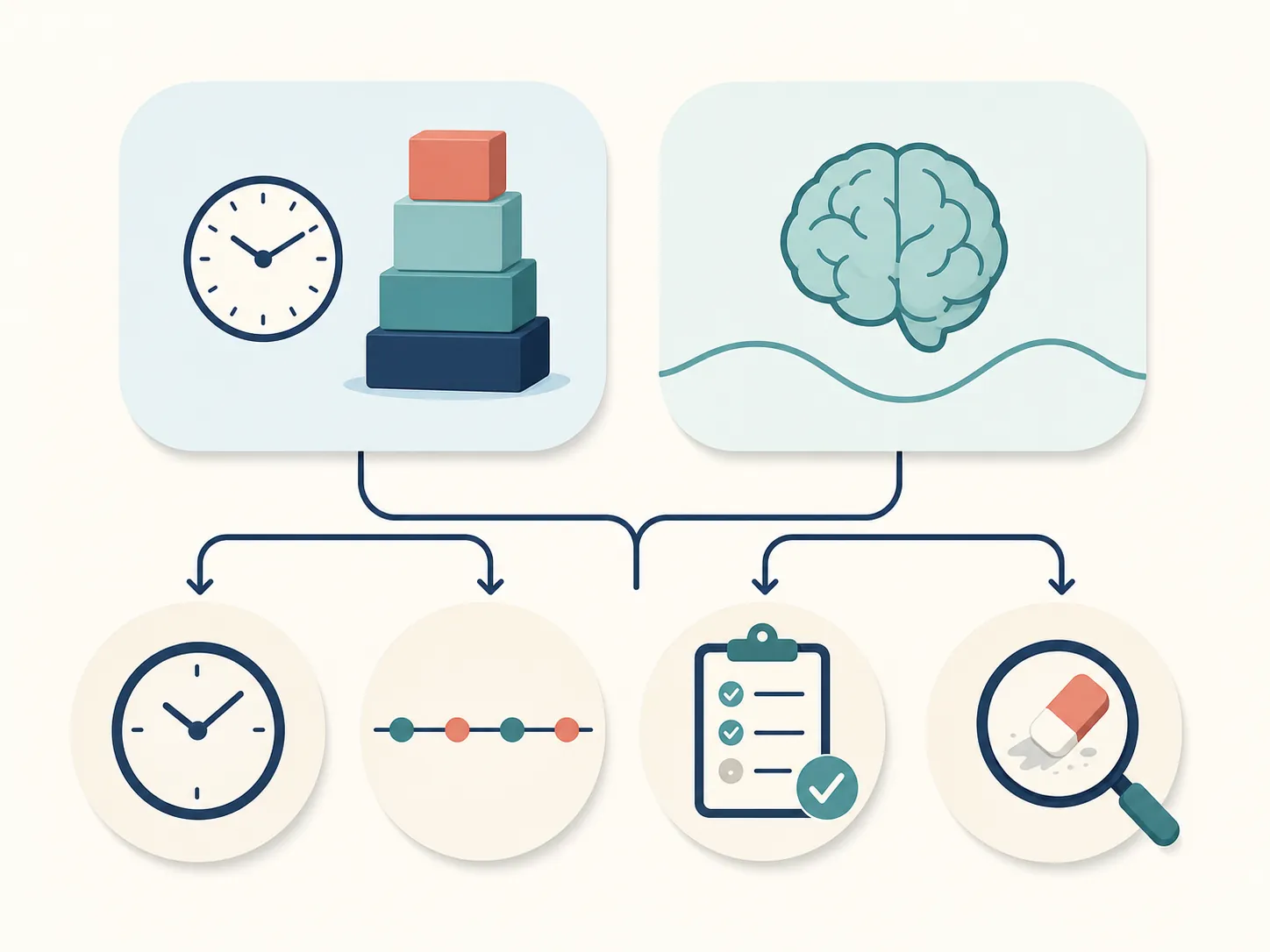
This is where personality research is more useful, but only if it is translated into behavior. Albar and colleagues studied 309 medical students and found that conscientiousness was positively correlated with several learning-strategy measures, including Motivation at r=0.68, Time Management at r=0.64, Concentration at r=0.56, and Test Strategies at r=0.41. Neuroticism was negatively correlated with Anxiety at r=-0.56 and Test Strategies at r=-0.39.[3] Those are correlations, not destiny and not a personalized prescription. Still, they point toward the right inspection points: consistency, planning, concentration, anxiety, and strategy.
A broader meta-analysis by Poropat also found that conscientiousness correlates with academic performance largely independently of intelligence.[4] Again, that does not mean “be more conscientious” is a study plan. It means that the habits clustered under conscientiousness—showing up, managing time, finishing assigned work, checking quality—deserve more attention than a quiz category that only tells you which format you like.
| Audit area | Ask this before changing your methods | What the answer changes |
|---|---|---|
| Start behavior | When a study block is on the calendar, do I begin on time or bargain it away? | If starting is weak, make sessions shorter, visible, and tied to a specific first task. |
| Spacing | Is my work spread across days, or do I depend on long catch-up sessions? | If spacing is weak, distribute practice before adding new resources. |
| Completion | Do I finish practice sets and timed sections, or stop when difficulty rises? | If completion is weak, reduce set size but require full review. |
| Error review | Can I explain why my wrong answers were tempting? | If review is weak, build an error log before buying another content course. |
| Anxiety | Do I avoid timed practice because I do not want to see the score? | If anxiety is high, use lower-stakes practice tests and predictable review routines. |
| Strategy | Do I know how the exam asks questions, manages time, and sets traps? | If strategy is weak, practice in the exam’s format instead of only studying content. |
The point is not to diagnose yourself as a conscientious or anxious person. The point is to notice the study behavior early enough to change tomorrow’s block. A student who keeps missing planned sessions needs a different fix from a student who studies daily but never reviews missed questions. A student who understands content but panics under time pressure needs a different fix from a student who is calm and underprepared.
The default pair: practice testing plus distributed practice
Once you have the behavior audit, you still need techniques. This is where the evidence becomes refreshingly plain. Dunlosky’s review for American Educator rated practice testing and distributed practice as the only two high-utility techniques among ten reviewed. Lower-utility techniques included rereading, highlighting, summarization, and keyword imagery.[5]
That does not mean you can never highlight or summarize. It means those methods should not be the center of an exam plan just because a quiz says you are a certain kind of learner. For score improvement, the safer default is to retrieve information from memory, face exam-like questions, space the work across days, and review the evidence your misses give you.

Here is how the audit turns into planning decisions:
- If your consistency is low, shrink the study block before you change the study style. A reliable 30-minute block with five exam questions and review is more useful than a fantasy three-hour block that keeps sliding to tomorrow.
- If your spacing is weak, stop treating the calendar as empty space. Put practice on separate days first, then decide which content review belongs around it.
- If your anxiety is high, make practice testing routine instead of dramatic. Use lower-stakes sets, predictable timing, and a review script so every score produces a next action.
- If your test strategy is weak, move closer to the real exam format. Untimed content notes may feel productive, but the exam will ask you to choose under constraints.
- If your review is shallow, slow down after the answer key. For each miss, record the content gap, the trap, the time decision, or the careless step that caused it.
This is less entertaining than a quiz result, but it gives you a lever. “I am a visual learner” does not tell you whether to take a diagnostic section tonight. “I avoid timed sections because the number makes me anxious” does.
What to do with preferences without letting them run the plan
Preferences still have a place. They can help you choose tools, make review less unpleasant, and reduce friction. If a diagram helps you compare grammar rules, use it. If walking while reciting formulas keeps you engaged, fine. If an app’s interface makes you more likely to open it after dinner, that matters.
The boundary is simple: use preferences to make the evidence-based work easier to do, not to replace the work. A visual preference can shape your error log layout. It should not excuse skipping retrieval practice. An audio preference can make commute review useful. It should not become the reason you never sit for a timed reading passage.
If you are choosing apps, formats, or study environments, a preference-first resource can still be useful as a tool-selection guide. Treat a learning-style app stack as a way to make studying more tolerable, not as proof that matching a visual, auditory, or kinesthetic label raises exam scores.
Put the audit inside the exam you are actually taking
A personality-style result usually floats above the exam. Your plan cannot. The SAT, GRE, MCAT, ACT, and ASVAB differ in content, timing, section structure, and scoring goals. Your self-audit should feed an exam-first plan, not sit next to it like a separate identity.
Start with the exam’s demands, then map the behavior audit onto them. For the SAT, that may mean using the SAT prep guide to organize sections and timing, then using the score-gap method to decide which gaps deserve the next block. For the ASVAB, use the ASVAB exam prep guide before choosing drills, because broad “study style” advice will not tell you which subtests are carrying the consequence.
If you want more technique depth after the audit, stay close to methods that force retrieval, spacing, and discrimination between tempting answers. A piece on whether NYT Connections counts as vocabulary study is useful for separating game-like exposure from exam-grade practice. For mixed practice and pattern detection, Yu Deng’s random data theory and better study techniques can sit downstream from the same question: what will make your next practice session more diagnostic?
A study-style test you can use tonight
If you wanted a quiz, use this instead. It is not a personality score. It is a quick way to decide what tomorrow’s study block should repair.
- Write down your next exam date and the score or outcome you are aiming for.
- List the last three study sessions you actually completed, not the ones you intended to complete.
- For each session, mark whether it included practice testing, spaced review, error analysis, or only passive review.
- Name the biggest blocker: starting, spacing, finishing, anxiety, strategy, or review.
- Build the next block around that blocker, using practice testing and distributed practice as the default pair.
- Use your preferences only to make that block easier to begin and finish.
So if diagrams help, draw the diagram after you try to retrieve the process from memory. If audio helps, listen after you have tried to explain your missed questions. If color coding helps, color code the error log, not the illusion that rereading is the same as knowing. The plan should be built from deadline, exam format, practice evidence, and the behaviors most likely to break under pressure.
References
- The Myth of “Learning Styles”, University of Michigan Online Teaching
- Evidence-Based Higher Education – Is the Learning Styles “Myth” Important?, 2017
- Interplay between personality traits and learning strategies: the missing link, 2022
- A meta-analysis of the five-factor model of personality and academic performance, PubMed, 2009
- Strengthening the Student Toolbox, American Federation of Teachers, Fall 2013
Related exhibits & inventory
Verified outcomes
No verified outcomes on file for this exam yet
See Methodology for how outcome evidence is disclosed once logged.
Planners
No planner filed for this exam yet
A downloadable timeline template for this exam hasn't been published yet.
Tool verdicts
AI-tool cautions
No AI tools tested for this exam yet
No hands-on AI-accuracy logs have been filed for this exam.
Questions about this plan
Ask a question about a specific section, timeline, or citation in this plan — or flag something that needs correcting.
Comments
Join the discussion with an anonymous comment.