
SAT, ACT, GRE, MCAT, ASVAB Planner
Why heat waves hurt your studying—and how to plan around it
Last reviewed: Q3 2026. If your timed set suddenly feels slower, sloppier, and more irritating during a heat wave, start with the evidence label: this is not automatically a discipline problem. The best heat-wave study tips begin by protecting the cognitive work your SAT, ACT, GRE, MCAT, ASVAB, or course exam actually requires.
The research is strong enough to change a study plan. It is not precise enough to tell you, “Your room was 8 degrees warmer, so your score dropped exactly X points.” The most relevant field evidence comes from a Harvard-led study of 44 young adults in Greater Boston during a summer heat wave: students in non-air-conditioned dorm rooms averaged 26.3°C indoors, compared with 21.4°C in air-conditioned rooms, and performed worse on morning cognitive tests after waking. Their Stroop reaction time was about 13.4% slower, their throughput was about 9.9% lower, and the overall cognitive reductions reported across measures ranged from 4.1% to 13.4%.[1]

Heat does not have to ruin a study day, but it can change what the day is good for
The Harvard study matters because it looks uncomfortably close to real studying. It was not a lab puzzle performed by people in abstract “hot conditions.” It followed students living in dorms, sleeping overnight, waking up, and taking brief cognitive tests in the morning. That is close to the student who opens a practice test at the kitchen table and wonders why their brain feels delayed.
The study also gives a useful boundary. It was a small observational field cohort, not a universal score-prediction machine: 44 participants, one Greater Boston summer, and testing right after waking.[1] Treat the numbers as a serious warning about cognitive burden, not as a personal penalty calculator.
That distinction matters because standardized-exam students often respond to one bad practice block by adding more work in the same conditions. If the room is doing part of the damage, more grinding at the worst hour may only give you more evidence that you are frustrated. The better response is to move the work that needs sustained attention, working memory, and fast error-checking into the coolest blocks you can control.
Why timed exams are especially exposed
A heat-wave slump does not hit every task the same way. A 2024 review in Frontiers in Psychology found that acute heat stress most consistently impairs complex cognition, including sustained attention, vigilance, and working memory, while simpler tasks are more resistant. The same review also notes evidence that office-type performance degrades above roughly 23°C.[4]
That is exactly why test prep can feel disproportionately bad in heat. A standardized exam is not just “knowing content.” It asks you to hold a condition in working memory while comparing answer choices, carry a multi-step math setup without losing a sign, read a dense passage while the clock is running, and maintain vigilance long enough to catch the trap in question 37 after already answering 36 questions.
Math deserves special attention because the school-performance evidence points in the same direction, even though it comes from a different setting than solo bedroom prep. A Yale-linked study reported that test days above 32°C reduced math scores by about 0.066 standard deviations, described as roughly a quarter year of schooling, and that air conditioning offset 36.6% of the effect but did not eliminate it.[2] NWEA reported in 2025 that math scores were about 0.05 standard deviations lower on 81–100°F test days, while reading was unaffected; it also reported a counterintuitive 0.06 standard deviation increase above 101°F and about double the impact in high-poverty schools.[3]
Those Yale and NWEA findings are broader academic-performance context, not a direct measurement of your apartment, dorm room, library carrel, or shared-house study setup. They use school-day temperature conditions, not your exact indoor practice-test environment. Still, they support a practical judgment: timed math-heavy work is a poor thing to schedule casually into the hottest part of the day.
Build the day around temperature, not guilt
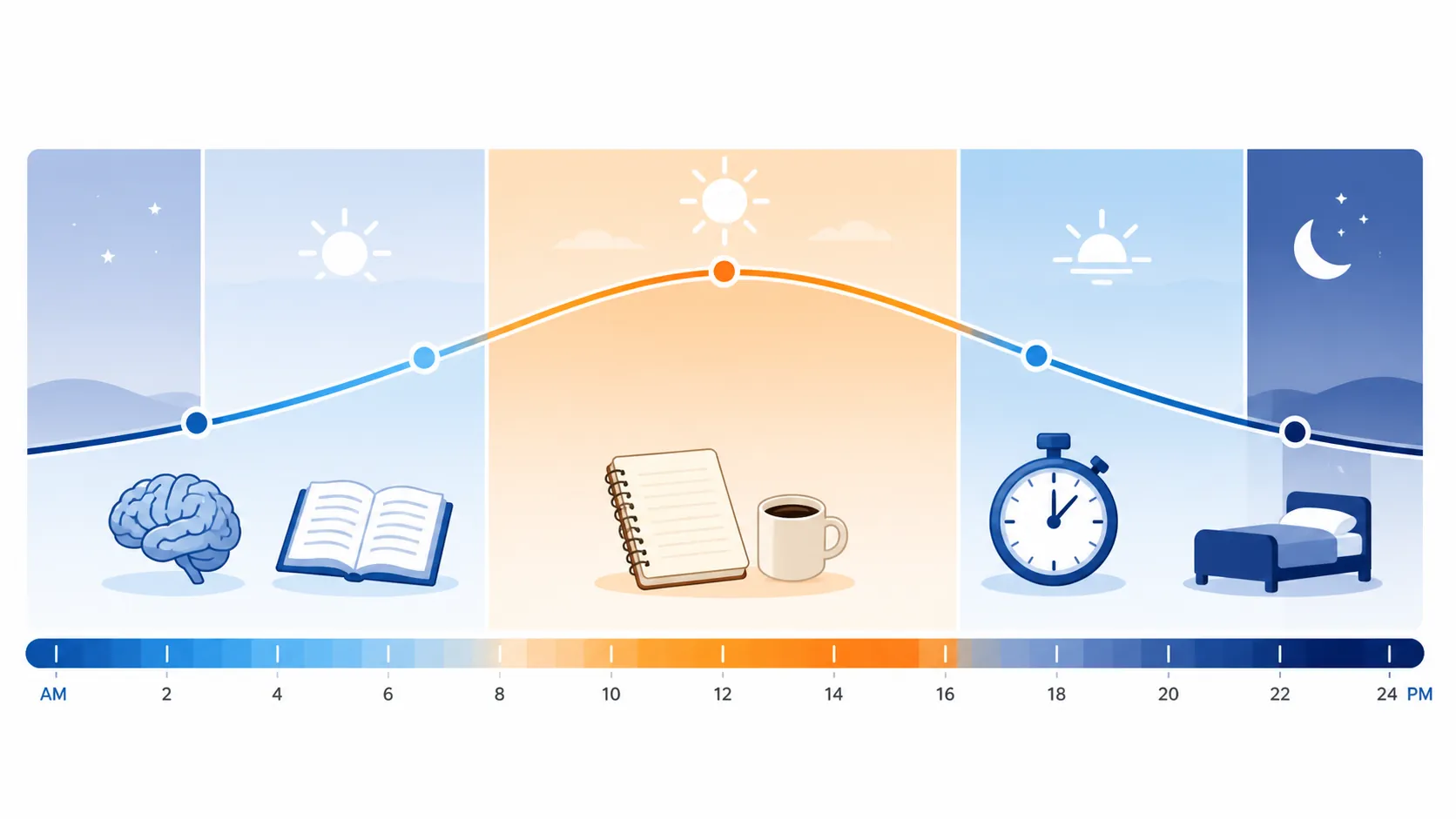
During a heat wave, the question is not “Can I study?” It is “Which kind of studying belongs in this room at this hour?” A useful plan separates heavy cognitive work from lower-load review.
| Part of the day | Best use during a heat wave | What to avoid if the room is hot |
|---|---|---|
| Coolest reliable block, often early morning | Timed math, passage sets, full explanations, new concepts, difficult error review | Starting with email, passive videos, or chores while the best cognitive window disappears |
| Warming late morning or midday | Flashcards, formula recall, light content review, organizing missed questions, printing materials | High-stakes timed sections that you will treat as a verdict on your ability |
| Peak indoor heat | Breaks, errands, administrative prep, very light review, relocating if possible | Long MCAT-style passage blocks, GRE quantitative drills, SAT/ACT math sections, ASVAB arithmetic reasoning marathons |
| Cooler evening, if your room actually cools | Short timed sets, review of morning mistakes, practice-test corrections | A full-length test if the room is still trapping heat |
| Night | Cooling the room, protecting sleep, setting up the morning block | Treating sleep loss as a harmless trade for one more overheated drill set |
The practical move is simple: put your hardest block at the coolest time you can consistently access. If the only quiet cool time is 6:30–8:30 a.m., that is where your highest-value work goes. Do not spend that block rereading notes you already understand. Use it for the tasks that heat is most likely to damage: timed reasoning, multi-step math, passage analysis, and error review that requires you to reconstruct why the wrong answer tempted you.
Warmer blocks still have a place. They are better for tasks with lower working-memory demand: sorting a missed-question log, labeling question types, reviewing formulas, doing spaced flashcards, or watching a targeted explanation at normal speed. If you use spaced repetition, the heat-aware version is not “abandon review.” It is to move fragile new learning and difficult recall into better conditions and leave maintenance review for the less ideal hours. For more on choosing a spaced-review system, see StudyMethod’s Anki vs. Quizlet vs. Knowt vs. Brainscape comparison.
Move full-length practice tests out of peak heat when possible
Full-length practice tests are the easiest place to waste a day during a heat wave. They combine all the vulnerable ingredients: sustained attention, timed pressure, working memory, reading endurance, and math accuracy. If your room peaks in the afternoon, do not start a full-length test at noon just because that was the original plan.
Move the test earlier, move it later, or split your diagnostic purpose from your endurance purpose. For example, if you need a clean read on SAT timing, schedule the test during a cooler window and use tools such as Khan Academy SAT practice with Bluebook deliberately. If the day is too hot for a trustworthy score signal, switch to a smaller practice-question block and use SAT practice questions for targeted review instead of pretending the full-length result is clean.
There is one exception: if your real exam is likely to happen in a warm testing center, you may want some realistic practice under imperfect conditions. Even then, do not make every hard practice block a heat-stress experiment. Use one or two controlled exposures only after you already have a baseline from better conditions.
Protect the night before, because heat can steal the morning
The Harvard dorm study did not only find hotter rooms and slower morning performance. It also reported that each 1°C warmer overnight room temperature was associated with about 2.74 fewer minutes of sleep.[1] That sounds small until a warm room stays warm night after night. For a test-taker, the damage is not only the unpleasant night; it is the next morning’s supposedly “fresh” study block starting with less sleep behind it.

This is where generic heat advice becomes relevant only if it changes the next day’s calendar. Cooling the sleep environment is not a wellness extra; it protects the block where your most difficult studying should happen. Open windows when the outside air is cooler than the room, close blinds before direct sun heats the space, and move the next day’s materials into place before bed so the cool morning does not get spent looking for a charger.
The World Health Organization recommends ventilating at night when outdoor air is cooler, limiting indoor heat gain, and using fans only when the air temperature is below 40°C; it also gives a practical fluid pacing target of about one cup of water per hour during heat exposure.[6] The University of Warwick’s student toolkit offers heat-study tactics in the same practical lane, but these are student-support recommendations, not exam-performance experiments.[7]
Hydration needs a slot, not a slogan
“Drink water” is too vague to be a study plan. The useful version is scheduled: water before the hard block, water available during it, and a refill point before you start the next task. A review on dehydration and cognition reported that around 2% dehydration can impair attention, psychomotor skill, and immediate memory.[5] Those are not fringe skills for exams; they are part of reading accurately, marking answers correctly, and holding a calculation long enough to finish it.
Do not turn hydration into another form of panic. The goal is steady availability and pacing, not chugging a large amount right before a timed section and then needing to stop. If you are taking medication, have a medical condition, or have been told to limit fluids, follow medical guidance rather than a generic study article.
A heat-aware study day
Here is the planner version. Adjust the clock times to your local temperature pattern, your work schedule, and your household constraints.
- Before bed: set up the next morning’s materials, charge devices, block sunlight if the room heats early, and ventilate only when outside air is cooler.
- Cool morning block: do the hardest timed work first. For SAT/ACT, that usually means math or dense reading. For GRE, quantitative reasoning or text-completion review with strict timing. For MCAT, passage sets and review. For ASVAB, arithmetic reasoning and word knowledge drills that require active recall.
- Late morning: review the missed questions from the first block while the reasoning is still fresh. Do not wait until the room is at its worst to reconstruct your mistakes.
- Hottest period: switch to low-load work, relocate, rest, or handle logistics. If you must study, use short sessions and stop treating speed as a clean measure of ability.
- Cooler evening: do a shorter timed set or targeted review if the room actually cools. If it does not, protect sleep and preserve the next morning.
The plan changes if you have access to a cooler location. A public library, campus building, community center, or air-conditioned room can become your “hard-block site.” If the commute is short enough, reserve that location for high-value work rather than spending the coolest environment on passive review.
If you cannot relocate, narrow the ambition of the hottest block. A student in a non-AC apartment may still make progress by doing one short error-log pass, ten flashcards, or a formula sheet rewrite. That is not the same as conceding the day. It is refusing to use the worst conditions for the task most likely to be distorted by them.
How to read a bad practice result during a heat wave
A hot-room practice score is information, but it is not always the information you think it is. Look at the error pattern before changing your whole study plan. Heat-related errors often look like lapses in execution: skipped words, arithmetic slips, slower reaction time, rereading the same sentence, losing track of a condition, bubbling or clicking the wrong answer, or running out of time on problems you can solve when untimed.
Content gaps look different. If you do not know a geometry rule, an amino acid property, a grammar convention, or a vocabulary meaning, cooler air will not teach it to you. The heat-aware response is not to excuse every miss. It is to separate “I never learned this” from “I could not execute reliably in this environment.”
| If the miss looks like... | Treat it as... | Next action |
|---|---|---|
| You knew the method but made a simple arithmetic or reading slip | Possible execution strain | Redo the item later in a cooler block before calling it a content weakness |
| You could not remember the rule, formula, definition, or concept | Content gap | Schedule direct instruction or active recall in the next cool block |
| You lost time across the whole section | Possible heat, pacing, or endurance issue | Repeat a shorter timed set in better conditions and compare |
| Only math collapsed while reading held steady | A pattern worth watching | Move math to the coolest block for several days and track whether accuracy recovers |
| Everything declined after a poor night of sleep | Sleep-protection issue | Adjust the evening environment and reduce late overheated drilling |
Put the heat adjustment inside your exam plan
The heat-wave plan should not live in a separate wellness notebook. It belongs inside the same calendar that decides when you take diagnostics, when you review missed questions, and when you taper before test day. If you are building or revising that calendar, start with StudyMethod’s study planners and then adjust the hardest blocks toward the coolest hours you can realistically protect.
For exam-specific work, keep the environmental adjustment attached to the exam’s actual demands. SAT students can use the SAT score-gap method to decide which sections deserve the protected cool block. ASVAB students can use the ASVAB exam prep guide to keep arithmetic reasoning, word knowledge, and mechanical comprehension from being dumped into whatever hour is left.
Cooling a room will not magically rescue a score, and the research does not justify pretending it will. But if heat is degrading the same complex skills your exam tests, the rational response is not to prove your toughness at the hottest hour. Move the hardest work into the best conditions you can control.
References
- Reduced cognitive function during a heat wave among residents of non-air-conditioned buildings: An observational study of young adults in the summer of 2016, PLOS Medicine, 2018.
- Yale study: Abnormally hot days could impact your cognitive skills, Yale School of Public Health.
- New NWEA research examines impact of heat on academic outcomes, NWEA, 2025.
- The impact of heat stress on human cognition: a systematic review and meta-analysis, Frontiers in Psychology, 2024.
- Cognitive performance and dehydration, PubMed, 2012.
- Tips for keeping cool, World Health Organization.
- Studying in the heat, University of Warwick.
Fill in this timeline
This is a skeleton schedule, not a performance claim — for section-by-section strategy to fill in each slot, read the exam hub. For evidence that a similar timeline worked, compare against real outcome logs.