
ASVAB Exam Hub
The 2026 Lunar Eclipse as Your Astronomy Exam Study Guide
Study for an intro astronomy lunar-eclipse exam using the real August 27–28, 2026 deep partial lunar eclipse as a worked example. The guide maps the event's verified numbers — umbral magnitude, obscuration, contact times, and Saros 138 — onto the definitions, data-interpretation skills, and practice-question formats the test actually asks, with a short review plan to follow.
- gre
- mcat
- asvab
- sat
- act
- digital-adaptive
- official-material
- section-strategy
- test-date-timeline
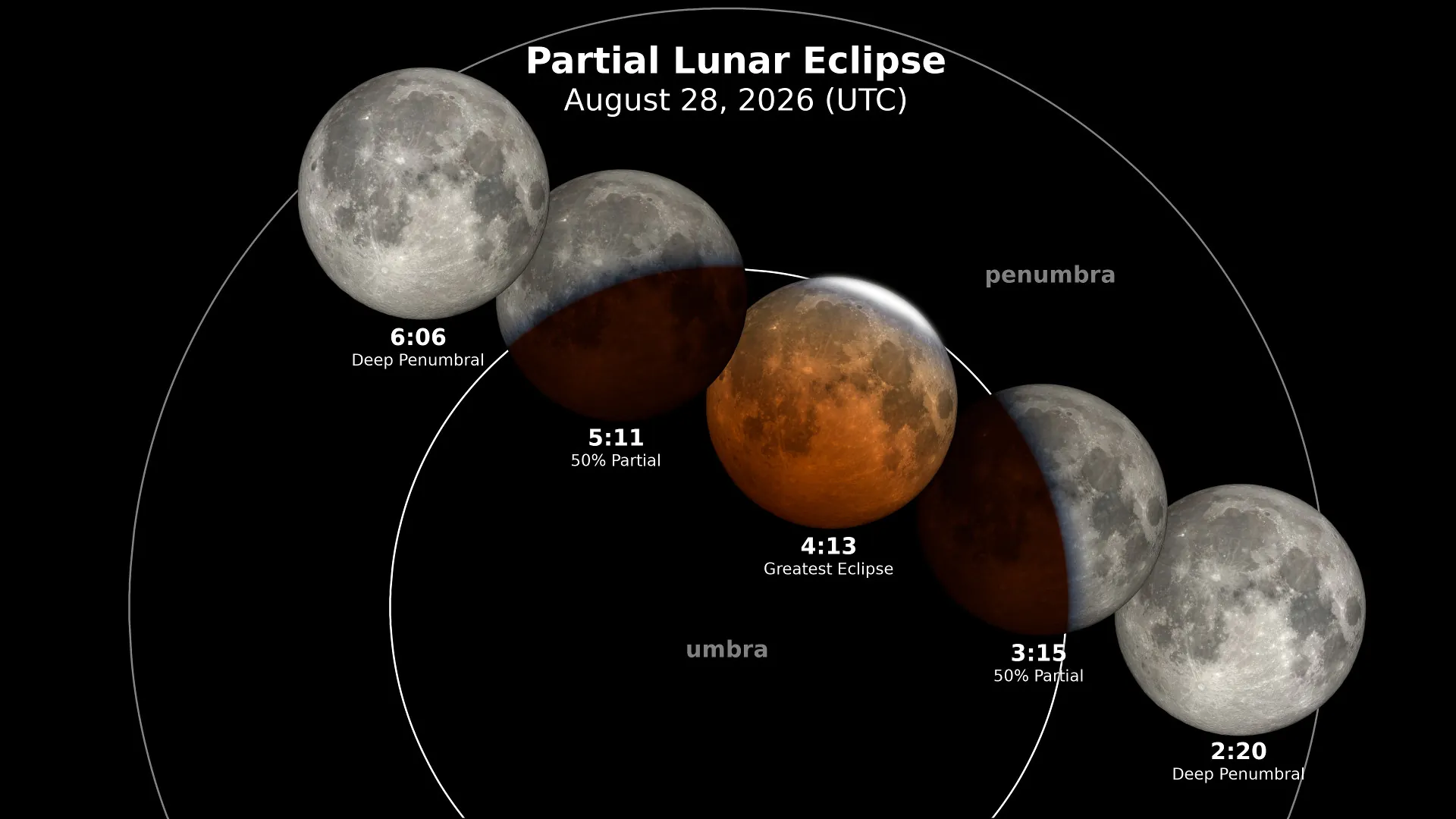
Put the August 27–28, 2026 lunar eclipse on the desk as if it were the data sheet for your exam. The useful facts are not “blood moon” or “Earth’s shadow” by themselves. The useful facts are the ones an exam can turn into a diagram, a sequence question, or a number trap: umbral magnitude 0.9299, about 96% obscuration, P1 at 01:23 UT, U1 at 02:33 UT, greatest eclipse at 04:13 UT, U4 at 05:52 UT, P4 at 07:02 UT, gamma 0.4964, and Saros 138, member 29 of 82.[1][2]
Last reviewed: August 2026. This guide treats the 2026 eclipse as an exam worked example, not mainly as a viewing guide. If you need the when-to-watch version, use the companion partial lunar eclipse explainer. Here, the goal is the astronomy test: the same concepts show up in high-school Earth/space science, college AST 101, ASVAB General Science astronomy review, and ACT Science earth/space passages.
| 2026 eclipse fact | What an exam can ask you to do with it |
|---|---|
| Deep partial lunar eclipse on August 27–28, 2026 [1] | Classify the eclipse type from data, not from a dramatic headline. |
| P1 01:23 UT, U1 02:33 UT, greatest 04:13 UT, U4 05:52 UT, P4 07:02 UT [1] | Put contact labels in order and identify penumbral versus umbral stages. |
| Umbral magnitude 0.9299 [1] | Recognize that the Moon does not become totally immersed in the umbra because the value is less than 1.0. |
| About 96% obscuration [2] | Keep area covered separate from diameter immersed. |
| Penumbral magnitude 1.9645 and gamma 0.4964 [1] | Read shadow-geometry clues from a catalog table. |
| Saros 138, member 29 of 82 [1] | Connect one eclipse to a repeating family rather than to the Moon’s ordinary monthly orbit. |
Start with the contact labels, not the nickname
A lunar eclipse happens at full Moon when the Moon passes through Earth’s shadow. Earth’s shadow has a darker central umbra and a lighter outer penumbra. That is already enough vocabulary to decode the 2026 contact labels: P means penumbra, U means umbra, and “greatest” means the moment of deepest passage through the shadow.[3]
| Contact label | 2026 time | Plain exam meaning |
|---|---|---|
| P1 | 01:23 UT | The Moon first enters Earth’s penumbra; the eclipse begins subtly. |
| U1 | 02:33 UT | The Moon first enters the umbra; the partial eclipse begins. |
| Greatest eclipse | 04:13 UT | The Moon is deepest in Earth’s shadow. |
| U4 | 05:52 UT | The Moon leaves the umbra; the partial phase ends. |
| P4 | 07:02 UT | The Moon leaves the penumbra; the eclipse is over. |
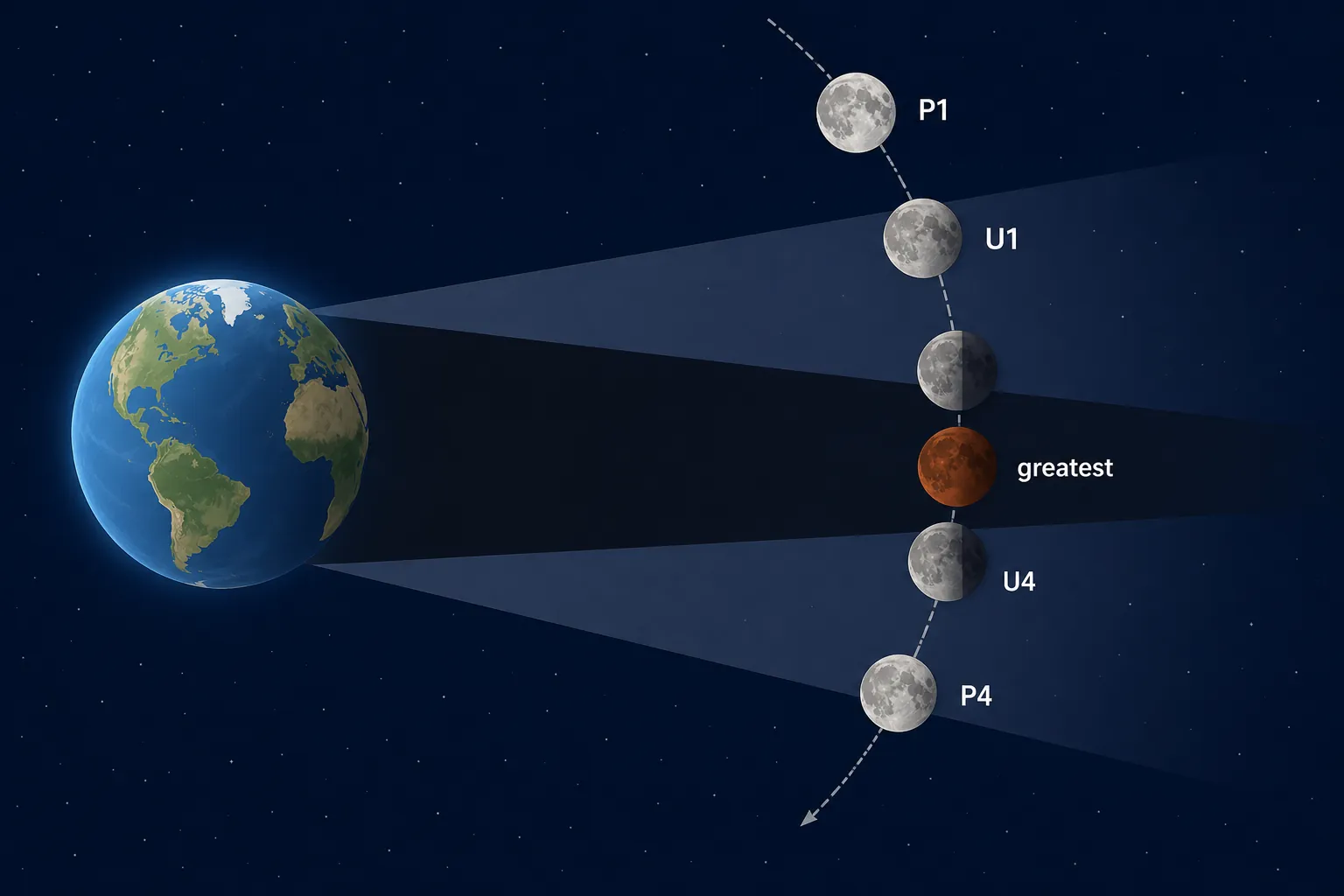
That table is the cleanest way to avoid a common miss: P1 is not when the “visible bite” necessarily becomes obvious, and U1 is not greatest eclipse. P1 and P4 mark the outer penumbral boundary. U1 and U4 mark the darker umbral boundary. If an exam gives only the labels, sketch the Moon crossing a wide faint shadow first, then a smaller dark shadow, then leaving in reverse order.
For the 2026 event, the umbral phase runs from 02:33 UT to 05:52 UT, while the whole penumbral-to-penumbral sequence runs from 01:23 UT to 07:02 UT.[1] If a test asks which interval is the partial lunar eclipse, use U1 to U4. If it asks for the entire eclipse event, use P1 to P4.
The number trap: 0.9299 magnitude is not the same as 96% obscuration
This is the point to slow down. The NASA catalog gives the August 2026 eclipse an umbral magnitude of 0.9299.[1] Sky & Telescope describes the same event as having roughly 96% of the lunar disk obscured, while also noting the magnitude as about 0.93.[2] Those numbers are not competing answers to the same question.
Umbral magnitude is tied to the fraction of the Moon’s diameter immersed in Earth’s umbra at maximum. Obscuration refers to the fraction of the Moon’s visible surface area covered. Diameter and area do not scale the same way, especially when a curved shadow covers most, but not all, of a circle.
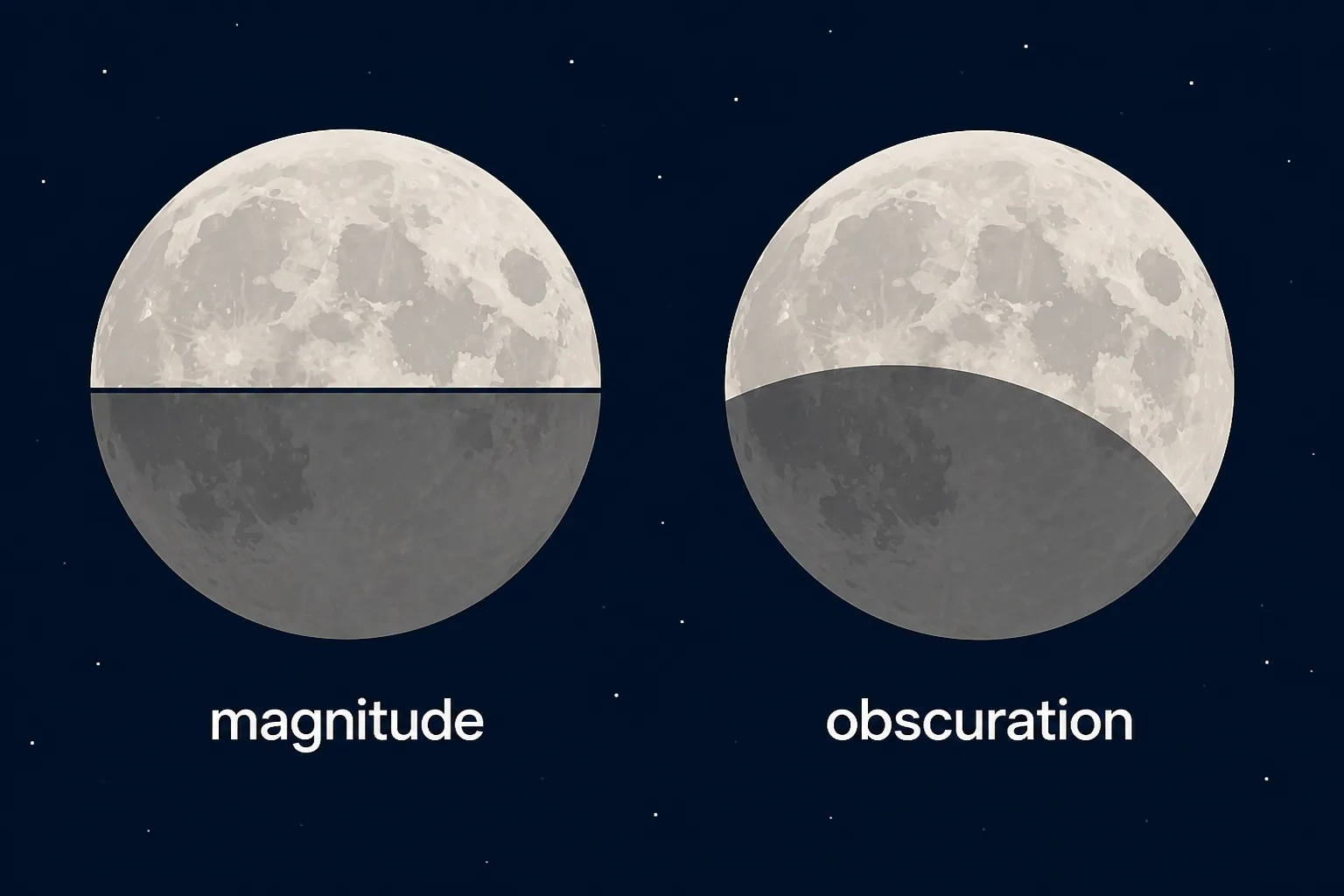
That is why the classification remains “partial.” A total lunar eclipse would require the Moon to be completely inside the umbra. In catalog language, an umbral magnitude below 1.0 means the Moon is not fully immersed in the umbra. The August 2026 value, 0.9299, is close to total but still short of it.[1]
If your instructor rounds the magnitude to 0.93, that is normal. If a source rounds the obscuration to about 96%, that is also normal. What you should not do is write “magnitude = 96%.” On an exam, that turns a careful data-reading item into a preventable wrong answer.
Why a deep partial eclipse can still look red
The red color is not a separate kind of eclipse. It is what can happen to sunlight on its way through Earth’s atmosphere before it reaches the Moon. NASA explains lunar-eclipse redness through Rayleigh scattering and refraction: shorter blue wavelengths scatter away more easily, while redder light is bent through Earth’s atmosphere into the shadow. NASA’s wording is memorable because it is physically useful: the effect is “as if all the world’s sunrises and sunsets are projected onto the Moon.”[3]
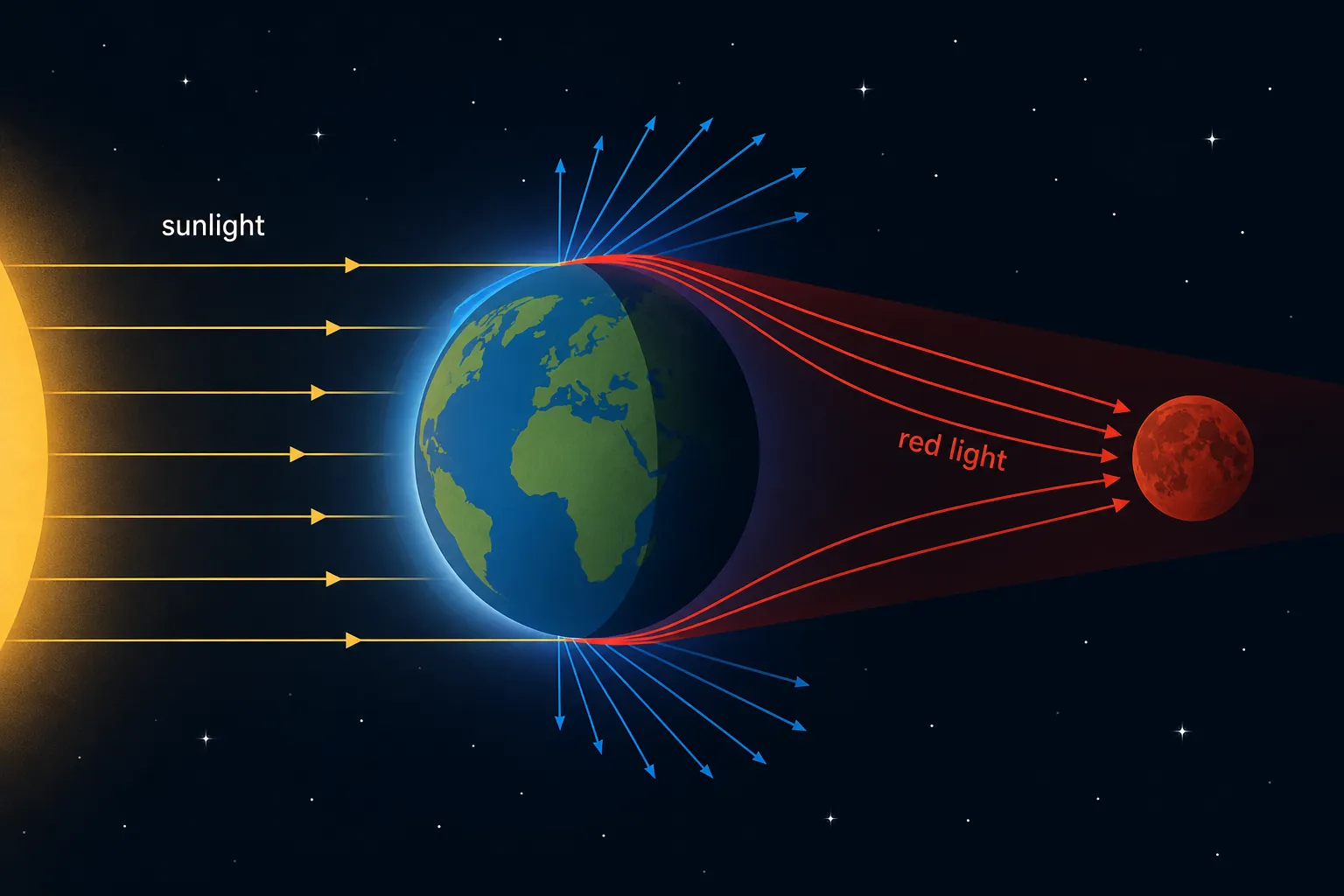
For the August 2026 eclipse, that explanation matters because the event is deep partial. Most of the Moon enters the umbra near maximum, so the shadowed portion can take on the reddish color students associate with “blood moon” coverage. But the correct classification still comes from the geometry: not all of the Moon enters the umbra.
A solid exam answer therefore separates appearance from classification. Red color explains what the shadowed part may look like. Umbral magnitude explains whether the eclipse is partial or total.
Why there is no lunar eclipse every full Moon
A lunar eclipse requires a full Moon, but a full Moon is not enough. The Sun, Earth, and Moon also have to line up closely enough for the Moon to pass through Earth’s shadow. NASA’s eclipse overview ties lunar eclipses to the full-Moon phase and the geometry of Earth’s umbra and penumbra, which is the reason the phase requirement and the alignment requirement have to be learned together.[3]
The missing word in many rushed answers is “node.” The Moon’s orbit is tilted relative to Earth’s path around the Sun, so most full Moons pass above or below Earth’s shadow. Eclipses happen when the full Moon occurs near one of the points where the Moon’s orbit crosses the Sun-Earth plane. Those crossing points are the nodes.
Use the August 2026 event this way: full Moon tells you the phase; Earth’s umbra and penumbra tell you the shadow zones; node alignment tells you why this full Moon becomes an eclipse while most full Moons do not. If a question asks, “Why don’t lunar eclipses occur every month?” the answer is not “because the Moon is sometimes new.” It is because the full Moon usually is not lined up with Earth’s shadow near a node.
Saros 138 is recurrence, not the Moon’s monthly motion
NASA lists the August 2026 lunar eclipse in Saros 138 as member 29 of 82.[1] NASA’s Saros 138 catalog places that series across the years 1521 to 2982.[4] Those facts are useful only if you attach them to the right idea: a Saros is an eclipse-recurrence pattern, not the same thing as the Moon going around Earth once.
A typical trap answer says, “The eclipse repeats every month because the Moon orbits Earth every month.” That confuses ordinary lunar motion with eclipse alignment. The Moon reaches full phase about once per cycle, but the Sun-Earth-Moon geometry does not line up with a node every time. Saros numbering is about families of eclipses with similar geometry, separated by a much longer recurrence interval than a month.[4]
For a test, remember three levels instead of one loose fact: the Moon’s monthly motion gives phases, node alignment allows eclipses, and the Saros family connects similar eclipses across long spans of time.
Visibility is useful context, but it is not the main exam skill
NASA’s August 2026 skywatching note says the deep partial lunar eclipse is visible across much of North and South America and parts of Europe and Africa, with about 93% of the Moon’s diameter in Earth’s umbra at maximum.[5] That is worth knowing if you plan to observe it, but it is secondary for the exam compared with the shadow geometry and the magnitude-versus-obscuration distinction.
For observation and measurement work, use the companion guides on measuring a partial lunar eclipse and the event explainer linked above. A study guide does not need to become five tabs of skywatching logistics.
Practice questions that use the 2026 data
These are not trivia questions about one night in 2026. They are the formats an intro astronomy exam can use after giving you an eclipse diagram, a short paragraph, or a catalog table.
- Question: A lunar eclipse table lists P1 = 01:23 UT, U1 = 02:33 UT, greatest = 04:13 UT, U4 = 05:52 UT, and P4 = 07:02 UT. Which interval is the partial umbral eclipse? Answer: U1 to U4, or 02:33 UT to 05:52 UT. P1 to P4 is the whole penumbral-to-penumbral event.[1]
- Question: The umbral magnitude is 0.9299. Is the eclipse total? Answer: No. Because the umbral magnitude is less than 1.0, the Moon is not completely immersed in Earth’s umbra. It is a deep partial lunar eclipse.[1]
- Question: A news headline says the eclipse has about 96% obscuration. Another table gives magnitude 0.9299. Which number decides whether the eclipse is total? Answer: The umbral magnitude. Obscuration describes surface area covered; magnitude describes diameter immersed in the umbra.[1][2]
- Question: Why might the Moon look reddish even though the eclipse is partial? Answer: The shadowed part of the Moon can receive redder sunlight refracted through Earth’s atmosphere after shorter blue wavelengths scatter away. Red color is an appearance effect; it does not make the eclipse total.[3]
- Question: Why is a full Moon required for a lunar eclipse, and why is it not sufficient? Answer: A lunar eclipse requires the Moon to be opposite the Sun with Earth between them, which is the full-Moon geometry. It also requires the Moon to be near a node so it passes through Earth’s shadow instead of above or below it.[3]
- Question: The eclipse is listed as Saros 138, member 29 of 82. What concept does that test? Answer: Eclipse recurrence. Saros membership connects this eclipse to a long family of similar eclipses; it is not the same as saying eclipses occur every lunar month.[1][4]
- Question: Which is safe to view without special filters: a lunar eclipse or a solar eclipse? Answer: A lunar eclipse. NASA Space Place distinguishes lunar-eclipse viewing from solar-eclipse viewing, where proper solar filters are required to protect your eyes.[6]
A short review plan for the next two weeks
This review plan is a study recommendation, not a sourced claim about how long learning takes. Use it if your lunar-eclipse exam is close and you need the material to become usable fast.
- Redraw the 2026 contact sequence from memory: P1, U1, greatest, U4, P4. Label penumbra and umbra before you add times.
- Write one sentence that classifies the event: “The August 27–28, 2026 eclipse is deep partial because its umbral magnitude is 0.9299, below 1.0.”
- Write a second sentence that separates the numbers: “Magnitude is a diameter measure; obscuration is an area measure.”
- Explain the red color without using the phrase “blood moon” until the end. Your answer should include scattering, refraction, and Earth’s atmosphere.
- Answer the node question out loud: full Moon is required, but node alignment is why eclipses do not happen every month.
- Use Saros 138 only after the mechanics are clear. Its job is recurrence, not basic phase order.
- If your course also uses astronomy passages for broader science-reading practice, compare this guide with StudyMethod’s other exam-hub science guides, such as the El Niño weather exam study guide and the California earthquake fault lines study guide. The subject changes; the data-reading habit does not.
If you can explain why the August 2026 eclipse is deep partial rather than total, read its P1-to-P4 contact sequence, keep magnitude separate from obscuration, and connect the event to nodes, red color, and Saros 138, you have turned one real eclipse into an exam-ready study guide.
References
- Eclipses During 2026 — NASA Eclipse Web Site
- Next Up! A Deep Partial Lunar Eclipse on Aug. 27–28 — Sky & Telescope
- Eclipses and the Moon — NASA Science
- Catalog of Lunar Eclipses in Saros 138 — NASA Eclipse Web Site
- What’s Up: August 2026 Skywatching Tips from NASA — NASA Science
- What Is an Eclipse? — NASA Space Place
Related exhibits & inventory
Verified outcomes
No verified outcomes on file for this exam yet
See Methodology for how outcome evidence is disclosed once logged.
Planners
No planner filed for this exam yet
A downloadable timeline template for this exam hasn't been published yet.
Tool verdicts
AI-tool cautions
No AI tools tested for this exam yet
No hands-on AI-accuracy logs have been filed for this exam.
Questions about this plan
Ask a question about a specific section, timeline, or citation in this plan — or flag something that needs correcting.
Comments
Join the discussion with an anonymous comment.