
SAT, ACT, MCAT, ASVAB, GRE Exam Hub
Hank Green's Plastic Recycling Argument, Explained
Hank Green's 2026 video argues plastic recycling fails because virgin plastic is nearly free, not because consumers sort poorly. This explainer reconstructs his claim-evidence chain — cheap feedstocks, costly sorting, polymer degradation, and industry knowledge since the 1970s — and models how to extract the same claim, evidence, and warrant on exam science passages.
- gre
- mcat
- asvab
- sat
- act
- digital-adaptive
- official-material
- section-strategy
- test-date-timeline
Start with Hank Green’s claim, not recycling folklore
Hank Green’s 2026 hankschannel video essay, There’s an Actual Reason You Can’t Recycle Plastic was uploaded on January 7, 2026, runs about 36 minutes and 33 seconds, and had more than 2.1 million views in the August 1, 2026 research snapshot used for this article. The same metadata page shows “No transcript to display,” so this is not a line-by-line recap or a pretend transcript reconstruction.[1]

That caveat matters. A student does not need to memorize the video’s exact order to understand the argument. The useful move is to identify the claim Green is making, separate the evidence from the examples, and explain the warrant — the hidden reasoning that connects the facts to the conclusion.
The official thesis is economic: plastic recycling cannot compete because the precursor chemicals used to make virgin plastic are, in the video’s framing, basically free.[1] Plastics News, writing about the video two days after upload, described it as “a take on why plastics recycling is broken without placing blame on individuals or recyclers.”[2] That is the right entry point. The issue is not that one household forgot to rinse a container. The issue is that the recycled material has to survive a much more expensive trip before it can become a usable input again.
The argument a test writer would make you prove
If this were a science or policy passage on an exam, the question would probably not ask, “Do you feel bad about plastic?” It would ask what the author’s central claim is, which evidence supports it, and why that evidence is supposed to prove the claim.
| Passage-analysis part | What it looks like in Green’s recycling argument |
|---|---|
| Claim | Plastic recycling is broken as a market, not mainly because consumers or local recyclers are careless. |
| Evidence | Virgin plastic begins with cheap, clean precursor chemicals, while recycled plastic begins as mixed, dirty waste that must be collected, sorted, cleaned, shredded, melted, pelletized, and remade. |
| Further evidence | Mechanical recycling can degrade polymers, and practical recycling is concentrated around a few plastics such as PET and HDPE rather than all plastic types. |
| Warrant | A higher-cost, often lower-quality input cannot reliably compete against a cheaper, cleaner virgin input unless something outside the ordinary market changes. |
That table is the article’s center of gravity. The recycling-rate statistics matter, but they are not the proof by themselves. A low rate tells you the outcome is bad. The economic chain explains why the outcome keeps happening.
Why cheap virgin plastic changes the whole reading
Virgin plastic starts as a controlled industrial input. The producer knows what chemical stream it is using, what polymer it wants, and what performance the customer expects. If the precursor chemicals are cheap enough to be treated as nearly free in the video’s framing, the finished virgin resin gets a major head start before recycling even enters the comparison.[1]
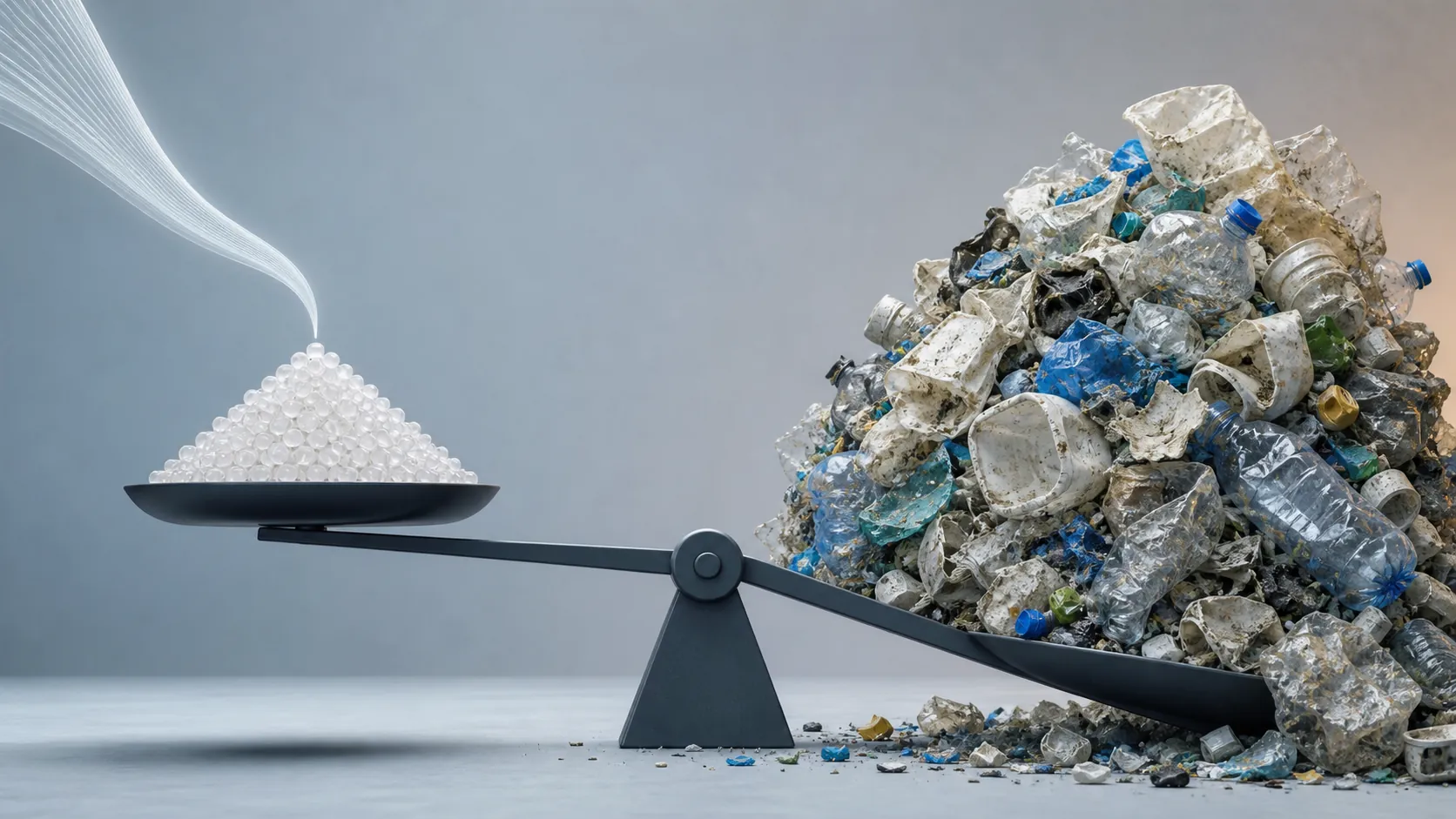
Used plastic starts from the opposite condition. It is mixed by polymer type, label, cap, additive, color, food residue, local collection rule, and previous use. Before it can become a recycled resin pellet, someone has to separate useful material from useless or harmful material. That labor and machinery do not appear because people are morally failing at the bin. They appear because waste is not the same thing as feedstock.
This is where better sorting matters but cannot carry the whole argument. Better sorting can reduce contamination. It can make a recycling stream more valuable. It can help a facility avoid turning one bad batch into a worse batch. But it does not erase the starting asymmetry: one side begins with cheap, uniform material, and the other begins by paying to recover order from disorder.
What has to happen before waste becomes resin again
Mechanical plastic recycling is not one action called “recycle.” It is a chain of actions. Recycle Now, a consumer-facing program run by WRAP, describes plastic recycling as a process that includes sorting, washing, shredding, melting, pelletizing, and making new products.[3]
- Collection: plastic has to be gathered from households, businesses, or deposit systems.
- Sorting: the material has to be separated by plastic type and often by color.
- Cleaning: food residue, labels, dirt, and other contaminants have to be removed.
- Size reduction: plastic is shredded or flaked so it can be processed more consistently.
- Melting and pelletizing: the cleaned material is melted and formed into recycled pellets.
- Remaking: those pellets have to meet a buyer’s requirements for a new product.
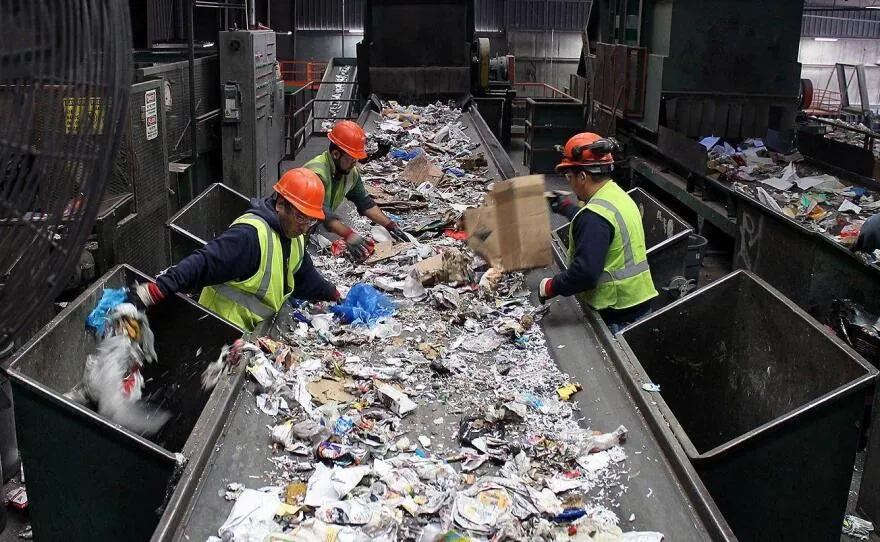
Sorting is technically serious work. Plastic can be separated using density, electrostatic properties, or near-infrared sensor systems, and the goal is not just to remove trash. The goal is to avoid mixing polymers that behave differently when processed.[4] A clear PET bottle, a colored detergent container, a flexible film, and a black food tray may all look like “plastic” to a consumer, but they are not interchangeable industrial inputs.
This is also why the word “recyclable” causes so much trouble. Some plastics are technically recyclable under the right conditions, but that does not mean they are commonly collected, sorted at scale, cleaned economically, and sold into a stable market. Recycle Now’s practical guidance centers the most commonly recycled household plastics around bottles made from PET and HDPE, with other formats depending heavily on local collection and processing systems.[3]
Then comes the quality problem. Mechanical recycling usually involves heat, and heat can shorten or damage polymer chains. Wikipedia’s overview of plastic recycling describes polymer degradation as a limiting factor in melt-processing recycled plastic.[4] That does not mean recycled plastic is useless. It means the recycled resin may be less predictable, less pure, or less suitable for demanding uses than virgin resin.
For an exam passage, that last sentence is the hinge. If recycled plastic costs more to prepare and may perform worse, then the market does not need a villain in every household to produce a bad outcome. The structure itself pushes buyers toward virgin material.
The rate statistics are calibration, not the proof
The big numbers are still useful, as long as they are kept in their lanes. Globally, the OECD reported that only about 9% of plastic waste was recycled, while 19% was incinerated and roughly half went to sanitary landfills.[5] That is a global waste-management snapshot, not a measure of whether one local bin was sorted correctly.
The U.S. figure often cited from Greenpeace’s 2022 report is narrower and harsher: NPR reported that only about 5% of plastic waste in the United States was actually reprocessed into new products.[6] NPR also reported Greenpeace’s use of the Ellen MacArthur Foundation’s 30% threshold for calling an item recyclable at scale, and Greenpeace’s conclusion that no plastic type met that threshold in the United States.[6]
Those numbers should not be mashed into one universal “plastic recycling rate.” Global recycling, U.S. actual reprocessing, collected-bottle recycling, and a “recyclable” label measure different things. A careful reader does not treat them as synonyms just because they all sound like bad news.
NPR also included the American Chemistry Council’s pushback against Greenpeace’s conclusions, which is a reminder that industry groups, environmental groups, and waste researchers may frame the same system differently.[6] But the disagreement over framing does not remove the central mechanism: recycled plastic has to pay for recovery, sorting, cleaning, and quality loss before it can compete.
The history matters because it shows predictability
The most exam-relevant history is not a neat morality play. It is evidence that the economic and technical difficulties were visible early. A 1973 industry report quoted in Wikipedia’s plastic-recycling overview stated, “There is no recovery from obsolete products,” and described sorting as “infeasible.”[4]
That matters because the modern public message often made plastic look broadly recyclable. Resin identification codes — the numbered symbols many people associate with recycling — were created by the plastics industry in 1988.[4] NPR’s reporting also discusses how plastic recyclability was promoted despite industry awareness of major recycling limits.[6]
The careful conclusion is not “every person in the industry had the same motive.” The supported conclusion is narrower and stronger: documented industry knowledge and public-facing recyclability messaging diverged. Students should notice that distinction. It is the difference between an evidence-based inference and a satisfying story the evidence does not quite prove.
How to turn this into an exam answer
The transferable skill is not plastic trivia. It is argument extraction. On SAT or ACT reading, MCAT CARS, ASVAB science-adjacent passages, and GRE-style argument questions, the content may be unfamiliar, but the task is often the same: find what the author wants you to accept, identify the facts used to support it, and state the reasoning that makes the facts matter.
- Claim: plastic recycling fails mainly as an economic market, not mainly because consumers sort badly.
- Evidence: virgin plastic starts from cheap, clean precursor chemicals, while recycled plastic starts from mixed waste that must be collected, sorted, washed, shredded, melted, pelletized, and sold.
- Evidence: heat-based recycling can degrade polymers, and practical recycling is concentrated around a few plastic types rather than all plastic packaging.
- Historical support: industry documents and later resin-code messaging show that these limits were not a brand-new discovery.
- Warrant: a dirty, mixed, degraded input will struggle to beat a cheap, clean virgin input unless policy, pricing, design, or purchasing rules change the comparison.
That same move applies when a passage is about climate patterns, planetary geology, water quality, or astronomy. For more practice with this kind of reading, compare the claim-evidence discipline in the heat dome explainer, the environmental-science reasoning in the Lake Erie whitefish MCAT case study, the unresolved-versus-confirmed evidence work in the Mars polygon features guide, and the science-passage strategy in the meteor shower study guide.
The exam-ready answer is this: the video’s argument is not mainly that recycling facilities are lazy or that families are personally ruining the planet with yogurt cups. Plastic recycling fails because the market asks a dirty, mixed, degraded material to compete with an almost-free virgin one. That is the claim students need to reconstruct, and the warrant they need to be able to say out loud.
References
- There’s an Actual Reason You Can’t Recycle Plastic, Nerdfighteria Wiki, January 7, 2026.
- Kickstart: Recycling, Hank Green, soft plastics and Meyer, Plastics News, January 9, 2026.
- Plastic recycling, Recycle Now.
- Plastic recycling, Wikipedia.
- Plastic pollution is growing relentlessly as waste management and recycling fall short, OECD, February 22, 2022.
- Recycling plastic is practically impossible — and the problem is getting worse, NPR, October 24, 2022.
Related exhibits & inventory
Verified outcomes
No verified outcomes on file for this exam yet
See Methodology for how outcome evidence is disclosed once logged.
Planners
No planner filed for this exam yet
A downloadable timeline template for this exam hasn't been published yet.
Tool verdicts
AI-tool cautions
No AI tools tested for this exam yet
No hands-on AI-accuracy logs have been filed for this exam.
Questions about this plan
Ask a question about a specific section, timeline, or citation in this plan — or flag something that needs correcting.
Comments
Join the discussion with an anonymous comment.