
ACT, SAT, ASVAB Exam Hub
What Do Curiosity's Mars Polygon Features Tell Students?
Mars's polygons aren't one feature — they're a family of crack patterns that record the planet's ancient climate. This student guide decodes Curiosity's three key finds, from the confirmed wet-dry cycles at Pontours to the still-unresolved Valle Grande field, and shows how that evidence reasoning appears in ACT, SAT, and ASVAB science passages.
- gre
- mcat
- asvab
- sat
- act
- digital-adaptive
- official-material
- section-strategy
- test-date-timeline
In June 2026, Curiosity photographed a Martian scene that looks almost too organized to be natural: a broad stretch of Valle Grande covered with small honeycomb textures, each polygon only about 1.5 to 3 inches across. NASA/JPL described it as the largest field of polygons Curiosity has seen since landing on Mars in 2012, using panorama images taken on sols 4,930 and 4,931 of the mission. The part students should notice first is not that the pattern is beautiful, though it is. It is that NASA has not yet said what made it. Mud cracks, temperature cycles, and burial compaction are all still possible explanations. [1]
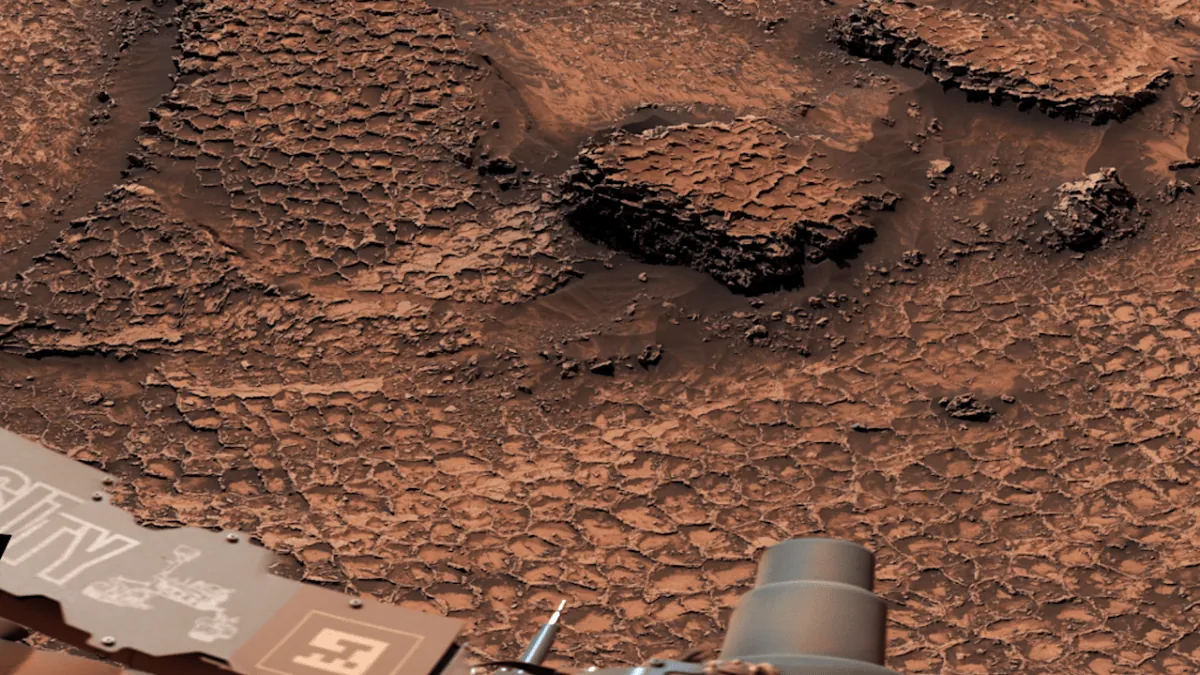
That uncertainty is not a weakness in the discovery. It is the point. “Polygon features” on Mars are not one single object with one single cause. The word polygon names a shape pattern: cracks or ridges making repeated many-sided outlines. The explanation has to be earned from the details — size, junction shape, mineral coating, rock layer, and what instruments actually measured.
For a student reading a rover passage, the trap is to see “polygon” and jump straight to “mud cracks.” Sometimes that may be right. Sometimes it is only one hypothesis. Curiosity’s three main polygon finds make a useful evidence ladder: Old Soaker was an early possible mud-crack case, Pontours became the strong repeated wet-dry-cycle case, and Valle Grande is the new open puzzle.
A polygon is a pattern before it is an explanation
| Curiosity find | What was observed | What the evidence supports | What not to overclaim |
|---|---|---|---|
| Valle Grande, announced July 29, 2026 | A large honeycomb-like field of small polygons, roughly 1.5–3 inches across, photographed in June 2026 | Curiosity has found the mission’s largest polygon field, and scientists are looking for clues to its origin [1] | Do not call it confirmed mud cracks yet |
| Old Soaker, reported in 2017 | A slab of rock with a polygonal crack network | Scientists identified it as possible mud cracks [2] | Do not treat “possible” as “proved” |
| Pontours, reported in 2023 | Hexagonal cracks with Y-shaped junctions and sulfate-rich preservation | Repeated wet-dry cycles in ancient Martian mud about 3.6 billion years ago [3] | Do not use Pontours to explain every polygon field on Mars |
That table is close to how a standardized-test science passage works. The passage gives an observation, then an interpretation, then a limit. The correct answer often depends on which column you are actually being asked about.
Old Soaker: the simple version, with the word “possible” doing real work
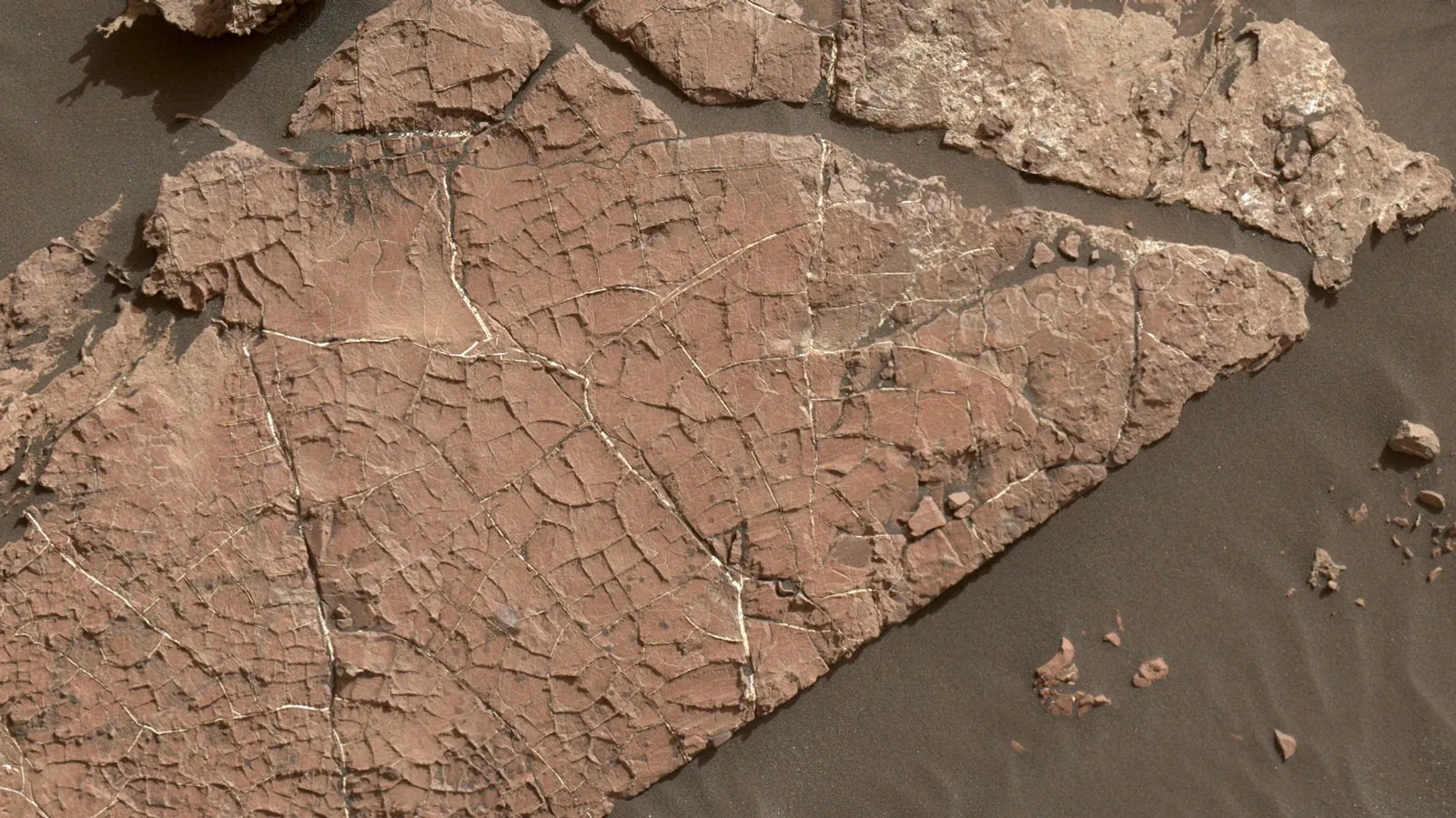
Old Soaker is the clean beginner case because the claim stayed narrow. In 2017, JPL described a rock slab examined by Curiosity that showed a network of polygons. The team interpreted the feature as possible mud cracks — the kind of pattern that can form when wet sediment dries and shrinks. [2]
The important exam word is “possible.” A polygonal crack network fits a mud-crack explanation, but fitting an explanation is not the same as locking it in. Old Soaker gives students the first step in the reasoning chain: a shape can suggest a process, but scientists still look for stronger evidence before turning a suggestion into a climate claim.
Pontours: where cracks became evidence for repeated wet-dry cycles
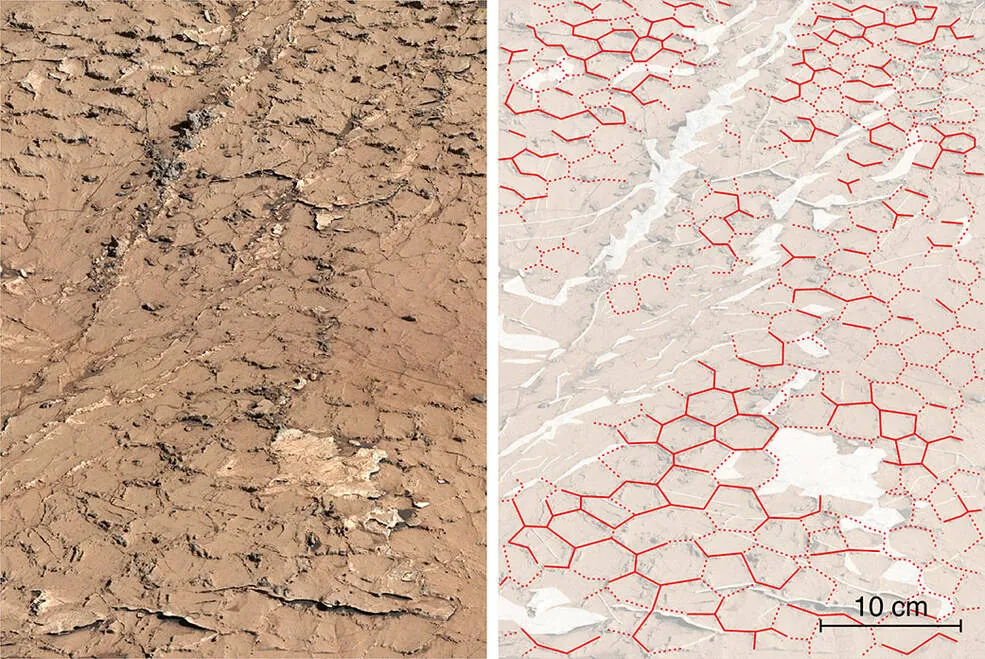
Pontours is the case to slow down for. Curiosity found ancient hexagonal cracks preserved in Martian bedrock, and NASA/JPL reported in 2023 that these cracks were evidence of repeated wet-dry cycles in mud about 3.6 billion years ago. [3]
The observation did not begin as “Mars had a repeating climate cycle.” It began with shapes in rock. The cracks formed polygons. More importantly, many of their intersections had a Y shape, and the network made hexagons. That detail matters because different cracking histories leave different junctions.
When mud dries once, cracks commonly meet in T-shaped junctions: a newer crack runs into an older crack and stops. That is already useful evidence for drying. But Pontours showed Y-shaped junctions and hexagons. NASA explained that this geometry points to repeated wetting and drying, because the cracks did not simply form once and freeze in place; they reopened and changed as the mud went through multiple cycles. [3]
William Rapin, the lead author of the Nature paper on the discovery, put the shape evidence bluntly: “It’s impossible to make this hexagonal pattern without regular periods of wet and dry.” [4]
What each piece of Pontours evidence adds
- Polygon network: there was cracking in the rock surface.
- T-junction comparison: a single drying event can explain some mud-crack patterns, but that is not enough for Pontours.
- Y-junctions and hexagons: the shape points to cracks that were affected by repeated wet-dry cycles, not just one drying event. [3]
- ChemCam sulfate evidence: Curiosity’s instrument work showed sulfate-rich material associated with the cracks, helping explain how the crack network was preserved for billions of years. [3]
- Climate inference: together, the geometry and chemistry support the conclusion that this ancient Martian environment repeatedly became wet and then dry. [3]
Notice the order. The rover did not photograph a hexagon and instantly prove an ancient climate pattern. The claim rose as the evidence stacked up: shape, junction type, repeated pattern, mineral preservation, and geological age.
Pontours also explains why scientists care about wet-dry cycling without turning the result into a life-detection claim. The Nature paper connected such cycles to prebiotic chemistry because drying can concentrate chemical building blocks and help them form longer chains. That is about conditions that could matter for life’s chemistry, not evidence that life existed there. [5]
Why Valle Grande is not Pontours yet
Valle Grande looks like the kind of find that tempts people to borrow Pontours’ conclusion. It has a “sea of polygons.” It is fresh. It is visually obvious. But NASA/JPL’s July 2026 announcement kept the origin open: mud cracking, temperature-driven cracking, and compaction from burial are all being considered. Scientists said they are hopeful the field contains clues that will help them determine how it formed. [1]
| Possible explanation for Valle Grande | What it would mean | What would help decide |
|---|---|---|
| Mud cracking | Wet sediment dried and shrank, leaving a crack network | Junction shapes, mineral evidence, and context showing a drying sediment environment |
| Temperature cycles | Rock or soil expanded and contracted as temperatures changed, producing cracks without requiring the same wet-dry mud story | Evidence that the pattern fits thermal stress rather than sediment drying |
| Burial compaction | Sediment was compressed after being buried, and cracking or ridging appeared as the material changed under pressure | Layer relationships and rock textures showing that compaction, not surface drying, best explains the field |
Those are not three equally proven answers. They are competing hypotheses. A good science passage may ask which hypothesis is supported by a new measurement, which one is weakened, or which one remains possible because the data are not yet enough.
This is also why “polygon” should not be memorized as a synonym for “lake bed.” NASA’s own Mars imagery includes polygonal patterned ground associated with contraction and cracking in cold surface materials, a different mechanism from Curiosity’s mud-crack cases. [6]
Other Mars polygon discoveries sit in still different categories. China’s Zhurong mission, for example, has been discussed in connection with buried polygon patterns roughly 70 meters across near the Martian equator. That is a very different scale from Valle Grande’s inch-sized honeycomb textures, and it should not be blended into the Curiosity mud-crack story as if all polygons are the same feature. [7]
The student version: read the claim at the same strength as the evidence
For ACT Science, the Curiosity polygon story is a data-reasoning problem. A passage might give diagrams of crack junctions, a short description of ChemCam results, and two competing explanations. The task is rarely to admire Mars. It is to match the evidence to the claim without adding extra certainty.
For SAT Reading science passages, the same story tests wording. “Suggests,” “is consistent with,” “confirmed,” and “remains unresolved” do not mean the same thing. Old Soaker was possible mud cracks. Pontours supported repeated wet-dry cycles. Valle Grande is the largest polygon field Curiosity has seen, but its origin is still unresolved. Those differences are not fine print; they are the answer choices.
For ASVAB General Science, the useful background is earth-science logic: sediments can crack as they dry, materials can expand and contract with temperature, minerals can preserve surfaces, and instruments can turn a photograph into a stronger geological interpretation.
- Separate observation from interpretation: “hexagonal cracks” is an observation; “repeated wet-dry cycles” is an interpretation supported by additional evidence.
- Track the instrument evidence: ChemCam’s sulfate finding at Pontours matters because chemistry helped explain preservation, not just shape.
- Watch for comparison words: T-junctions and Y-junctions point to different cracking histories.
- Keep old and new claims separate: Pontours can be confirmed more strongly than Valle Grande because the evidence chain is different.
- Do not turn a pattern label into a cause: polygon tells you what the feature looks like, not automatically how it formed.
If you want the same style of rover evidence practice, the Perseverance rover study guide is the natural sibling article. For astronomy passages that use the same observation-to-explanation pattern, see the meteor shower study guide, the Buck Moon ASVAB guide, and the sky-blue physics explainer.
Pontours lets students say something strong: Curiosity found preserved hexagonal mud cracks that record repeated wet-dry cycles in an ancient Martian setting about 3.6 billion years ago. Valle Grande lets students say something different: Curiosity has found the mission’s largest field of small polygon textures, but scientists have not yet determined whether mud cracking, temperature cycling, burial compaction, or some combination best explains it. [3][1]
References
- NASA’s Curiosity Mars Rover Discovers Field of Honeycomb Textures, NASA, July 29, 2026
- Mars Rover Curiosity Examines Possible Mud Cracks, JPL, 2017
- Cracks in Ancient Martian Mud Surprise NASA’s Curiosity Rover Team, NASA, Aug. 9, 2023
- Ancient mud cracks on Mars point to conditions favorable for life, Science/AAAS
- Sustained wet–dry cycling on early Mars, Nature, 2023
- Polygonal Patterned Ground, NASA Science
- Mars’ polygon patterns at the equator hint at an ancient climate, Science News Explores
Related exhibits & inventory
Verified outcomes
No verified outcomes on file for this exam yet
See Methodology for how outcome evidence is disclosed once logged.
Planners
No planner filed for this exam yet
A downloadable timeline template for this exam hasn't been published yet.
Tool verdicts
AI-tool cautions
No AI tools tested for this exam yet
No hands-on AI-accuracy logs have been filed for this exam.
Questions about this plan
Ask a question about a specific section, timeline, or citation in this plan — or flag something that needs correcting.
Comments
Join the discussion with an anonymous comment.