
ASVAB Exam Hub
What to Know About the Perseverance Rover for Science Class
Your science-class test won't quiz Perseverance rover trivia — it tests five transferable science concepts the mission illustrates. This study guide covers those concepts in ASVAB General Science and ACT Science question format, plus an annotated practice passage and explained practice questions.
- gre
- mcat
- asvab
- sat
- act
- digital-adaptive
- official-material
- section-strategy
- test-date-timeline
No, you do not need to memorize Perseverance rover trivia for science class. For a test, the useful question is simpler: which science ideas does the rover make easier to remember? A good Perseverance rover study guide for science class should turn the mission into five testable concepts: Mars as a terrestrial planet, rock classification, atmosphere and CO2 chemistry, spectroscopy, and cautious reasoning from evidence.
Here is the orientation you actually need. Perseverance launched on July 30, 2020, and landed on Feb. 18, 2021, in Jezero Crater, a 45-kilometer-wide crater on Mars selected because it preserves clues about ancient water environments. NASA describes the mission around four science objectives, including looking for signs of ancient microbial life, studying Martian geology and climate, collecting rock and regolith samples, and preparing for future human exploration.[1] The rover carries seven science instruments and is powered by a Multi-Mission Radioisotope Thermoelectric Generator, or MMRTG.[2] Ingenuity, the small helicopter that flew with Perseverance, completed 72 flights, but for most classroom and standardized-test purposes it is only background, not the main study target.[1]
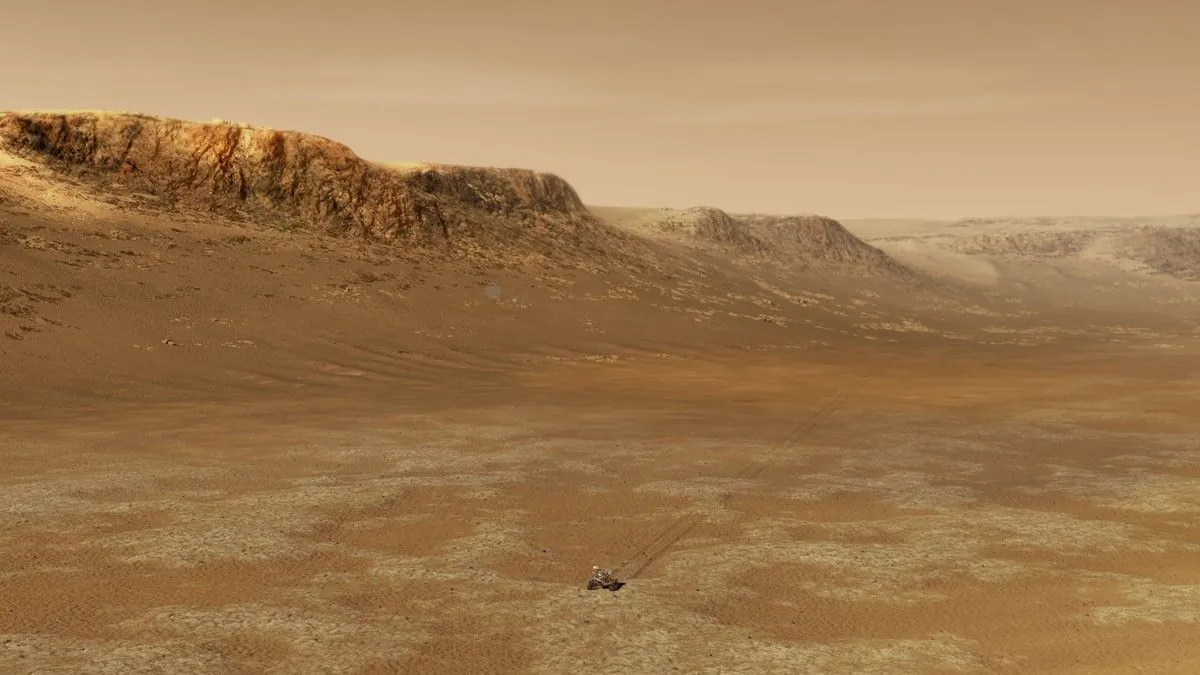
That is enough biography. ASVAB General Science and ACT Science do not reward you for reciting instrument acronyms. ASVAB General Science study topics include planets, rock types, the water cycle, and the atmosphere, which are exactly the concepts Perseverance can illustrate.[3] ACT Science questions, meanwhile, are more likely to ask what a table, graph, experiment, or competing explanation supports than to ask who built a rover. Because ACT section timing and format details can change, check the current ACT source for the administrative details; use this article for the science-reasoning work.
If you want more ASVAB astronomy practice after this, the same exam-hub pattern appears in ASVAB General Science moon and astronomy question types. If you are mainly training ACT Science passage skills, compare this with the data-passage approach in heat dome vs. heat wave ACT Science prep.
The five Perseverance facts that can become test questions
| Mission fact | Science concept | Likely test move |
|---|---|---|
| Perseverance studies rocks in Jezero Crater on Mars. | Mars is a terrestrial planet with a rocky surface, iron-bearing minerals, and evidence of past water environments. | Classify Mars with Mercury, Venus, and Earth; connect reddish color to oxidized iron; infer why ancient water matters. |
| Perseverance found both igneous rocks and sedimentary lakebed deposits. | Rocks can be classified by how they form. | Distinguish cooled magma or lava from deposited layers of sediment. |
| MOXIE produced oxygen from carbon dioxide in the Martian atmosphere. | Chemical reactions rearrange atoms; Mars has a CO2-rich atmosphere. | Track reactants and products, or calculate an average from total output and number of trials. |
| Perseverance uses instruments that analyze the composition of rock surfaces. | Spectroscopy identifies materials by how they interact with light, X-rays, or other radiation. | Match an unknown material to a reference pattern rather than guessing from appearance alone. |
| Cheyava Falls was reported as a potential biosignature, not confirmed life. | Scientific conclusions require evidence strong enough to rule out alternatives. | Separate observation, hypothesis, and conclusion. |
1. Mars is a terrestrial planet, so expect rock-and-atmosphere questions
The easiest ASVAB-style question is classification: Mars is a terrestrial planet. That means it belongs with Mercury, Venus, and Earth, not with gas giants such as Jupiter or Saturn. If a question gives you choices like rocky surface, rings, mostly hydrogen and helium, or no solid surface, the Mars clue points to rocky surface.
The red-color detail is also testable, but not as a postcard fact. Mars is often called the Red Planet because iron-bearing minerals in its surface materials have oxidized. In test language, that is a chemistry and geology clue: iron plus oxygen-related reactions can produce reddish iron oxides. If the question asks why Mars appears reddish, do not answer “because it is hot.” Mars looks red because of oxidized iron compounds in surface dust and rocks.
Jezero Crater matters because it gives the rover a location where rock evidence can preserve a water story. NASA chose Jezero because it contains geological evidence connected to ancient water environments.[1] On a classroom test, the jump from “past water” to “possible habitat” is fair. The jump from “past water” to “life definitely existed” is not.
2. Igneous versus sedimentary rock is the rock-type detail worth remembering
This is the Perseverance detail that earns its space in a study guide. NASA reports that Perseverance found igneous rocks, which surprised scientists who had expected the crater floor to be sedimentary, and it also found sedimentary lakebed deposits at Wildcat Ridge.[4] That gives you both major rock-forming ideas in one mission.
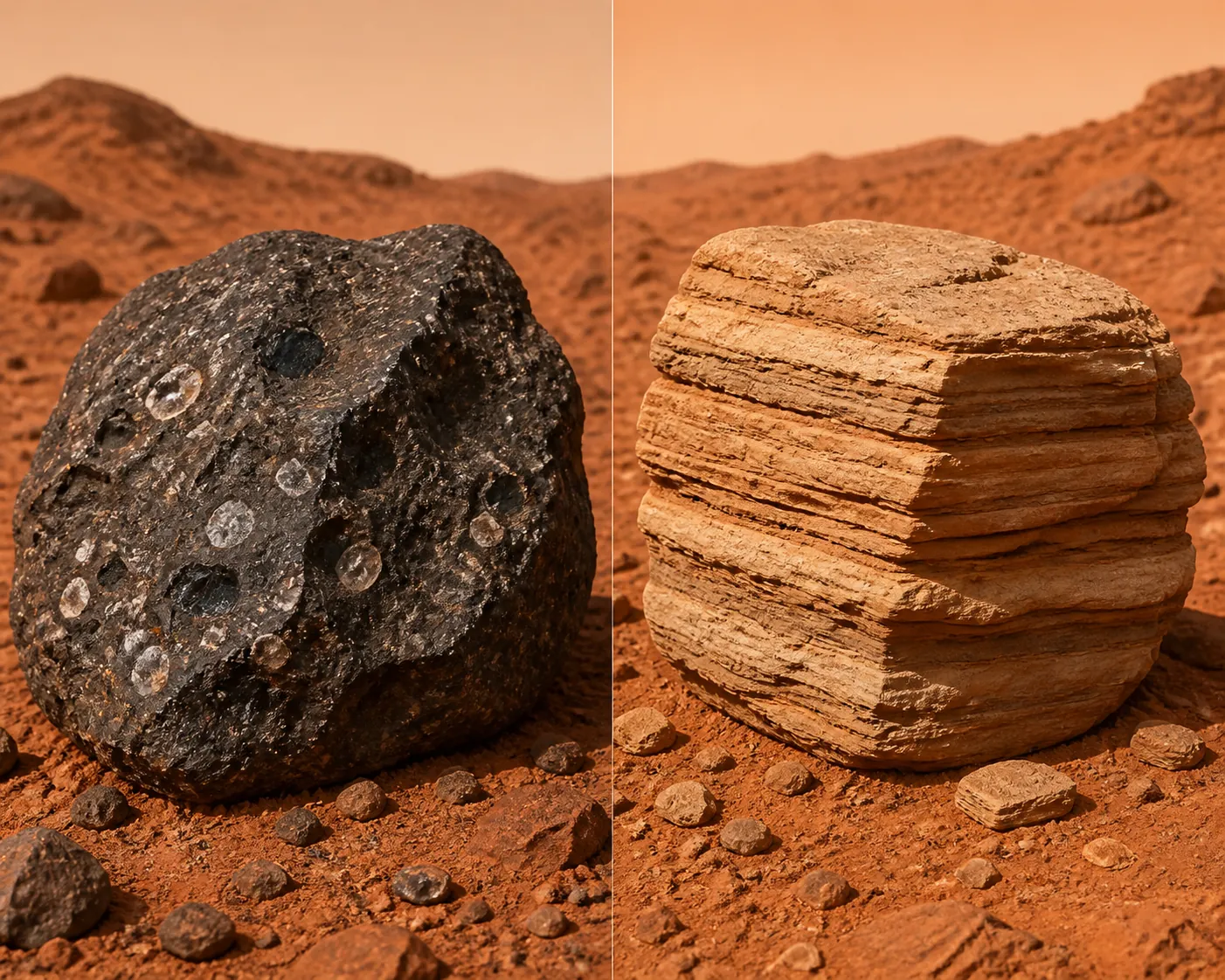
Igneous rock forms when molten material cools and solidifies. If the cooling happens slowly underground, crystals can grow larger; if lava cools quickly at the surface, crystals may be small. Sedimentary rock forms when particles settle, accumulate, compact, and cement, often in layers. A lakebed deposit points naturally toward sedimentary reasoning because lakes can collect layers of sediment over time.
An ASVAB-style fact question might ask which rock type forms from cooled magma. An ACT-style passage might give observations: Rock A has interlocking crystals; Rock B has thin layers and rounded grains. The answer is not “the Mars rock.” The answer is that Rock A is more consistent with igneous formation, while Rock B is more consistent with sedimentary deposition.
3. MOXIE turns Martian atmosphere chemistry into a solvable problem
MOXIE is useful because it turns an atmosphere fact into chemistry. NASA reports that MOXIE produced 122 grams of oxygen from Martian carbon dioxide across 16 runs.[4] You do not need to know the engineering details to answer the testable science question: carbon dioxide contains carbon and oxygen atoms, and a chemical process can separate oxygen from a CO2-rich atmosphere.

The math is also fair game. If a passage says 122 grams of oxygen were produced in 16 runs, the average output per run is 122 ÷ 16, or about 7.6 grams per run. That average does not prove every run produced exactly 7.6 grams. It only summarizes the total over the number of runs. That distinction is exactly the kind of small trap standardized science questions like to set.
For ASVAB General Science, remember the broad relationship: Mars has a thin atmosphere rich in carbon dioxide, and carbon dioxide is made of carbon and oxygen. For ACT Science, expect a data interpretation task: calculate an average, identify a reactant or product, or decide whether a result supports a claim.
4. Spectroscopy is not a rover acronym; it is an evidence method
Perseverance carries instruments that analyze the composition of rocks and surface materials, including instruments that use X-ray and light-based techniques.[2] In a test passage, that usually becomes spectroscopy reasoning: different substances produce different signals when they interact with energy. A scientist compares an unknown sample’s signal with reference patterns to infer what the sample contains.
Do not study spectroscopy as “the thing SHERLOC does” or “the thing PIXL does.” Study the transferable rule. If a mineral has a known spectral pattern and an unknown rock produces a matching pattern, that supports the inference that the mineral is present. If the pattern only partially matches, the conclusion should be weaker. If two minerals produce overlapping signals, the passage may ask what additional test would help distinguish them.
5. A potential biosignature is not a life announcement
Cheyava Falls is the place where students are most likely to overread the headline. NASA said in 2025 that Perseverance had discovered a potential biosignature in a rock called Cheyava Falls, with features described as “leopard spots,” minerals including vivianite and greigite, and organic carbon.[5] The important word is potential. NASA did not announce confirmed life on Mars.
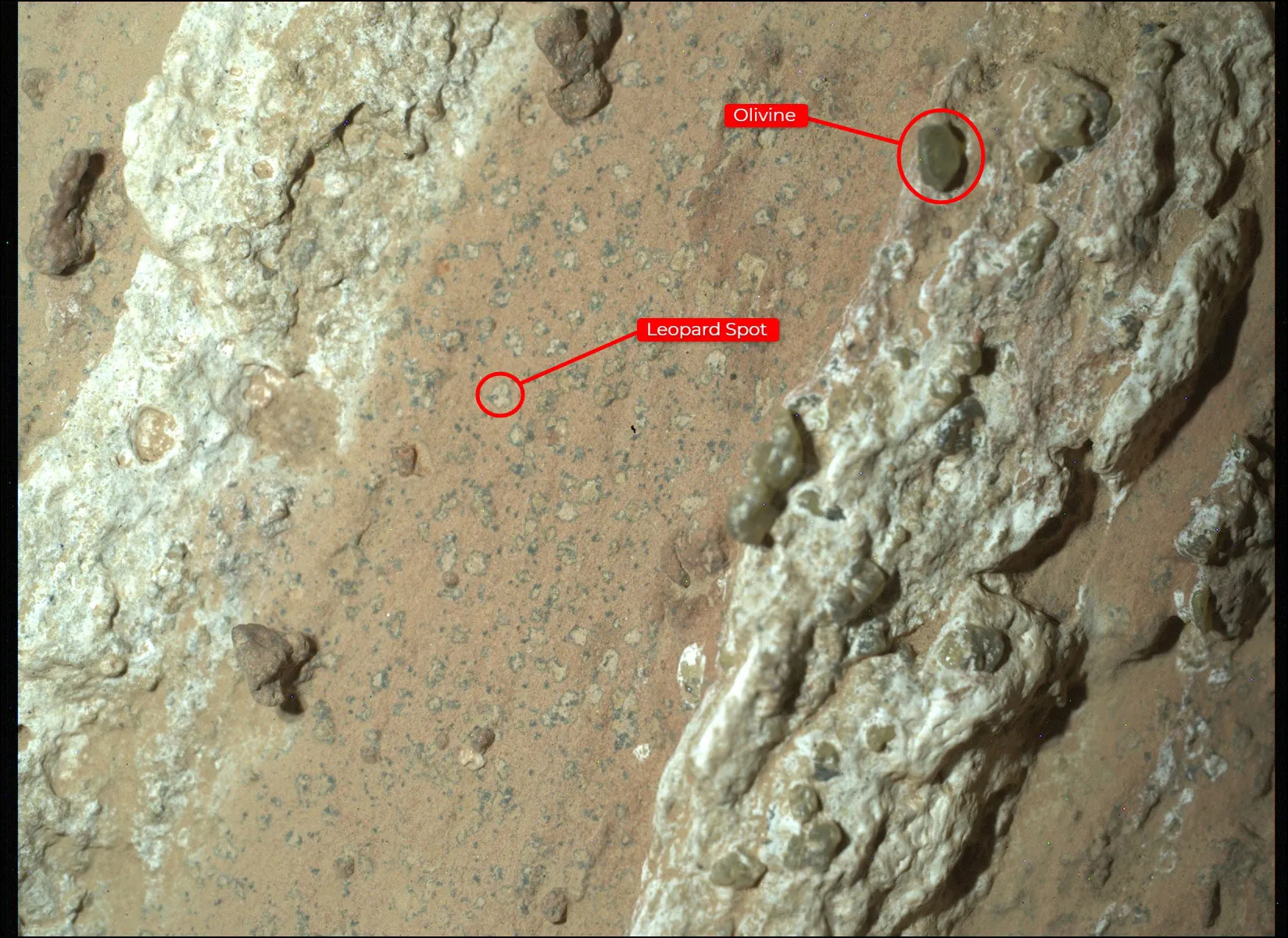
The Planetary Society’s interview with lead author Joel Hurowitz also frames the result as evidence that needs careful interpretation, not a final answer.[6] In exam language, the observation is “the rock contains certain minerals, spots, and organic carbon.” A hypothesis is “these features could have formed through biological processes.” A cautious conclusion is “further testing is needed to distinguish biological from nonbiological explanations.”
If you are preparing for MCAT-style evidence reasoning, the organic-carbon issue gets a deeper treatment in How Perseverance’s organic carbon tests MCAT evidence skills. For high-school science, keep the rule narrower: suggestive evidence is not the same as confirmation.
What not to memorize
Skip the trivia pile unless your teacher specifically assigned it. You do not need a complete list of instrument acronyms, wheel dimensions, camera names, or every Ingenuity flight. You also should not rely on old screenshots for sample-count numbers. NASA maintains a current Mars rock samples page, and those counts can change as the mission continues.[7] If a class question asks for a current count, use a dated NASA source, not memory.
The better study move is to ask, “Can this fact become a question?” If it can test a science concept, keep it. If it is only a name, date, or gadget label, it is probably not the center of the exam.
Annotated ACT-style mini-passage
Use the passage below the way you would use an ACT Science passage: underline what is measured, what is observed, and what is concluded. Do not add facts that are not in the passage.
A Mars rover investigated rocks in Jezero Crater, a crater selected because it preserves evidence related to ancient water environments. Scientists expected some areas to contain sedimentary rocks, but the rover also identified igneous rocks on the crater floor. Later observations included sedimentary lakebed deposits at Wildcat Ridge. The rover also carried an experimental device, MOXIE, that produced oxygen from carbon dioxide in the Martian atmosphere. Across 16 runs, MOXIE produced a total of 122 grams of oxygen.[1][4]
| Passage detail | What a test can ask | Careful answer habit |
|---|---|---|
| Jezero preserves evidence related to ancient water environments. | Why would scientists study this location? | Because past water environments can preserve geological clues relevant to habitability; this does not prove life. |
| Igneous rocks were found on the crater floor. | What process forms igneous rock? | Cooling and solidification of molten material. |
| Sedimentary lakebed deposits were found at Wildcat Ridge. | What process is suggested by lakebed layers? | Deposition, compaction, and cementation of sediment. |
| MOXIE produced oxygen from carbon dioxide. | Which substance was the reactant source of oxygen atoms? | Carbon dioxide. |
| 122 grams of oxygen were produced across 16 runs. | What was the average oxygen production per run? | 122 ÷ 16 = about 7.6 grams per run. |
| The passage gives a total and number of runs only. | Can you conclude every run produced the same amount? | No. An average does not show equal output in each trial. |
Notice what the passage does not say. It does not say that all Jezero rocks are sedimentary. It does not say that all Martian rocks formed in water. It does not say MOXIE produced enough oxygen for astronauts. It gives limited observations, and the correct answers must stay inside those limits.
Practice questions with explained answers
- ASVAB-style: Mars is best classified as which type of planet? A. Gas giant B. Terrestrial planet C. Ice giant D. Dwarf planet. Answer: B. Mars is a rocky terrestrial planet, so it belongs with Mercury, Venus, and Earth, not with Jupiter, Saturn, Uranus, or Neptune.
- ASVAB-style: The reddish color of Mars is most closely associated with which substance? A. Chlorophyll B. Iron oxide C. Liquid nitrogen D. Methane ice. Answer: B. The key science idea is oxidation of iron-bearing minerals, not surface temperature or plant material.
- ASVAB-style: A rock formed when molten material cooled and solidified would be classified as what? A. Igneous B. Sedimentary C. Metamorphic D. Organic. Answer: A. Igneous rocks form from cooled magma or lava. Perseverance’s crater-floor igneous rocks are a concrete Mars example of that category.[4]
- ASVAB-style: A layered rock deposit in an ancient lakebed most directly suggests which process? A. Nuclear fusion B. Sediment deposition C. Photosynthesis D. Planetary rotation. Answer: B. Lakebeds can collect sediments in layers; over time those sediments may compact and cement into sedimentary rock.
- ACT-style: MOXIE produced 122 grams of oxygen in 16 runs. What was the average oxygen production per run? A. 0.13 g B. 7.6 g C. 16 g D. 122 g. Answer: B. Divide total oxygen by number of runs: 122 ÷ 16 = 7.625, or about 7.6 grams per run.[4]
- ACT-style: If a passage reports only a total of 122 grams over 16 runs, which conclusion is justified? A. Each run produced exactly the same amount. B. The final run produced 122 grams. C. The average was about 7.6 grams per run. D. MOXIE produced oxygen without any reactant. Answer: C. A total and number of trials allow an average; they do not show that every trial had identical output.
- ACT-style: A rover instrument compares the signal from an unknown rock with reference signals from known minerals. What method is this most similar to? A. Spectroscopy B. Vaccination C. Erosion D. Pollination. Answer: A. Spectroscopy-style reasoning uses patterns produced by interactions with energy to infer composition.
- ACT-style: A rock contains organic carbon and mineral features that could be consistent with biological activity, but nonbiological explanations have not been ruled out. Which conclusion is strongest? A. Life has been confirmed. B. The rock is impossible to study. C. The observations are suggestive and require more testing. D. Organic carbon can only form in animals. Answer: C. Cheyava Falls was described as a potential biosignature, not confirmed life.[5][6]
- Classroom reasoning: Why is Jezero Crater a useful landing site for a Mars geology mission? A. It has evidence connected to ancient water environments. B. It is made entirely of metal. C. It has the same atmosphere as Earth. D. It proves modern rivers flow on Mars. Answer: A. The crater was selected because its geology preserves clues about ancient water environments; the stronger claims are not supported by that fact.[1]
- Mixed ACT/ASVAB: Which statement is the best example of evidence-based caution? A. “A rover saw interesting minerals, so Mars life is confirmed.” B. “A rover saw no forests, so Mars never had water.” C. “Rock and chemical evidence can support hypotheses, but conclusions require testing alternatives.” D. “All red planets contain oxygen for humans.” Answer: C. Good science separates observation from hypothesis and avoids claiming more than the data support.
References
- Mars 2020 Perseverance — NASA Science
- Rover Components — NASA Science
- ASVAB General Science Study Guide — ASVAB Practice Tests
- Science Highlights — NASA Science
- NASA Says Mars Rover Discovered Potential Biosignature Last Year — NASA — Sept. 10, 2025
- A biosignature on Mars? Unpacking Perseverance’s Cheyava Falls find — The Planetary Society — Oct. 2025
- Mars Rock Samples — NASA Science
Related exhibits & inventory
Verified outcomes
No verified outcomes on file for this exam yet
See Methodology for how outcome evidence is disclosed once logged.
Planners
No planner filed for this exam yet
A downloadable timeline template for this exam hasn't been published yet.
Tool verdicts
AI-tool cautions
No AI tools tested for this exam yet
No hands-on AI-accuracy logs have been filed for this exam.
Questions about this plan
Ask a question about a specific section, timeline, or citation in this plan — or flag something that needs correcting.
Comments
Join the discussion with an anonymous comment.