
ACT,SAT,MCAT Exam Hub
Heat Dome vs Heat Wave — What Test-Takers Need to Know
A comparison study guide that breaks down the difference between heat domes and heat waves for test-takers facing climate terminology on ACT Science, SAT Reading, and MCAT science passages — includes a quick-reference table and a practice quiz for self-testing.
- gre
- mcat
- asvab
- sat
- act
- digital-adaptive
- official-material
- section-strategy
- test-date-timeline
If a passage asks for the heat dome vs heat wave difference, use this first: a heat dome is the atmospheric setup; a heat wave is the hot-weather result. A heat dome is an upper-level high-pressure ridge that traps an exceptionally warm air mass over an area. A heat wave is several consecutive days of abnormally hot weather at the surface. The American Meteorological Society added “heat dome” to its glossary in March 2022 and defines it as “an exceptionally warm air mass at middle latitudes during the warm season associated with a synoptic-scale area of high pressure aloft.” [1] NOAA explains that a heat wave is at least two consecutive days of abnormally hot weather, with the exact threshold depending on the region rather than one national temperature cutoff. [2]
That distinction is enough to eliminate many wrong answers. If an answer choice describes a ridge, pressure pattern, trapped air, or a lid-like atmospheric setup, it is pointing to a heat dome. If it describes unusually hot days at ground level, health impacts, city temperature records, or a period of dangerous heat, it is pointing to a heat wave.
| Comparison point | Heat dome | Heat wave | Test-taking clue |
|---|---|---|---|
| Basic meaning | Atmospheric mechanism: high pressure aloft associated with an exceptionally warm air mass [1] | Surface weather outcome: at least two consecutive days of abnormally hot weather [2] | Mechanism vs. result |
| Where to picture it | Upper atmosphere / middle levels, pressing down like a lid | Near the ground, where people, crops, roads, and buildings experience heat | Aloft vs. surface |
| Main process | High pressure suppresses rising motion and helps trap hot air | Temperatures stay unusually high for the local area | Cause vs. observed condition |
| Duration | Can persist for days to weeks | Typically several days or longer, depending on the local definition | A long hot spell may be the result; the dome is the setup |
| Geographic scale | Often broad, sometimes continental-scale | Regional or local, measured against normal conditions for that place | Do not assume one fixed temperature threshold |
| Nighttime cooling | Often suppresses overnight cooling because the trapped air mass remains in place | May include hot nights, but nighttime behavior depends on the event | Hot nights strengthen the case for a persistent trapping setup |
| Most tempting wrong answer | Treating it as just a synonym for any hot day | Treating it as proof that a heat dome caused the event | Heat domes produce heat-wave conditions; heat waves can have other causes |
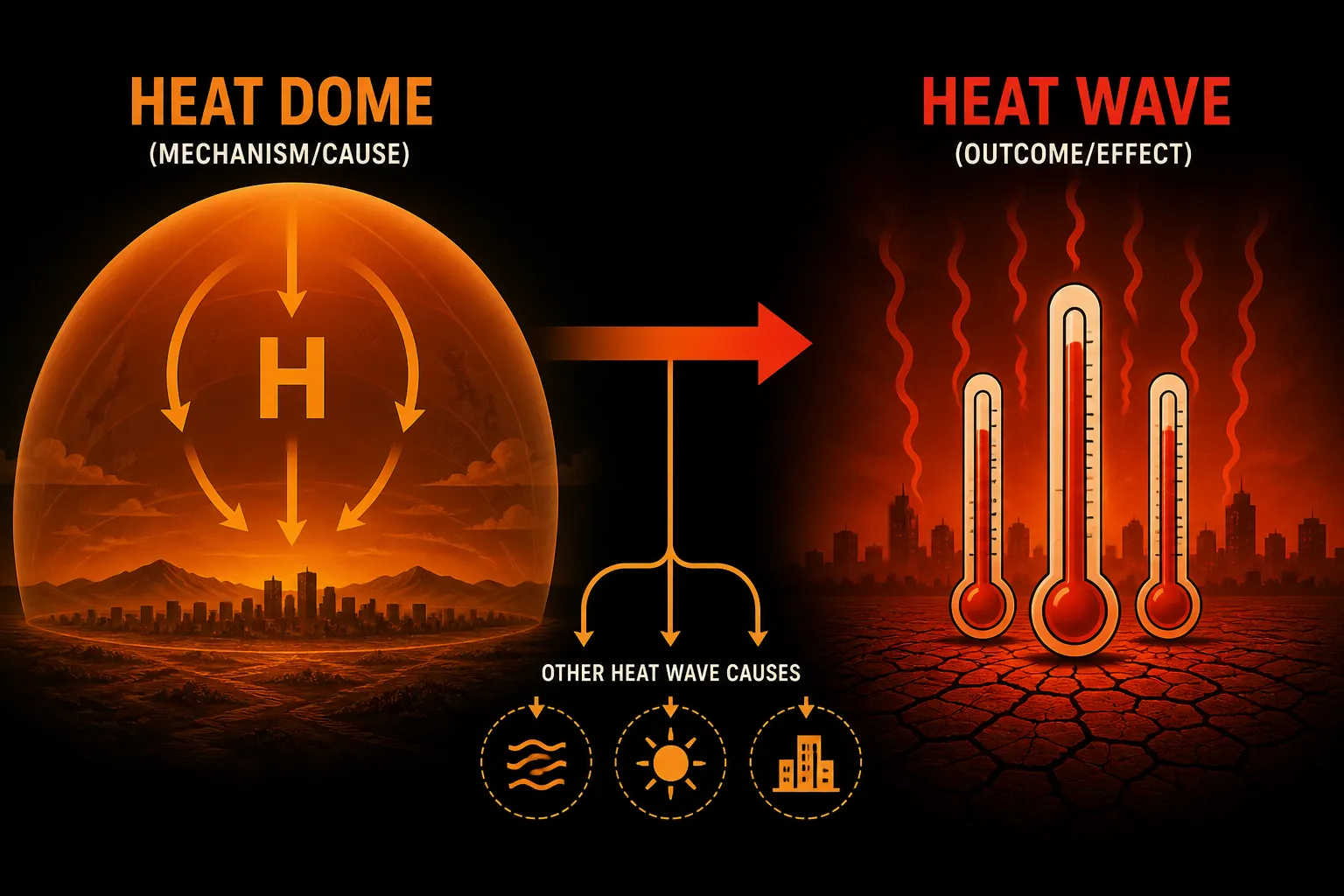
Start With Mechanism, Then Outcome
A heat dome is not defined by how miserable the sidewalk feels. It is defined by the atmospheric pattern that helps produce that misery. The useful classroom picture is a lid: high pressure aloft keeps hot air from dispersing easily, and the air mass stays parked over the same broad area. That image is good for memory. It is not a full model of every wind, pressure, and radiation process inside the event.
A heat wave is measured closer to the people reading the thermometer. The National Weather Service definition, as described by NOAA, focuses on at least two consecutive days of abnormally hot weather, but “abnormally hot” depends on the location. A temperature that is extreme for Seattle may be ordinary summer weather somewhere else. That is why exam passages often include local averages, anomalies, percentiles, or city records instead of one universal cutoff. [2]
The relation is one-way enough to remember, but not so simple that every question becomes automatic. A heat dome can cause heat-wave conditions. A heat wave, by itself, does not prove a heat dome was present. A passage could describe a heat wave caused by another pattern, or it could use “heat dome” in a popular news sense without giving the technical high-pressure setup. Under exam pressure, look for the evidence the passage actually gives.
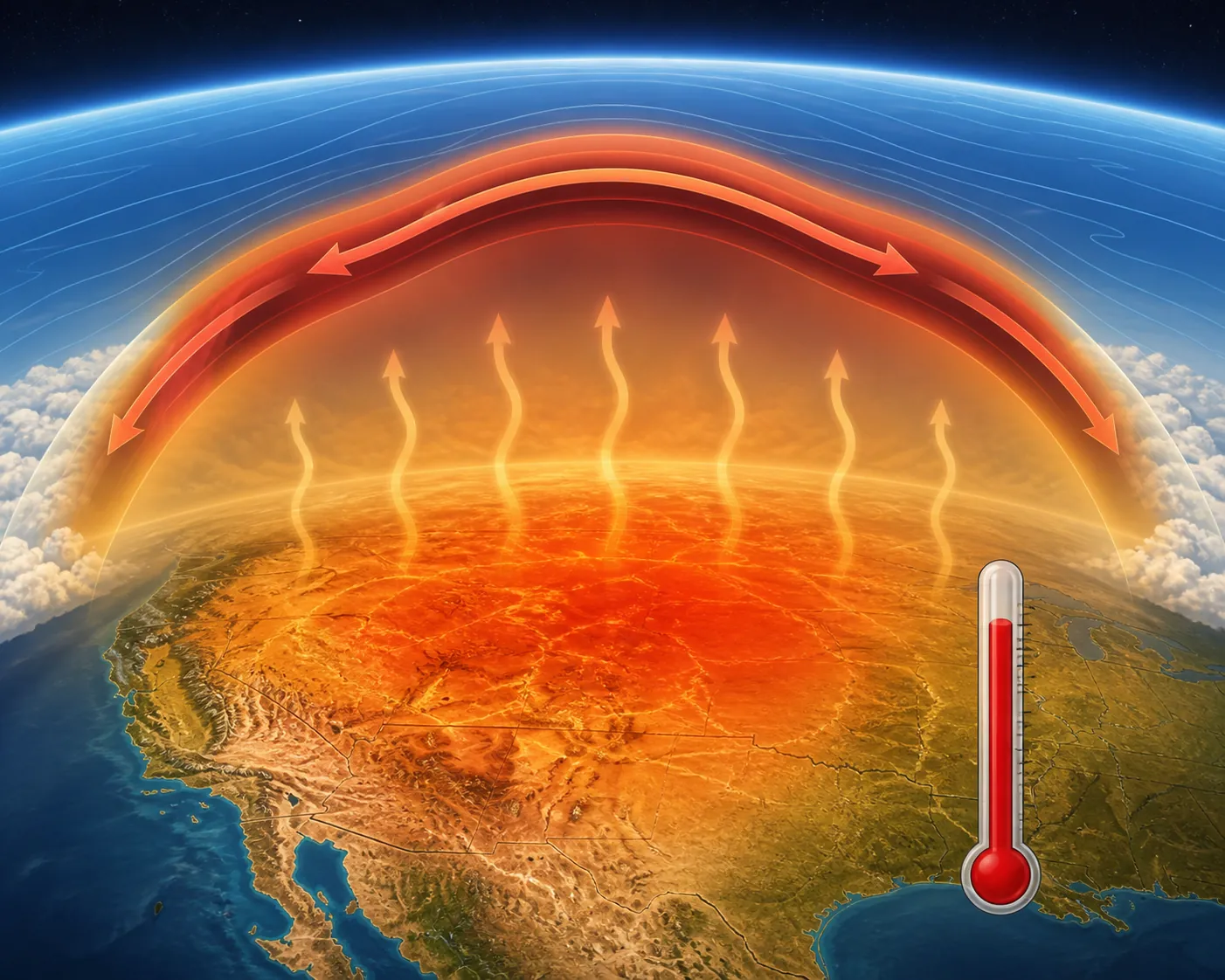
Heat Dome: The Setup Aloft
The AMS definition matters because it keeps the term from floating into pure metaphor. A heat dome is tied to an exceptionally warm air mass at middle latitudes during the warm season and to a synoptic-scale area of high pressure aloft. “Synoptic-scale” means the pattern is large enough to show up on broad weather maps, not just over one parking lot or one city block. [1]
For test purposes, the important verbs are “traps,” “persists,” and “suppresses.” A high-pressure ridge tends to limit the vertical mixing that might otherwise help heat escape. The same general air mass can remain over a region for multiple days. If the passage adds clear skies, dry soils, or limited nighttime cooling, those details may explain why temperatures climb higher or stay dangerous after sunset.
There is also a source caveat worth keeping. The National Weather Service has an official definition for heat wave, but it does not have an official glossary definition for heat dome in the same way. The AMS glossary entry is the cleaner technical anchor. A passage may exploit that mismatch by using “heat dome” as a popular label while asking about a formal heat-wave threshold.
Heat Wave: The Surface Event
A heat wave is the condition people experience and agencies warn about: a stretch of unusually hot weather. NOAA’s explanation gives the minimum structure as at least two consecutive days, but it also stresses that thresholds vary by region. [2] That region-dependence is not a footnote. It is the whole reason a passage might compare a Pacific Northwest city with a desert city and ask which location experienced the larger anomaly.
On an ACT Science graph, heat wave evidence may look like a run of daily maximum temperatures above a local threshold. On an SAT Reading passage, it may appear as a description of hospitalizations, power demand, agricultural stress, or record-setting temperatures. On an MCAT-style passage, it may connect heat exposure to physiology. None of those surface outcomes automatically identifies the upper-atmosphere mechanism.
- If the question asks what a heat wave is, answer with consecutive abnormal surface heat.
- If the question asks what can cause a heat wave, a heat dome may be correct if the passage gives high pressure aloft.
- If the question asks whether every heat wave is a heat dome, reject it. That reverses the relationship.
- If the question gives only surface temperatures, do not infer a heat dome unless the passage supplies the atmospheric setup.
The Relationship Most Questions Are Testing
The safest logic chain is: upper-level high pressure can trap a warm air mass; the trapped air mass can raise and prolong surface temperatures; those surface conditions can meet the definition of a heat wave. That is the direction. It runs from atmospheric setup to observed weather.
The common wrong answer runs backward. It sees several hot days and claims a heat dome must have caused them. That may be true in a real event, but it is not guaranteed by the definition of heat wave. A passage has to provide the ridge, high pressure aloft, stalled circulation, or similar mechanism before “heat dome” becomes the precise term.
| Passage wording | Best label | Why |
|---|---|---|
| “A stationary ridge of high pressure aloft remained over the region.” | Heat dome | The clue is the upper-level atmospheric setup. |
| “Daily highs stayed above the local warning threshold for three days.” | Heat wave | The clue is consecutive abnormal surface heat. |
| “Overnight lows remained unusually high during the event.” | Heat-wave condition, possibly strengthened by a dome | Hot nights describe the surface impact; the mechanism still needs evidence. |
| “The city broke its all-time temperature record during a stalled high-pressure pattern.” | Both | The record is the heat-wave result; the stalled high pressure is the heat-dome mechanism. |
| “The article says the term was used in news coverage but does not define the pressure pattern.” | Use caution | Popular wording may be broader than the technical AMS definition. |
Worked Example: The 2021 Pacific Northwest Event
The 2021 Pacific Northwest heat dome is the cleanest study case because it shows both terms at once. The atmospheric setup was the heat dome. The record-breaking temperatures in places such as Portland, Seattle, and Lytton were heat-wave conditions produced under that setup.
The numbers are hard to forget: Portland reached 116°F, Seattle reached 108°F, and Lytton, British Columbia reached 121.3°F, or 49.6°C, breaking Canada’s all-time temperature record three times in three days. USDA Climate Hubs reports more than 250 deaths in the United States from the event and agricultural losses exceeding $600 million. [3]
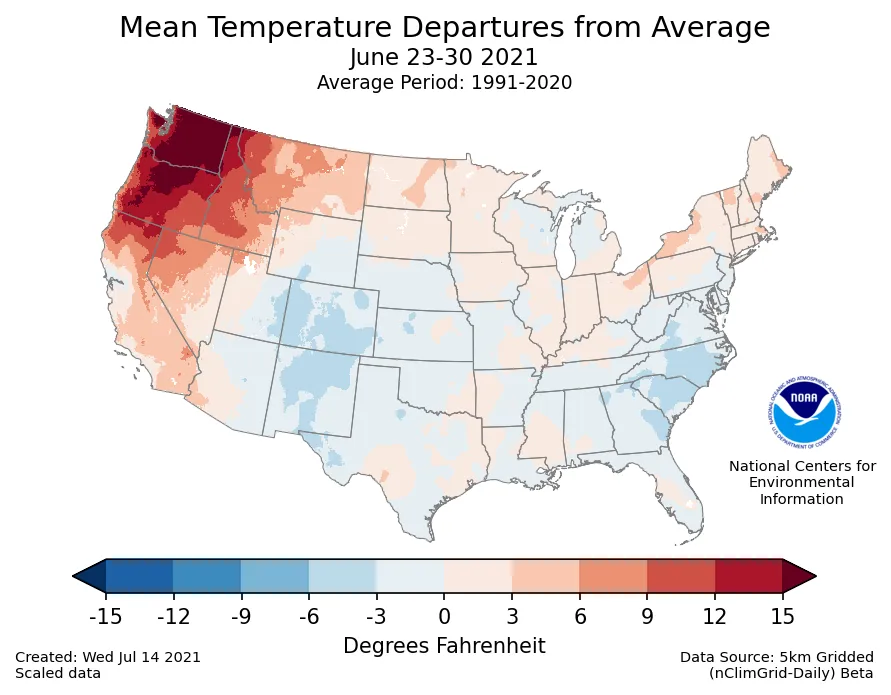
A Science Advances analysis described the event as “among the most extreme events ever recorded globally” and reported that the temperature anomaly exceeded 5 standard deviations from the climatological mean. [4] In passage language, that matters because “extreme” is not just an emotional description. It is tied to how far the observed temperatures sat from the expected distribution.
Attribution studies add another layer, and this is where students often overread. World Weather Attribution found that human-caused climate change made the Pacific Northwest event about 150 times more likely. [5] That statement is about changed likelihood, not a claim that climate change was the only cause. A Nature Communications study later found that the heat dome circulation explained about 50% of the temperature anomaly, with the rest coming from background warming and soil-moisture feedback. [6] That is a good example of a passage dividing one dramatic outcome into multiple contributing factors.
Notice how the case can be sorted without memorizing every meteorological detail. The ridge and circulation pattern belong in the heat-dome column. The 116°F, 108°F, and 121.3°F readings belong in the heat-wave column. The deaths, agricultural losses, and hot nights are impacts of the surface heat. The climate-attribution findings discuss how the probability and intensity of such an event changed, not the basic definition of either term.
Stronger-reader note: QRA and soil feedback
Some passages may add harder vocabulary. A PNAS study linked the 2021 event to quasi-resonant amplification of wave 7 in the jet stream, which preceded the event by about two weeks, dried soils, and helped amplify temperatures through feedback loops. [7] You do not need to turn that into a full jet-stream lecture. For answer-choice purposes, treat it as an upstream atmospheric pattern and land-surface feedback that strengthened the setup leading to the heat wave.
Why These Terms Show Up More Often
Climate background matters here only because it explains why these terms appear in more passages. EPA Climate Indicators data show that U.S. heat-wave frequency rose from about two per year in the 1960s to about six per year in the 2010s and 2020s. [8] That trend is about heat waves, not specifically about heat domes. A test question may ask whether a source is measuring frequency of hot-weather events, frequency of a particular atmospheric pattern, or public use of a term.
There is also a language issue. Some meteorologists have argued that “heat dome” can oversimplify varied upper-level ridge configurations and that the term became media-friendly before it became fully settled as technical shorthand. [9] That does not make the term useless. It means students should check whether a passage is using the AMS-style definition, a news shorthand, or a general description of dangerous heat.
Fast Elimination Rules
- Choose heat dome when the passage emphasizes high pressure aloft, a ridge, a lid, trapped air, or a stalled atmospheric pattern.
- Choose heat wave when the passage emphasizes consecutive days of abnormal surface heat.
- Reject any answer that treats the two terms as perfect synonyms.
- Reject “one fixed temperature cutoff” unless the passage supplies a local threshold.
- Do not infer a heat dome from a heat wave unless the passage gives evidence of the atmospheric setup.
- Read attribution language carefully: “made more likely” is not the same as “single-handedly caused.”
Practice Quiz
Use these as exam-style checks. The explanations matter more than the letter choice.
- A passage describes “a broad ridge of high pressure aloft that remained nearly stationary for several days.” Which term is most directly described? A. Heat wave B. Heat dome C. Urban heat island D. Drought
- A city has three consecutive days of temperatures far above its normal summer range. The passage gives no information about pressure patterns. What can you safely conclude? A. A heat wave occurred B. A heat dome definitely occurred C. A heat dome did not occur D. The event was not weather-related
- Which answer best states the relationship? A. Heat waves cause heat domes B. Heat domes are surface temperature records C. Heat domes can produce heat-wave conditions D. Heat waves and heat domes are official synonyms
- A question asks why one city’s 100°F day may count as more unusual than another city’s 100°F day. Which fact is most relevant? A. Heat-wave thresholds vary by region B. Heat domes occur only in Canada C. All heat waves last exactly two days D. A heat dome is measured only at night
- In the 2021 Pacific Northwest event, Portland’s 116°F and Seattle’s 108°F readings are best classified as what part of the event? A. The upper-level pressure ridge B. Surface heat-wave conditions C. The formal AMS definition D. A jet-stream wave number
- A study says climate change made an event about 150 times more likely. What is the safest interpretation? A. Climate change was the only cause B. The event could not have occurred before industrial warming C. The probability of an event like it increased D. The term heat wave changed its definition
- A passage says “the heat dome caused a heat wave,” then asks which term refers to the mechanism. Which answer should you choose? A. Heat dome B. Heat wave C. Both equally D. Neither
Answers and explanations
- B. The clue is “high pressure aloft” and “stationary,” which describes the atmospheric setup.
- A. Consecutive abnormal surface heat supports heat wave. Without pressure-pattern evidence, heat dome is not guaranteed.
- C. This preserves the direction: mechanism can produce outcome.
- A. Heat-wave thresholds are regional, so the same temperature can have different significance in different places.
- B. City temperature records are surface conditions, not the upper-atmosphere mechanism.
- C. Attribution language about likelihood is probabilistic. It does not reduce a complex event to one cause.
- A. The heat dome is the mechanism; the heat wave is the result.
References
- heat dome, AMS Glossary of Meteorology, March 2022.
- What is a heat wave?, NOAA NESDIS.
- 2021 Northwest Heat Dome: Causes, Impacts and Future Outlook, USDA Climate Hubs.
- The 2021 western North America heat wave among the most extreme events ever recorded globally, Science Advances, 2022.
- Rapid attribution analysis of the extraordinary heatwave on the Pacific Coast of the US and Canada June 2021, Earth System Dynamics, 2022.
- Anthropogenic intensification of the 2021 western North America heat wave, Nature Communications, 2023.
- Quasi-resonant amplification of wave 7 and the 2021 Pacific Northwest heat wave, PNAS, 2024.
- Climate Change Indicators: Heat Waves, EPA.
- Heat dome terminology and meteorological usage, Yale Climate Connections, 2025.
Related exhibits & inventory
Verified outcomes
No verified outcomes on file for this exam yet
See Methodology for how outcome evidence is disclosed once logged.
Planners
No planner filed for this exam yet
A downloadable timeline template for this exam hasn't been published yet.
Tool verdicts
AI-tool cautions
No AI tools tested for this exam yet
No hands-on AI-accuracy logs have been filed for this exam.
Questions about this plan
Ask a question about a specific section, timeline, or citation in this plan — or flag something that needs correcting.
Comments
Join the discussion with an anonymous comment.