
GENERAL Planner
How to Study for Fall Exams When a Heat Advisory Hits
The first sign that a heat advisory is interfering with exam prep is usually not dramatic. A practice section that normally feels manageable turns slow. Math drills take twice as long. A full-length test becomes impossible to finish, and the score report looks like proof that the whole plan is failing.
For students preparing for August, September, or October SAT, ACT, GRE, or MCAT dates, the useful answer is not to force the old schedule harder. During a heat advisory, a normal study plan can produce misleading data. A weak midday quantitative block may be telling you less about algebra, data interpretation, or chemistry reasoning than about the room, the hour, and the temperature.
Most heat-advisory study advice for students stops at water, breaks, and lighter clothing. Those matter, but they do not solve the planning problem. The schedule itself has to change, because the evidence on heat and cognition is concrete enough to justify moving the hardest work out of the hottest part of the day.

Why Your Normal Study Plan Breaks in the Heat
One of the most planner-relevant findings comes from a Yale School of Public Health study by Chen and colleagues, published in 2024. The study found that math scores dropped by the equivalent of one-quarter year of schooling on days above 89.6°F, and that air conditioning mitigated only about 36.6% of the effect.[1]
That does not mean a hot afternoon will lower your SAT Math, ACT Science, GRE Quant, or MCAT Chem/Phys score by a specific number of points. The study was conducted in China, and it was not a standardized-test prep experiment. But it does make one practical point hard to ignore: math performance is sensitive to high heat, and air conditioning may reduce the damage without erasing it.
The threshold does not have to reach triple digits before studying suffers. A UCLA Luskin review published in 2025, covering 14.5 million students across 61 countries, concluded that even moderately warm days between 80°F and 90°F impair attention, memory, and focus.[2] Those are not side skills for fall exams. They are the machinery of reading comprehension, timed reasoning, formula recall, passage mapping, and error checking.
A Penn State classroom temperature experiment from 2004–2005 points in the same direction from a different angle: student performance improved significantly when the classroom temperature was reduced from 77°F to 68°F.[3] The exact room, test, and student population are not identical to your study setup, but the implication is practical. A room that feels merely “warm” can still be a worse place to collect reliable practice-test data.
There is also broader evidence that heat exposure is associated with lower cognitive function. The ABCD study by Assari and Zare, published in 2025, examined 11,878 children aged 9–10 using the NIH Toolbox cognitive battery and found significant associations between extreme heat exposure and lower cognitive function independent of socioeconomic factors.[4] Because those participants were younger than SAT, ACT, GRE, or MCAT test-takers, the finding should not be stretched into an exam-score prediction. It does, however, add weight to a cautious scheduling rule: do not put your hardest thinking where heat is most likely to distort it.
The Three-Zone Heat Schedule
A heat-adjusted schedule does not mean studying less by default. It means protecting the hours when your practice results are most likely to reflect your actual readiness. The simplest version divides the day into three study zones.
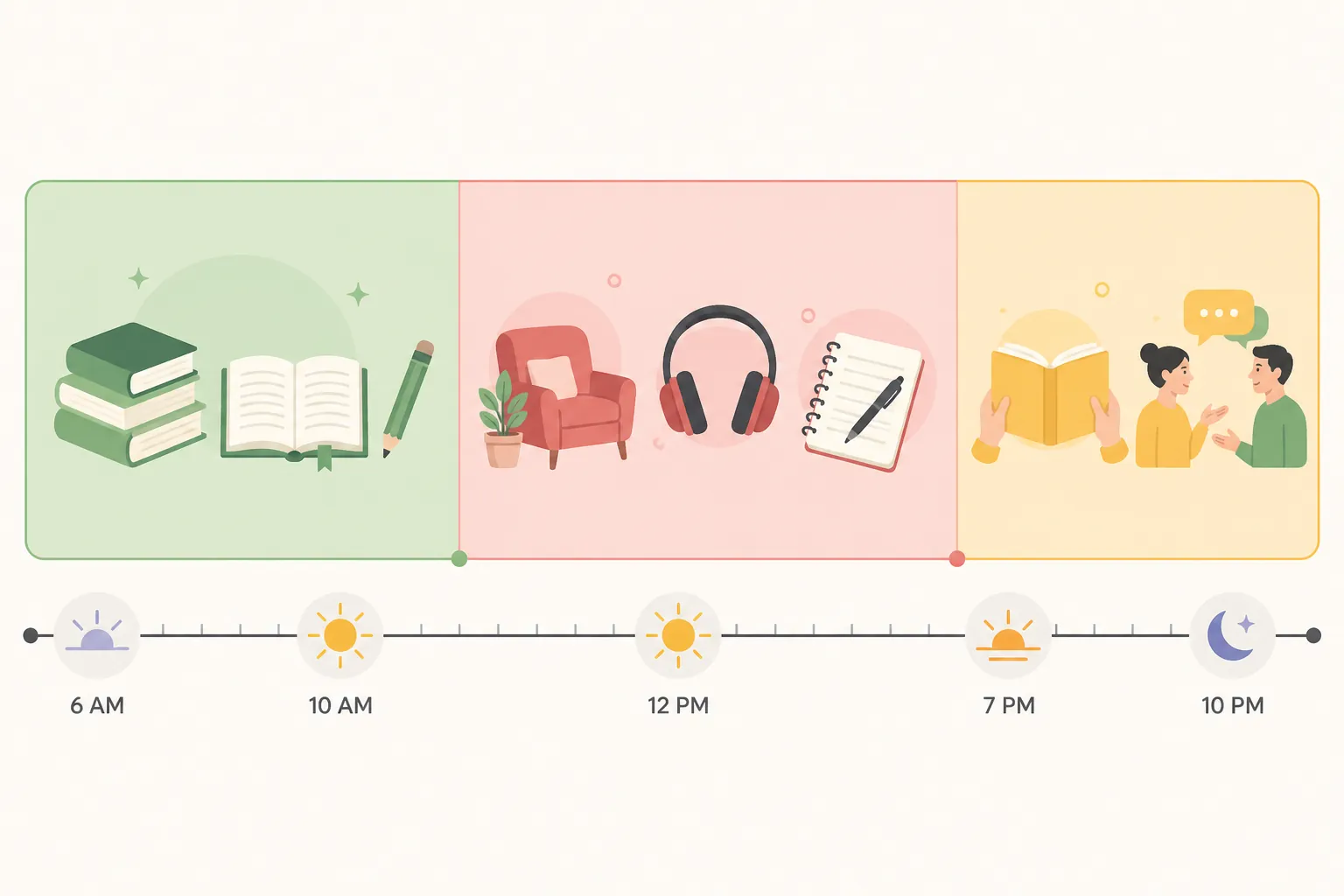
| Zone | When to use it | Best study work | How to treat score data |
|---|---|---|---|
| Green Zone | Before 10am or when the study space is below 80°F | Full-length tests, timed math, memorization, dense science review, difficult verbal reasoning | Treat these as your cleanest readiness checks |
| Yellow Zone | After 7pm, once the space is cooler or heat stress has eased | Section drills, passage reading, missed-question review, flashcards, moderate timed sets | Avoid treating evening fatigue as a full verdict on ability |
| Red Zone | Midday and early afternoon during the hottest conditions | Light review, organizing notes, listening to prep audio, formula sheets, recovery | Do not use this for major score judgments |
Green Zone: Protect the Hardest Work
Green Zone is the part of the day to defend first. If you have only two clean study hours, put them before 10am or inside a reliably cool room below 80°F. This is where full-length practice tests, timed quantitative sets, high-value memorization, and the hardest passage work belong.
For SAT and ACT students, Green Zone is the right home for math sections, grammar accuracy work, and any timed reading set you plan to use as a benchmark. For GRE students, put Quant comparison, data interpretation, text completion, and full verbal sets here. For MCAT students, reserve Green Zone for Chem/Phys, Bio/Biochem, CARS passages that require careful concentration, and any full-length exam day simulation.
The rule is not that you must wake up before sunrise to be serious. The rule is that benchmark work needs benchmark conditions. If a score will influence whether you change your test date, rewrite your study plan, or decide you are “bad at” a section, do not collect that score in the worst heat of the day.
Yellow Zone: Use the Evening Deliberately
Yellow Zone is useful, but it should carry a different load. After 7pm, many students have cooler rooms, lower sun exposure, and fewer heat-related distractions. That makes the evening a good place for section drills, passage reading, missed-question review, Anki or flashcard sessions, vocabulary, equation review, and planning tomorrow’s Green Zone block.
The evening is not automatically easy. If you worked a shift, commuted in heat, cared for siblings, or spent the afternoon in a room without reliable cooling, your brain may still be paying the bill. Keep Yellow Zone moderate: useful enough to move prep forward, not so important that one tired night rewrites your view of your ability.
Red Zone: Downgrade Without Apologizing
Red Zone is not a failed study block. It is a different kind of block. During the hottest part of the day, use low-intensity tasks that keep the plan alive without demanding peak attention: sorting missed questions, rewriting a formula sheet, labeling essay examples, listening to a prep podcast, reviewing a short set of flashcards, packing materials for a library session, or taking a real recovery break.
This is where many students accidentally punish themselves. They schedule a brutal timed set at 2pm, underperform, then spend the evening repairing confidence instead of reviewing mistakes. Red Zone should not produce your most important score data. It should reduce friction so the next Green Zone block starts clean.
Weekly Planner Template for a Heat Advisory Week
Use this template as the core weekly planner. It is built for a heat advisory week, not an ideal week. Replace the example tasks with your exam sections, but keep the intensity pattern intact.
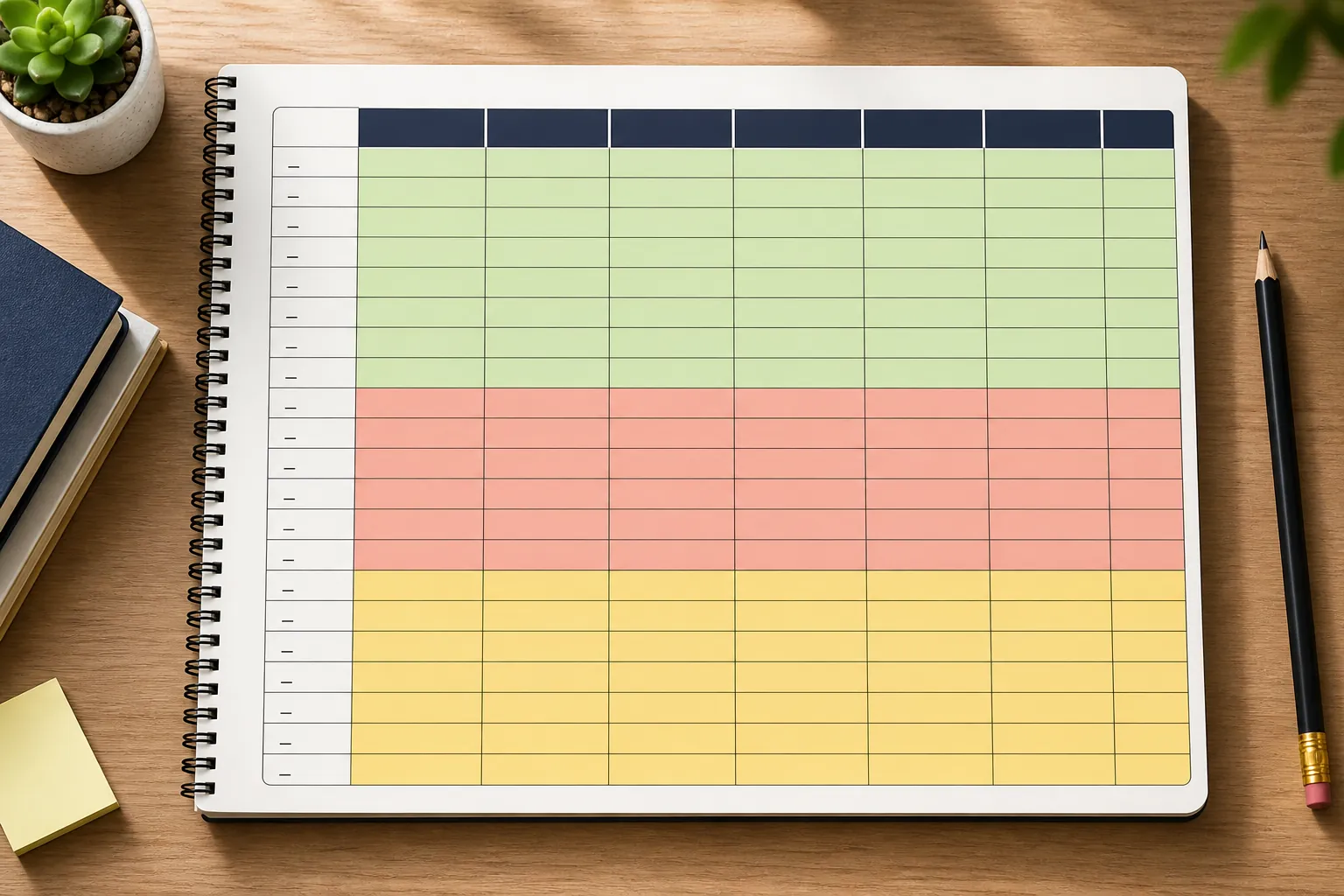
| Day | Green Zone: before 10am or below 80°F | Red Zone: hottest midday hours | Yellow Zone: after 7pm |
|---|---|---|---|
| Monday | Timed high-priority section or math/science drill | Organize missed questions; update formula or grammar sheet | Review errors from morning; short passage set |
| Tuesday | Memorization plus difficult timed set | Light flashcards or prep audio; rest if heat stress is high | Section drill or reading practice |
| Wednesday | Full section benchmark or half-length test block | Score only mechanical items; defer judgment | Analyze patterns; plan Thursday targets |
| Thursday | Weak-area drill under timed conditions | Rewrite notes; prepare materials for next morning | Moderate review set or vocabulary |
| Friday | Practice test segment or cumulative quiz | Recovery, errands, low-stakes flashcards | Missed-question review |
| Saturday | Full-length test or longest weekly simulation | Break, food, cooling, no major score interpretation | Light review only if energy is stable |
| Sunday | Short diagnostic or targeted cleanup | Planner reset; organize next week | Preview assignments; choose Green Zone priorities |
If you are within two weeks of the exam, Saturday’s Green Zone is usually the best place for the full-length practice test. If you are earlier in the cycle, use that block for the longest section combination you can complete under decent conditions. Either way, score interpretation should wait until you are cooled down and can review without rushing.
Track 1: If You Have Reliable Air Conditioning
Reliable AC gives you more flexibility, but it does not make the heat irrelevant. The Yale study’s finding that air conditioning mitigated about 36.6% of the heat effect is a useful caution: cooling helps, but it should not become an excuse to schedule the week as if the advisory does not exist.[1]
- Keep the hardest benchmark work in the morning when possible, especially full-length tests and math-heavy sections.
- Use AC rooms for backup Green Zone blocks when mornings are impossible because of work, class, family duties, or appointments.
- Avoid placing your first serious timed work immediately after a hot commute; give yourself a cooling buffer before starting.
- Use midday AC time for review or moderate drills unless the room is genuinely cool and you are physically settled.
- Mark any practice result taken during a heat advisory with a note about time, room, and temperature conditions.
A student with reliable AC can still use Red Zone for serious work if the room is cool and the body has had time to adjust. The mistake is assuming that “indoors” automatically means “valid testing conditions.” A library room at 72°F after a calm morning is different from a bedroom that cools slowly after hours of sun.
Track 2: If You Do Not Have Reliable AC
Without reliable AC, the schedule needs fewer heroic assumptions. The goal is to protect a small number of high-value blocks rather than pretend every hour is equally usable.
- Move one major study task into the earliest realistic morning block, even if that block is shorter than your usual session.
- Pre-pack materials the night before so the morning block starts with work, not setup.
- Use public cooling options when available, such as a library, school building, community center, or quiet indoor space.
- Treat midday as Red Zone unless you have moved to a cooler location and had time to settle.
- Keep evening work flexible: choose review, passage reading, or flashcards instead of another high-stakes timed set.
This track may look lighter on paper, but it is often more honest. If you cannot control the room, the commute, the work schedule, or the noise level, your planner has to spend its limited precision where it matters most. One protected morning benchmark can be more useful than four heat-impaired sessions that leave you with unreliable scores and a worse mood.
How to Apply the Template by Exam
The zones matter more than the test label. SAT, ACT, GRE, and MCAT prep all rely on attention, memory, timed reasoning, and error review. Since the available research does not directly measure score changes on these exams during heat advisories, the safest use of the evidence is to adjust task placement, not to predict exact point losses.
| Exam | Put in Green Zone | Put in Yellow Zone | Put in Red Zone |
|---|---|---|---|
| SAT | Math modules, full practice tests, timed reading/writing benchmarks | Grammar review, missed-question analysis, short reading sets | Formula review, vocabulary, organizing mistakes |
| ACT | Math, Science, full section timing, full-length tests | English rules, Reading passages, Science review without full timing pressure | Bubble-sheet review, note cleanup, short flashcards |
| GRE | Quant, data interpretation, full verbal sets, official practice tests | Text completion, reading review, error logs | Vocabulary, formula sheets, pacing notes |
| MCAT | Full-lengths, Chem/Phys, Bio/Biochem, high-focus CARS | Passage review, Anki, Psych/Soc review, targeted science drills | Equation sheets, content maps, audio review, logistics |
If a practice result surprises you during a heat advisory, annotate it before judging it. Write the time, location, whether the room was cooled, how you slept, and whether you had been outside or commuting before the block. Those notes will not excuse every missed question, but they can keep you from making a major decision from contaminated data.
What to Do When a Full-Length Test Is Already Scheduled
A full-length test during a heat advisory needs more planning than an ordinary study day. The test itself should start in Green Zone if at all possible. If that means beginning earlier than usual, set up the night before: calculator, pencils, scratch paper, water, snack, login, timer, and answer sheet.
- Start early enough that the hardest sections happen before the room warms.
- Use the most stable cooling option you can access, even if it is not your usual study location.
- Keep official break timing, but do not use breaks for chores, errands, or outdoor exposure.
- Score the test later, ideally in Yellow Zone or the next morning.
- Compare the result with nearby practice data before changing your whole plan.
EdWeek’s 2022 reporting on research by Park and Goodman described cumulative heat effects across the school year in PSAT-related work.[5] That is a reminder that heat is not only a one-day annoyance. Repeated hot study days can gradually lower the quality of practice, especially if the student keeps scheduling the hardest tasks during the same bad conditions.
Small Adjustments That Support the Schedule
The University of Warwick’s student guidance on studying in hot weather emphasizes practical steps such as staying hydrated, taking breaks, keeping rooms cooler where possible, and adjusting workload during heat.[6] Those are useful supports, but they work best when they serve the larger schedule rather than replace it.
- Set up the morning block the night before so the coolest hour is not lost to searching for materials.
- Keep water nearby, but do not treat hydration as a substitute for moving high-stakes work out of Red Zone.
- Use fans, shades, curtains, and cooler rooms to protect Green Zone first.
- Batch errands, chores, and commuting away from the hours before serious timed work.
- Write “heat conditions” beside any practice score that may have been affected.
The useful planner question is not “How do I stay perfectly productive all day?” It is “Which two or three hours need to be protected so my prep remains accurate?” During a heat advisory, protect the morning, downgrade midday, use evening deliberately, and do not treat heat-impaired performance as a clean measure of exam readiness.
References
- Chen et al., Journal of the Association of Environmental and Resource Economists, 2024
- UCLA Luskin review on heat and student cognition, UCLA Luskin, 2025
- Penn State classroom temperature experiment, Penn State, 2004–2005
- Assari & Zare ABCD study using NIH Toolbox cognitive battery, 2025
- EdWeek reporting on Park & Goodman PSAT heat research, Education Week, 2022
- University of Warwick student toolkit tips for studying in hot weather, University of Warwick
Fill in this timeline
This is a skeleton schedule, not a performance claim — for section-by-section strategy to fill in each slot, read the exam hub. For evidence that a similar timeline worked, compare against real outcome logs.