
Comparison
A Student's Guide to the 2026 Perseid Meteor Shower
The 2026 Perseid meteor shower peaks on the night of August 12–13 under a completely dark new moon — the best conditions since 2021. This guide helps students plan a low-friction viewing session around study schedules, with realistic meteor rate expectations and simple location tips.
Verdict panel
- Compared
- not specified
- Target exam
- not specified
- Best for
- not specified
- Pricing last reviewed
- pricing currency unconfirmed
The 2026 Perseid meteor shower is one of the rare sky events that is actually worth making a small plan for. The new moon falls on August 12 at 17:37 UTC, so the peak night of August 12–13 is moonless, giving the Perseids their darkest peak conditions since 2021; similarly clean moon conditions are not expected again until 2029. [1]
That does not mean you need a telescope, a campsite, or permission to ruin your sleep for the rest of the week. For most students, the workable version is simple: choose the darkest safe place you can reach, check the weather before you commit, go out after midnight, stay long enough for your eyes and patience to do something useful, and keep your expectations out of fantasy-land.
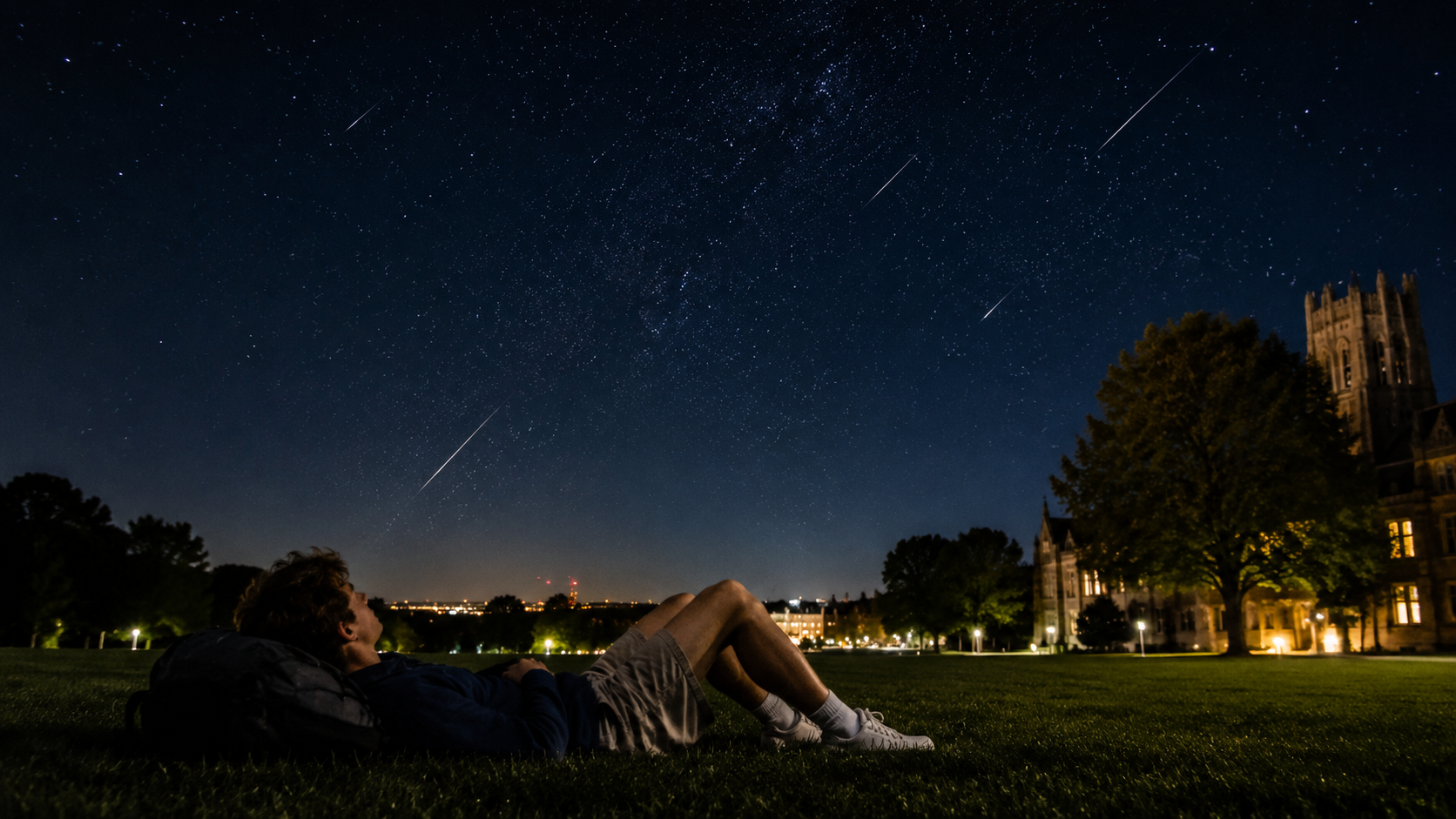
The short version: when to watch
| If you can do one thing | Plan |
|---|---|
| Best night | Night of August 12 into the morning of August 13, 2026 |
| Best viewing block | After midnight until dawn, with the pre-dawn hours especially useful |
| Why that night matters | The peak lands under a completely dark new moon |
| Predicted peak moment | 14:53 UTC on August 13, which means no single local nighttime gets the perfect “instant” everywhere |
| North America | Use the mornings of August 12 and August 13, after midnight until dawn |
| Backup window | The Perseids are active from July 17 to August 24, so nearby clear nights still count |
The predicted peak is 14:53 UTC on August 13, and the broad activity period runs from July 17 to August 24. For North American viewers, the practical advice is to treat the mornings of August 12 and 13 as the main chances, especially the hours after midnight and before dawn, when the Perseid radiant is higher in the sky. [1][2]
If that timing already sounds inconvenient, that is the honest part of meteor watching. The shower improves after midnight because your part of Earth is turning more directly into the debris stream, and because Perseus climbs higher. You do not need to stare at Perseus, though. Meteors can appear across the sky, so the goal is a wide, dark view, not a perfect diagram.
A 15-minute student plan for August 12–13
The best Perseid viewing plan is not complicated. It is mostly a time-management plan with a sky attached.
Before dinner: decide whether the night is worth it
Check three things before you start moving your schedule around: cloud cover, smoke or haze, and whether your viewing spot is actually darker than the sidewalk outside your dorm or house. A moonless peak helps a lot, but it cannot fix a low cloud deck or a parking lot floodlight.
If the forecast is bad on the exact peak night, do not treat the whole thing as lost. The Perseids are not a one-minute event. The activity window is broad enough that a nearby clear night can be more rewarding than the official peak under clouds. [1]
Pick the darkest safe place you can reach without turning the night into a trip
On campus, that usually means avoiding the obvious bad spots: directly under walkway lights, beside glassy buildings, near athletic fields with security lighting, or anywhere headlights sweep across every few minutes. A slightly darker field, hill, lakeside path, or edge of campus can beat the prettiest central quad if the quad is lit like a stage.
Use a light-pollution map or a weather app if it helps, but do not spend the whole evening optimizing. A realistic student target is “darker than where I was going to stand,” not “perfect rural sky two hours away.” If you want a more location-focused checklist, use this student guide to picking a Perseid viewing spot before you leave.
Set one viewing block, not an all-night identity
If you have class, lab, work, or a parent who reasonably wants to know why you are leaving after midnight, make the plan bounded. A strong student version might look like this: finish the non-negotiable work earlier, nap if you can, leave around midnight or 1 a.m., watch for 60 to 90 minutes, and go home without pretending you are going to be productive at dawn.
The first 20 minutes are not wasted. Your eyes need time to adapt to darkness, and your brain needs time to stop treating every airplane as a personal betrayal. If you only stand outside for eight minutes, you are mostly testing your impatience.
- Minimum useful attempt: 30 minutes outside, after your eyes adjust.
- Better student block: 60 to 90 minutes after midnight.
- Ambitious version: pre-dawn watch, only if the next morning can survive it.
Bring less than you think
Bring a blanket or chair, a layer warmer than you think you need, water, a snack if you are staying out long enough to get annoyed, and a red-light setting if you must use a light. If you are with friends, agree before you start that nobody is going to blast a white phone screen into everyone’s dark-adapted eyes every four minutes.
Do not bring binoculars or a telescope for the meteors. Meteors cross large areas of sky quickly, and magnifying equipment narrows your field of view. Your best instrument is a comfortable position that lets you look at a wide patch of sky without craning your neck. [3][4]
About that “80 to 100 meteors per hour” claim
You will see plenty of headlines around the 2026 Perseids quoting ideal rates around 80 to 100 meteors per hour, and some sources discuss even higher possible numbers under exceptional assumptions. NASA describes the Perseids as commonly producing about 50 to 100 meteors per hour, while other viewing guides use roughly similar ideal dark-sky ranges. [4][3]
That number is a Zenithal Hourly Rate, or ZHR. It is not a promise that one student on a suburban campus edge will personally count 100 meteors between 1:00 and 2:00 a.m. ZHR assumes very dark skies, a high radiant, a wide unobstructed view, and a trained or attentive observer. Most students will have compromises: light pollution, trees, buildings, haze, tired eyes, conversation, and the occasional glance at a phone.
A suburban viewing rate may be closer to about 25 meteors per hour, and even that depends on local sky quality and weather. [3] This is the part worth taking seriously before you recruit half your group chat. A 25-meteor hour can still feel great if you are lying under a dark sky and a few bright Perseids cut across it. It can feel disappointing only if you were promised a meteor every 36 seconds like a scheduled campus shuttle.
Count the night by quality, not just total. One bright fireball, a short burst of several meteors, or a long persistent train can make the whole session worth it. The Perseids are known for bright meteors, fireballs, colorful trails, and trains that can linger for several seconds. [4][3]
How to watch once you are outside
Once you reach your spot, stop turning the session into a setup project. Put the blanket down, face a broad open area of sky, and let your eyes adjust. If one part of the sky is blocked by buildings or trees, face the clearer side. If a light is in your peripheral vision, move or use a bag, tree, wall, or your own body to block it.
You do not need to identify Perseus to see Perseids. The radiant matters because meteors appear to trace back to that part of the sky, and because viewing improves as it rises higher after midnight. But staring straight at the radiant is not the move. Meteors near the radiant have shorter apparent paths; many of the more satisfying streaks appear farther away from it.
- Lie back instead of standing. Neck pain ends more meteor sessions than astronomy does.
- Keep your phone face down, dimmed, or in red mode.
- Watch a wide area of sky rather than chasing individual directions.
- Give the session at least one real quiet stretch. Meteors are easier to notice when nobody is constantly asking whether that was one.
- If safety requires lights, use them. A ruined dark adaptation is better than a bad walk back.
Stargazing apps can be useful at the beginning and end of the session: finding Perseus, checking constellations, confirming directions, or comparing darker nearby areas. They are much less useful as the main event. If you want tools without turning the night into screen time, this viewing guide for astronomy students is the better place to sort that out before you go.
What you are actually seeing
The Perseids happen because Earth passes through debris left by Comet Swift-Tuttle. The comet last visited the inner solar system in 1992, follows an orbit of about 133 years, and has a nucleus about 26 kilometers wide. Each August, Earth crosses the stream of small particles shed along that orbit. [5][1]
Those particles hit the atmosphere at about 37 miles per second, or 59 kilometers per second. They burn up around 60 miles, or 97 kilometers, above the ground, at temperatures above 3,000°F, or about 1,650°C. [4] The visible streak is not a rock falling all the way to campus. It is the atmosphere lighting up as the particle tears through it.
The better ones can leave persistent trains, which are glowing trails that remain after the meteor itself has vanished. Some Perseids are fireballs, meaning they appear brighter than Venus. [4][3] These are the meteors people remember later, not because they saw hundreds, but because one bright streak made everyone stop talking at the same time.
If you have coursework, make the outing earn its place
If astronomy, physics, environmental science, photography, or data collection is part of your semester, the Perseids can be more than a late-night break. Keep it light: record the start and end time, sky conditions, rough location type, limiting obstructions, and the number of meteors you noticed. Do not turn a relaxing watch into a lab report unless someone is grading it.
For a study-friendly version, use the shower as a reward after a defined work block rather than as an excuse to let the whole evening dissolve. A plan like “finish the problem set draft by 10:30, pack by 11:00, leave at 12:15” is boring in exactly the way useful plans are boring. If you want to build the night around work blocks, the Perseid meteor shower study session plan is a better fit than improvising at midnight.
If you want the science layer without hauling a textbook outside, connect the observations to radiant geometry, comet debris, atmospheric entry, and light pollution afterward. This Perseid astronomy lesson guide can help turn what you saw into something more structured the next day, when your eyes and patience have recovered.
Backup nights, bad forecasts, and the eclipse coincidence
The most annoying Perseid outcome is not a low meteor count. It is staying up late under clouds because the calendar said “peak.” If August 12–13 is cloudy, smoky, stormy, or unsafe where you are, use a nearby clear night. The peak matters, but the activity period from July 17 to August 24 gives you room to be practical. [1]
The farther you move from the peak, the more rates generally drop, so do not expect the same odds two weeks away. But a transparent, dark sky on a shoulder night can beat the official peak from a bright, humid, half-blocked location. That is especially true if your actual choice is between a calm one-hour session and a miserable all-night attempt that wrecks the next day.
There is also a total solar eclipse on August 12, 2026, visible from Greenland, Iceland, and Spain. It is a striking calendar overlap, but for most students reading a Perseid viewing guide, it is just that: an overlap. Unless you are already in or traveling to the eclipse path, it should not change your meteor plan. [1][2]
The grounded reason 2026 is worth the effort
Most annual meteor shower notices are easy to ignore if your week is full. The 2026 Perseids are different because the sky conditions remove the biggest natural obstacle: moonlight. You still have to deal with clouds, light pollution, timing, and your own schedule, but the new moon is doing students a favor this year.
So make the plan modest. Pick a dark reachable spot. Watch after midnight. Stay long enough for your eyes to adjust. Do not expect a guaranteed meteor count. If the weather fails, use a backup night. If it works, you get one of the cleaner Perseid chances of the decade without buying anything or turning a weeknight into a production.
References
- Perseid meteor shower 2026: All you need to know — EarthSky
- Perseid meteor shower 2026 — When, where and how to see it — Space.com
- Astronomer's top tips for the 2026 Perseid meteor shower — Sky at Night Magazine
- Perseids — NASA Science
- Perseids — Wikipedia
Back to the exam this applies to
Target exam not specified — see all exam hubs.
Comments
Join the discussion with an anonymous comment.