
I Tested Anthropic Claude for Exam Prep
Accuracy Warning — Anthropic Claude
Do not use Claude-generated questions, answer keys, or score estimates without verification; generated practice can include ambiguous answer choices.
- Accuracy:
- Moderate
- Tested:
- Missed-question explanations and generated SAT practice questions
- Last tested:
- 2026-08-01
I tested Anthropic Claude for standardized-exam prep, not for Anthropic’s own certification exams. My anchor was the digital SAT because it forces an AI tutor to handle both reading-and-writing reasoning and math explanation without hiding behind one subject. The short verdict: Claude was strongest when I fed it an official or official-style missed question and asked it to explain the reasoning. It was much weaker when I asked it to create new practice. If your test date is close, Claude belongs beside official materials, not in place of them.
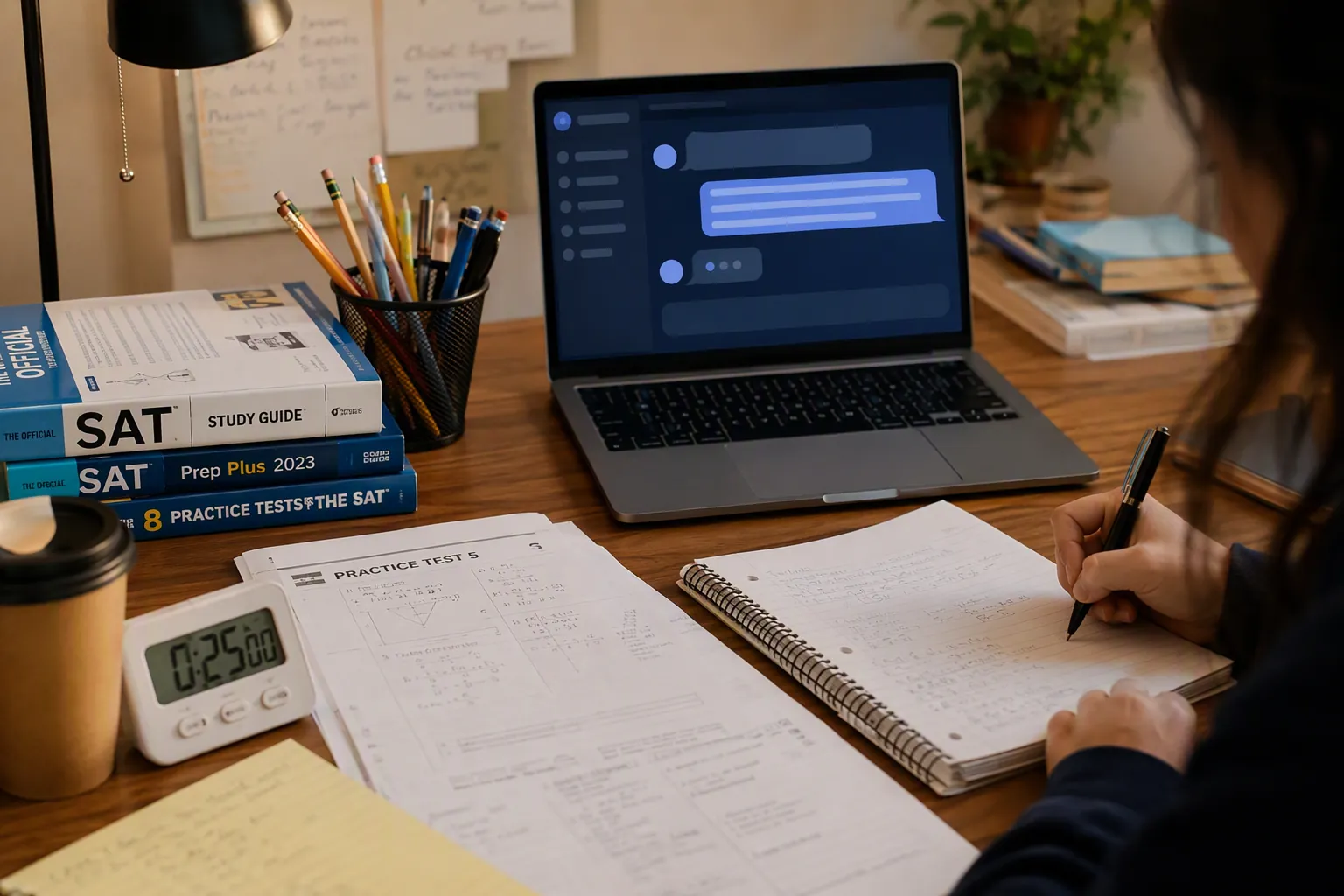
| Test disclosure | What I used |
|---|---|
| Last tested | August 1, 2026 UTC |
| Account tier | Claude Pro |
| Model label | Claude Sonnet in the Claude web app; exact backend version was not independently auditable from the chat transcript |
| Anchor exam | Digital SAT |
| Tasks tested | Missed-question explanations, alternate solution paths, Socratic review, reading-and-writing reasoning checks, generated practice questions, short study-plan help |
| Accuracy warning | I checked Claude’s work against official or official-style SAT material where possible. I would not use any generated question, answer key, or score estimate without verification. |
If you are building an SAT calendar from scratch, start with official practice and the site’s SAT exam hub. My test here was narrower: once a student already has real practice questions, can Claude make the study session better without quietly pulling them away from the exam?
How I tested Claude
I used Claude the way I see students actually use AI during a study week. I did not ask it to replace a prep book or produce a complete six-week SAT course. I gave it specific jobs after a practice attempt: explain why I missed a question, compare my reasoning with the official answer, turn an error into a review drill, and, when I wanted to stress-test it, generate a few similar questions.
The most important constraint was that Claude had to orbit the practice set, not become the practice set. For math, I gave it my work after I had already attempted the question. For reading and writing, I gave it the relevant passage excerpt, the answer choices, my chosen answer, and the correct answer only after asking it to reason through the options. I kept the official explanation nearby as the judge. That made the session feel less magical and much more useful.
- First pass: attempt the question without Claude.
- Second pass: paste my work or reasoning into Claude and ask for diagnosis, not the answer.
- Verification pass: compare Claude’s explanation with the official answer and my notes.
- Transfer pass: ask for one short follow-up drill or one Socratic review thread.
- Cutoff rule: if Claude started producing new SAT-like questions, I treated them as disposable review prompts, not score evidence.
That cutoff rule mattered almost immediately. Claude’s explanations often improved the session. Its original questions often made the session feel productive while becoming harder to verify.
Where Claude helped: missed-question explanations
Claude was at its best when I gave it a bounded problem and a student mistake. In one algebra item, I pasted my scratch work and wrote: “Do not solve from the beginning. Find the first line where my reasoning breaks.” Claude did exactly what I wanted from a patient tutor. It wrote: “Your first two transformations are fine. The mistake starts when you divide by the expression that could be zero; that move changes the set of possible solutions. Before simplifying, ask what value would make that denominator vanish.”
That explanation did two useful things. It located the error instead of re-teaching the whole topic, and it named the exam-relevant habit: before canceling, check what you are canceling. A beautiful full solution can be a trap in test prep because it lets the student nod along without learning where the score leaked. Claude avoided that in this case.
It was also good at translating official explanations into plainer language. When an official-style reading question hinged on why an answer choice was too broad, Claude’s first version was wordy. I pushed back: “Say this like you are talking to a student who keeps choosing the strongest-sounding answer.” The useful part came back as: “The passage supports a smaller claim than this answer makes. Strong language is only safe when the passage is equally strong.” That is the kind of sentence a student can carry into the next question.
The limitation is that Claude sometimes over-explained even when I asked for a quick diagnosis. A one-minute correction could turn into a mini-lesson, then a second example, then a general strategy. For a student with unlimited curiosity, that is pleasant. For a student with six weeks and a target score, it needs a leash.
Learning Mode: disciplined, patient, and expensive in minutes

Claude’s Learning Mode is the part that made me most optimistic and most nervous. In normal chat, Claude will usually answer directly unless you constrain it. In Learning Mode-style prompting, it becomes more willing to ask, wait, and build from the student’s response. That is real tutoring behavior, and it is much closer to how I want AI to behave around exam prep.
Mashable’s September 2025 hands-on test captured the tradeoff well. In that field test, Claude stuck to the Socratic prompt 10 out of 10 times and refused to simply give direct answers, but one polynomial long-division lesson ran about 90 minutes and produced roughly 100 follow-up questions. The article described the experience as “Socrates for the five percent,” a phrase that is uncomfortably fair for deadline prep: excellent for a learner who will stay with the thread, inefficient for many students who mainly need to convert errors into reliable points. [1]
My own run had the same shape on a smaller scale. When I asked Claude to walk me through a math miss without revealing the final answer, it asked useful questions: What relationship is fixed? Which quantity changes? What does the answer choice need to represent? The thread stayed coherent. It did not lose the original problem. It did not suddenly dump a polished solution after one wrong student reply.
The cost was pace. Socratic review is not the right mode for every miss. If the error is a vocabulary gap, a formula you forgot, or a careless sign mistake, you may need a quick correction and another official question more than a 20-message conversation. Claude’s patience is a feature only when the student can afford to spend that patience.
The practical setting I liked best was narrow: “Ask me up to three questions to make sure I understand why my answer was wrong, then stop.” That gave Claude room to teach without letting the chat become the study session.
The weak point: generated practice
When I asked Claude to generate SAT-style practice, the surface quality was high. The questions looked polished. The answer explanations sounded confident. The difficulty labels sounded plausible. That is exactly why I do not trust it as a question engine.
One reading-and-writing prompt it generated had two answer choices that were too close to each other. The claimed correct answer was “to challenge a common assumption about the cause of the trend,” while another choice said “to explain why new evidence changes how researchers interpret the trend.” In the passage Claude had written, both were defensible. When I asked why the second choice was wrong, Claude gave a confident explanation that would also weaken the answer it had marked correct.
That is not a harmless flaw. On a standardized exam, answer choices are engineered. The distinction between “tempting but wrong” and “best supported” is the test. If an AI writes a passage, writes the choices, chooses the answer, and judges the explanation, the student has no independent anchor unless they already know enough to catch the problem.
The math generation was better for simple drills. If I asked for five untimed linear-equation warmups, Claude produced usable practice for skill review. But once I asked for official-style mixed-difficulty items with SAT-like traps, the value dropped. Some problems were too generic. Some answer choices did not diagnose common mistakes. Some explanations were longer than the problem deserved. None of that tells me what my SAT score is likely to do.
So I would use Claude-generated questions only for low-stakes rehearsal: “Give me three quick examples to practice this concept before I return to my official set.” I would not use them to measure readiness, set a target score, or decide that a topic is finished.
Why the score-impact evidence makes me stricter
The caution here is not that AI is useless. The caution is that AI can make practice feel better while failing to improve test performance. That distinction matters more than the chat transcript.
Hechinger’s coverage of the UPenn study “Generative AI Can Harm Learning” reported a result that should make every exam-prep student pause: students using ChatGPT solved 48% more practice problems correctly, but then scored 17% worse on the actual test. A fine-tuned hint-based tutor group solved 127% more practice problems, yet showed no test-score improvement. The underlying paper is by Bastani, Handa, and coauthors; because the figures here are taken from Hechinger’s coverage, I would verify the full paper text before treating every secondary breakdown as settled. [2][3]
That finding does not prove Claude will hurt SAT performance. It was not my exact tool, my exact exam, or my exact workflow. But it supports the exam-first rule I kept coming back to during the test: easier practice is not the same as transferable performance. If Claude helps you solve a problem only while Claude is present, the gain may disappear when the timer starts and the chat window closes.
This is where I became less impressed by conversational fluency. Claude can sound like an excellent tutor. Often, it is one. But the question for prep is narrower: after the explanation, can the student solve the next official-style question alone, under time pressure, without being led by hints?
What outside evidence says about Claude specifically
Anthropic’s own Education Report is useful mainly because it shows that the behavior this article worries about is already common. In an April 2025 report based on 1 million student conversations, Anthropic said students used Claude mainly to create or improve educational content, at 39.3% of conversations, and that about 47% of student-AI conversations were “Direct” answer-seeking, including direct answers to test questions. That is vendor data, but it matches the pattern I see in real study behavior: students often turn AI into an answer machine unless the study routine prevents it. [4]
Talkory’s May 2026 honesty test gives Claude a modest point in its favor, with a large label attached. In a 20-question vendor-run test, Claude 3.7 Sonnet produced confident wrong answers on 4 out of 20 questions and corrected false premises 8 out of 10 times, outperforming the other named models in that small comparison; ChatGPT-4o had 11 confident wrong answers out of 20 and Grok 2 had 13 out of 20. This is not an independent benchmark, it is small, and it was run on a model version that may not match the one in a student’s account. Still, it fits my trial impression that Claude is often more willing than some chatbots to slow down and question the premise. [5]
XDA Developers’ February 2026 first-person study comparison also lines up with Claude’s strengths: long-form consistency, file analysis, Artifacts, and Projects organization. Those are useful for keeping a study thread coherent or working through uploaded notes. They do not turn Claude into a validated SAT question bank. If you want the broader tool-against-tool breakdown, use our Claude vs. ChatGPT tested for exam prep comparison instead of treating this article as a model ranking. [6]
Pricing is another place where students should slow down before committing. As a mid-2026 snapshot, Claude commonly appears in Free, Pro at about $20 per month, Max 5x at about $100 per month, and Team at about $25 per user per month, with no official Pro student discount confirmed in the research I reviewed. Prices, limits, and feature access change quickly, so recheck before paying for a study month. [7]
Where Claude fits in a six-week SAT plan

I would use Claude after the real attempt, not before it. The official question should create the pressure. The timer should expose the weakness. Claude can then help turn that weakness into language the student understands.
- Use Claude to unpack missed questions: paste your reasoning and ask where it first breaks.
- Use it to compare solution paths: ask whether your method was valid, slow, or fragile under time pressure.
- Use it for Socratic review in small doses: cap the number of questions it can ask before it must summarize.
- Use it to translate dense explanations into plain English, then return to official practice.
- Use generated drills only as warmups, never as evidence that your score has improved.
I would not use Claude as the study plan. It can help you organize one, but it does not know your actual score history unless you supply it, and it cannot validate readiness from its own generated work. I would not use it as the source of practice questions. I would not use it as the authority over official answers. I would not ask it to predict a score from a chat session.
I would also build a backup routine. If your practice block depends on Claude and Claude is down, your study session should not collapse. Keep official PDFs, a printed error log, and at least one non-AI review method ready. For reliability planning, use our Claude outages exam-prep tracker and Claude outage study backup plan. Claude is a useful layer; it should not become your infrastructure.
If you are testing other AI study tools in the same way, the closest sibling review is our MiniMax H3 tested for exam prep article. If you want a more structured Socratic alternative, compare Claude’s Learning Mode behavior with our ChatGPT Study Mode hands-on guide for students. The decision should come down to how the tool fits your study routine, not which chatbot sounds more polished.
My verdict
Claude is one of the better AI tools I have used for explaining why a student missed a problem. It is calm, coherent, and unusually good at keeping the thread of a mistake intact. In Learning Mode-style use, it can behave like the tutor many students wish they had after hours.
That does not make it a prep system. A prep system has to protect official practice, timed performance, answer-key accuracy, and score reality. Claude can support those things when the student controls the study routine. It can also blur them when the student lets the chat generate the practice, judge the answer, explain the result, and decide what comes next.
My role-based verdict is simple: use Claude to unpack missed questions, ask follow-up explanations, compare reasoning paths, and run short Socratic reviews. Do not use it as your question source, your study plan, your score predictor, or the authority over official answers.
References
- I tried learning from Anthropic's AI tutor. I felt like I was back in college — Mashable, Sep 2025
- Kids who use ChatGPT as a study assistant do worse on tests — Hechinger Report
- Generative AI Can Harm Learning — SSRN
- Anthropic Education Report: How university students use Claude — Anthropic, Apr 2025
- Which AI Admits It Does Not Know? 20-Question Honesty Test — Talkory, May 2026
- I ditched ChatGPT for Claude, and it changed how I study — XDA Developers, Feb 2026
- Claude AI Review — G2
Authoritative source
For the authoritative version of this contentHow to Read the '1 in 4 NFL Players CTE' Study
Report an error in this tool's output
Found something this tool got wrong beyond what's documented above? Report it so the accuracy log stays current.
Comments
Join the discussion with an anonymous comment.