
Are Claude Outages a Risk to Your Exam Prep?
Accuracy Warning — Claude
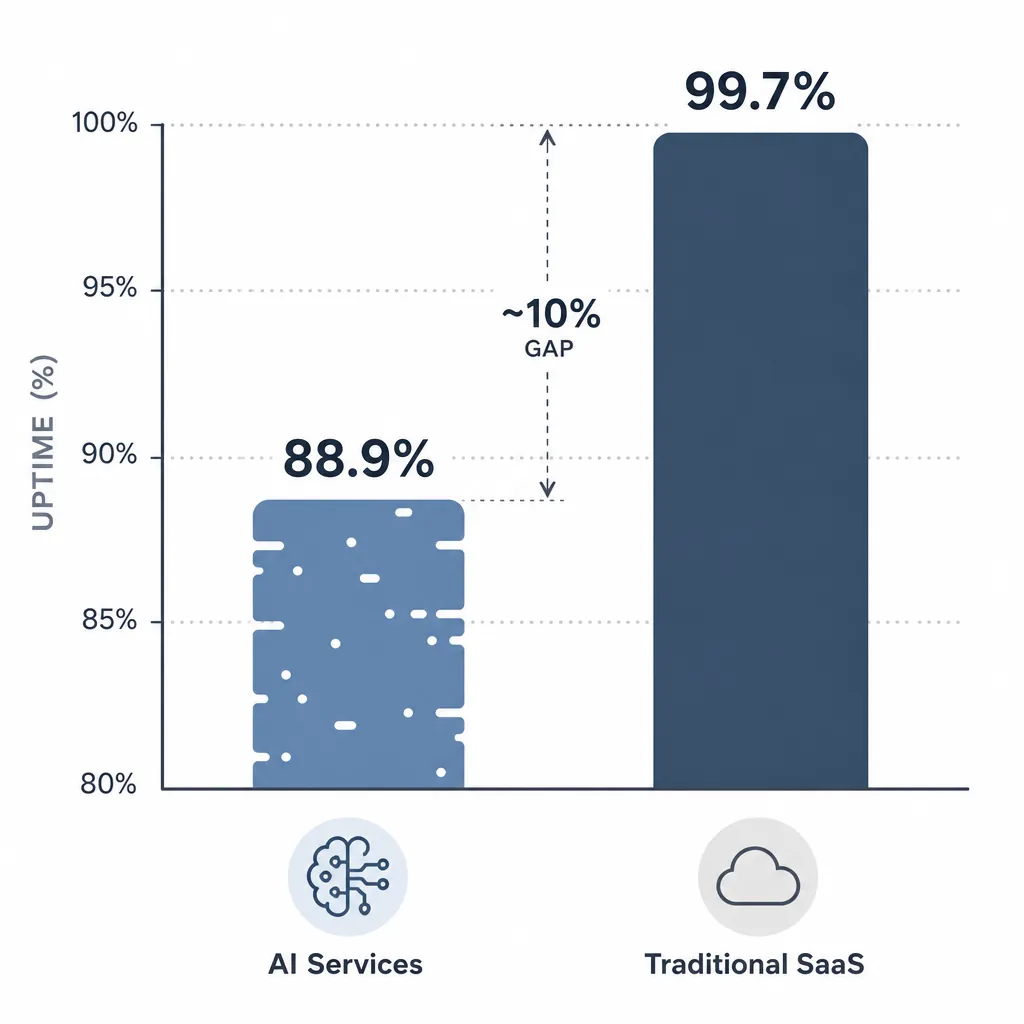
Claude outages and quota drain bugs can disrupt exam prep; reliability is roughly 10% lower than traditional SaaS. Use as supplement, not primary infrastructure.
- Accuracy:
- Moderate
- Tested:
- Generating practice questions and explanations
- Last tested:
- 2026-06-23
If Claude goes down close to your test date, your study plan is exposed only if Claude has become the plan. For GRE, MCAT, ASVAB, SAT, and ACT prep, the safer verdict is simple: Claude can be an excellent supplement for explanations, practice prompts, rewording weak answers, and getting unstuck, but it should not be the primary infrastructure your schedule depends on.
Reliability context matters here. As of Q3 2026, available outage data suggests AI study tools still behave more like fragile, fast-scaling infrastructure than like mature consumer software. One March 2026 analysis put average AI-service uptime at 88.9% across five major providers, compared with 99.7% for traditional consumer SaaS products such as Canva, Figma, and Grammarly — roughly a 10-percentage-point gap.[1] That number should not be treated as a prediction of your personal experience; it is based on status-page tracking and may miss transient or regional failures. It is still enough to change how a deadline-driven student should build a workflow.

The March 2 outage was visible. That made it easier to handle.
The cleaner failure story came on March 2, 2026. Claude had just launched Import Memory, a feature that helped users bring context from other tools into Claude. Demand surged, Claude reportedly reached #1 on the App Store, and Anthropic attributed the outage to “unprecedented demand.” The result was a roughly four-hour worldwide failure across web, API, and mobile access.[2][3][4]
For a student, that kind of outage is bad but at least legible. If you planned to spend 7:00 to 9:00 p.m. generating CARS passages, reviewing chemistry explanations, or turning a missed SAT math problem into five similar drills, the failure is obvious. The chat will not load. The app will not respond. You complain for a few minutes, check the status page, and switch tasks if you have a backup plan.
The March outage also shows a practical problem that students often underestimate: popularity can create pressure on the same infrastructure they are relying on. A feature launch, a usage spike, and app-store momentum are not abstract product news if they happen during your last full-length review week.
The June 2 failure was more dangerous for exam prep
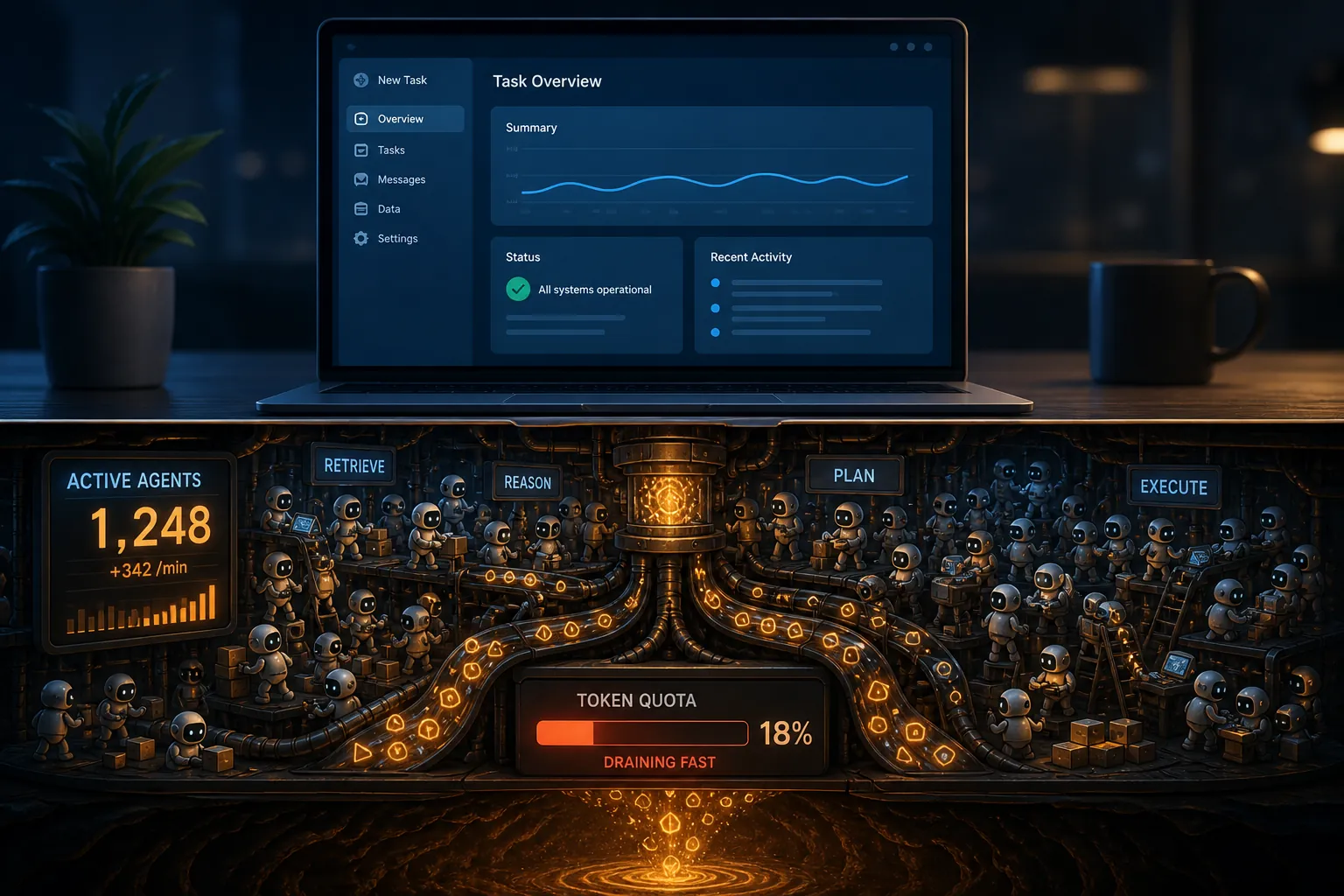
The June 2, 2026 incident is the one students should study more carefully. It was not just Claude being unavailable. Reports described a bug in Claude Code’s sub-agent system that caused sub-agents to multiply exponentially, consuming tokens at 10 to 100 times the normal rate and draining Pro and Max plan quotas within minutes.[5][6][7]
That is a different failure mode. A visible outage tells you to stop waiting. A silent quota drain invites the wrong diagnosis: maybe your prompt was too long, maybe you used the tool inefficiently, maybe you misunderstood your plan limits, maybe you should try again. For a student with a fixed evening block, that confusion is expensive. It burns time before the studying even begins.
The reported student impact should be handled carefully. The Economic Times said students experienced delays in research, exam prep, and learning assistance during the June 2 outage.[5] That is useful evidence that the disruption reached educational use, but it is not the same as a broad, quantified study of test-taker harm. The stronger point comes when that report is paired with Anthropic’s own education-use data.
Anthropic’s April 2025 Education Report found that 39.3% of student conversations involved creating or improving educational content, and 33.5% involved technical explanations.[8] Those are exactly the study workflows that fail when a tool becomes unavailable or quietly consumes quota: turning notes into practice, explaining a missed concept, rewriting a weak answer, or making a confusing topic less intimidating. The caveat is important: the report analyzed about 1 million conversations from higher-education email accounts on Free and Pro tiers, which may overrepresent computer science students, early adopters, and college users rather than high school SAT or ACT students.[8]
A third June incident widened the pattern, even without a root cause
Claude had another major disruption on June 23, 2026. TechRadar’s live coverage reported a peak of 7,119 Downdetector reports, said all model tiers were affected, and noted Anthropic’s statement that “a fix has been implemented.” The root cause was not publicly identified in that coverage.[9]
That lack of root-cause detail limits what can be concluded. It would be overreach to say the June 23 incident repeated the June 2 bug. It is fair to say that, from the student’s side of the screen, the distinction may not matter much during a scheduled study block. If the model is unreachable, degraded, or unreliable, the planned Claude-dependent task still stops.
The wider incident record also argues against treating these as isolated annoyances. One compilation from Anthropic’s status page counted more than 50 total incidents, including 24 classified as major or critical; in March alone, it counted 22 incidents across 20 days.[1] The source is a commercial AI-infrastructure vendor, so its redundancy framing deserves some skepticism, but the incident-density signal is still relevant for students deciding how much of their prep system should sit on one service.
What actually breaks when Claude is unavailable
The study impact is not just “I cannot chat with an AI.” It depends on which job Claude was doing in your prep system.
| Claude-dependent task | What an outage or quota failure interrupts | Why it matters near a test date |
|---|---|---|
| Practice-question generation | New drills, variations on missed questions, passage-style prompts | You lose the planned repetition block unless official or saved questions are ready |
| Concept explanations | Step-by-step clarification of biology, math, grammar, physics, or reading logic | A confusing topic can stay unresolved until the next study window |
| Study-plan adjustment | Rebalancing the week after a weak practice test or missed session | The next action becomes vague at the exact moment you need triage |
| Weakness diagnosis | Pattern-finding across wrong answers or essay responses | You may keep doing more questions without knowing what they are supposed to fix |
| Technical explanations | Code, statistics, equations, lab reasoning, or other structured problem solving | A single blocked explanation can stall an entire assignment-like study task |
The riskiest setup is the one that looks efficient on a normal night: no printed plan, no official-question queue, no saved explanations, no alternate AI account, no offline review task, and all practice generation happening live inside Claude. That workflow feels lean until the service fails. Then the student is not choosing between good study options; they are rebuilding the evening while anxious.
This is where adoption and effectiveness need to stay separate. The Education Report shows that many students use Claude for educational content creation and technical explanations.[8] It does not prove that Claude improves scores, and it does not prove that outages caused measurable score drops. What it does show is that the affected workflows are real study workflows, not fringe uses.
Use Claude where it is strong, but keep the spine somewhere else
A resilient exam plan does not require abandoning Claude. It requires demoting Claude from “the place where my prep lives” to “one tool that accelerates parts of the prep.” That distinction matters most during the final month, when the cost of a lost evening is higher and the room for improvisation is smaller.
- Keep official materials as the spine: test-maker guides, official question banks, released tests, official scoring rubrics, and your fixed test-date calendar should remain usable without Claude.
- Use Claude for acceleration: ask it to explain a missed concept, rephrase your answer, generate extra drills, compare solution methods, or turn a weak explanation into a clearer one.
- Save key outputs before you need them: download study plans, copy high-value explanations, keep formula sheets and error logs outside the chat window, and preserve any prompts you reuse often.
- Maintain at least one backup route: another AI tool, a textbook chapter, a trusted video source, a tutor note, or a prebuilt official-question set.
- Assign outage-safe tasks in advance: flashcard review, error-log cleanup, timed reading passages, formula recall, essay outline practice, or review of already-missed questions.
The same reliability principle appears in enterprise AI guidance, where multi-LLM redundancy and graceful degradation are recommended for systems that cannot simply stop when one model provider has trouble.[6][10][3] Students do not need enterprise architecture. They do need the smaller version of the same idea: if Claude fails, the next useful task should already be obvious.
Backup plans are not magic. A regional internet problem, a shared cloud dependency, or a peak-demand event can affect more than one tool. A second AI service can also give worse explanations or different formatting. The goal is not perfect continuity. The goal is to prevent one unavailable chat window from deciding whether the day’s study happens.
A practical standard for the final weeks
Three weeks from an exam, the question is no longer whether a tool is impressive. The question is whether the workflow survives a bad night. If Claude is unavailable at 8:00 p.m., can you still do the planned official questions? Can you still review yesterday’s misses? Can you still practice the skill the block was meant to train? If the answer is yes, Claude is being used safely. If the answer is no, the plan is too brittle.
The 2026 Claude outages do not make Claude a bad study tool. They make it a tool with infrastructure risk. The right conclusion is not panic and not reassurance. Use Claude for the work it does well, but do not let a high-stakes test date depend on a single AI service staying available.
References
- Claude Code Outages: Why AI Reliability Matters, Sanj.dev
- Claude Outage After Import Memory Launch, TechCrunch
- Claude Outage and Multi-LLM Redundancy Analysis, Digital Applied
- Claude Worldwide Failure Coverage, Windows Forum
- Claude AI Outage Disrupts Research and Exam Prep, The Economic Times
- Claude Code Sub-Agent Bug and AI Redundancy Guidance, Deployflow
- Anthropic Resets Quotas After Claude Code Bug, Storyboard18
- Anthropic Education Report, AnthropicApril 2025
- Claude Down Live Blog: Anthropic Says Fix Has Been Implemented, TechRadarJune 23, 2026
- Technology Radar: AI Architecture and Resilience Guidance, Thoughtworks
Authoritative source
For the authoritative version of this contentHow to Read the '1 in 4 NFL Players CTE' Study
Report an error in this tool's output
Found something this tool got wrong beyond what's documented above? Report it so the accuracy log stays current.
Comments
Join the discussion with an anonymous comment.