
Claude Keeps Going Down? Here's Your Study Backup Plan
Accuracy Warning — Claude
Claude outages can disrupt study sessions; users should not rely solely on AI for exam content accuracy due to hallucination risks.
- Accuracy:
- Moderate
- Tested:
- Using Claude for exam practice and review
- Last tested:
- 2026-07-31
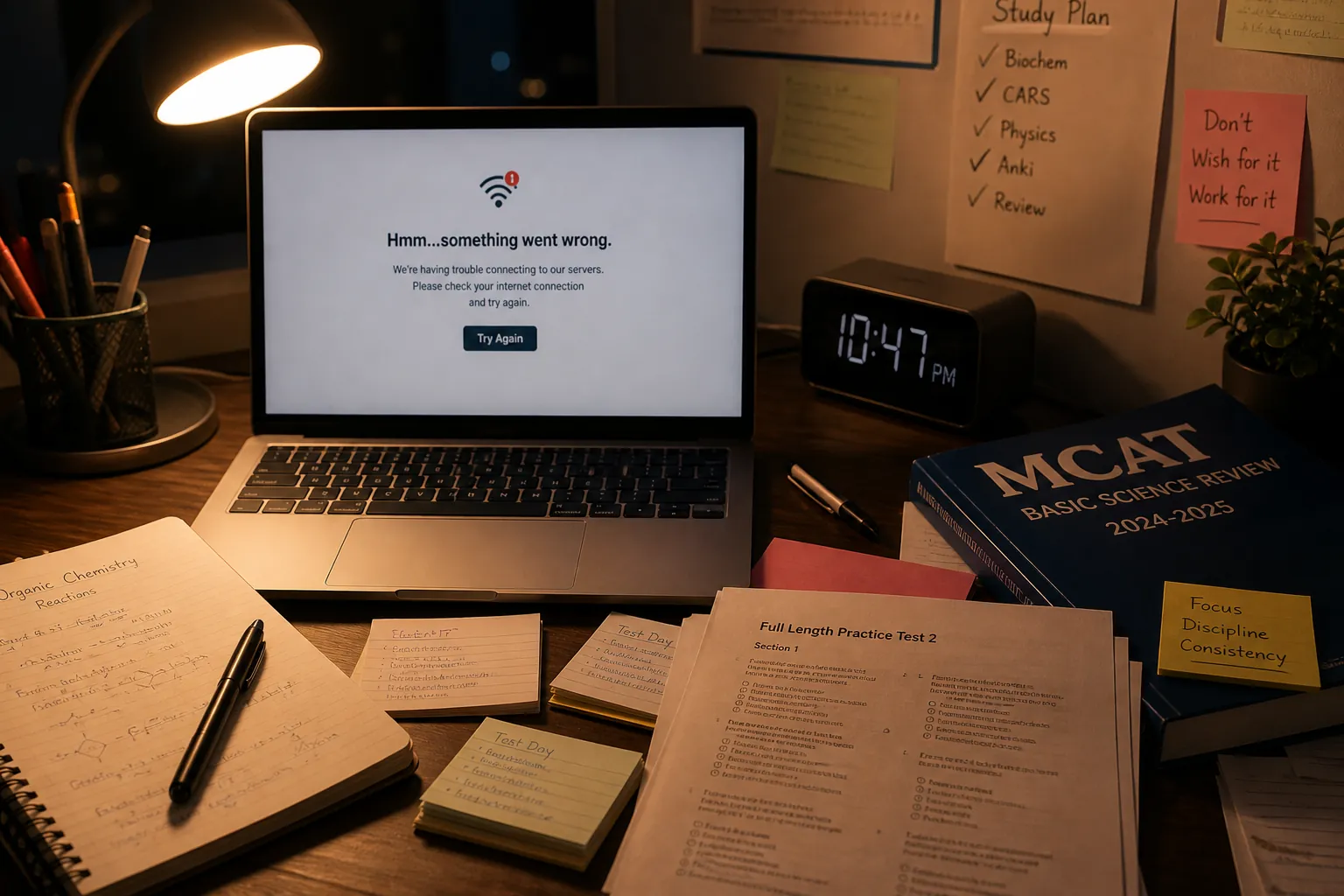
At 8:40 p.m., a Claude error is not an abstract reliability problem. It is the first quarter of a two-hour study block disappearing while an MCAT section review, GRE quantitative error log, ASVAB math drill, or SAT writing pass sits unfinished. The real damage usually comes after the first error: refreshing the same chat, opening the status page too early, waiting five more minutes, then trying to restart the original plan with half the session gone.
That is why a Claude outage backup plan for studying needs to be written before the next outage, not invented during it. Since January 2026, StatusGator has recorded 157 Claude outage events, with at least 24 classified as major or critical. That count includes minor incidents, warnings, elevated errors, and full outages, so it should not be read as 157 complete service failures. It is still enough disruption to justify a fixed failover routine for anyone studying against a test date.[1]
The March 2026 reliability comparison makes the same point from a different angle: Claude was reported at 92.97% uptime for that month, compared with an 88.9% five-service AI-industry average and 99.7% for consumer SaaS examples such as Canva and Grammarly. That is one measurement period, not a permanent ranking of every month in 2026. For a student, the useful conclusion is narrower: AI tools are not yet boring enough to become the only place your study plan lives.[2]
Separate a hiccup from a broken study block
Most students do not need a dramatic outage philosophy. They need a clock rule. Claude degradations have often appeared as 15-to-30-minute windows, but some have stretched much longer: March 2 lasted about 4 hours, March 27 about 5 hours, and June 18 about 4 hours and 10 minutes. DeployFlow also described the June 2 incident as tied to a Claude Code sub-agent bug that caused exponential token consumption.[3]
The first mistake is treating the status page as a stopwatch. Anthropic’s own status page has been reported to have a 15-to-30-minute average delay in acknowledging incidents, according to a StatusGator accuracy rating discussed in the March outage analysis.[2] That does not make the status page useless. It means it should not be your first response when your study timer is already running.
A better rule is simple: give Claude a short window to recover, then protect the study objective instead of protecting the tool. If the task was “review missed acids and bases questions,” the objective is not “finish this Claude thread.” It is to identify the mistake pattern, write the correction, and do another targeted pass.
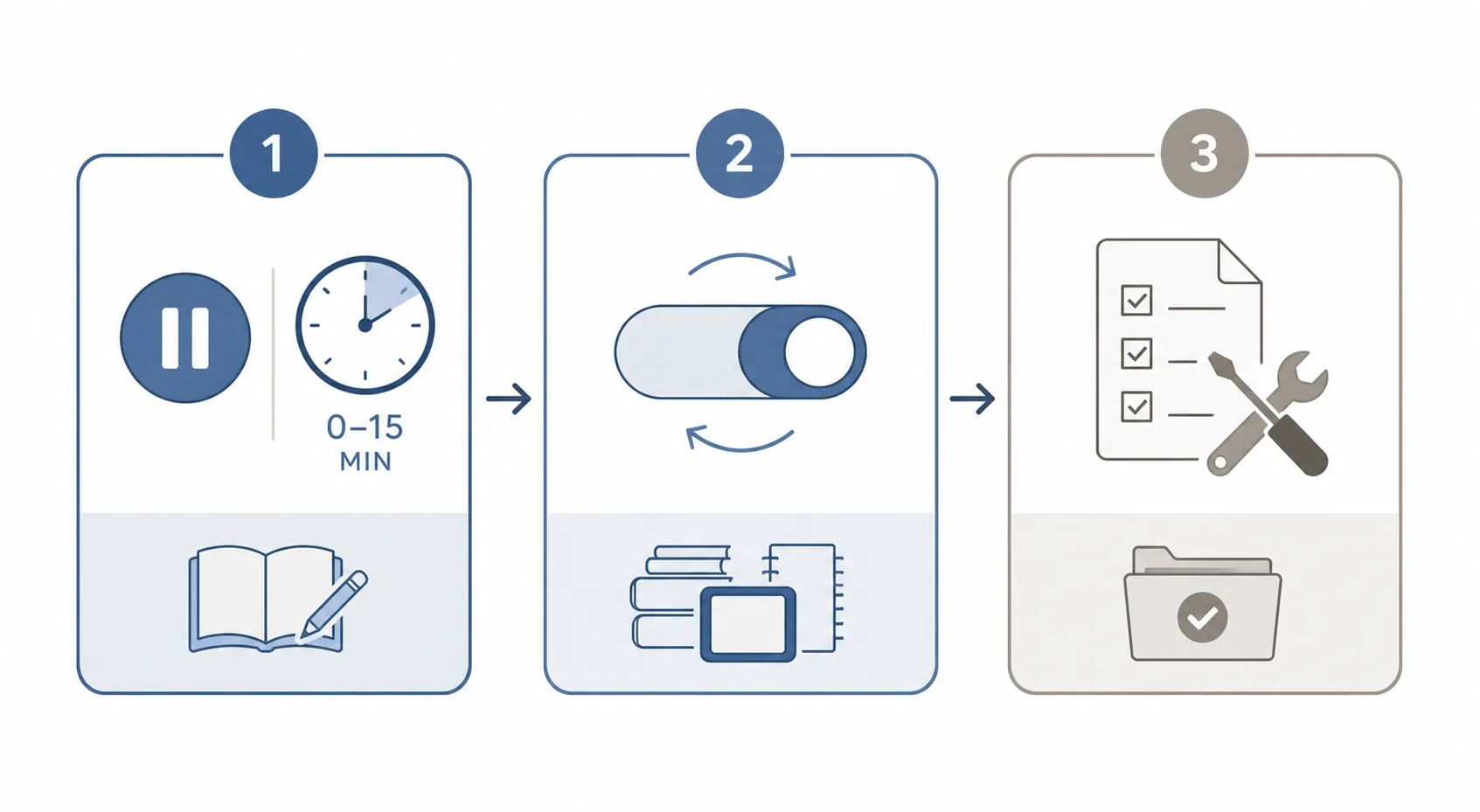
The outage clock: what to do first
| Time since first error | What to do | What not to do |
|---|---|---|
| 0-5 minutes | Save or screenshot what you can, note the exact task you were doing, and try one clean reload. | Do not start rewriting the whole prompt from memory. |
| 5-15 minutes | Move to a non-Claude version of the same task: printed answers, notes, downloaded questions, Anki, or a saved plan. | Do not refresh in a loop while calling it studying. |
| 15-30 minutes | Assume the session is at risk. Switch to the preselected backup for that task type. | Do not wait for the status page to confirm what your timer already knows. |
| 30+ minutes | Declare the Claude block over. Finish a complete backup study block and write one line about what must be rescheduled. | Do not keep the whole evening suspended around one chat window. |
The 15-minute mark matters because it stops the vague middle state. A short interruption can be absorbed. A 25-minute wait inside a two-hour block is no longer a harmless pause; it has changed the task. At that point, the decision is not whether Claude will eventually return. The decision is whether tonight’s study objective survives.
This is especially important because students do use Claude for tasks that can stall when the service disappears. Anthropic’s education report found that, among .edu Claude.ai users studied during an 18-day window in 2025, content creation accounted for 39.3% of student conversations and technical problem-solving for 33.5%. That is not a clean sample of GRE, MCAT, ASVAB, SAT, or ACT students, and it does not prove exactly how test-prep users behave. It does show why an outage can stop more than casual browsing when a student has placed drafting, explaining, debugging, or planning work inside one AI environment.[4]
Back up the task, not the app
A good failover plan does not say “use another chatbot” for everything. Exam tasks fail in different ways when Claude goes down. Some tasks need official answer keys. Some need a human-readable explanation. Some need a saved schedule. Some should not be handed to a second model at all.
| If Claude was being used for... | Best backup during an outage | Why this preserves the study objective |
|---|---|---|
| Practice questions | Official practice sets, purchased question banks, downloaded PDFs, printed tests, or previously assigned problem sets | The goal is exam-valid practice, not fresh AI-generated items. |
| Reviewing missed questions | Official explanations, your error log, textbook section notes, class notes, or a saved answer explanation folder | The goal is to classify the mistake and correct the rule, not to continue the same chat. |
| Concept explanation | Notes, textbook chapters, official explanations, a source-grounded tool such as NotebookLM, or another tutor-style AI used only against supplied sources | The goal is a trustworthy explanation tied to material you can verify. |
| Essay feedback | A saved rubric, sample scored responses, checklist review, or a later AI pass once the draft is preserved | The goal is revision against criteria, not immediate conversational reassurance. |
| Study scheduling | A downloaded weekly plan, calendar blocks, spreadsheet, or written priority list | The goal is knowing what to do next without asking a model to reconstruct the week. |
| Technical problem-solving | Local notes, official documentation, saved examples, textbook solutions, or another tool with the relevant files and constraints available | The goal is to continue debugging from evidence, not to paste fragments into an empty chat. |
Practice questions deserve the strictest rule. If you were asking Claude to generate new high-stakes exam items and it goes down, do not make the emergency version “ask a different model to improvise.” For SAT, ACT, GRE, MCAT, and ASVAB prep, the safer fallback is official material, reputable question banks, or already-downloaded drills. AI can help explain why an answer is wrong; it should not become the only source of what counts as a realistic question.
Concept explanation is different. If Claude was helping you understand enzyme kinetics, comma placement, linear equations, or circuit rules, a backup AI can be reasonable if it is anchored to sources you already trust. This is where a source-grounded tool such as NotebookLM for student research can fit: upload or point it toward the assigned material, then use it to navigate that material rather than inventing a replacement curriculum.
Scheduling is the easiest task to protect and the most embarrassing one to lose. If your whole weekly plan exists only in Claude, export or copy the plan into a calendar, spreadsheet, note, or printable checklist. A service error should never be able to make you wonder what subject comes next.
Use Learning Mode when time allows for friction
Claude can be unusually useful when it slows students down. A Mashable review of Claude Learning Mode found it was the only AI tutor tested that refused to give direct answers and instead leaned into a Socratic style.[5] For deep learning, that matters. A student who has to explain a reasoning step, commit to an answer, and revise a misconception is doing more useful work than a student copying a polished explanation into a notebook.
That same strength can be a poor fit during a timed failover. If you have 18 minutes left to check why three GRE data interpretation questions were wrong, a tutor that insists on a long dialogue may not be the right backup. Use teaching-style tools when the study block is designed for reasoning practice. Use answer keys, explanations, and error logs when the block is designed for fast correction.
If you want alternatives that still teach instead of simply handing over answers, compare them by behavior, not branding. A useful tutor asks you to predict, justify, retrieve, and revise. The distinction is covered more directly in AI study tools that teach instead of just giving answers, and it becomes important when your backup tool has to preserve learning rather than merely keep you company.
Build the backup kit before the outage
The backup kit should be boring enough that you can use it while annoyed. It does not need to predict every outage cause. It needs to keep the next 90 minutes productive.
- Keep one offline or non-Claude practice source ready for each exam section you are actively studying.
- Maintain a running error log outside Claude, with columns for question source, mistake type, corrected rule, and next review date.
- Save the weekly study plan somewhere that opens instantly: calendar, spreadsheet, notes app, or paper.
- Download or bookmark official explanations, rubrics, formula sheets, and passage sets before the study week begins.
- Preselect one source-grounded AI backup and one non-AI backup for explanation-heavy blocks.
- Decide the switch point in writing: for example, “after 15 minutes, I move to the backup task.”
For extended outages, non-AI tools become more valuable, not less. Anki, handwritten retrieval, official answer explanations, and printed practice sets are not glamorous, but they do not need a model endpoint to keep working. If you are deciding where AI adds value and where traditional tools still win, AI study tools vs. traditional study tools is the more useful comparison than another generic list of chatbot substitutes.
Flashcards deserve the same source discipline as practice questions. If an outage pushes you into review mode, a vetted deck or your own error-based cards are usually safer than emergency AI-generated cards. The tradeoff is covered in Anki decks download vs. AI-generated decks, but the outage version is simple: do not let a server error become the reason your review material gets less reliable.
What Claude memory export can and cannot rescue
Claude’s memory export feature can help during a longer disruption because it lets users export memory through support.claude.com for transfer elsewhere.[6] That can be useful if Claude has stored stable information about how you like explanations, what you are studying, or recurring preferences.
It is not a magic recovery of the conversation that just failed. It does not replace your current thread, project files, unfinished request, uploaded source packet, or the answer explanation you were halfway through. For exam prep, treat memory export as a continuity aid for an extended disruption, not as the main backup plan for tonight’s timed block.
The source-of-truth rule
The more exam-like the task, the less comfortable you should be with a single AI provider as the source of truth. Jason Robinovitz has argued that AI systems can misjudge human difficulty because what machines find easy and what students find hard diverge sharply.[7] That critique should not be stretched into “never use AI for test prep.” It should make students cautious about letting one model decide which questions are realistic, which explanations are sufficient, and which skills are actually weak.
For active recall and spaced repetition, the backup question is not just which app is available. It is whether the tool makes you retrieve before seeing the answer, returns missed material on a schedule, and keeps the original source visible enough to audit. A broader comparison of AI tools for active recall and spaced repetition can help here, but the outage rule is immediate: when Claude disappears, switch to the tool that best preserves retrieval practice, not the tool with the most fluent explanation.
A sample two-hour failover block
Suppose the planned block is MCAT chemistry review from 8:30 to 10:30 p.m., and Claude fails while explaining missed equilibrium questions. This example is hypothetical, but it shows how the clock rule works.
| Time | Action |
|---|---|
| 8:30-8:40 | Start reviewing missed questions in Claude. |
| 8:40-8:45 | Claude errors. Screenshot any visible explanation, write “equilibrium missed Qs” in the error log, and try one reload. |
| 8:45-8:55 | Open official explanations and textbook notes. Continue classifying each missed question by mistake type. |
| 8:55 | Claude still unavailable. Stop checking. Switch fully to the backup task: write corrected rules and redo related official questions. |
| 9:30 | Do Anki or handwritten retrieval on the same concept family. |
| 10:10 | Write what remains for the next block: “ask Claude to compare my equilibrium error patterns if available.” |
Notice what did not happen: the student did not spend 35 minutes proving that Claude was really down. The evening still produced an error log, corrected rules, fresh retrieval, and a clean handoff for the next session. That is what a backup plan is supposed to protect.
Keep Claude, but demote it from single point of failure
Claude can still be part of a strong study routine. It can make students explain their reasoning, turn vague confusion into a sharper question, and help organize a messy review session. The mistake is letting one chat window become the question bank, planner, tutor, essay coach, and panic button.
By Q3 2026, a student using Claude every day for exam prep should have a written failover routine: one clock rule, one backup source for each major task, one saved schedule outside Claude, and one non-AI study mode that can start immediately. You do not need to quit Claude. You do need to stop waiting politely while a fixed-date exam gets closer. Patience is not a study strategy.
References
- Claude Outage History, StatusGator.
- Claude Outages Are a Feature, Not a Bug: What AI Vendor Lock-in Looks Like in 2026, sanj.dev.
- Claude Anthropic Outage: How to Protect Your Claude Infrastructure, DeployFlow.
- Anthropic Education Report: How University Students Use Claude, Anthropic.
- Anthropic's Claude Learning Mode is the best AI tutor I've tested, Mashable.
- Import and export your memory from Claude, Anthropic Support.
- The Illusion of AI SAT Prep, Jason Robinovitz.
Authoritative source
For the authoritative version of this contentHow to Read the '1 in 4 NFL Players CTE' Study
Report an error in this tool's output
Found something this tool got wrong beyond what's documented above? Report it so the accuracy log stays current.
Comments
Join the discussion with an anonymous comment.