
We Tested Grok vs Copilot on Real Exam Questions
Accuracy Warning — Grok vs Copilot
Neither tool is safe as an answer key; both are weaker on math and diagram questions and can produce confident but wrong reasoning.
- Accuracy:
- Moderate
- Tested:
- Solving real GRE, MCAT, SAT, and ACT questions with explanations
- Last tested:
- 2026-08-25
Last tested: August 25, 2026. Last reviewed: August 25, 2026. Category fit: ai-study-tools hands-on trial.
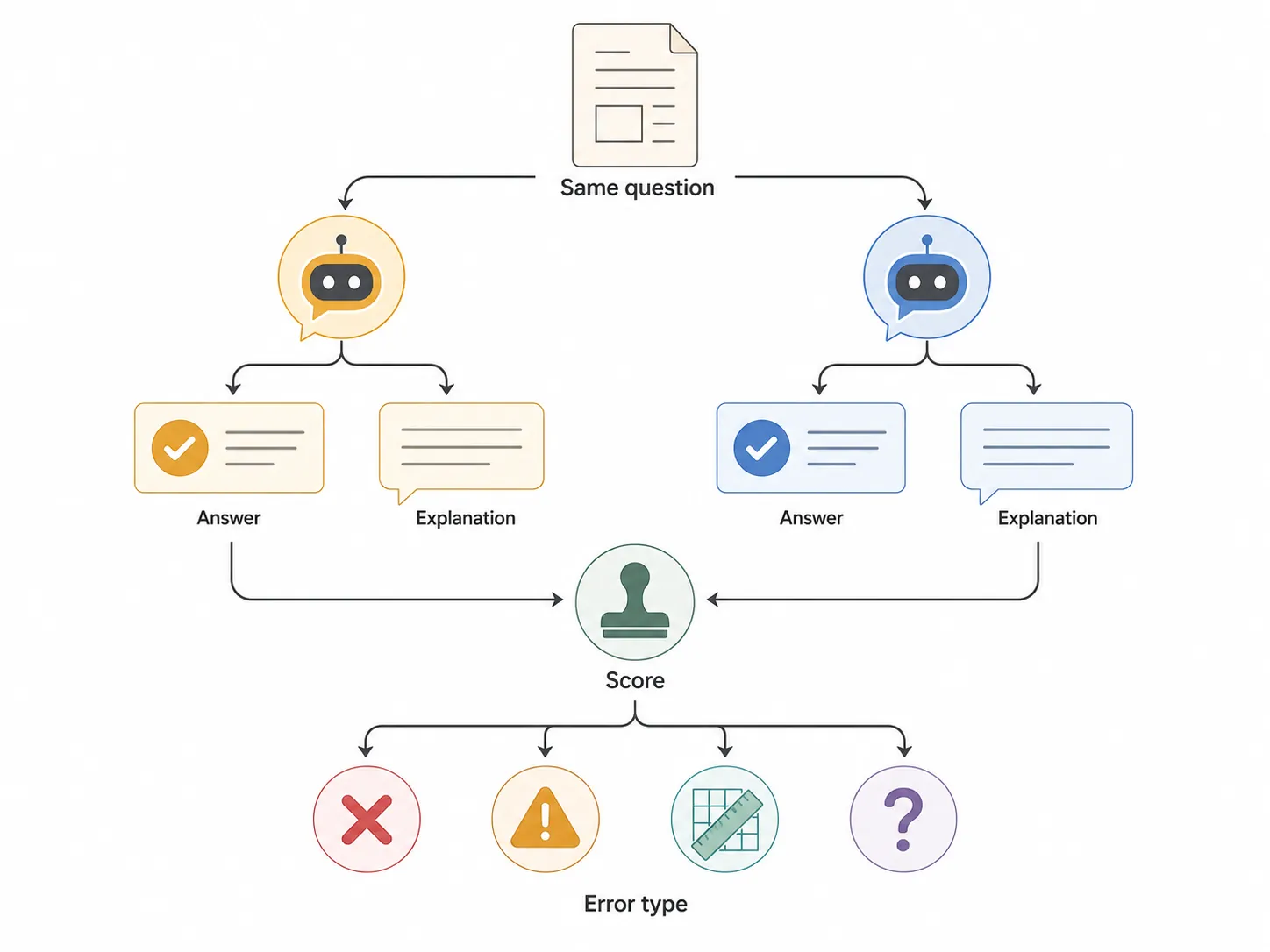
I tested Grok vs Copilot for exam prep the way a student would actually need the comparison: same real GRE, MCAT, SAT, and ACT questions; same instruction; one run per tool; scored final answers separated from explanation quality; misses labeled by error type. The uncomfortable result is that the two assistants finished much closer than benchmark marketing would lead you to expect. Both looked safer on verbal, reading, and English work than on math-heavy or diagram-dependent items. Neither one earned answer-key status.
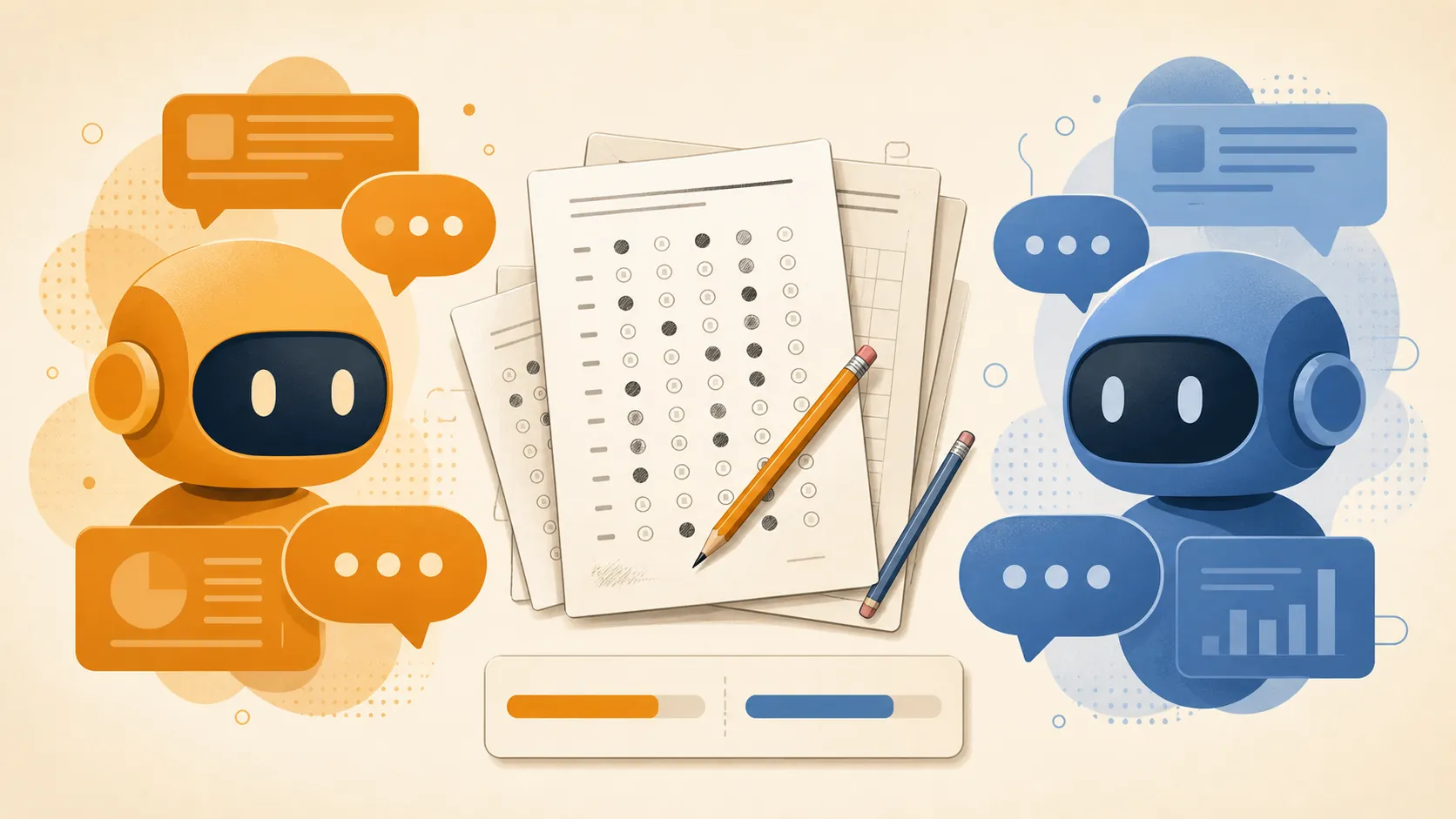
The point of this trial was narrow: if you have two weeks before a real test and are tempted to let one chatbot become a second tutor, which mistakes would you be inviting into your missed-question log?
The protocol before the verdicts
I did not ask either tool to summarize a prep book, generate a fake test, or explain general strategy. Each run used the same exam item and the same instruction: solve the question, give the answer, and explain the reasoning. I scored the final answer first. Only after that did I judge whether the explanation would help a student learn the right move or accidentally rehearse the wrong one.
| Protocol choice | Why it matters for exam prep |
|---|---|
| Same question, same instruction | Prevents one tool from getting an easier version of the task. |
| One run per model | Matches the way most students use chatbots under time pressure instead of rerolling until the answer looks right. |
| Final answer scored separately | A polished explanation cannot rescue a wrong bubble choice. |
| Explanation reliability judged separately | A correct answer with bad reasoning can still teach a bad habit. |
| Misses classified by type | The repair job is different for a wrong computation, a misread passage, and a fabricated source. |
I use evidence labels throughout the article. “Moderate evidence” means the same-question trial supports the pattern, but the sample is still a hands-on site test rather than a large independent benchmark. “Limited evidence” means the result is useful for caution but too narrow to generalize across the whole exam. “No evidence” means I did not test that exam in this head-to-head.
That pattern is not coming out of nowhere. A May 8, 2026 AJOSR comparison tested ChatGPT, Copilot, and Gemini on 90 SAT/ACT questions across math, reading, and English; it found strong language performance, notably lower math performance, and no statistically significant overall difference among the models, though Grok was not included in that study. [1] GregMat’s August 30, 2025 ETS PowerPrep experiment showed that some frontier OpenAI and Google models could do well on GRE material while a smaller OpenAI model was described as “nearly useless,” but that test did not include Grok or consumer Copilot. [2] Those studies frame the suspicion; they do not settle this head-to-head.
That restraint matters because the marketing atmosphere around these products is loud. Snorkel reported that Grok reached a 29% mean pass rate on GDPval+ across about 2,000 professional tasks, ahead of GPT-5.5 at 22% and Opus 4.8 at 21%, in a July 8, 2026 benchmark write-up. [3] DataCamp reported an Artificial Analysis Intelligence Index score of 61 for Grok 4.6 on August 21, 2026. [4] Those are not GRE quant proofs, MCAT passage proofs, or SAT calculator-section proofs. A professional-work benchmark and a standardized-test item are different animals.
Copilot also needs date-stamped handling. Microsoft announced its Study and Learn Agent as generally available on May 13, 2026, and its Notebook Study Guide feature as generally available to Copilot Chat users on June 11, 2026. [5][6] Those features matter because a setup grounded in a student’s uploaded materials with citations is a different study object from a chatbot improvising a solution from the prompt alone. I tested the assistant behavior against exam questions; I did not treat Microsoft’s education framing as proof of answer accuracy.
Result snapshot
| Exam | Evidence label | Answer accuracy pattern | Explanation reliability | Dominant risk |
|---|---|---|---|---|
| GRE | Moderate evidence | Closer than model-ranking rhetoric suggests; verbal safer than quant | Often useful on verbal; less dependable when algebra or multi-step quant work must be exact | Plausible math reasoning that lands on or justifies the wrong choice |
| MCAT | Limited evidence | Better on text-based reasoning than on items requiring tight science setup or figure interpretation | Can sound like a tutor while skipping the discipline of passage evidence | Overconfident explanations on passage/diagram-dependent work |
| SAT/ACT | Moderate evidence | Reading and English stronger than math, matching the direction of outside SAT/ACT research | Grammar and reading explanations are more checkable; math explanations need verification | Arithmetic, setup, and shortcut errors that are easy to copy |
| ASVAB | No evidence | Not tested in this head-to-head | Not judged | Do not infer ASVAB readiness from GRE, MCAT, SAT, or ACT behavior |
The scoring sheet was less dramatic than the product names. Grok did not separate itself in a way that would justify trusting it as a universal exam solver. Copilot did not become safe just because it lives in a more education-friendly ecosystem. Both could be helpful when the task was to explain a passage choice, compare answer choices, or restate a grammar rule. Both became less trustworthy when the item demanded exact symbolic setup, a diagram read, or a chain of calculations where one early assumption controls the answer.
GRE: verbal help is more believable than quant help
Evidence label: Moderate.
On GRE-style work, the split was familiar: verbal reasoning was the safer side of the ledger, quant was where I wanted scratch paper beside the chatbot. When Grok and Copilot handled sentence-level verbal tasks, their explanations were usually close to the kind of reasoning a tutor would want to see: eliminate the answer choice that breaks the sentence logic, pay attention to contrast words, and avoid choosing a word merely because it “sounds academic.”
The quant misses were more consequential. A wrong vocabulary elimination is usually visible once you compare it to the official explanation. A wrong quant setup can be harder to catch because the assistant still writes a clean sequence of steps. That is the worst tutoring failure mode: not a blank stare, but a neat solution path that trains the student to reproduce the wrong shortcut.
| GRE task type | Grok behavior in this trial | Copilot behavior in this trial | Study judgment |
|---|---|---|---|
| Text completion / sentence logic | Generally more usable when the explanation stayed anchored to sentence structure | Generally more usable when it explicitly compared answer choices | Acceptable as a second explanation after the official answer is known |
| Reading-style inference | Better when asked to quote or paraphrase the relevant line from the prompt | Better when kept close to the passage rather than allowed to generalize | Useful for reviewing why tempting choices are wrong |
| Quant comparison / algebra | Could produce a plausible chain that needed independent checking | Could also produce a plausible chain that needed independent checking | Unsafe as an answer key |
| Geometry or diagram-dependent reasoning | More likely to need a human check of the visual setup | More likely to need a human check of the visual setup | Limited value unless the student can verify the diagram assumptions |
This is where GregMat’s ETS PowerPrep context is useful but incomplete. It shows that LLM performance on GRE material can vary sharply by model, with some frontier systems scoring high and weaker systems collapsing, but it does not answer whether Grok or consumer Copilot should sit next to a student’s GRE study plan. [2] In this head-to-head, the practical rule is simpler: use either tool to interrogate verbal explanations; do not let either tool grade your quant work unless you already have the official answer or can redo the math yourself.
MCAT: the danger is a fluent explanation that outruns the passage
Evidence label: Limited.
The MCAT is a bad place for a chatbot to be almost right. A GRE vocab miss wastes a review cycle. An MCAT passage miss can teach the student to ignore the passage, import outside science, or treat a graph as decorative. In this trial, both Grok and Copilot were more convincing when the question could be answered by close reading and basic concept matching. They became less reliable when the item depended on a figure, an experimental setup, or a careful distinction between what the passage said and what general biology or chemistry might suggest.
That does not make them useless for MCAT study. It makes the use case narrower. If a student pastes a passage excerpt and asks, “Which sentence supports answer B over answer D?” the answer can be worth reading. If the student asks, “Make me a new MCAT-style passage and questions,” the tool is now playing test-writer, science editor, and answer-key author at the same time. That is a much weaker setup.
MCAT Self Prep explicitly warns that generating MCAT-style questions with generative AI tools such as ChatGPT or Grok is “much more faulty and prone to errors.” [7] That warning matched what I would do with these results: let an assistant help unpack a real MCAT practice item you already have; do not let it become the source of your practice set.
| MCAT use | Verdict from this trial |
|---|---|
| Explaining why an official answer choice is supported | Potentially useful if the explanation points back to the passage |
| Reviewing basic science vocabulary after a missed question | Useful as a starting explanation, then verify with a trusted content source |
| Interpreting figures, experimental design, or multi-step data reasoning | High caution; require manual verification |
| Generating new MCAT-style questions | Unsafe for serious practice |
SAT and ACT: reading and English are the better fit; math still needs a key
Evidence label: Moderate.
The SAT/ACT result was the cleanest match between this trial and outside research. AJOSR’s 2026 comparison found strong language performance and notably lower math performance across ChatGPT, Copilot, and Gemini, with no statistically significant overall difference between the models it tested. [1] Grok was absent from that study, so it cannot be imported as a Grok result. Still, the direction lined up with the head-to-head here: reading and English explanations were more usable than math explanations.
On reading, both assistants were at their best when forced to stay inside the passage. Good instructions mattered. “Explain why C is better than A using only the passage” produced more useful review than “What is the answer?” The first prompt makes the tool behave like a missed-question reviewer. The second invites it to become a confident answer machine.
On English and grammar items, the explanations were often checkable because the rule was visible: agreement, punctuation, concision, transition logic. The risk was not usually that the assistant invented an exotic rule. The risk was that it over-explained a simple choice and made the student think every grammar miss requires a paragraph of theory. For SAT/ACT English, a useful AI explanation should usually be short enough to turn into one line in a missed-question log.
Math was different. Both Grok and Copilot could produce answers that looked like classroom solutions, but the reliability drop matters because students often use AI exactly when they are already unsure of the setup. If you cannot tell whether the equation should have been linear, quadratic, proportional, or geometric, a fluent solution is not enough protection.
| SAT/ACT area | Safer AI role | Unsafe AI role |
|---|---|---|
| Reading | Compare two answer choices against quoted passage evidence | Pick the answer without showing passage support |
| English | Name the tested grammar or rhetoric rule and keep the explanation brief | Turn every item into a long generic grammar lecture |
| Math | Check a student-written solution after the official answer is known | Serve as the first and final answer key |
| Data or diagram items | Restate what the graph or figure appears to show, then verify manually | Infer unstated relationships from the visual |
For SAT and ACT prep, the deciding question is not “Which chatbot sounds more like a teacher?” It is “Can I verify this explanation quickly against the passage, rule, or official solution?” If the answer is no, the tool is not saving time.
ASVAB: no evidence from this head-to-head
Evidence label: No evidence.
I did not run an ASVAB accuracy comparison in this Grok-vs-Copilot test. Do not infer ASVAB performance from the GRE, MCAT, SAT, or ACT sections. ASVAB prep has its own mix of arithmetic reasoning, word knowledge, paragraph comprehension, mechanical comprehension, electronics, and other content areas; a chatbot that handles SAT reading adequately has not proved it can handle those domains.
If ASVAB is the exam in front of you, start with the ASVAB hub rather than borrowing confidence from this comparison.
The error types that matter more than the brand name
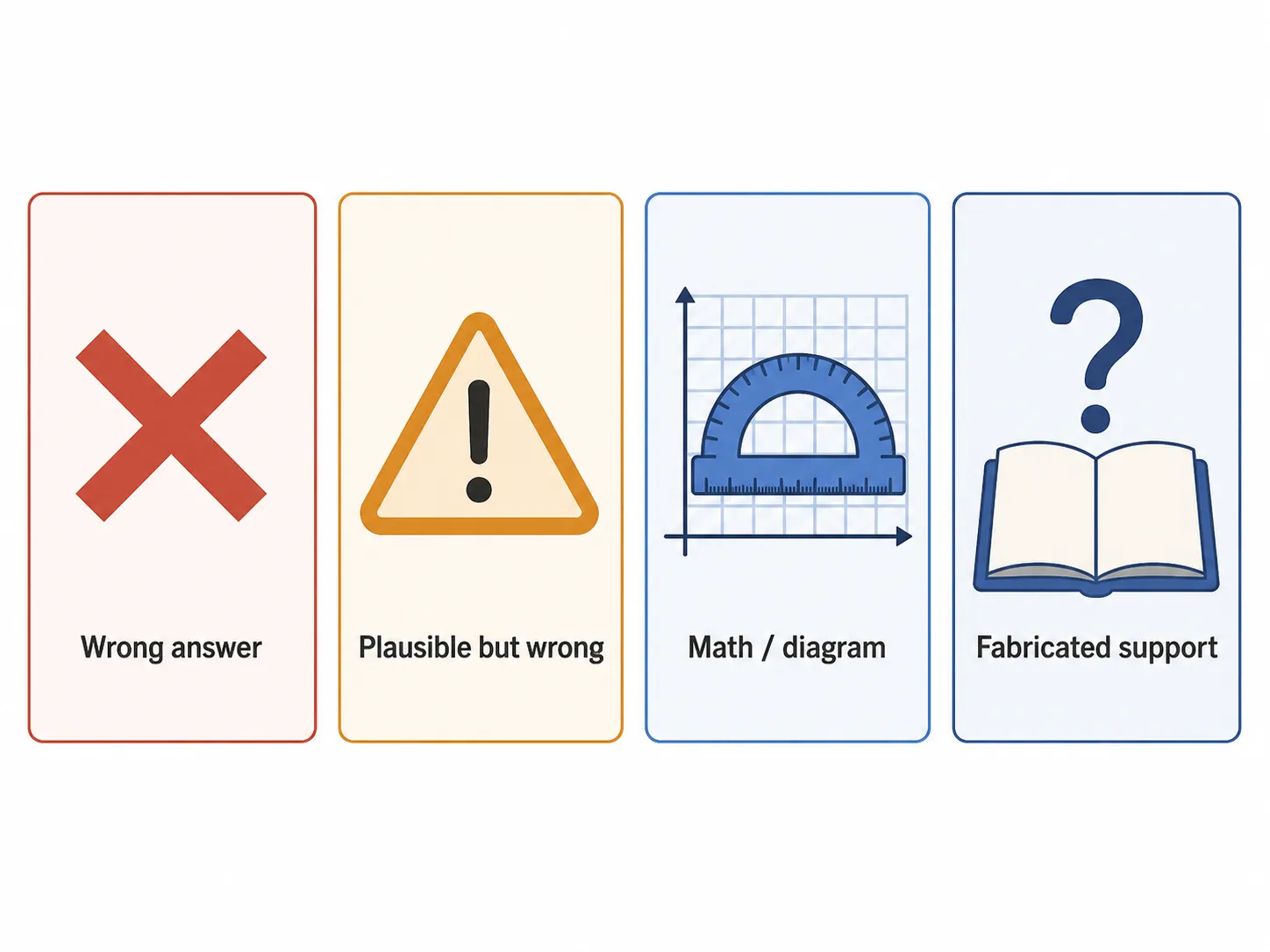
A raw accuracy comparison is too blunt for studying. Two tools can miss the same number of items and create very different repair work. The error labels below are the ones I would actually write in a missed-question log.
| Error label | What it looked like | Why it matters |
|---|---|---|
| Wrong answer | The selected option did not match the scored answer. | Easy to detect if you have the official key; dangerous if you do not. |
| Plausible-but-wrong reasoning | The explanation sounded instructional but rested on a bad assumption, skipped a constraint, or justified the wrong elimination. | This is the highest tutoring risk because the student may rehearse the mistake. |
| Math / diagram failure | The tool mishandled a calculation, setup, graph, geometry relation, or visual dependency. | These errors are hard for weak students to catch because the written work can look orderly. |
| Unverifiable or fabricated support | The tool implied support it did not actually establish from the prompt or cited-like authority. | This damages trust in the real source materials and can pull review away from the official explanation. |
The second row is the one I care about most. A chatbot that says “I’m not sure” is annoying but manageable. A chatbot that confidently teaches a wrong setup is worse. Students do not just lose that one point; they can carry the pattern into the next practice set.
The fabricated-support category is why citation-style output should not be treated as proof by itself. StudyMethod’s AI chatbot hallucination-rates task map is the better place for the broader hallucination discussion. In this exam trial, the practical rule is smaller: if the assistant claims support, make it point to the exact passage line, equation step, uploaded note, or official explanation. If it cannot, treat the explanation as unverified.
Where Copilot’s study features actually help
Copilot’s strongest exam-prep argument is not that it magically solves every item. It is that Microsoft has been building study tools around grounding and citations. The Study and Learn Agent was announced as generally available on May 13, 2026, and Copilot Notebook Study Guide became generally available to Copilot Chat users on June 11, 2026, with study-guide behavior tied to the learner’s own uploaded materials and citations. [5][6]
That changes the verification routine. If Copilot is explaining your own notes, a class handout, or an official solution you uploaded, you can ask it to cite the material it used and then open that material. That is much better than asking an open chatbot to produce an answer from memory. It still does not make the answer correct. It only gives you something to check.
For a student, that distinction is practical. A grounded setup can support review: “Using only this official explanation, turn my miss into a three-line error log.” An ungrounded setup is riskier: “Make me ten questions like this and give me the answer key.” The first keeps the human and the official source in the loop. The second lets the chatbot invent both the test and the grading standard.
Where Grok’s benchmark momentum does not answer the study question
Grok’s recent benchmark momentum is real enough to notice. It is just not the same as exam-prep reliability. GDPval+ asks about professional task performance. Artificial Analysis aggregates intelligence signals across model tasks. A standardized test question asks something more specific: can the model select the scored answer under the constraints of that exam and explain the reasoning without teaching a shortcut that fails on the next item?
In this trial, Grok’s higher-status model story did not create the kind of separation a test-taker could safely build a prep routine around. It could be helpful, especially when the reasoning task was text-based. It could also miss in the ways that matter: a polished math explanation, a shaky diagram assumption, or support that sounded firmer than the prompt allowed.
For the single-tool version of that finding, see the Grok 4.6 exam-prep trial, last tested the same day as this comparison.
Safe and unsafe ways to use either tool
The safe uses all have one thing in common: the chatbot is not the source of truth. It is a reviewer, translator, or second explanation after the scored answer exists somewhere else.
- Safe: ask either tool to explain an official answer in simpler language.
- Safe: ask it to compare two tempting answer choices using only the passage or problem statement.
- Safe: paste your own solution and ask where the first unsupported step appears.
- Safe: turn a verified missed question into a short error-log entry.
- Safe with caution: use Copilot’s grounded study features on uploaded notes, then check the cited material yourself.
The unsafe uses are the ones students reach for when they are tired.
- Unsafe: treat Grok or Copilot as the answer key for a practice set.
- Unsafe: accept a math solution because the steps look organized.
- Unsafe: ask either assistant to generate high-stakes practice questions and then drill from its answer key.
- Unsafe: let a citation-looking response replace the official explanation or source passage.
- Unsafe: rerun the same question until one model agrees with your preferred answer.
The practice-question warning is especially important for MCAT and other passage-heavy exams. If the generated passage is flawed, the answer key can be flawed in a way that looks like content review. That is not efficient studying; it is ungraded rehearsal.
Which one should you choose?
Choose based on the kind of error you can detect and correct, not on a benchmark rank. If you already have strong math skills and mainly want a fast verbal or reading explainer, either tool can be useful as a second pass. If math setup is your weak point, neither one should be allowed to grade you. If you need traceable review from your own notes or uploaded explanations, Copilot’s study-oriented setup gives it a practical verification advantage. If you are comparing general chatbot answers on raw exam prompts, this trial did not show a separation large enough to make Grok or Copilot safe as the default answer authority.
For adjacent comparisons, use the ChatGPT exam-study assistant trial and the Gemini AI exam-prep audit. The same rule applies across the series: a chatbot can help you review a mistake, but the official key, the passage, the equation, and your own scratch work still have to win the argument.
References
- Measuring AI Accuracy on Standardized Tests: A Comparative Study of ChatGPT, Copilot, and Gemini, AJOSR, May 8, 2026.
- Which LLM is the Best on ETS Questions, GregMat, August 30, 2025.
- Grok 4.5 Testing Results: How SpaceXAI's New Model Performs on Real Professional Work, Snorkel AI, July 8, 2026.
- Grok 4.6, DataCamp, August 21, 2026.
- Study and Learn: AI built for your student, Microsoft Education Blog, May 13, 2026.
- Copilot Notebooks and Study Guide now available to Copilot Chat users, Microsoft Tech Community, June 11, 2026.
- How to Use AI to Study for the MCAT, MCAT Self Prep.
Authoritative source
For the authoritative version of this contentHow to Read the '1 in 4 NFL Players CTE' Study
Report an error in this tool's output
Found something this tool got wrong beyond what's documented above? Report it so the accuracy log stays current.
Comments
Join the discussion with an anonymous comment.