I Tested Grok 4.6 for Exam Prep. Does It Work?
Accuracy Warning — Grok 4.6
Confident fabrication in roughly one of three unknown-answer cases; verify all generated questions, answers, and policies against official material.
- Accuracy:
- Moderate
- Tested:
- Concept explanations, missed-question tutoring, flashcard drafting, and practice-question generation
- Last tested:
- 2026-08-25
Last tested: August 25, 2026. I tested Grok 4.6 the way a deadline-driven student would actually use it: not as a chatbot demo, and not as a benchmark trophy case, but beside official exam material with the answer key open. The short answer is yes, Grok 4.6 can work for exam prep — if the job is explanation, re-explanation, flashcard drafting, or light drilling. It becomes much less safe when it starts inventing practice questions, full practice sections, or answer-key-like facts that you do not already know how to verify.
The biggest warning is not that Grok sounds confused. It usually does not. The warning is that on Artificial Analysis’s AA-Omniscience benchmark, Grok 4.6 posted 48.2% accuracy and a 65.7% non-hallucination rate, which means a meaningful share of unknown-answer situations can still produce confident fabrication rather than a clean “I don’t know.” [1] For a student with three weeks left before the GRE, MCAT, SAT, ACT, or ASVAB, that is not an abstract model-quality issue. That is how a fake rule, fake distractor, or fake explanation gets copied into a study system.

How I tested Grok 4.6
I used a task-by-task test rather than asking whether Grok is “good at exams” in general. That broad question hides the real decision. A model can be excellent at explaining a missed algebra step and still be a bad source of new SAT-style questions. It can summarize a dense biology passage clearly and still hallucinate an answer choice if you ask it to behave like the AAMC.
The check was anchored to official or official-style material: ETS-style GRE work, College Board SAT material, AAMC-style MCAT passage reasoning, ACT-style grammar and reading tasks, and DoD/ASVAB-style arithmetic and word-knowledge practice. I treated official explanations and answer keys as the source of truth. Grok’s answer only counted as useful if it helped me understand, review, or drill that material without replacing the original source.
- Practice-question generation: asked Grok to create new GRE, SAT, ACT, MCAT, and ASVAB-style questions, then checked wording, tested scope, answer validity, and explanation quality.
- Concept explanations: asked for explanations of quant, grammar, biology, chemistry, reading, and mechanical reasoning concepts that appear in common prep workflows.
- Missed-question tutoring: supplied an official or known item, the correct answer, and the student’s wrong answer, then asked Grok to explain the trap and the faster route.
- Flashcard drafting: asked for concise cards from missed questions, formulas, vocabulary, grammar rules, and science concepts.
- Socratic quizzing: asked Grok to question the student one step at a time without giving away the answer too early.
- Study-plan help: asked it to turn a short score report and official-resource inventory into a study plan.
- Fact-checking: asked for exam facts, answer explanations, and current policy-like details, then checked whether those should have been verified against official sources.
I used three evidence labels. “High” means the task worked repeatedly in the field test and could be checked against an answer key or stable concept. “Medium” means the task was useful but depended heavily on prompt quality and verification. “Low” means there is no published exam-specific accuracy evidence for Grok 4.6, so the result should be treated as a cautious workflow note rather than a general claim about all exams.
Verdict by study task
| Task | Verdict | Evidence label | How I would use it |
|---|---|---|---|
| Concept explanations | Works | High | Use it to restate a quant, grammar, science, or reading concept after you have identified the weak point. |
| Re-explaining missed official questions | Works best | High | Give it the official item, correct answer, your wrong answer, and ask for the trap, shortcut, and takeaway. |
| Flashcard drafting | Works with review | High | Let it draft cards, then edit every card before it enters Anki, Quizlet, or a paper deck. |
| Socratic quizzing | Useful with guardrails | Medium | Use it for one-step-at-a-time reasoning drills, not for scoring or official-difficulty simulation. |
| Study plans | Useful if constrained | Medium | Give it your test date, official resources, missed-question log, and time budget; reject vague plans. |
| Fact-checking exam details | Use with caution | Low to Medium | Ask it to locate or compare sources, but verify policies, scoring, dates, and official claims yourself. |
| Practice-question generation | Heavy caution | Low | Accept only as rough warm-up drills after auditing every stem, answer, and explanation. |
| Full-length practice exams | Fails the trust test | Low | Do not use it as a replacement for official ETS, College Board, AAMC, ACT, or DoD-aligned material. |
Where Grok helped most: after the official question was already in the room
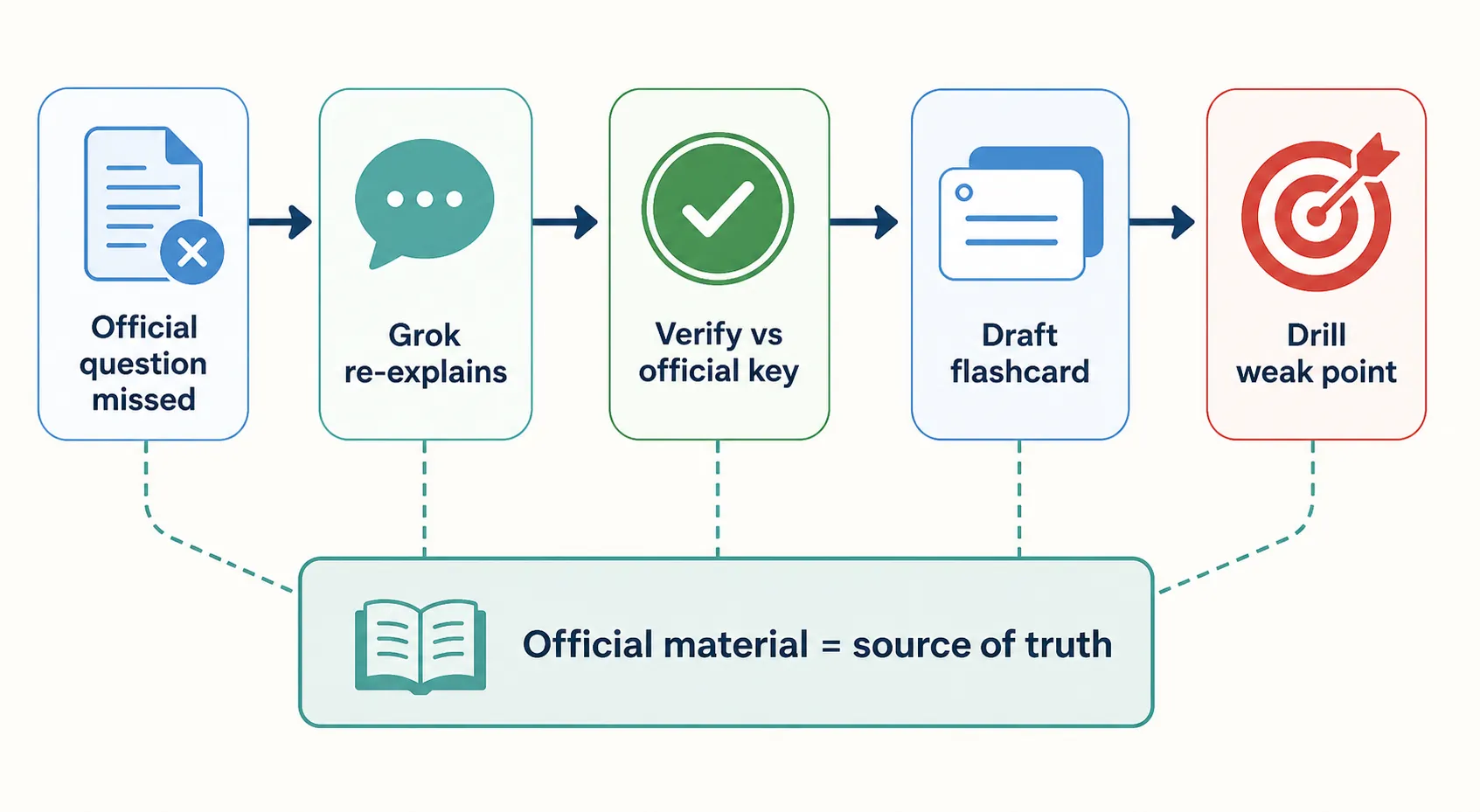
Grok 4.6 was at its best when I did not ask it to be the test maker. The strongest workflow started with a real question, a real answer key, and a real mistake. Then Grok became useful: it rewrote a dense explanation, named the trap, separated the tested rule from the distracting detail, and turned the miss into a review card.
That pattern fits Grok 4.6’s broader profile. SpaceXAI’s launch post gives Grok 4.6 a February 1, 2026 knowledge cutoff and presents it as strong on knowledge-work benchmarks, including GDPVal-AA Elo 1753, AA-Briefcase 1577, and Harvey LAB 15.8%. The same launch data is less flattering on some agentic rows, including DeepSWE 65.9% versus 73% for the comparison shown there, and Terminal-Bench v3.0 at 26%. [2] In plain prep terms: I am more interested in it as a reasoning assistant sitting beside known material than as an autonomous exam-building machine.
Concept explanations
For concepts, Grok was usually clear and patient. It could explain why plugging in numbers works on a GRE algebra problem, why a semicolon answer choice changes an SAT grammar sentence, why an MCAT passage question depends on experimental setup rather than outside biology trivia, or why an ASVAB arithmetic-reasoning problem calls for a ratio instead of a raw subtraction.
The useful prompt was not “teach me math.” It was narrower: “I missed this because I set up the proportion backward. Explain the correct setup, then give me one similar but easier check question.” That kept the model close to the student’s actual error. When the prompt named the mistake, Grok spent less time producing a polished mini-lesson and more time repairing the broken step.
For STEM-heavy prep, this was the part I liked most. It could unpack unit conversion, conditional probability, acid-base logic, experimental controls, basic mechanics, and graph interpretation in a way that felt like a tutor slowing down at the right sentence. I still checked formulas and final answers, but the explanation layer was genuinely helpful.
Missed-question tutoring
This was the strongest use case. A missed official question already has the thing AI lacks: a validated stem, a tested skill, a correct answer, and sometimes an official explanation. Grok’s job is then smaller and safer. It does not need to decide what the exam should test. It needs to explain why the correct answer wins and why the attractive wrong answer loses.
The best prompt looked like this: “Here is the question, the official answer, and my wrong answer. Do not challenge the official answer unless there is a clear transcription issue. Explain the trap in my wrong answer, the fastest valid route, and the one rule I should remember.” That instruction matters. Without it, a fluent model can wander into debating the item. With it, Grok usually behaved like a useful review partner.
For reading and passage-based science questions, I had to constrain it more tightly. If I asked Grok to infer beyond the passage, it sometimes over-explained using outside knowledge. If I told it to cite only the provided lines or facts, the explanations became cleaner. That distinction matters especially for MCAT CARS, SAT Reading and Writing, and ACT Reading, where the right answer often depends less on general intelligence than on staying inside the text.
Flashcard drafting
Grok drafted good first-pass flashcards from missed questions. Not final cards. First-pass cards. That difference is important. A model-generated card can be too wordy, too broad, or quietly tilted toward the explanation it just gave rather than the rule the exam actually tested.
The cards improved when I forced a format: one front, one back, one tested skill, no trivia, no answer-choice letters. For example, a hypothetical GRE quant miss might become: “Front: When a percent increase is followed by a percent decrease, can you subtract the percentages directly? Back: No. Apply each percent change sequentially to the current value.” That kind of card helps because it captures the transferable mistake, not the disposable details of the original item.
For MCAT science, I preferred cloze-style cards only after verifying the concept in a trusted prep source. For SAT and ACT grammar, I liked rule-and-example cards. For ASVAB vocabulary, I would use Grok to generate memory hooks, but I would not let it choose the word list from scratch.
The hallucination check is the pivot
The place where Grok stopped feeling like a tutor and started feeling risky was factual certainty without a checkable anchor. When I asked for explanations tied to supplied material, the output was often useful. When I asked for answer-key-like claims, exam-policy details, or newly generated test content from memory, the burden shifted back to me. That is the exact wrong direction for a tired student.
Artificial Analysis’s AA-Omniscience result is useful because it tests a behavior students care about: what happens when the model does not know. Grok 4.6’s 65.7% non-hallucination rate does not mean every third study answer is false. It means that in a benchmark designed around unknown-answer behavior, the model still had a substantial hallucination problem. [1] That is enough to change how I would use it.
For a broader comparison of this problem across study tools, I would keep a separate eye on measured AI study chatbot hallucination rates. But for day-to-day prep, the rule is simpler: if Grok produced the question, answer, explanation, date, score conversion, or policy detail, it has not earned trust yet. It has produced a draft.
The cleanup cost is the real issue. If Grok gives a wrong explanation for an official question, the official key can catch it. If Grok invents a flawed practice question, there may be nothing to catch it unless the student is already strong enough to audit the item. That is a bad bargain for the students most tempted to ask for unlimited practice.
Practice questions were useful only after I stopped treating them as practice-test questions
Grok can write plausible exam questions. That is not the same as writing good exam questions. The difference shows up in the details: the tested skill is a little too obvious, the wrong answers are not tempting in the right way, the wording does not match the testing body’s voice, or the difficulty has no reliable calibration.
This is not a Grok-only problem. Mike McNelis’s critique of AI-generated practice exams identifies recurring failure modes that match what I saw in the field test: recall-level questions, testing-body voice mismatch, outdated outlines, hallucinated details, and no psychometric validation. [3] Those are not cosmetic flaws. A practice test is supposed to tell a student what the real exam will punish. If the practice item is miscalibrated, the student learns the wrong lesson.
There is also older peer-reviewed evidence that should keep expectations modest. A ChatGPT 3.5-era study from January–February 2023 found that only 32% of generated multiple-choice questions were fully correct with explanations, while 25% had wrong or misleading answers. [4] That is not direct evidence about Grok 4.6, and it would be sloppy to pretend it is. It is, however, a useful reminder that fluent MCQ generation has a long history of looking better than it tests.
When generated questions are acceptable
I would use Grok-generated questions only as small, labeled drills after a concept has already been learned. A safe request is something like: “Create three non-official warm-up drills on linear equations with integer answers. Label them as practice drills, not GRE questions. Include the solution steps. I will verify them.” That can be useful before returning to official ETS material.
I would not ask: “Make me a full GRE Quant section,” “Make an AAMC-style CARS passage,” or “Generate an ACT Reading test with scoring.” The model can fill the page. It cannot provide the same confidence as an official practice exam, because it is not matching a live test form, a validated blueprint, or a scoring scale.
Full-length practice exams fail the trust test
Full-length AI practice exams are where I would draw the hard line. Grok 4.6 can create something that resembles a test. That resemblance is the problem. A student may spend two hours taking it, another hour reviewing it, and then adjust a study plan around a score that has no official meaning.
Exam prep is not just exposure to question-shaped text. It is exposure to official wording, tested scope, difficulty distribution, answer-choice design, passage density, timing pressure, and scoring logic. Grok can help you understand those things when you bring real material to it. It should not be trusted to manufacture them.
Socratic quizzing worked when Grok was kept on a leash
Socratic quizzing was helpful for students who tend to read explanations too passively. Grok could ask, “What quantity are we solving for?” or “Which sentence gives the author’s actual position?” before revealing the next step. That is better than dumping a full solution immediately, especially for quant and passage reasoning.
The guardrail is to stop it from becoming a new question bank. I had better results when I supplied the original problem or passage and asked Grok to question me through it. I had weaker results when I asked it to invent a chain of exam-style questions and act as the grader. The first version trains reasoning on known material. The second version adds unverified content.
A good Socratic prompt is short: “Ask me one question at a time about this official problem. Do not reveal the answer until I commit to a step. If I make a mistake, identify the exact assumption that failed.” That produced cleaner tutoring than prompts asking Grok to “be my exam coach,” which tended to invite motivational filler.
Study plans were fine after I gave it real constraints
Grok’s study plans were acceptable when I gave it a test date, target score, current score, available hours, official resources, and a short missed-question log. Without those constraints, the plans became generic: review content, take practice tests, analyze mistakes, repeat. That is true, but it is not worth paying a model for.
The useful version asked me to protect official practice tests, rotate weak areas, and turn mistakes into review tasks. I still had to edit the plan. Grok does not know whether a student is exhausted after work, whether Saturday practice tests are realistic, or whether a particular official test should be saved for the final week. It can draft the calendar. The student still has to make it survivable.
For comparison, this pattern is similar to what showed up in our other hands-on AI study trials, including Claude for exam prep and Fable 5 for exam prep: AI is much more useful when it reorganizes a real prep system than when it pretends to replace one.
Fact-checking: useful for finding what to verify, not for becoming the authority
Grok 4.6’s February 1, 2026 knowledge cutoff is recent enough to be useful for many stable academic concepts, but exam policies, registration rules, fee details, accommodations procedures, score reporting, and official resource pages can change. [2] For those, I would not let Grok answer from memory. I would ask it to point me toward the official source, then I would open that source myself.
This matters for every exam in a different way. GRE students need official ETS timing, scoring, and practice-test details. MCAT students need AAMC policy and current content guidance. SAT and ACT students need current digital-test and registration information. ASVAB students need service-specific and DoD-aligned information rather than a generic military aptitude summary. Grok can help organize those checks. It should not be the final citation.
What the benchmarks do and do not tell a test-taker
The benchmark picture supports a cautious “yes” for knowledge work, not a blank check for exam prep. Artificial Analysis gives Grok 4.6 an Intelligence Index score of 61, tied with GPT-5.6 Sol and behind Claude Opus 5 at 63 and Fable 5 at 62. [1] That puts it in serious-model territory. It does not prove it can write a valid ACT English section or a psychometrically meaningful MCAT practice exam.
I am also careful with vendor benchmark tables because the Grok 4.5 CursorBench contamination episode was documented after the fact, which is enough reason to treat self-reported rows as context rather than verdict. [5] That does not make the launch numbers useless. It just means they should not outrank a task-level check with official material open.
Early hands-on reports also split on speed and cost behavior. An eesel review reported engineers completing tasks roughly three times faster than with Claude at comparable quality, while paddo.dev described Grok 4.6 as slower and more token-hungry than Grok 4.5 in its own testing context. [6][5] Those reports are about engineering workflows, not SAT or MCAT prep, but they reinforce the same point: benchmarks and anecdotes help frame expectations; they do not replace the student’s specific task.
Cost and access snapshot as of August 2026
As of this August 2026 snapshot, I would not assume that every free Grok user is definitely getting Grok 4.6. The pricing page explicitly names Grok 4.6 under paid consumer access, with SuperGrok at $30/month, Plus at $100/month, and Heavy at $300/month. [7] Third-party student-access summaries describe a free tier at roughly 10 messages per two hours, while xAI-related materials have described higher limits of roughly 20–30 per period, so the safe wording is simple: free access and limits are uncertain unless your account screen confirms the model and allowance. [8][9]
For students, the cleanest paid decision is whether the $30/month tier saves enough review time to justify itself. Krater and Coursiv both describe a U.S. .edu student offer as two months free before reverting to $30/month, with no ongoing student rate identified in those summaries. [8][9] That may be worth it for a student who will use Grok every day to review missed official questions. It is not worth it if the plan is to generate fake full-length tests.
The API route is a separate decision for power users building custom drills or review tools. DataCamp reports a 500K-token context window and pricing at $2 per million input tokens and $6 per million output tokens, doubling past a 200K-token threshold. [10] Cost-per-task estimates conflict: Artificial Analysis and eesel cite about $0.84 per task, Emergent quotes $1.04, and DataCamp’s chart gives $1.23. [1][6][11][10] That spread is enough to avoid false precision. For most students, the consumer subscription question matters more than API math.
The workflow I would actually use
If I were adding Grok 4.6 to a serious prep stack, I would keep the workflow narrow and repetitive. The official material stays in charge. Grok gets to explain, question, rephrase, and draft. It does not get to publish the test.
- Do an official or trusted question first, without Grok.
- Check the official answer and mark the exact reason for the miss.
- Give Grok the question, the official answer, your wrong answer, and a strict instruction not to override the answer key.
- Ask for the trap, the fastest valid explanation, and the transferable rule.
- Have it draft one or two flashcards, then edit them yourself.
- Ask for a short follow-up drill only if you can verify the answer and explanation.
- Return to official material for scoring, timing, and readiness decisions.
That is the version of Grok 4.6 I would trust: explainer, missed-question tutor, flashcard drafter, and light drill partner. I would not trust it as a practice-exam generator. Every generated answer should be verified before it enters the study system, and every readiness decision should still come from official ETS, College Board, AAMC, ACT, or DoD-aligned material.
References
- Grok 4.6 Benchmarks & Analysis, Artificial Analysis
- Grok 4.6, xAI
- Why AI-Generated Practice Exams Keep Failing Real Candidates, Medium
- ChatGPT-generated multiple-choice questions for medical education, PubMed Central
- Grok 4.6 publishes the exam it loses, paddo.dev
- Grok 4.6 Review, eesel
- Pricing, xAI
- Grok Student Discount, Krater
- Grok for Students 2026, Coursiv
- Grok 4.6, DataCamp
- Grok 4.6 Benchmarks, Emergent
Authoritative source
For the authoritative version of this contentHow to Read the '1 in 4 NFL Players CTE' Study
Report an error in this tool's output
Found something this tool got wrong beyond what's documented above? Report it so the accuracy log stays current.
Comments
Join the discussion with an anonymous comment.