Does Gemini AI Actually Work for Exam Prep?
Accuracy Warning — Gemini AI
Gemini can produce confident but wrong explanations, especially on math and visual questions; verify all answers against official practice material before trusting them.
- Accuracy:
- Moderate
- Tested:
- Answering SAT/ACT-style questions and ophthalmology board exam questions
- Last tested:
- 2026-08-25
Last reviewed: August 25, 2026. If the question is “I tested Gemini AI for exam prep — does it work?”, the honest answer is: not as a single verdict. Gemini can be useful for exam prep when the task is verbal, text-based, and easy to verify. It is much less safe when a student uses it as an answer key, a score predictor, or a substitute for official practice material.
That distinction matters more than the brand name. A fluent AI explanation can feel like tutoring even when it is just a confident reconstruction of a wrong path. For a low-stakes study session, that may only waste ten minutes. For a student drilling SAT math, MCAT science passages, GRE quantitative reasoning, or ASVAB mechanical concepts, the bigger risk is quieter: the wrong explanation becomes the habit that shows up on test day.
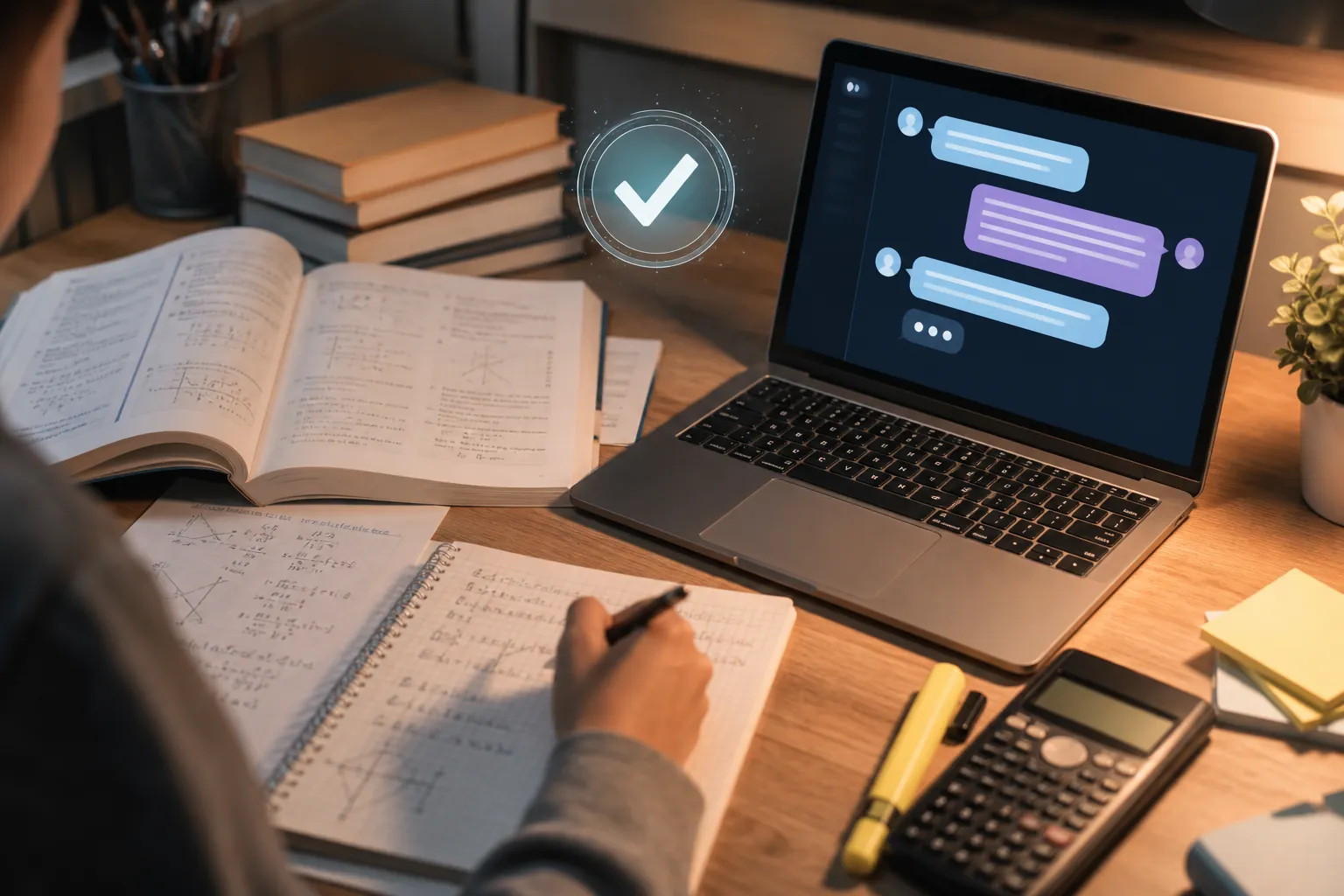
The shortest defensible answer: useful helper, unsafe answer key
Gemini belongs in the same category as other AI study tools: potentially helpful after the student has an official source to check against. It can rephrase a confusing answer explanation, generate extra grammar examples, summarize a biology concept, or help turn missed questions into a review list. It should not be the authority that decides whether your answer was right.
The studies that matter do not support a blanket “Gemini works” or “Gemini fails” judgment. They show performance changing by exam type, section, model version, and whether the questions are text-only, math-heavy, or visual. That is why official practice remains the diagnostic source, especially for exams like the SAT where third-party practice tests cannot fully reproduce the official adaptive testing system. For that specific issue, see our guide to free online SAT practice test accuracy.
What the SAT/ACT evidence actually says
The most directly useful study for high-school test-takers is an American Journal of Student Research comparison of ChatGPT, Copilot, and Gemini on SAT and ACT-style material. The study used 90 total questions: 30 Math, 30 Reading, and 30 English. It found that all three AI tools performed strongly on language tasks, performed notably lower on math, and showed no statistically significant overall differences by chi-square testing among the three tools.[1]
That last phrase is easy to overread. “No statistically significant overall differences” does not mean “safe for every section.” It means the study did not find an overall performance gap among the three tools large enough to clear that statistical test. A student does not take an “overall AI average.” A student misses a system of equations question, a punctuation question, or an inference question. Section-level weakness is exactly where exam prep damage happens.
| Finding from the SAT/ACT study | What it can support | What it cannot support |
|---|---|---|
| 90 total SAT/ACT questions across Math, Reading, and English | A useful exam-prep snapshot across major high-school test sections | A definitive benchmark for every SAT or ACT form |
| Strong performance on language tasks | Gemini may be more reasonable for Reading and English review when checked | Permission to treat AI explanations as official answer explanations |
| Lower performance on math | Math work needs tighter verification and more caution | Using Gemini as a math diagnostic or answer key |
| No statistically significant overall differences by chi-square | Gemini was not clearly separated overall from ChatGPT or Copilot in that sample | A claim that all tools are equally reliable on every section |
The venue also matters. This is useful supporting data because it asks the right exam-prep question and uses recognizable SAT/ACT categories. It is not the kind of large, official testing-board benchmark that should settle the issue by itself. The value is practical, not absolute: it points students toward the places where Gemini is more likely to help and the places where verification cannot be optional.
The verbal use case is the one I would actually keep
For Reading and English work, Gemini’s strengths line up better with what the student needs. It can explain why a transition is too strong, turn a grammar rule into a few simpler examples, summarize a dense passage, or help a student compare two answer choices. Those are tasks where the student can usually check the result against an official answer explanation or the passage itself.
The SAT/ACT comparison supports that cautious use: language tasks were the stronger area across the AI tools tested.[1] That does not make Gemini a private tutor. It makes Gemini a tolerable second explainer after the official answer key has already established what is correct.
A safer request is not “solve this and tell me the answer.” It is closer to: “The official answer is C. Explain why C fits the sentence better than B, using only the grammar rule involved.” That keeps the AI away from the authority role and puts it in the explanation role, where errors are easier to catch.
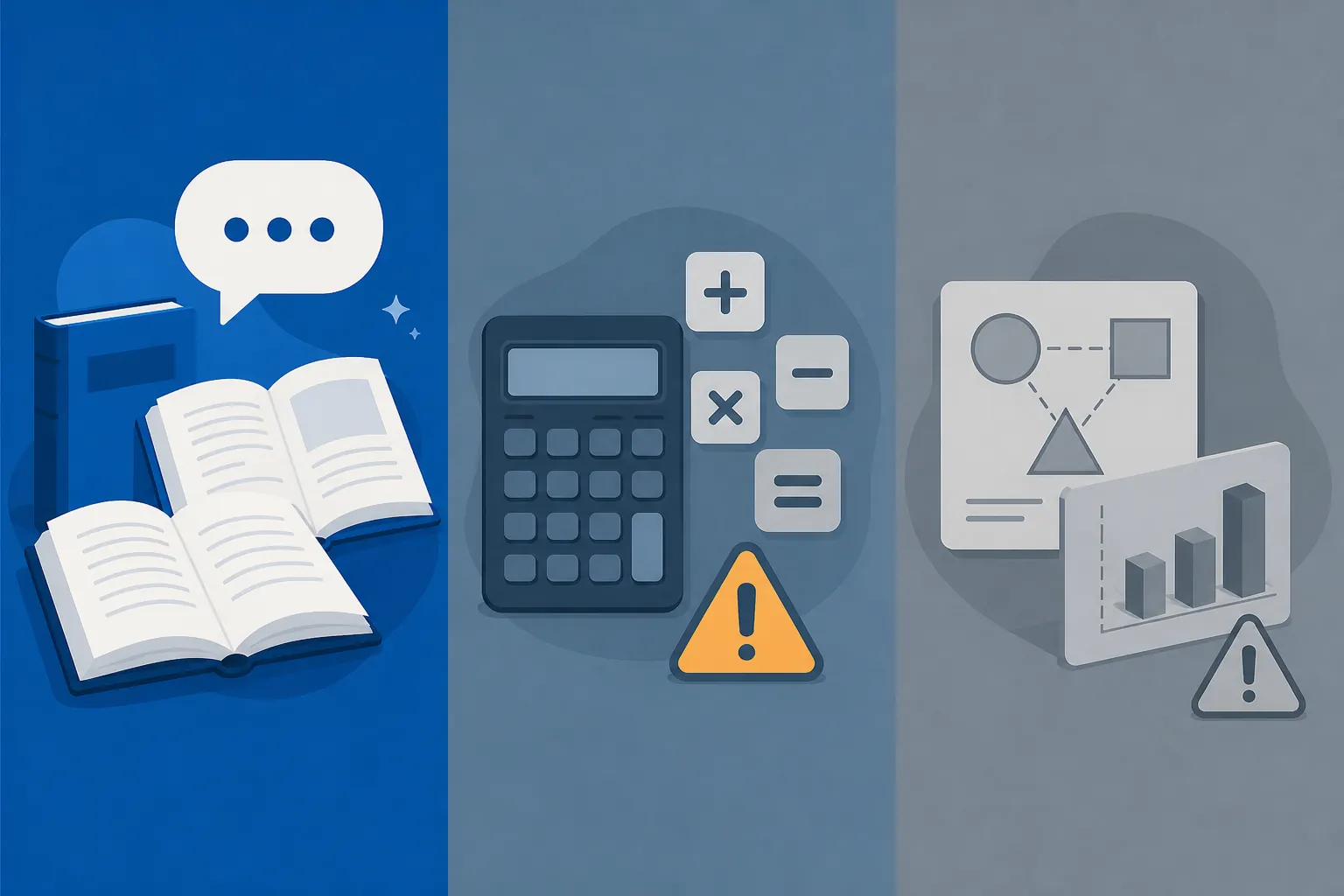
Math is where a fluent answer can train the wrong habit
Math weakness in the SAT/ACT study is not a small footnote for exam prep. Math errors are often procedural. If Gemini gives a wrong reason for distributing, factoring, setting up a ratio, or interpreting a graph, the student may practice that procedure repeatedly before noticing the original explanation was flawed.
A hypothetical example: a student misses a word problem, asks Gemini for a shortcut, and receives a clean-looking setup that happens to reverse the relationship between two quantities. The answer may look polished enough to copy into a notebook. The student has not just recorded a wrong answer; they have rehearsed a wrong translation habit.
That is why Gemini should not be used as the first judge of math correctness. Use official explanations, released test material, teacher-reviewed solutions, or a verified prep source first. If Gemini enters the study process, it should be asked to explain a known-correct solution, not to invent the answer path from scratch.
Text-only medical-board data looks stronger, but it does not transfer everywhere
A Cureus/PMC study gives a useful contrast because it tested a different kind of exam task: 220 text-only Brazilian ophthalmology board questions. In that study, Gemini 2.0 Advanced scored 85.45% and 80.91% under the reported evaluation conditions, while ChatGPT-4o scored 80.00% and 84.09%. The study also reported moderate inter-evaluator agreement.[2]
That is a much better setting for a large language model than a diagram-heavy or calculation-heavy test section: text-only, knowledge-heavy, board-style questions. It suggests that Gemini can look competent when the task is mostly retrieving, organizing, and applying written medical knowledge. For an MCAT student reviewing a text explanation of a physiology concept, that is relevant. For an MCAT student working through a figure, graph, experimental setup, or passage with subtle visual information, it is much less reassuring.
The year-to-year swings in the same study are a useful warning against quoting one accuracy number as if it travels. Gemini’s performance was reported as 100% on the 2008 question set and 71.4% on the 2010 question set.[2] That gap is not something a student can ignore by saying “Gemini is good at board questions.” It depends on the question set.
The model version also matters. This study tested Gemini 2.0 Advanced.[2] A result from Gemini-Pro, Gemini 2.0 Advanced, or a later Gemini model should not be blended into one generic “Gemini accuracy” claim. If a prep company, forum post, or YouTube test does not name the version, it is not giving students enough information to judge score risk.
The Step 1 number I would not use
One tempting NBME Step 1 comparison surfaced only as a search-snippet claim in the materials reviewed for this article. I am not treating it as evidence here because the underlying source could not be checked. It also referred to Gemini-Pro, a dated model label, so even a verified version would need careful framing before being applied to a 2026 study plan.
Coverage matters as much as raw accuracy
A student searching for Gemini exam prep may be preparing for the SAT, ACT, MCAT, GRE, ASVAB, LSAT, or a professional board exam. Those are not interchangeable. A tool that can explain algebra is not automatically an ASVAB prep system. A tool that can summarize a biology passage is not automatically an MCAT diagnostic engine. A tool that can generate practice questions is not automatically matching the official exam blueprint.
This is especially important for exams with specialized scope. If Gemini gives an ASVAB student a general mechanical-comprehension explanation, that may be useful as a study aid. It does not prove the tool covers the ASVAB at the right distribution, difficulty, timing, or wording. The same caution applies to GRE quantitative reasoning, MCAT experimental passages, and any exam where visuals or official item style carry a large part of the difficulty.
Community reports can help students spot patterns, but Reddit-style claims are not measured accuracy evidence. Screenshots of correct answers are even weaker. The minimum useful question is: which exam, which section, which model version, which question source, and how were wrong answers counted?
Where Gemini fits in a verified study plan
The safest way to use Gemini is to make it work around official material, not replace it. If you already have a released question, an official answer, or a trusted explanation, Gemini can help you process that material in a different voice. If you do not have a way to check the answer, the output should be treated as a draft, not a fact.
| Use case | Risk level | Safer way to handle it |
|---|---|---|
| Explaining an official Reading or English answer | Lower | Give Gemini the official answer and ask it to explain the rule or passage evidence |
| Generating extra grammar examples | Lower | Use them for unscored practice, then verify the rule with a trusted source |
| Summarizing a science or history passage | Lower to moderate | Check that the summary does not add facts outside the passage |
| Solving SAT/ACT/GRE math from scratch | Higher | Use an official or teacher-reviewed solution first; use Gemini only to rephrase it |
| Interpreting diagrams, charts, figures, or image-heavy questions | Higher | Do not rely on the AI unless the answer can be checked against official material |
| Creating a diagnostic score or full prep plan from AI-generated questions | Highest | Use official tests or exam-specific verified tools for score decisions |
If you are comparing Gemini with other tools, the useful comparison is task by task. Our ChatGPT exam-study assistant test is a better companion piece than a generic feature comparison, because it separates study tasks instead of treating “AI tutoring” as one thing. For reliability habits, the AI study chatbot hallucination-rate guide is the more relevant warning.
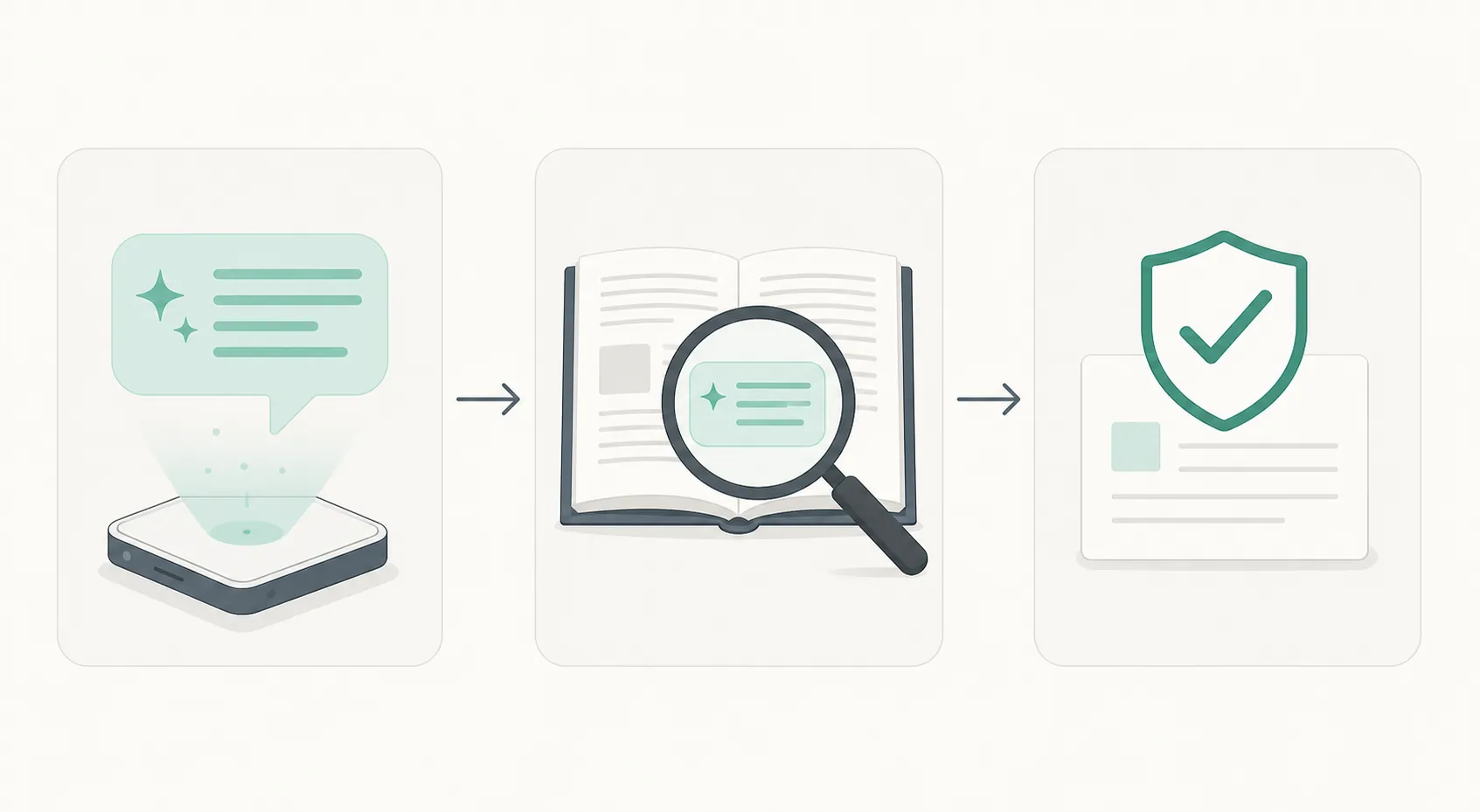
A quick verification rule before you trust a Gemini answer
Before letting a Gemini answer affect your study plan, run it through a simple check:
- Find the official or trusted answer first.
- Ask Gemini to explain that answer, not decide it.
- Compare every major reasoning step against the official explanation.
- If Gemini adds an unsupported fact, changes the question, or skips a math step, mark the response unreliable.
- If you cannot verify the output, do not use it for scoring, diagnosis, or memorized review.
That rule is intentionally stricter for math, visual reasoning, and exam-specific diagnostics than it is for verbal review. A wrong paraphrase is usually easier to catch. A wrong algebra habit, a wrong graph interpretation, or a hallucinated medical rationale can survive long enough to become part of how a student answers under time pressure.
So, does Gemini AI work for exam prep? It can work as a supplementary study helper for explanations, verbal review, summarization, and extra low-stakes practice questions when the answers are checked against official material. It should not be used as an authoritative answer key, diagnostic score predictor, or replacement for official SAT, ACT, MCAT, GRE, ASVAB, or board-prep resources.
Use Gemini where a wrong answer is easy to catch. Avoid it where a wrong answer quietly trains the wrong habit. Judge it by exam, section, question type, and model version — not by the name “Gemini AI” alone.
References
- Measuring AI Accuracy on Standardized Tests: A Comparative Study of ChatGPT, Copilot, and Gemini — American Journal of Student Research.
- Comparative Analysis of ChatGPT-4o and Gemini 2.0 Advanced in Answering Brazilian Ophthalmology Board Examination Questions — Cureus / PubMed Central.
Authoritative source
For the authoritative version of this contentHow to Read the '1 in 4 NFL Players CTE' Study
Report an error in this tool's output
Found something this tool got wrong beyond what's documented above? Report it so the accuracy log stays current.
Comments
Join the discussion with an anonymous comment.