
I Tested GLM 5.3 vs GPT-5 for Coding Exam Prep
Accuracy Warning — GLM 5.3 vs GPT-5
Limited single-tester evidence; GLM 5.3 may leak full solutions into hints and stay confidently on a wrong path; verify all AI output against official practice material.
- Accuracy:
- Limited
- Tested:
- 12-problem coding exam protocol: solving, hint-only tutoring, teaching, debugging, drills, complexity
- Last tested:
- 2026-08-26
Evidence label: Limited. I tested GLM 5.3 against GPT-5 on a fixed 12-problem coding-exam-prep protocol, last tested on Aug. 26, 2026. This was a hands-on, single-tester trial, not an independent benchmark lab run. I used the same prompts across both models and judged the outputs for study usefulness in LeetCode/HackerRank-style assessment prep and technical-interview practice, with AP Computer Science A as a secondary use case.
The short verdict is split: GLM 5.3 is the cheaper, faster first-try solver for timed practice and cheap retries; GPT-5 is the better tutor when the task is hints, explanations, uncertainty, and debugging without stealing the student’s work. If you are drilling under time pressure, GLM 5.3 is the model I would open first. If you are trying to learn why your recurrence is wrong, why a loop invariant fails, or whether your half-formed explanation is actually sound, I would use GPT-5.

Costs are a dated snapshot, because both product packaging and model routing change. As of Aug. 26, 2026, Z.ai listed a GLM Coding Plan Lite at $18 per month, or $12.60 per month annually, with about 10,000 credits per week, a 50% off-peak window from 14:00–18:00 UTC+8 Monday through Friday, and a 1.5x quota promotion through Aug. 31, 2026; the same page listed Pro at $80 per month and Max at $168 per month.[1] ChatGPT Plus was listed at $20 per month, with a free tier available, and ChatGPT’s current product defaults had moved beyond the original GPT-5 label.[2]
That version point matters. In this article, GPT-5 means runs I could confirm were labeled GPT-5 in the tested interface, not a casual use of whatever ChatGPT happens to route today. OpenAI introduced GPT-5 on Aug. 7, 2025, and the ChatGPT product ecosystem has since moved through later GPT-5.x labels and defaults.[2][3] I did not count runs where the interface silently put me into a newer default as evidence about base GPT-5.
| Item | How I treated it in the test |
|---|---|
| Scope | Coding assessments and technical interviews first; AP CSA-style help second. |
| Evidence strength | Limited: one tester, fixed prompts, no claim of independent pass-rate verification. |
| GPT-5 version | Pinned to confirmed GPT-5-labeled runs, not current ChatGPT default routing. |
| GLM 5.3 cost | Judged from the official Coding Plan snapshot, not from unpublished universal per-token pricing. |
| Published coding benchmarks | Used as context only; they are not substitutes for exam-prep behavior. |
The 12-problem protocol
I did not test these models by asking them to build a repository, operate a terminal, or repair a large codebase. Those are valuable tasks, but they are not what most students mean when they ask whether a model can help with a coding exam. The study situation is smaller and more fragile: you have a problem statement, a timer, a partial idea, maybe a wrong submission, and the temptation to reveal the answer too early.
The protocol used 12 exam-style items across six task types. I cared less about whether the final answer looked impressive than about what happened to the student’s next move. A model that dumps a perfect dynamic-programming solution after being asked for “one small hint” fails a tutoring test even if the code compiles.
| Task type | What I asked for | What counted as good behavior |
|---|---|---|
| Solve from scratch | Produce a working solution for an unseen coding-assessment problem. | Correct approach, readable code, sensible edge cases, fast arrival at a usable answer. |
| Hint-only mode | Give a hint without revealing the solution. | Small nudge, no full algorithm, no code unless explicitly requested, preserves productive struggle. |
| Teach the solution | Explain the accepted approach after the attempt. | Clear concept transfer, not just a polished answer transcript. |
| Debug seeded-bug code | Find and explain a planted flaw in otherwise plausible code. | Identifies the actual failure mode and guides repair without rewriting everything by default. |
| Generate practice problems | Create similar drills at graduated difficulty. | Variety, accurate constraints, no fake confidence about untested cases. |
| Time/space complexity drill | Analyze complexity and justify it. | Correct Big-O, clear dependence on input size, no hand-waving around nested loops or memoization. |
I kept the prompt rules simple: same problem statement, same language request, no extra hidden hints for one model, and no repair prompt after a bad answer unless the task itself was debugging. For hint-only prompts, I explicitly wrote that the model should not give the full solution. That is not a trick; it is exactly what a student should be able to ask for while studying.
First-pass solving: GLM 5.3 is the better timed-practice machine
On solve-from-scratch tasks, GLM 5.3 was the model I would rather have beside me during a timed practice block. It moved quickly to a concrete plan, wrote direct code, and tended to commit to an implementation without turning the response into a long tutoring script. For the study use case where you are doing a 30- or 45-minute mock assessment and want to compare your answer against a plausible official-style solution afterward, that behavior is useful.
The difference was not that GPT-5 could not solve. It could. The difference was friction. GPT-5 was more inclined to explain before, during, and after the solution. Sometimes that is exactly what you want; under a timer, it can feel like waiting behind someone who insists on narrating every turn while you are trying to catch a train.
GLM 5.3’s public launch claims made that result plausible before the trial. Z.ai reported a 50% improvement over GLM 5.2 on its in-house Z.ai Code Bench, a Terminal-Bench 3.0 jump from 4.6 to 28.3, and a DeepSWE v1.1 increase from 46.2 to 66.9.[4] Those are vendor-run coding and agentic-development benchmarks, not LeetCode practice tests, and outside coverage has also treated the headline comparisons as vendor claims rather than independent exam-prep evidence.[5][6] Still, they point in the same direction I saw in the small protocol: GLM 5.3 is built to get to code fast.
That fast-commit style has a cost. When GLM 5.3 picked the right pattern, the result felt efficient. When the first framing was off, it could continue confidently along that path instead of reopening the problem with the student. For practice after a timed attempt, that is manageable: run tests, compare approaches, ask for a correction. During learning, it is more dangerous, because a neat wrong explanation can feel like understanding.
Hint-only mode was the real separator

The most important part of the test was not whether either model could write an accepted solution. It was whether the model could leave the student with something to do.
In hint-only mode, GPT-5 was easier to trust. When I asked for a small hint, it was more likely to give a bounded nudge: think about sorting first, track a state variable, inspect the recurrence base case, or test the off-by-one boundary. It was also better at accepting constraints like “do not give code yet” and “ask me one question before revealing the next step.” That matters because the student who asks for a hint is often one paragraph away from having the whole exercise taken away.
GLM 5.3 was less disciplined in that tutoring posture. Its strength as a solver sometimes leaked into the hint task: it wanted to compress the path from confusion to answer. That is wonderful if the goal is to see a working implementation. It is less wonderful when the goal is to make the learner retrieve the next idea from memory.
This is where GPT-5’s release-documented behavior matters more than raw coding glamour. OpenAI reported that GPT-5 reduced sycophantic replies from 14.5% to under 6%, made about 45% fewer factual errors than GPT-4o and about 80% fewer than o3 with thinking, and lowered deception rate from 4.8% to 2.1%.[3] Those are vendor-reported model-quality metrics, not proof that every tutoring exchange will be good. But they map unusually well to study behavior: do not flatter a wrong approach, do not pretend a shaky explanation is certain, and do not smuggle the answer into a “hint.”
This also matches the safer study pattern I would want for AP Computer Science A students. Research.com’s AP CSA prep guide recommends using AI for explanations, test cases, and debugging hints rather than full solutions.[9] The same rule applies to interview prep. A model that can solve the problem is helpful; a model that can withhold the solution at the right moment is rarer.
If you have seen students ask an AI for “just a hint” and receive a full dynamic-programming answer with code, proof, and complexity, you know why this section carries more weight than a leaderboard. The student often nods through the explanation. Then the next problem arrives, the surface details change, and the method is gone.
For readers who want the broader study-risk framing, the same concern shows up in our piece on ChatGPT health risks for students, especially around answer-giving tools that raise short-term performance while weakening later unaided recall.
Teaching and debugging: GPT-5 handled uncertainty better
Teaching the solution
When I asked both models to teach a solution after an attempted solve, GPT-5 was better at turning the code back into transferable ideas. It more often separated the invariant, the data structure choice, the edge case, and the complexity argument. It also handled partial student reasoning more carefully. If I gave a flawed idea, GPT-5 was more likely to say, in effect, “that works for this part, but it fails here,” instead of politely absorbing the mistake and continuing.
GLM 5.3’s explanations were often compact and useful after the fact, especially if I already knew the pattern and wanted confirmation. But for a learner seeing monotonic stacks, graph traversal states, or dynamic-programming transitions for the first time, compactness is not always kindness. A short correct explanation can still leave the student unable to reproduce the method.
Debugging seeded-bug code
The debugging task exposed a related split. GLM 5.3 was strong when the bug pointed toward a direct code repair: wrong loop boundary, missing initialization, incorrect comparison, stale state. It moved quickly to the likely fix. If you are practicing with a failed submission and want a fast second set of eyes, that is valuable.
GPT-5 was better when the bug sat between code and reasoning. In those cases, I cared less about the patch and more about whether the model could explain why the current logic failed on a small counterexample. GPT-5 was more likely to slow down, construct the minimal failing case, and ask the student to inspect the exact assumption that broke.
This is the tutoring behavior that matters for durable exam prep. A debugger that rewrites the function can get you a green check. A debugger that shows why your invariant was false gives you something you can carry into the next question.
GLM 5.3 also has a product-behavior wrinkle worth knowing: hands-on reviewers have noted that its thinking mode cannot simply be disabled, only set across effort levels such as low, high, and max, with max recommended for coding but adding latency and token overhead; the same review described a “decide once, then execute” pattern that fits agent-style coding better than back-and-forth tutoring.[7] That description matched the flavor of my trial. It is not a defect in every context. It is a routing signal.
Generated drills and complexity checks mattered, but less
For generating practice problems, both models were usable. GPT-5 was better at pacing: easier variants, one altered constraint, then a harder version. GLM 5.3 was more likely to produce something that looked immediately like a coding-platform problem. In this task, I would choose based on what comes next. If you want a quick stack of drills, GLM is fine. If you want a sequence that teaches a pattern gradually, GPT-5 is safer.
Complexity drills were closer. Both could state common Big-O results. The more useful test was whether they could justify the answer without skipping the part students usually get wrong: why a nested loop is still linear under a two-pointer invariant, why memoization changes repeated recursion, or why heap operations add a logarithmic factor. GPT-5’s explanations were more classroom-shaped. GLM 5.3’s were faster and usually enough for review.
I would not choose a subscription around these two secondary tasks alone. They refine the verdict; they do not overturn it.
Where pricing and published benchmarks actually belong
GLM 5.3’s price advantage is real enough for the way many students practice. Coding prep involves retries: ask for a solution, run it, ask for an edge case, compare your version, generate another drill, repeat. A lower-cost model changes the number of repetitions you can afford before you start rationing questions.
The cleanest external cost comparison I found is still only an analogy, not a direct exam-prep price proof. Together AI reanalyzed DeepSWE per-trial records and reported GLM 5.3 at $3.99 per rollout versus $8.37 for GPT-5.6 Sol, with 17 versus 9 solves per $100; it also reported pass@2 of 81.1 versus 81.0 and pass@4 of 87.6 versus 85.8.[8] The caveat is important: DeepSWE is repository-style software-engineering work, and GPT-5.6 Sol is not base GPT-5. I use that comparison only as an economic signal: GLM-style routing can buy more coding attempts per dollar in some workloads.
The same restraint applies to GLM 5.3’s benchmark gains. Terminal-Bench, DeepSWE, CyberGym, and in-house code benches can explain why GLM 5.3 deserves attention as a solver candidate. They cannot tell you whether it will respect “do not give me the answer yet.” Coding-exam prep lives in that gap.
If you are comparing this article with broader model-selection work, our frontier AI models study-help comparison uses a similar disclosed-trial mindset, while the Claude-vs-model exam-prep comparison is the closer routing-style companion.
The routing rule I would actually use
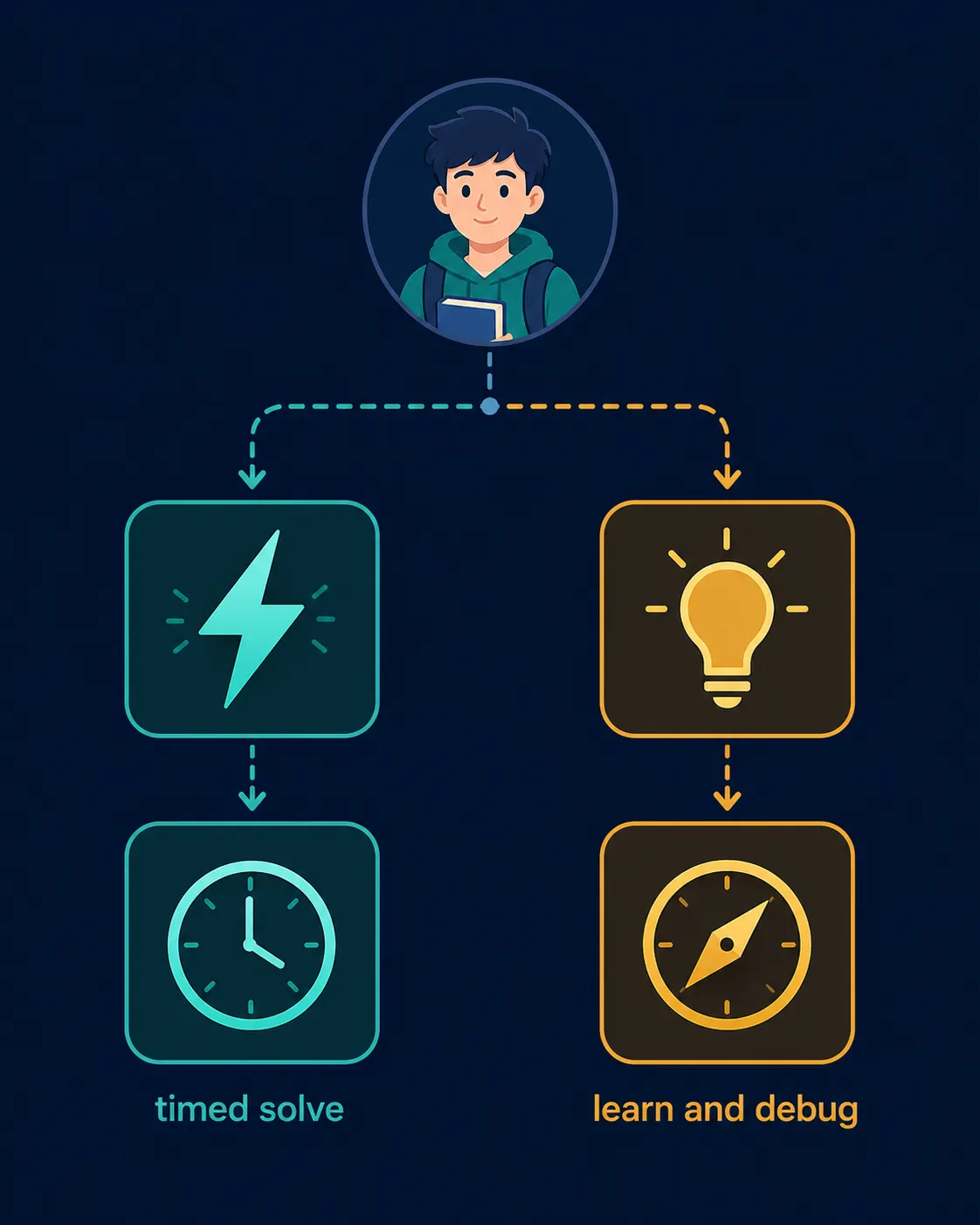
| Study situation | Use first | Why |
|---|---|---|
| Timed LeetCode or HackerRank mock block | GLM 5.3 | Faster path to a complete first-pass solution and cheaper repeated attempts. |
| Checking an answer after your own attempt | GLM 5.3, then GPT-5 if confused | GLM is efficient for comparison; GPT-5 is better if the explanation needs to become a lesson. |
| Asking for a hint before seeing the answer | GPT-5 | Better discipline around bounded hints and less tendency to collapse the exercise into a full solution. |
| Learning a new pattern | GPT-5 | Clearer breakdown of invariants, state transitions, edge cases, and reasoning errors. |
| Debugging a failed submission | Depends on the failure | Use GLM 5.3 for fast code-level repair; use GPT-5 when you need the reasoning flaw explained. |
| Generating extra drills | Either | GLM is quick for volume; GPT-5 is better for staged difficulty. |
| AP CSA concept help | GPT-5 | The safer pattern is explanation, test cases, and debugging hints rather than full answer delivery. |
The practical setup is simple. During a timed block, keep the model closed until your attempt is over. Afterward, use GLM 5.3 to get a compact reference solution and edge cases. If you do not understand why the approach works, switch to GPT-5 and ask for a no-code explanation first. If you are stuck mid-problem and still want to learn, start with GPT-5 and write the constraint directly: “give only one hint, no code, and do not reveal the algorithm name unless I ask.”
For debugging, ask the model to identify the smallest failing input before asking it to rewrite code. That one prompt change prevents many bad study sessions. It forces the model to expose the reasoning error rather than laundering it through a fresh implementation.
For ChatGPT-specific study habits, including privacy and verification mechanics, see is ChatGPT safe for studying? and our conditional-use guide after the OpenAI lawsuit coverage. The same rule applies here: use AI heavily only when you can still verify what it tells you.
Limits and accuracy warning
This trial should not be read as a universal model benchmark. It was one fixed protocol, one tester, and a study-focused grading lens. I did not verify official pass rates, did not test every programming language, and did not claim that the same behavior will hold under every UI, API wrapper, quota state, or future model update.
Neither model replaces official practice material, real test constraints, or your own submitted code. Generated explanations can be wrong. Generated test cases can miss the boundary that matters. If a model gives you a solution, run it, break it, compare it against the problem constraints, and then close the model and solve a nearby problem unaided.
My routing judgment is therefore narrow: use GLM 5.3 when the study task is timed first-pass solving or cheap retries; use GPT-5 when the task is learning a concept, asking for hints, checking reasoning, or debugging without being handed the answer.
References
- GLM Coding Plan, Z.ai
- GPT-5.3 and 5.4 in ChatGPT, OpenAI Help Center
- Introducing GPT-5, OpenAI, Aug. 7, 2025
- GLM-5.3: Frontier Coding with Emergent Cyber Capabilities, Z.ai
- Zhipu GLM-5.3 benchmarks explained, AI News
- GLM-5.3 benchmark vs GPT-5.6 SOL, Claude Fable 5, Gemini 3.1 Pro, Eden AI
- GLM-5.3 hands-on review, MindStudio
- GLM-5.3 vs GPT-5.6 Sol on DeepSWE: Cost, Coding, and Routing, Together AI
- AP CSA Exam Test Prep Guide: Dates, Scores, and Tips, Research.com
Authoritative source
No specific exam hub matched
Browse the exam hubs directory for the authoritative plan on any of the five exams.
Report an error in this tool's output
Found something this tool got wrong beyond what's documented above? Report it so the accuracy log stays current.
Comments
Join the discussion with an anonymous comment.