
Claude Opus 5 or Fable 5 for Exam Prep Tasks?
If you are searching for Claude Opus 5 vs Fable 5 tested for exam prep, the useful answer is probably not a universal winner. You need a routing rule: which model handles the ordinary study work cheaply, and which tasks are difficult enough to justify paying for Fable 5.
As of Q3 2026 launch week, the cleanest snapshot is this: Claude Opus 5 is listed at $5 per million input tokens and $25 per million output tokens, while Fable 5 is listed at $10 per million input tokens and $50 per million output tokens.[1][2] On the Artificial Analysis Intelligence Index, Opus 5 scores 61 and Fable 5 scores 60 at max effort.[3] That benchmark is a proxy, not a controlled SAT, ACT, GRE, or MCAT outcome study. It does not prove that either model raises exam scores. It does, however, make the price premium hard to justify for routine study tasks unless Fable 5 is solving a problem Opus 5 visibly cannot.
One more timing caveat matters: Opus 5 launched on July 24, 2026, only days before this article’s current date.[1] Any launch-week comparison should be treated as task-matching from available pricing, model behavior, benchmark, and risk evidence—not mature exam-prep evidence from a large sample of students. For the broader model comparison, start with Is Claude Opus 5 or Fable 5 Better for Studying? This article narrows the question to exam-prep work.

The Dated Evidence Snapshot
| Question | Opus 5 | Fable 5 | Exam-prep meaning |
|---|---|---|---|
| API price | $5 input / $25 output per MTok | $10 input / $50 output per MTok | Fable costs 2x before you know whether the task needs it. |
| Proxy capability score | 61 on Artificial Analysis Intelligence Index | 60 on Artificial Analysis Intelligence Index at max effort | Near parity for general reasoning and knowledge-work tasks, not direct exam-score proof. |
| Reasoning control | Five effort levels: low, medium, high, xhigh, max | Always-on thinking cannot be disabled | Opus can be matched to task difficulty; Fable spends premium reasoning by default. |
| Launch-week confidence | Launched July 24, 2026 | Available in Q3 2026 comparison materials | Prices and behavior should be rechecked before heavy spending. |
The table is enough to set a default. If the task is bounded, repeatable, and easy to verify, start with Opus 5. If the task requires holding many constraints over a long horizon, and Opus 5 fails in a way you can identify, escalate to Fable 5.
Use Opus 5 First for Most Exam-Prep Work
Most AI study sessions are not frontier-model obstacle courses. They are small loops: explain the rule, generate a few questions, check an answer, diagnose the miss, revise the plan, repeat. That is exactly where paying double for every token becomes wasteful.
Opus 5’s effort levels are the practical advantage here. Low, medium, high, xhigh, and max let a student spend less on quick concept lookups and more only when the task genuinely has a reasoning bottleneck.[1] Fable 5’s always-on thinking is impressive when the work needs it, but it is a poor fit for ordinary drilling if the model cannot stop using its expensive mode.[2]

A good operating policy is simple: Opus 5 medium for ordinary explanations and question generation, Opus 5 high for missed-question diagnosis and multi-step reasoning, Opus 5 xhigh or max only when you are checking a hard chain of reasoning. Fable 5 comes later, not first.
If you are making a broader budget decision—subscription, API credits, or course replacement—the cost question belongs next to your official materials and practice-test budget, not in a model leaderboard. The companion guides on whether a Claude Opus 5 subscription can replace a test prep course and Opus 5 student project pricing are the more direct places for that math.
How the Routing Rule Works by Study Task
The model choice should come from the shape of the task, not from the exam logo at the top of the book. A GRE algebra explanation, an ACT grammar rule, an SAT function question, and an MCAT amino-acid review can all be cheap or expensive depending on what you ask the model to do.
| Task | Default route | Escalate only if... |
|---|---|---|
| Concept review | Opus 5 low or medium | The explanation must reconcile several conflicting sources or edge cases. |
| Practice question generation | Opus 5 medium | You need a large, constraint-heavy set with answer rationales and difficulty balancing. |
| Study-plan drafting | Opus 5 medium or high | The plan must optimize many constraints across a long time horizon. |
| Missed-question diagnosis | Opus 5 high | The miss depends on a hidden multi-step reasoning failure Opus cannot isolate. |
| Multi-step quantitative reasoning | Opus 5 high, then xhigh if needed | Opus gives an incorrect or unstable chain after you provide the official answer. |
| MCAT cross-topic integration | Opus 5 high | The task requires linking many biology, chemistry, and passage constraints at once. |
| Large syllabus-to-plan transformations | Opus 5 high or xhigh first | The syllabus, practice set, constraints, and rationales exceed Opus’s reliable planning behavior. |
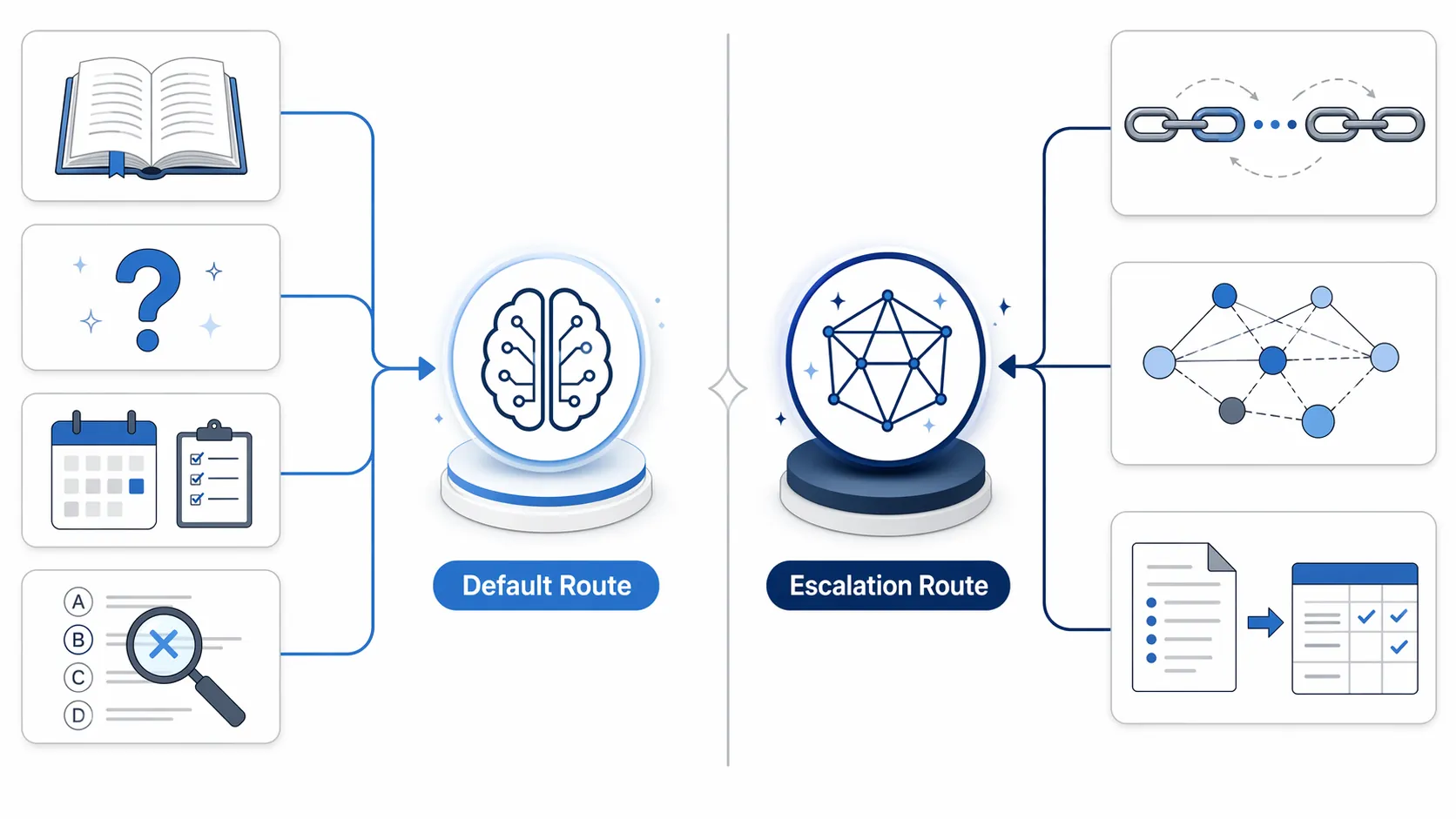
Concept Review
Concept review is the easiest place to overspend. If you ask for a plain-English explanation of standard deviation, semicolon usage, electrochemistry sign conventions, or a CARS passage strategy, the task is bounded and checkable. Use Opus 5 at low or medium effort.
The key is to make the model produce something you can test immediately: a short explanation, one contrast case, and two quick questions. If the answer is wrong, your prep book or official explanation will usually expose it fast. Fable 5’s premium reasoning does not buy much when verification is that close.
Practice Question Generation
For everyday practice questions, Opus 5 medium is the default. Ask for a small batch, require answer choices, require rationales, and compare the output against the style of official materials. The model is helping you create reps, not replacing the exam maker.
Fable 5 becomes more plausible when the generation task stops being small. A hypothetical example: you paste a long syllabus, list weak areas from several practice tests, ask for a week of mixed MCAT biology and chemistry passages, require rationales for every answer, and demand spacing across old and new topics. That is no longer “write me five questions.” It is a constraint-management task.
Study-Plan Drafting
Most study plans do not need Fable 5. A four-week SAT math review, a two-month ACT English schedule, or a GRE quant refresh plan can start in Opus 5 medium. The quality comes less from model mystique than from the inputs: test date, baseline score, weak topics, available study days, practice-test cadence, and official materials.
For GRE students building a full workflow, the model should sit behind the study architecture rather than drive it. Pair the plan with a resource hub such as the GRE Prep Hub, then use Opus to translate that structure into weekly assignments.
Escalation makes sense when the plan has many interacting constraints: school, work, accommodations, multiple official practice tests, a large backlog of missed questions, and uneven performance across sections. Even then, try Opus 5 high first. If it drops constraints, repeats assignments, or creates a plan that cannot be executed, Fable 5 has a clearer job.
Missed-Question Diagnosis
Missed-question review is where students should spend attention, not just tokens. A useful diagnosis separates content gaps, misread wording, trap-choice attraction, timing pressure, and calculation mistakes. Opus 5 high is a strong default because the task is reasoning-heavy but usually narrow: one question, one answer, one student explanation, one correction.
Give the model your chosen answer, the correct answer, and your scratch-work or paraphrase. Ask it to identify the first wrong move. If Opus can point to the exact step where the reasoning broke, there is no need to escalate. If it keeps giving generic advice—“read carefully,” “review fundamentals,” “practice more”—the model is failing the task, regardless of benchmark score.
Multi-Step Quantitative Reasoning
Hard GRE quant, SAT advanced math, and some ACT math questions are the first serious Fable 5 candidates. Not because Fable is automatically better at every equation, but because long chains create more places for a model to lose track of a condition, invert a ratio, or solve the wrong question.
Start with Opus 5 high. Ask for a step-by-step solution, then ask it to verify the answer using a second method or a quick plug-in check. If the official answer disagrees, provide that answer and ask Opus to find the first divergence. Only escalate when the failure is visible: inconsistent algebra, contradictory conclusions, or inability to reconcile the official answer with its own reasoning.
That escalation standard matters. “This problem feels hard” is not enough. “Opus gave two incompatible solution paths after I supplied the official answer” is enough.
MCAT Cross-Topic Integration
MCAT prep is where Fable 5 deserves more room. The hardest tasks are not isolated facts; they involve passage evidence, biology, chemistry, experimental design, and answer-choice logic moving together. A model that can hold more constraints over a longer reasoning horizon may be worth the premium when the task is truly integrative.
Still, the default should be Opus 5 high for ordinary MCAT review. Use it to explain enzyme kinetics, compare hormone pathways, summarize amino-acid properties, or diagnose why a passage answer was wrong. Move to Fable 5 when the request becomes something like: integrate a full passage, several figures, your wrong answer pattern, and the relevant physiology into a single causal explanation.
Medicine-adjacent study also needs safety discipline. If you use AI for MCAT biology, drug mechanisms, or clinical-sounding explanations, pair the workflow with the same habits covered in How to Use ChatGPT for Studying Medicine Safely: verify against trusted materials, do not treat generated explanations as medical advice, and watch for confident overreach.
Large Syllabus-to-Plan Transformations
The strongest Fable 5 use case is not a single flashcard or explanation. It is a large transformation: a course syllabus, an exam outline, a diagnostic score report, a list of missed questions, and a deadline, all turned into a usable plan with review loops and practice assignments.
This is also where careless AI planning can hurt a student. A beautiful plan that forgets official practice tests, overloads weak days, or delays review until the final week is not a productivity win. Try Opus 5 high or xhigh first. Escalate only if it cannot preserve the constraints you gave it.
The Cost-Control Mechanism Is the Real Difference
The “half the cost” argument is not just a price-table fact. It changes how you study. If the model has adjustable effort, you can match spend to consequence: low effort for a definition, medium for practice items, high for diagnosis, xhigh or max for a hard reasoning chain. That maps to real exam prep because not every prompt has the same stakes.
Fable 5’s always-on thinking removes that dial. DataCamp reports that Fable 5’s thinking cannot be disabled and cites Simon Willison’s public test in which a single agent session cost $99.26 in tokens.[2] That example should not be treated as a typical student study session. It is a cautionary signal about what can happen when a premium model keeps reasoning deeply through a task that may not need that much work.
Students who want to squeeze more value out of API credits should treat routing as part of the study system, not as a one-time model choice. The Tokenmaxxing Student Guide is the better next step if your main question is how to reduce waste across prompts, context, and repeated tasks.
Where Fable 5 Is Actually Worth Trying
Fable 5 is not a bad exam-prep choice. It is an expensive default. That distinction matters.
Use it when three conditions are all true: the task has many moving parts, the result affects a meaningful chunk of your study plan, and Opus 5 has already failed in a specific, observable way. A full MCAT section synthesis, a difficult GRE quant chain that Opus cannot reconcile with the official answer, or a large syllabus-to-plan conversion can meet that standard.
- Good Fable 5 escalation: “Here is a full passage, my wrong answer, the official answer, and my reasoning. Opus contradicted itself twice. Find the first causal error and rebuild the explanation.”
- Weak Fable 5 escalation: “Explain photosynthesis more clearly.”
- Good Fable 5 escalation: “Build a one-week plan from this long syllabus, these missed-question categories, my available hours, and two scheduled practice tests.”
- Weak Fable 5 escalation: “Make me a study schedule for the SAT.”
The point is not to punish yourself with the cheaper model. It is to save the premium model for work where deeper, longer reasoning changes the output you will actually use.
Two Fable 5 Risks Exam Takers Should Monitor
Fable 5 has two practical risks that matter more for some exam topics than others: safety fallback behavior and data retention.
Anthropic says Fable 5 safety classifiers reroute flagged queries to Opus 4.8 in fewer than 5% of sessions on average.[4] Test-Lab.ai reports that the rate concentrates among security-sensitive and biology-adjacent queries.[5] For exam prep, that means MCAT virology, drug mechanisms, medicine-adjacent biology, and cybersecurity-style prompts deserve closer watching. The average fallback rate does not tell you what will happen inside your specific topic cluster.
The issue is not only safety refusal. It is continuity. If a model silently changes behavior mid-session, a student may see a different level of depth, caution, or usefulness without realizing why. When studying sensitive science or security-adjacent material, keep prompts narrow, verify outputs, and note whether the model becomes unusually evasive or generic.
Fable 5 also requires 30-day data retention, while the cited platform materials do not state the same general-access requirement for Opus 5.[6] For most generic SAT grammar or GRE algebra prompts, that may not change your behavior. For personal schedules, disability accommodations, medical-school context, or detailed academic records, it should at least affect what you paste into the model.
A Practical Operating Policy
Start with Opus 5 at high effort for almost everything that affects exam performance: missed-question diagnosis, hard explanations, study-plan drafting, and multi-step practice review. Drop to medium or low for cheap lookups, simple concept refreshers, and small practice-question batches. Move up to xhigh or max before you leave Opus, especially when the task is still bounded enough to verify.
Escalate to Fable 5 only after Opus 5 demonstrably fails on a hard multi-step task whose outcome is worth the extra spend. The failure should be concrete: it loses constraints, contradicts itself, cannot reconcile an official answer, or produces a plan that collapses when checked against your calendar and materials.
There is no need to crown one model for every student. The best model choice is the one that preserves budget for practice, review, and official materials while using premium reasoning only where it changes the quality of the work.
References
- What's new in Claude Opus 5, Anthropic platform docs, July 24, 2026.
- Claude Fable 5: A Mythos-Class Model You Can Use, DataCamp.
- Claude Opus 5: A Technical Guide for Teams Evaluating It in Production, Amplifi Labs.
- Claude Fable 5 and Claude Mythos 5, Anthropic.
- Claude Fable 5 vs Opus 4.8, GPT-5.5, Gemini 3.1 Pro, Test-Lab.ai.
- Claude Fable 5 data retention requirement, Anthropic platform docs.
Related comparisons & exam hub
No matching exam hub found
Browse tool comparisons to find other verdicts for this exam.
Did this match your own testing?
Report whether your hands-on experience with this tool matched the verdict, or flag a pricing or accuracy change.
Comments
Join the discussion with an anonymous comment.