We Tested Gemini vs ChatGPT for Study Planning
Accuracy Warning — ChatGPT, Gemini
Neither generated plan is safe to follow as-is; both required verification against official exam specs, and Gemini's SAT practice tests have documented off-syllabus math, ordering, and progress-loss issues.
- Accuracy:
- Limited
- Tested:
- Generating and auditing a week-by-week digital SAT study plan from identical exam-scoped prompts
- Last tested:
- 2026-08-25
On Aug. 25, 2026, I gave ChatGPT and Gemini the same digital SAT study-planning prompt: same test date, same weekly hours, same starting score, same weak areas. Then I audited the output the way a student with a real registration deadline has to audit it: against the official test shape, the student’s actual score gap, and whether the calendar leaves room for retrieval, review, missed-question analysis, and full-length practice.
The short verdict: neither plan is safe to follow as-is. Both were fluent. Both were organized. Both looked more useful than a blank calendar. And both made assumptions that could cost a test-taker weeks if no one checks them against the exam.
That does not make the tools useless. ChatGPT was easier to push, correct, and turn into drills after the first plan came back. Gemini was better positioned as a research-and-practice entry point, especially because Google’s January 2026 SAT-only offer gives students free full best-model access plus free full-length SAT practice tests grounded in Princeton Review content, at least within that SAT scope as launched then. [1]
But the useful question is not which chatbot sounds more like a tutor. It is which failure mode is more dangerous for your exam: a plan that sounds adaptive but has to be interrogated, or a polished ecosystem that may still need official-spec verification before you trust the practice it serves.
The identical prompt I used
I used the digital SAT because it is the one exam where Gemini currently has a major, visible test-prep hook: the January 2026 SAT-only practice-test offer. I did not ask either tool for a generic “help me study” routine. The prompt had to force exam planning, not productivity theater.
Build me a study plan for the digital SAT.

Test date: Oct. 10, 2026.
Current score: 1290.
Target score: 1450.
Weekly study time: 8 hours.
Starting profile: Reading and Writing is inconsistent on evidence, transitions, and rhetorical synthesis. Math is strongest in linear equations and data analysis, weaker in advanced math, nonlinear functions, and geometry/trigonometry. I have school during the week and can do one longer session on the weekend.

I want a week-by-week plan that tells me what to study, how to practice, how often to take full-length practice tests, how to review mistakes, and how to adjust if my practice scores stall. Use official test requirements where relevant. Do not assume I can study more than 8 hours per week.
The grading was deliberately ugly. I was not scoring prose quality. I checked four things:
- Did the plan stay inside the actual digital SAT rather than drifting into old-SAT, generic English, or off-syllabus math?
- Did it allocate more time to the named weak areas instead of dividing the week symmetrically because symmetry looks clean?
- Did it reserve time for active recall, spaced review, and missed-question analysis, not just content coverage?
- Did the weekly load fit 8 hours without hiding extra work in phrases like “review thoroughly” or “take a practice test and analyze it”?
That last item matters. A full-length practice test plus serious review can swallow most of a week for a student with only 8 hours available. If a plan says “take a test, review it, drill weak areas, review flashcards, and learn new content” in the same week without making tradeoffs, it has already failed the calendar.
| Audit item | ChatGPT result | Gemini result |
|---|---|---|
| Overall plan shape | Clear week-by-week schedule with diagnostics, targeted drills, practice tests, and score checkpoints. | Cleaner-looking phase plan with weekly goals, practice-test milestones, and resource suggestions. |
| Exam alignment | Mostly stayed on digital SAT skills, but leaned on broad content categories and did not always distinguish official practice from generated practice. | Mostly stayed on SAT prep, but treated the Gemini SAT practice environment as more trustworthy than I would without verification. |
| Weak-area allocation | Named the weak areas and returned to them, but still gave too much equal-weight coverage in early weeks. | Looked more balanced than adaptive; the weak areas were listed, but the hours did not consistently move toward them. |
| Retrieval and review | Included error logs, mini-quizzes, and review loops, though some review time was under-budgeted. | Included review days and practice-test review, but compressed the work into optimistic blocks. |
| Feasibility at 8 hours/week | Usable after cutting and sequencing; too much was implied in some weeks. | Attractive calendar, but several weeks depended on review happening faster than it usually does. |
| Best use after audit | Interactive plan refinement, quiz generation, step-by-step correction. | Research grounding and, for SAT only as of the January 2026 launch, free full-length SAT practice access. |
ChatGPT gave the more editable plan
ChatGPT’s first plan was the one I would rather revise under pressure. It opened with a diagnostic, asked for score breakdowns, created a weekly rhythm, and repeatedly told the student to keep an error log. It also handled the fixed 8-hour limit better than Gemini in tone: instead of pretending the student had unlimited evenings, it grouped the week into shorter weekday sessions and a longer weekend block.
The problem was that “editable” is not the same as exam-ready. In the first pass, ChatGPT created a sensible-looking progression: diagnose, review foundations, drill weak areas, add timed sets, take practice tests, taper. That structure is fine. It is also the structure almost any competent chatbot can produce.
Where it drifted was allocation. The prompt named specific weaknesses: evidence, transitions, rhetorical synthesis, advanced math, nonlinear functions, and geometry/trigonometry. ChatGPT acknowledged them, but the early calendar still spread time broadly across Reading and Writing and Math. That is a common planning failure: the plan looks personalized because it repeats the student’s weak areas, then behaves like a standard template once the week-by-week work begins.
Its best move was the missed-question loop. ChatGPT told the student to classify errors, redo missed questions, and use short targeted quizzes. That is exactly the kind of thing an AI tool can help with if the student brings it real mistakes. A useful follow-up prompt would be: “Here are 12 questions I missed and why I think I missed them. Rebuild next week’s 8 hours around the patterns, and do not add new topics unless they explain the misses.” ChatGPT is good at that kind of back-and-forth.
Its weakest move was budgeting. In one practice-test week, the plan effectively asked for a full-length exam, review, targeted drills, and continued content work. A student with 8 hours can do that only if the review is shallow. Shallow review is the part of prep that feels efficient right up until the same mistake returns on the next test.
This matches the better evidence around ChatGPT Study Mode: it can be strong when the task is correction, questioning, and step-by-step reasoning, but it is not a mastery detector. Edutopia found that Study Mode caught an intentionally planted math error and corrected it step by step, while also asking too-basic questions on open-ended topics, over-focusing on the word “test,” and falsely signaling mastery. [2]
OpenAI’s own launch post for Study Mode also cautioned that the feature can show “inconsistent behavior and mistakes across conversations.” [3] That is the right level of trust: useful enough to keep in the study room, not authoritative enough to write the calendar alone.
Gemini made the cleaner calendar, then asked for more trust
Gemini’s plan looked more polished on first read. It divided the prep window into phases, named SAT skills, included practice-test checkpoints, and made the schedule easy to scan. If the assignment were “make a study plan that looks usable in a screenshot,” Gemini would score well.
The audit got rougher once the calendar had to pay for its own promises. Gemini’s plan leaned heavily on the idea that the student could use practice-test results to drive weekly adjustments, which is good in principle. But it did not give enough protected time for the slowest part of that loop: deciding why each missed question happened, separating content gaps from timing errors, and building the next week around the pattern.
It also had a confidence problem. Because Gemini is attached to Google’s SAT practice offer, the plan naturally pointed toward Gemini SAT practice as part of the workflow. That is attractive. Google’s launch, rolled out in January 2026, made full-length SAT practice tests available in the Gemini app for free, grounded in Princeton Review content, and paired that with free access to its best model tier for students in that SAT-only context. [1]
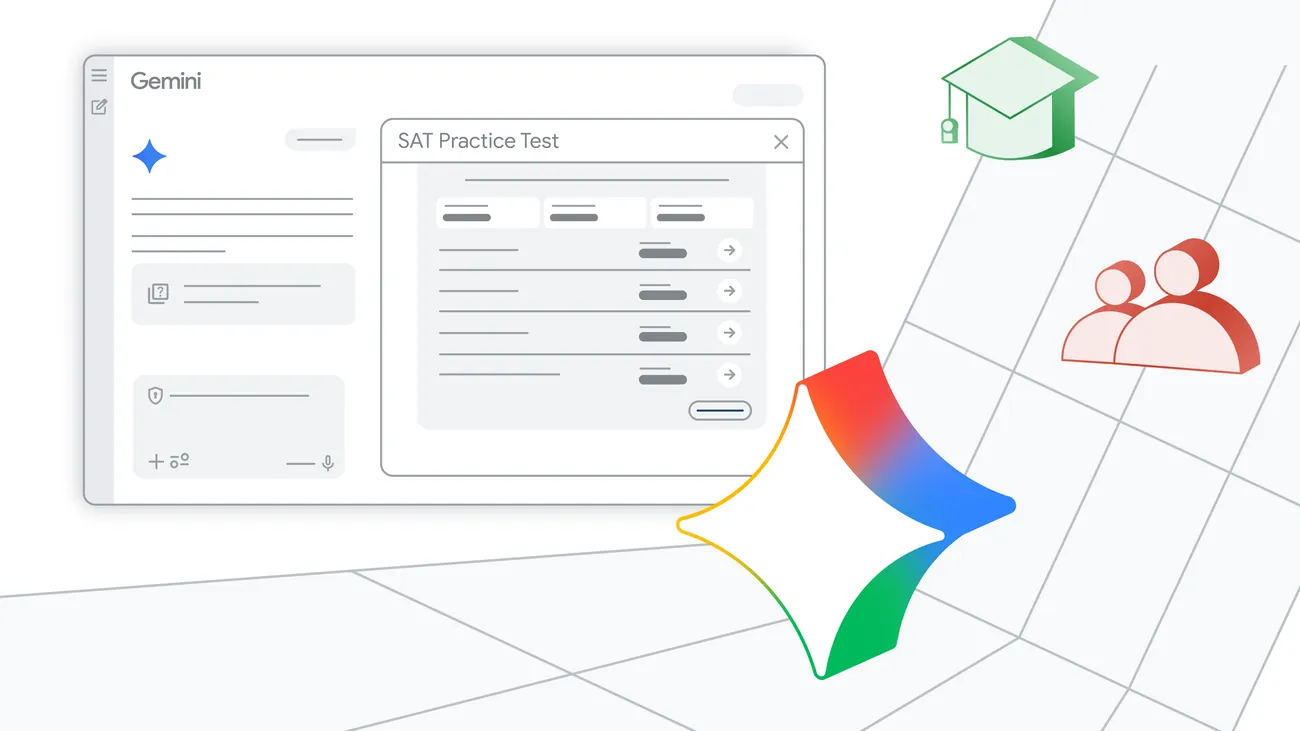
For a student who cannot pay for another prep platform, that is not a minor feature. Free full-length practice is useful. The catch is that, as of the January 2026 launch, the offer is SAT-only, and the practice tests still have to survive the same official-spec audit as anything else a student uses.
In my generated plan, Gemini did not make the worst documented SAT-practice mistakes directly inside the study calendar. It did not tell the student to study imaginary numbers or logarithms. The issue was subtler: it treated the practice environment as a stable source of truth instead of telling the student to verify every full-length test against official materials and to prioritize official Bluebook tests for benchmarking. That is where a student can get hurt. The calendar is not obviously wrong, so the student follows it.
Why Gemini’s SAT practice-test record changes the planning standard
The most concrete outside evidence in this comparison is not a vague complaint that “AI hallucinates.” It is the Gemini SAT practice-test error catalog reported by test-prep reviewers after Google’s January 2026 SAT-only launch.
Private Prep reported off-syllabus math appearing in Gemini SAT practice, including imaginary numbers, logarithms, and law of cosines; unsolvable questions caused by typos; Reading and Writing question-type ordering problems; modules with no rhetorical synthesis questions; over-represented literary passages; and inverted Module 2 difficulty. [4] ArborBridge’s review also flagged issues in the Gemini-powered SAT tests, including content and difficulty concerns. [5] MentoMind separately described SAT practice-test problems and reported a session-bound progress-loss case in which a tester signed out with two questions left and lost the test. [6]
Those are not cosmetic defects. Off-syllabus math changes what a student thinks they need to learn. A distorted Reading and Writing mix changes what they think they are weak at. An inverted module difficulty pattern can scramble score interpretation. Progress loss near the end of a test is not just annoying; it destroys the review trail.
MentoMind went further and recommended that students targeting 1400+ avoid relying on Gemini SAT prep. [6] I would treat that as MentoMind’s recommendation, not as a universal measured cutoff. The safer, narrower conclusion is enough: Gemini’s free SAT practice access is valuable, but it should not be promoted from “extra practice source” to “official benchmark” without verification.
This is also why the answer to “which AI should build my study plan?” changes by exam. If you are using Gemini for SAT planning in 2026, the free SAT-only offer matters. If you are using AI for GRE, MCAT, ACT, or ASVAB planning, that SAT practice-test advantage does not transfer. You are back to the same audit: official specs first, AI plan second.
The part both tools got right: structure
Both plans were organized enough to fool a tired student. They had phases. They had weekly targets. They had practice tests. They had review language. That is why structure is a weak differentiator.
A Mac Power Users forum test found that three chatbots given the same study-plan prompt each produced coherent multi-phase plans. [7] That test was about learning AI generally, not standardized-exam prep, so it should not be overread. But it supports the narrow point that matters here: modern chatbots can make a plan look orderly. Order is the starting line, not the quality check.
The hard part is not getting a six- or eight-week table. The hard part is deciding what gets cut when a full-length practice test consumes the weekend, what gets repeated when the same algebra error appears three times, and what gets ignored because it is not on the exam. That is where both first drafts needed human correction.
The hands-on reviews do not support one universal winner
Outside study-mode comparisons are genuinely mixed. MakeUseOf preferred ChatGPT’s Study Mode and found Gemini’s Guided Learning easier to derail. [8] Lifehacker found Gemini more rewarding for math work. [9] Cybernews preferred ChatGPT’s conversational feel while praising Gemini’s visuals. [10]
That conflict is more useful than a fake winner. Study planning is not one task. It includes researching the exam, building the first calendar, checking the calendar, generating drills, reviewing missed questions, explaining solutions, and revising the next week. A model can be strong in one part and careless in another.
In this test, ChatGPT’s advantage was not that its first plan was correct. It was that the plan invited revision. It was easier to say, “No, reduce content review, add two retrieval blocks, and rebuild around my missed advanced math questions,” and get something closer to usable. Gemini’s advantage was not that its first calendar was safer. It was that, for SAT students specifically as of the January 2026 launch, it sits near a free practice-test pathway that many students will reasonably want to use.

What I would change before following either plan
The first correction is to make official practice the measurement system. For the SAT, that means using official Bluebook practice tests as the score benchmark and treating third-party or AI-generated practice as supplemental. If you are deciding where Gemini’s free SAT tests fit, compare them with the official-test backbone covered in our guide to free SAT practice tests in 2026.
The second correction is to move from topic coverage to score-gap planning. The prompt already named the score gap and weak areas, but both models still tried to cover too much. A better version starts with the last diagnostic and asks: which question types are costing the most points, which are fixable in the remaining weeks, and which need repeated retrieval rather than another lesson? That is the planning logic behind the SAT score-gap method.
The third correction is to make review visible on the calendar. “Review mistakes” is not a task; it is a container. Inside it are slower actions: re-solving without notes, writing the reason for the miss, finding the tested skill, making one retrieval prompt, and scheduling a second attempt. If those actions do not fit, the plan is pretending.
The fourth correction is to cap new content during practice-test weeks. With 8 hours available, a full-length test week should usually be a measurement-and-repair week, not a “learn three new domains too” week. This is the same retention problem that shows up in ordinary school routines: spacing and retrieval have to be scheduled, not admired. For a broader version of that mechanic, see what a back-to-school study routine actually needs.
The task-scoped verdict
Use ChatGPT when the immediate danger is getting stuck with a static plan. It is better suited to iterative refinement: rebuilding next week from an error log, generating short quizzes, explaining a missed solution step by step, and turning a vague weakness into practice prompts. Do not let it infer mastery just because the conversation went smoothly.
Use Gemini when the immediate danger is poor grounding or lack of affordable SAT practice access. Its January 2026 SAT-only offer is genuinely useful for students who need free practice options, and Gemini can be helpful for organizing research around official requirements. Do not let the existence of a polished practice environment replace official-test verification, especially given the documented SAT practice-test issues.
For more AI head-to-head testing in the same exam-first style, the closest comparison on this site is our Grok vs. Copilot exam-prep test. For a deeper single-tool audit of Gemini in exam prep, see Does Gemini AI Actually Work for Exam Prep?.
The verification checklist before you follow either plan
- Open the official exam page or official practice platform first. Check sections, timing, allowed tools, tested domains, scoring, and official practice availability before accepting any AI schedule.
- Mark every AI-recommended topic as official, supplemental, or suspicious. If a topic is not clearly on the exam, do not give it calendar time until verified.
- Replace balanced weekly coverage with score-gap coverage. Your weak, high-value areas should get more time than topics you already handle well.
- Budget full-length practice honestly. Include test time, break time, review time, and a repair block. If that exceeds the week’s hours, cut new content.
- Require an error-log loop: miss, reason, tested skill, redo date, related drill, second attempt. If the plan only says “review mistakes,” rewrite it.
- Schedule retrieval and spaced review as named sessions. Do not rely on rereading, watching explanations, or “going over notes” as the main retention method.
- Use AI-generated quizzes as drills, not as score evidence. Official or officially aligned practice should carry the benchmarking weight.
- Re-audit the plan after every full-length test. A plan that does not change after new evidence is just a calendar.
References
- Practice SAT with Gemini, Google Blog, Jan. 21, 2026.
- Putting ChatGPT’s Study Mode Through Its Paces, Edutopia.
- ChatGPT study mode, OpenAI.
- The Scoop on Gemini SAT Practice Tests, Private Prep.
- The Lowdown on Gemini-Powered SAT Practice Tests, ArborBridge.
- Gemini SAT Prep Review, MentoMind.
- I asked three AI chatbots for an AI study plan. Here’s what I got, MPU Talk.
- ChatGPT vs. Gemini Study Mode, MakeUseOf.
- I Tested ChatGPT and Gemini Study Modes, Lifehacker.
- Gemini Guided Learning vs ChatGPT Study Mode, Cybernews.
Authoritative source
For the authoritative version of this contentHow to Read the '1 in 4 NFL Players CTE' Study
Report an error in this tool's output
Found something this tool got wrong beyond what's documented above? Report it so the accuracy log stays current.
Comments
Join the discussion with an anonymous comment.