
Study Buddy App Landscape: 10+ Apps Compared by Accountability Style, Price, and Best-Fit Student Persona
Confused by the mix of video body-doubling, gamified timers, community drop-in rooms, and AI study companions? This guide breaks down over 10 study buddy apps into four distinct categories, compares them by price and accountability style, and helps you choose the right app based on your personality, budget, and study goals.
Updated:
Why Studying Alone Is So Hard (And What the Science Says About Accountability)
You sit down to study. You open your notes. Then you check your phone. Then you check it again. Then you realize 45 minutes have passed and you have read the same paragraph four times. This is not a personal failing — it is a well-documented psychological reality. Studying alone removes the social pressure that keeps most people on task, and without that pressure, the brain defaults to seeking immediate rewards.
The research on accountability is striking. A study from Stanford found that students who worked with a virtual accountability partner spent 87% more time actually studying compared to those who studied alone. Researchers at Michigan State observed similar effects: students using accountability tools sustained focus for 34% longer sessions, reduced phone checking by 42%, and scored 28% higher on tests. These numbers are not marginal — they represent the difference between a C and an A for many students.
The challenge is that "accountability" means different things to different students. For some, it means a live person watching them work. For others, it means a virtual room full of silent strangers. For still others, it means a tree that dies if they touch their phone. And for a growing number, it means an AI that asks how their study session went. The study buddy app market has fragmented into four distinct categories, each built around a different psychological mechanism.
The Four Types of Study Buddy Apps: Which Accountability Style Fits You?
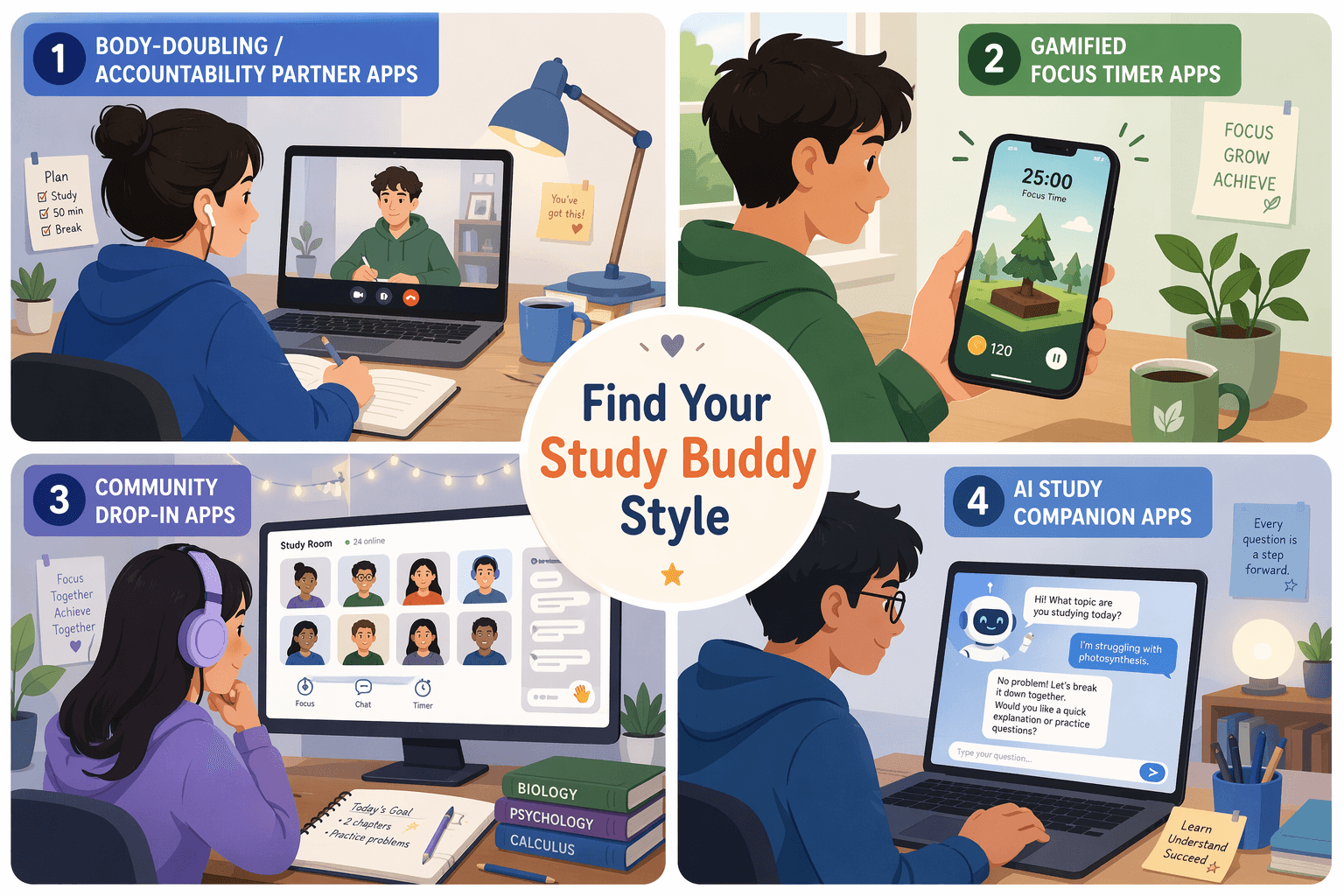
Every study buddy app solves the same core problem — keeping you focused — but they do it through fundamentally different mechanisms. The right choice depends on your personality, your budget, and whether you need real-time human presence or a structured habit-building system. Here are the four categories at a glance:
- Video Body-Doubling Apps: Live 1:1 video sessions where another person works alongside you. Maximum external accountability. Best for students who cannot self-motivate and need someone watching.
- Community Drop-In Rooms: Large, 24/7 virtual study rooms where you join silently or with optional camera/mic. Ambient social presence without the pressure of scheduling. Best for students who want company without commitment.
- Gamified Solo + Social Apps: Focus timers with game mechanics (growing trees, RPG character progression) and optional friend leaderboards. Best for self-motivated students who need a fun, low-pressure structure.
- AI Study Companions: Chat-based AI that quizzes you, explains concepts, and checks in on your progress. Best for students who want on-demand help and habit reminders without human interaction.
The sections below break down each category in detail, including specific apps, pricing, and the type of student each one serves best.
Category 1: Video Body-Doubling Apps (Focusmate, Coworking Cafe)
Body doubling is the most direct form of accountability: you and another person agree to work at the same time, on camera, without talking. The psychological mechanism is simple — the mere presence of another person working triggers social facilitation, making it harder to procrastinate. For students who struggle with self-discipline, this is the most effective category.
Focusmate
Focusmate is the gold standard in this category. It matches you with a random partner for a 50-minute video session. You state your goal at the start, work silently, and check in at the end. The platform has a 4.8/5 rating and a large enough user base that you can find a session at almost any hour.
Pricing as of Q2 2026: a free tier gives you 3 sessions per week. The Plus tier, which offers unlimited sessions, costs $8/month billed annually or $12/month billed monthly. This is a price increase from earlier reports of $5/month, so check the official Focusmate pricing page before subscribing.
Coworking Cafe
Coworking Cafe offers a similar 1:1 video body-doubling experience but at a higher price point: $25/month. It has a 4.0/5 rating and includes features like session scheduling and focus tracking. For most students, Focusmate offers better value, but Coworking Cafe may appeal to those who want a more polished interface or prefer its specific session format.
| Feature | Focusmate | Coworking Cafe |
|---|---|---|
| Price (unlimited) | $8/mo (annual) / $12/mo (monthly) | $25/mo |
| Free tier | 3 sessions/week | None |
| Session length | 50 minutes | Flexible |
| Rating | 4.8/5 | 4.0/5 |
| Best for | Students needing maximum accountability | Students who prefer a polished interface |
The main limitation of this category is that it requires scheduling and a camera. If you are camera-shy or cannot commit to specific session times, body-doubling apps may feel more like a chore than a solution.
Category 2: Community Drop-In Rooms (Study Together Discord, Studiosity, YPT)
Community drop-in rooms offer the social facilitation effect without the pressure of a 1:1 commitment. You join a large virtual room where dozens or hundreds of other students are studying silently. You can turn your camera on or off, use voice chat or not, and leave whenever you want. The ambient presence of other people working creates a subtle accountability that is enough for many students.
Study Together Discord
Study Together Discord is the most popular option in this category, with over 100,000 members and a 4.5/5 rating. It is 100% free and offers 24/7 study rooms with Pomodoro timers built in. You do not need a camera — you can join silently and just listen to the ambient noise of other people typing and turning pages. One user reported logging over 500 hours of study time through the platform.
Studiosity and YPT
Studiosity (free, 3.8/5 rating) offers a similar drop-in experience with a focus on connecting students studying similar subjects. YPT (free) is a time-tracking app with a built-in community feature where you can see how long others in your study group have been working. Both are solid options, but Study Together Discord has the largest active community and the most consistent availability of study rooms.
| App | Price | Camera Required? | Community Size | Rating |
|---|---|---|---|---|
| Study Together Discord | Free | No | 100k+ members | 4.5/5 |
| Studiosity | Free | No | Moderate | 3.8/5 |
| YPT | Free | No | Moderate | 4.0/5 |
Category 3: Gamified Solo + Social Apps (Forest, Habitica)
Gamified apps use game mechanics — points, levels, virtual rewards — to make focus itself the goal. They are ideal for students who are self-motivated but need a fun, low-pressure structure to stay on task. The accountability comes from the desire to maintain a streak or beat a personal record, not from another person watching.
Forest
Forest is the standout in this category. For a one-time payment of $3.99, you get a focus timer that grows a virtual tree while you work. If you leave the app to check social media, the tree dies. Over time, you build a forest that represents your accumulated focus time. It has a 4.3/5 rating and is widely considered the best value paid app for self-motivated students.
Forest also includes a social feature: you can plant trees with friends and see who stays focused the longest. This adds a competitive element that can be highly motivating for students who respond to leaderboards.
Habitica
Habitica takes a different approach: it turns your entire life into an RPG. You create a character, earn experience points for completing study sessions, and lose health for procrastinating. It is free to use and has a dedicated community. The RPG theme appeals to students who enjoy character progression, but the gamification can feel overwhelming if you just want a simple focus timer.
| App | Price | Mechanism | Social Features | Rating |
|---|---|---|---|---|
| Forest | $3.99 one-time | Virtual tree grows while you focus | Friend leaderboards | 4.3/5 |
| Habitica | Free | RPG character progression | Party quests with friends | 4.0/5 |
Category 4: AI Study Companions (ChatGPT, Pi, Character.AI, Replika)
AI study companions are the newest and fastest-growing category. These are chatbots designed to act as study partners — quizzing you on material, explaining concepts, and checking in on your progress. According to NotesXP, the global AI in education market hit $8.3 billion in 2025 and is growing at over 30% per year. The AI Companion Guides article, based on 6 weeks of testing across 7 platforms, found that AI companions "close about 60-70% of the gap" for students who cannot afford a human tutor, though they cannot fully replicate the study group effect.
ChatGPT Plus
ChatGPT Plus ($20/month) is the most capable AI companion for studying. It can explain complex topics, generate practice questions, and simulate a study partner. However, the AI Companion Guides testing revealed an 8% hallucination rate on specific historical dates and found that it fabricated a reaction mechanism during organic chemistry testing. This means you must verify any factual claims it makes, especially for high-stakes exams.
Pi, Character.AI, and Replika
Pi is completely free and designed to be a supportive, conversational companion. It is less capable than ChatGPT for deep subject matter explanations but excellent for daily check-ins and motivation. Character.AI offers a free tier and a $9.99/month premium tier; its standout feature is custom characters — for example, a "Professor Martinez" character that improved organic chemistry learning faster than textbook re-reading in testing. Replika, with a free tier and $5.83/month (annual) premium, showed a 23% increase in study hours during weeks with daily check-ins compared to weeks without.
| App | Price | Best For | Key Limitation |
|---|---|---|---|
| ChatGPT Plus | $20/mo | Deep subject explanations, practice questions | 8% hallucination rate on facts |
| Pi | Free | Daily motivation and check-ins | Limited subject depth |
| Character.AI | Free / $9.99/mo | Custom study characters for specific subjects | Variable character quality |
| Replika | Free / $5.83/mo (annual) | Habit building and emotional support | Not designed for deep subject tutoring |
Study Buddy App Comparison Matrix
The table below provides a side-by-side comparison of all the apps covered in this guide, organized by category. Use it to quickly narrow down your options before reading the detailed decision guide.
| App | Category | Price | Video Required? | Best For |
|---|---|---|---|---|
| Focusmate | Video Body-Doubling | Free (3/wk) / $8-12/mo | Yes | Maximum external accountability |
| Coworking Cafe | Video Body-Doubling | $25/mo | Yes | Polished 1:1 sessions |
| Study Together Discord | Community Drop-In | Free | No | Ambient social presence, 24/7 access |
| Studiosity | Community Drop-In | Free | No | Subject-specific study groups |
| YPT | Community Drop-In | Free | No | Time tracking with community |
| Forest | Gamified Solo+Social | $3.99 one-time | No | Self-motivated students, app blocking |
| Habitica | Gamified Solo+Social | Free | No | RPG fans, habit tracking |
| ChatGPT Plus | AI Companion | $20/mo | No | Deep subject explanations |
| Pi | AI Companion | Free | No | Daily motivation and check-ins |
| Character.AI | AI Companion | Free / $9.99/mo | No | Custom study characters |
| Replika | AI Companion | Free / $5.83/mo (annual) | No | Habit building and emotional support |
Which Study Buddy App Is Right for You? A Decision Guide by Student Type
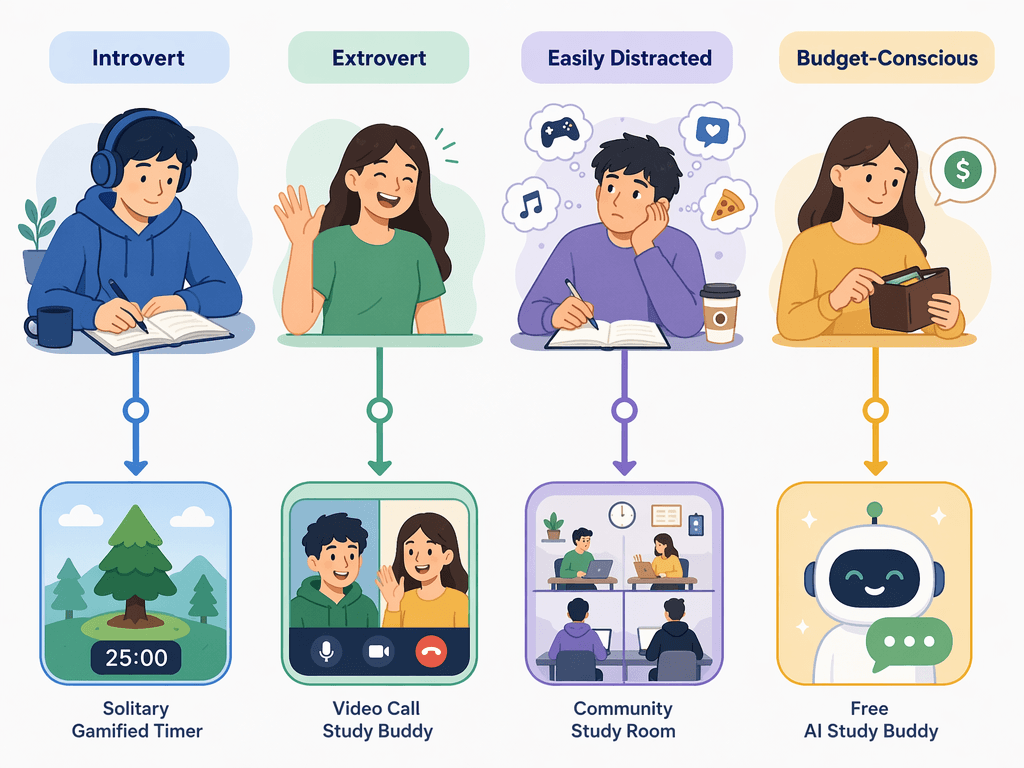
There is no single "best" study buddy app. The right choice depends entirely on your personality, your budget, and how much external structure you need. Use the guide below to find your match.
- The Introvert: If social interaction drains you, avoid video body-doubling apps. Start with AI companions like Pi (free) for daily check-ins or Forest ($3.99) for solo gamified focus. If you want human presence without interaction, Study Together Discord (free, no camera required) is a good middle ground.
- The Extrovert: If you thrive on social energy, Focusmate ($8-12/mo) or Coworking Cafe ($25/mo) will give you the direct human connection you need. You can also join Study Together Discord's voice channels for a more interactive experience.
- The Easily Distracted: If you cannot stay on task without external pressure, video body-doubling is your best bet. Focusmate's 50-minute sessions with a live partner provide the strongest accountability. Pair it with Forest's app-blocking feature to prevent phone distractions during the session.
- The Budget-Conscious: A completely free stack is possible: use Study Together Discord for ambient accountability, Pi for daily check-ins, and the free trial of Forest for app blocking. If you find you need more structure, upgrade to Focusmate's free tier (3 sessions/week) before committing to a paid plan.
For a deeper look at building a full toolkit tailored to your learning style, see our guide on Study Tools for Every Learning Style.
Free vs. Paid: Is It Worth Paying for a Study Buddy App?
The study buddy app market spans from completely free (Study Together Discord, Pi) to relatively expensive (Coworking Cafe at $25/month). The question is whether paying actually improves outcomes.
For many students, a free stack is genuinely effective. Study Together Discord provides ambient accountability at zero cost. Pi offers daily check-ins that can replace the habit-building role of a human study partner. The free tier of Focusmate gives you three sessions per week, which may be enough if you only need accountability for your most challenging study sessions.
However, paid options offer features that may justify the cost for students who need stronger accountability or AI-powered study help. Focusmate's unlimited tier ($8-12/month) removes the session cap, which matters if you study daily. ChatGPT Plus ($20/month) provides deep subject explanations that free AI companions cannot match. The key is to start with free tiers and upgrade only if you hit a clear limitation.
| Stack Type | Apps Included | Monthly Cost | Best For |
|---|---|---|---|
| Completely Free | Study Together Discord + Pi + Forest (free trial) | $0 | Budget-conscious students who need basic accountability |
| Free + Light Paid | Focusmate (free tier) + Pi + Forest ($3.99 one-time) | $0 + $3.99 one-time | Students who need occasional 1:1 sessions |
| Full Paid Stack | Focusmate (unlimited) + ChatGPT Plus + Forest | $23-32/mo | Students who need maximum accountability and AI tutoring |
For a proven minimalist free setup, read our guide on The 4 Free Apps That Actually Move Your Grades.
How to Stack Multiple Apps for the Best Results
The most effective approach is often to combine apps from different categories into a three-layer system. Each layer serves a different function, and together they create a complete study accountability system.
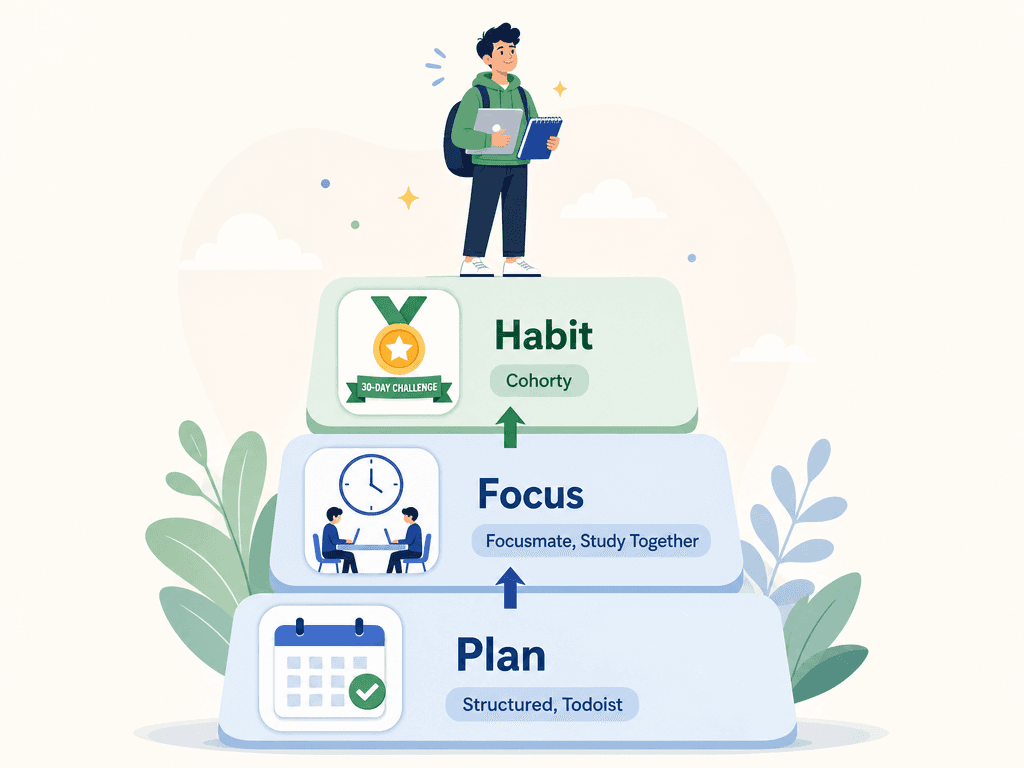
- Layer 1 — Planning: Use a scheduling app like Structured (free limited / $5/month premium) to block out your study sessions in advance. Knowing exactly when you will study removes the decision fatigue of "I'll study later." For a detailed guide on building an effective study schedule, see How to Build a Study Timetable That Actually Works.
- Layer 2 — Focus: During your scheduled study block, use a primary focus app. If you need maximum accountability, use Focusmate. If you want ambient presence, use Study Together Discord. If you prefer solo focus, use Forest. This is the core of your system.
- Layer 3 — Habit: Use a habit-building app like Cohorty (free) for 30-day challenges or Pi for daily check-ins. This layer ensures you maintain consistency over weeks and months, not just during individual sessions.
Students who stack all three layers report the strongest results. The key is to avoid downloading too many apps within a single layer — you do not need three focus apps. Pick one per layer and commit to using it for at least two weeks before evaluating.
For a broader strategy on reducing app clutter, read The Smart Study Stack, which explains how to build a 3-4 app system that outperforms having 14 apps.
Frequently Asked Questions About Study Buddy Apps
Can I use a study buddy app without a camera?
Yes. Community drop-in rooms like Study Together Discord do not require a camera. Gamified apps like Forest and Habitica do not use video at all. AI companions are text-based. Only video body-doubling apps like Focusmate and Coworking Cafe require a camera, and that is central to how they create accountability.
Are AI companions as good as real study partners?
No, but they are surprisingly close. The AI Companion Guides testing found that AI companions "close about 60-70% of the gap" for students who cannot afford a human tutor. They excel at providing on-demand explanations and daily check-ins, but they cannot replicate the social pressure of a live study partner or the collaborative problem-solving of a study group.
What is the best free study buddy app?
Study Together Discord is the best free option for most students. It has a large active community (100k+ members), requires no camera, and is available 24/7. For AI companions, Pi is the best free option for daily check-ins and motivation.
Can I use multiple study buddy apps at once?
Yes, and stacking apps from different categories is often the most effective approach. The three-layer system (planning app + focus app + habit app) is a proven framework. Just avoid stacking multiple apps within the same category — you do not need both Focusmate and Coworking Cafe.
How do I avoid getting distracted by the app itself?
This is a legitimate concern. The solution is to set up your app before your study session begins, then put your phone face-down or in another room. For desktop users, close all browser tabs except the study app. Forest's app-blocking feature is specifically designed to prevent this problem — it locks you out of distracting apps during a focus session.
For a deeper comparison of AI tools against traditional study methods, see AI Study Tools vs. Traditional Study Tools: What Actually Works in 2026. And for a detailed look at how AI can support active recall and spaced repetition, read our AI Study Tools Comparison.
Individual Tool Profiles
Related Comparisons
- Anki vs. Quizlet: Feature Matrix, Algorithm Explained, and Decision Guide for Students
A structured comparison of Anki and Quizlet for 2026 — covering the FSRS algorithm vs. session-based review, current pricing tiers and free-tier limits, AI card creation, and a five-persona decision guide so you can match the right tool to your actual study situation.
- Knowt vs. Quizlet vs. Anki: Which Free Flashcard Maker Should You Use in 2026?
If you already have Quizlet sets and are looking for a free alternative, this comparison helps you choose between Knowt (easy import, free study modes) and Anki (powerful spaced repetition, no AI). We break down the trade-offs so you can pick the right tool for your study style.
- Anki vs Quizlet: The Hidden Failure Modes of Each Tool (The Anki Trap vs The Quizlet Ceiling)
Anki and Quizlet each have a hidden failure mode. Anki users burn out on review debt and over-customization, while Quizlet users hit a retention ceiling because the app doesn't enforce proper spacing. This article explains both patterns, grounds them in research, and offers a practical decision framework to help you choose the right tool and build a sustainable study workflow.
Comments
Join the discussion with an anonymous comment.