
Anki vs Quizlet: The Hidden Failure Modes of Each Tool (The Anki Trap vs The Quizlet Ceiling)
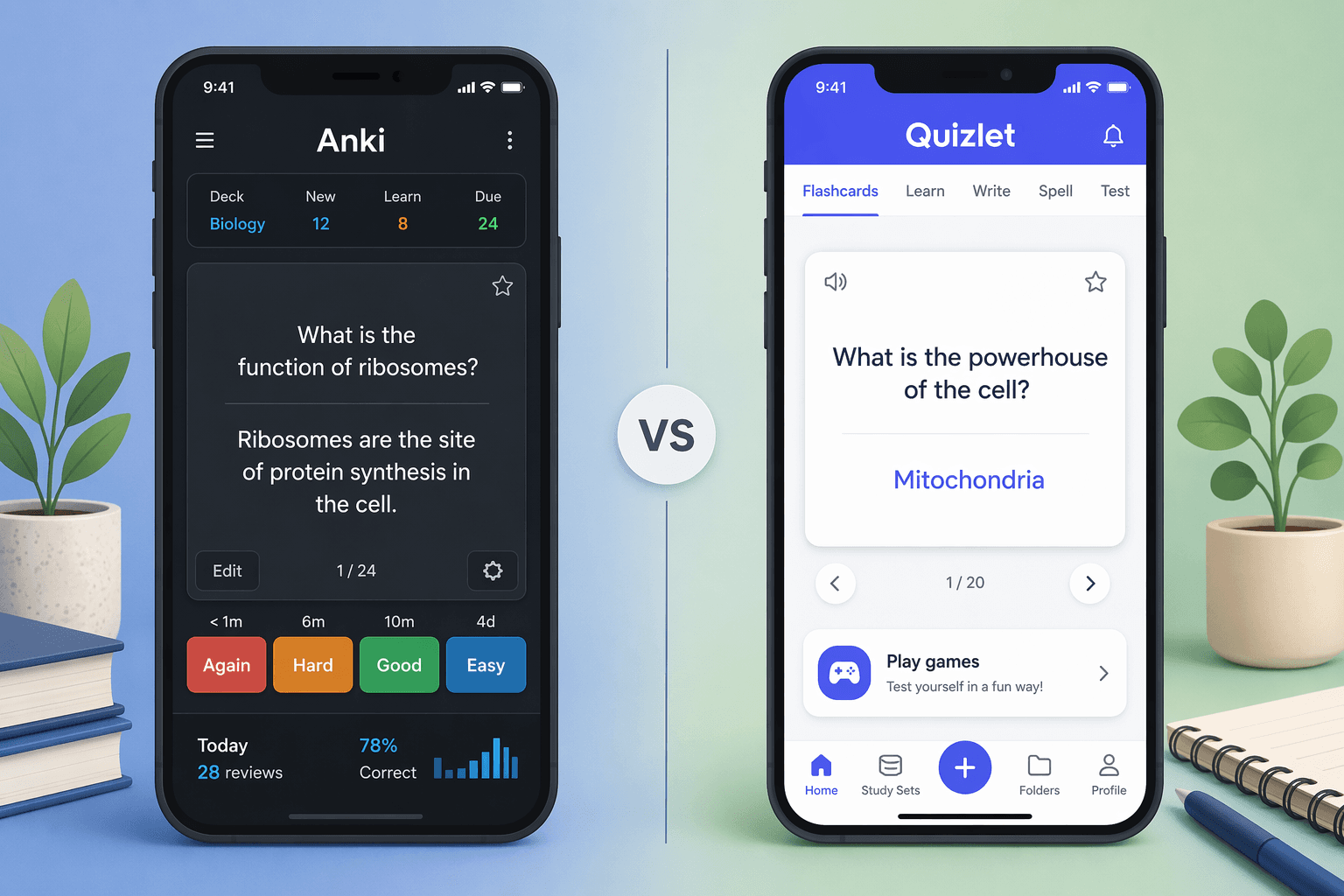
Anki and Quizlet each have a hidden failure mode. Anki users burn out on review debt and over-customization, while Quizlet users hit a retention ceiling because the app doesn't enforce proper spacing. This article explains both patterns, grounds them in research, and offers a practical decision framework to help you choose the right tool and build a sustainable study workflow.
Updated:
Introduction: Two Tools, Two Hidden Problems
If you've been searching for the perfect flashcard app, you've likely heard the standard advice: Anki for serious long-term retention, Quizlet for quick and easy studying. But what nobody tells you is that both tools have a hidden failure mode that can sabotage your progress — and most students don't see it coming until it's too late.
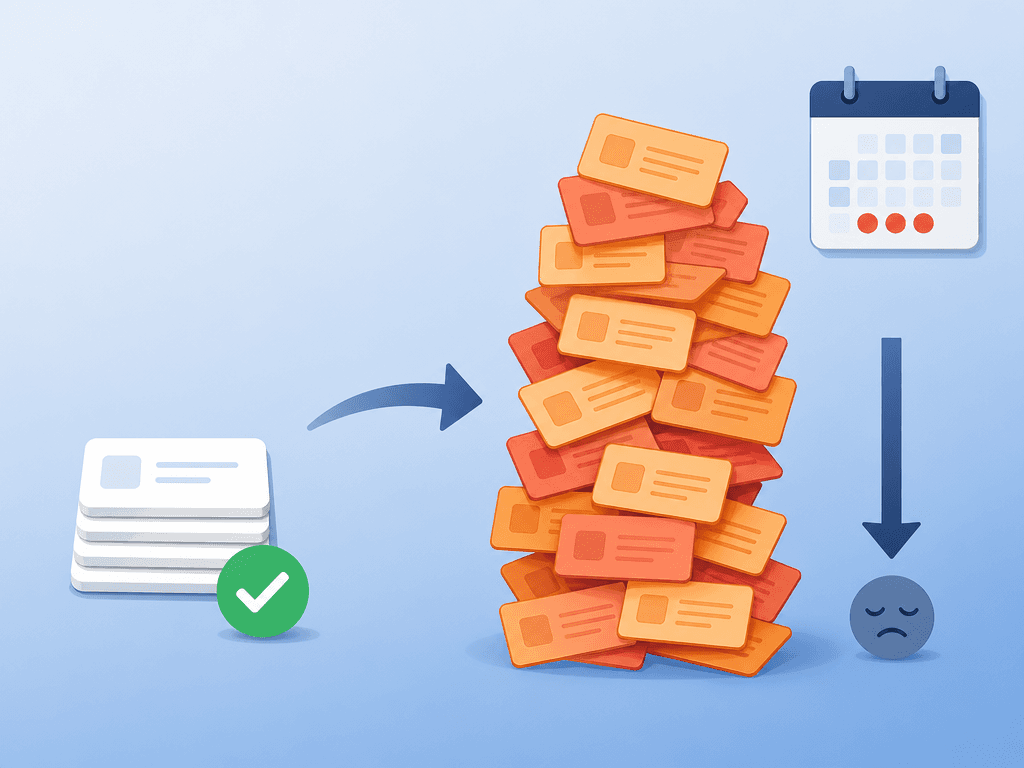
On one side, there's the Anki Trap: you invest hours building the perfect deck, only to be buried under a mountain of review debt after missing a few days. The anxiety of seeing 500+ cards waiting for you becomes a psychological barrier that pushes you to abandon the tool entirely.
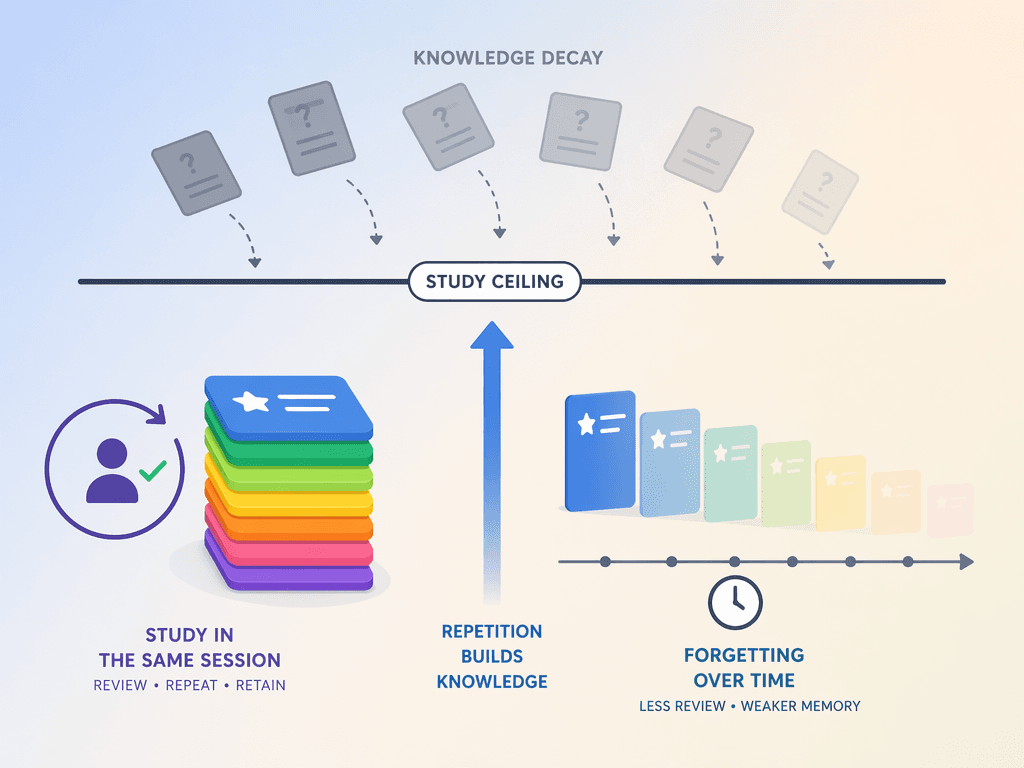
On the other side, there's the Quizlet Ceiling: you feel productive running through a set of flashcards in Learn mode, but because the app doesn't schedule reviews across days or weeks, most of that knowledge fades within days. You're studying hard, but you're not retaining.
The core thesis of this article is simple: understanding which failure mode you're more likely to encounter is the key to choosing the right tool — and building a study workflow that actually lasts.
The Anki Trap: When the Best SRS Tool Becomes a Burden
Anki's spaced repetition system (SRS) is widely considered the gold standard for long-term memorization. Surveys consistently show that 50-70% of medical students use Anki as their primary flashcard tool for high-stakes exams like the USMLE Step 1. Its FSRS algorithm, which became the default in 2023, uses machine learning to model individual memory patterns, and independent benchmarks suggest it can reduce required reviews by 20-30% compared to the older SM-2 algorithm at the same retention rate.
But this algorithmic power comes with a hidden cost: the system's very effectiveness creates a psychological burden that drives many users away.
The Psychology of Review Debt
Unlike Quizlet, where a missed day means nothing, Anki's algorithm faithfully tracks every card you were supposed to review. Miss three days of reviews, and you can easily face 500+ cards waiting for you. This isn't a technical problem — it's a psychological one. The sheer volume creates what some have called a 'wall of anxiety' that makes users feel like they've failed, leading them to abandon the tool entirely rather than face the backlog.
This pattern is backed by data. A 2023 pilot study by Levy et al. at the Kirk Kerkorian School of Medicine (N=45) examined Anki usage patterns among first-year medical students. The results were striking:
| Usage Group | Average Exam Score | Key Finding |
|---|---|---|
| Heavy/Intermediate Users | 90.34% / 91.74% | Consistent daily use correlates with top performance |
| Limited-Anki Users | 87.75% | Used Anki sparingly but consistently |
| Light Anki Users | 85.86% | Used Anki <50% of study days — scored lowest |
The study also found that heavy Anki users spent 73.86% of their total study time on Anki, compared to just 36.53% for limited-Anki users (p<0.001). This suggests that when students commit to Anki, they tend to go all-in — which makes the fall from consistency even more punishing.
When Memorization Becomes a Substitute for Understanding
Another dimension of the Anki Trap is the risk of treating memorization as understanding. Because Anki is so effective at drilling individual facts, it's easy to fall into the habit of memorizing the shape of a sentence or the pattern of a card rather than truly understanding the underlying concept. This is especially dangerous for subjects that require deep comprehension, like physiology or organic chemistry.
Students who fall into this trap end up with a deck full of cards they can 'pass' in a review session but cannot apply in a novel exam question. The tool becomes a crutch rather than a learning accelerator.
The Quizlet Ceiling: Why Session-Based Studying Fails Long-Term
Quizlet's appeal is obvious: it's fast, it's beautiful, and it makes studying feel like a game. With over 60 million monthly active users and 600 million+ total learners, it's by far the most popular flashcard platform in the world. Its AI features like Q-Chat and Magic Notes make card creation faster than ever, and its library of 800 million+ shared sets means you rarely have to create from scratch.
But there's a fundamental problem: Quizlet's Learn mode operates within single sessions and doesn't schedule reviews across days or weeks. In 2020, Quizlet removed its Long Term Learning mode — the feature that provided spaced repetition — leaving users with a system that feels productive but doesn't build durable long-term memory.
The False Sense of Productivity
Here's how the Quizlet Ceiling works in practice: you spend 30 minutes running through a set of 50 terms in Learn mode. You get most of them right. You feel good. You close the app, confident that you've studied.
But three days later, you've forgotten 70% of what you 'learned.' This isn't a personal failing — it's how memory works. The Ebbinghaus forgetting curve, first described in 1885, shows that approximately 70% of new information is lost within 24 hours without review. Without a system that schedules reviews at the right intervals, that curve applies to every Quizlet session.
The research is clear on this point. Karpicke & Roediger's landmark 2008 study published in Science demonstrated that active recall improves long-term retention by up to 50% compared to passive re-reading — but only when the retrieval practice is properly spaced. Active recall without spacing is like watering a plant once and expecting it to thrive.
What About Quizlet's AI Features?
Quizlet's recent AI additions — Q-Chat (an AI tutor that quizzes you on your sets) and Magic Notes (which converts your notes into flashcards) — are genuine time-savers for card creation. They make it faster to get content into the app. But they don't solve the fundamental retention problem. AI can help you create cards faster, but it can't schedule your reviews for you.
The Research Evidence: What the Science Actually Says
Before we talk about solutions, it's worth grounding this discussion in the cognitive science that explains why these failure modes exist. The research consistently points to two principles: spaced repetition and active recall.
| Study | Key Finding | Relevance to This Comparison |
|---|---|---|
| Cepeda et al. (2006) — Meta-analysis of 184 studies | Spaced practice produces 10-30% better retention than massed practice | Explains why Quizlet's session-based approach is fundamentally limited |
| Karpicke & Roediger (2008) — Science | Active recall improves long-term retention by up to 50% vs passive re-reading | Shows that retrieval practice is powerful — but only when spaced |
| Dunlosky et al. (2013) — Review of 10 techniques | Practice testing with spaced intervals ranked #1 most effective technique | Validates the Anki approach when used consistently |
| Levy et al. (2023) — Pilot study (N=45) | Light Anki users scored 85.86% vs limited-Anki users 87.75% | Suggests inconsistent Anki use may be worse than not using it at all |
| Upadhyay et al. (2021) — npj Science of Learning | ML-based spaced repetition retains info 69% longer than fixed schedules | Supports Anki's FSRS advantage over simpler algorithms |
The Dunlosky et al. 2013 review is particularly relevant. After evaluating 10 common study techniques, the researchers ranked practice testing with spaced intervals as the single most effective technique — above elaborative interrogation, self-explanation, and summarization. This is exactly what Anki does when used consistently, and exactly what Quizlet does not do.
Feature Comparison: Anki vs Quizlet at a Glance
| Dimension | Anki | Quizlet |
|---|---|---|
| Pricing | Free (desktop/Android/Web); $24.99 one-time (iOS) | $35.99/year (Plus); $44.99/year (Unlimited); free tier with ads and limits |
| SRS Algorithm | FSRS (ML-based, default since 2023); SM-2 available | None — session-based Learn mode; Long Term Learning removed in 2020 |
| AI Features | None built-in; community add-ons available | Q-Chat (AI tutor), Magic Notes (note-to-flashcard), AI quiz generation |
| Platform Support | Windows, macOS, Linux, Android, iOS, Web | Web, iOS, Android (no desktop app) |
| Offline Access | Full offline sync on all platforms | Limited offline on mobile (paid tiers) |
| Shared Content | Thousands of curated community decks (AnkiWeb) | 800M+ user-generated sets (less curated) |
| Customization | Extreme — card templates, add-ons, CSS, scheduling | Minimal — limited to text formatting and image embedding |
| Best For | Medical students, language learners, long-term exam prep | Casual learners, classroom use, quick shared review |
How to Escape the Trap or Break Through the Ceiling
The good news is that both failure modes are avoidable. The tool is not the problem — the workflow is. Here are practical fixes for users stuck in either pattern.
Escaping the Anki Trap
- Limit daily new cards to a sustainable number (e.g., 20-30 new cards per day, not 100). This prevents review debt from growing faster than you can handle.
- Use pre-made decks whenever possible. The AnKing deck for medical students and shared community decks for languages and other subjects are often better than anything you'd build yourself.
- Enable FSRS if it's not already active. Independent benchmarks suggest it reduces required reviews by 20-30% at the same retention rate, which directly reduces the psychological burden of review debt.
- Set a hard review cap (e.g., 200 reviews/day maximum). Cards that exceed the cap will carry over to the next day, preventing the backlog from becoming overwhelming.
- Build a weekly study schedule that includes dedicated Anki time. Consistency matters more than volume — the Levy et al. data suggests that moderate but consistent use outperforms heavy but inconsistent use.
Breaking Through the Quizlet Ceiling
- Use Quizlet for what it's good at: rapid card creation, shared sets for quick review, and initial exposure to new material. Its AI features (Q-Chat, Magic Notes) make this phase fast and efficient.
- Supplement with a spaced repetition tool for long-term retention. After your initial Quizlet session, export or recreate the most important cards in Anki (or another SRS tool) for proper spacing.
- Manually schedule weekly reviews if you're committed to staying in Quizlet. Set a recurring calendar reminder to revisit each set at increasing intervals (1 day, 3 days, 1 week, 2 weeks, 1 month). This is less convenient than an automated system but far better than single-session studying.
- Use Quizlet's Test mode periodically to check your actual retention, not just your familiarity with the set. If you're scoring well in Learn mode but poorly on a test taken a week later, you've hit the ceiling.
The Hybrid Solution: Using Both Tools in Different Phases of Learning
For many students, the best answer isn't choosing one tool — it's using both in different phases of the learning cycle. This hybrid approach acknowledges that each tool has genuine strengths that the other lacks.
Phase 1: Rapid Card Creation and Initial Exposure (Quizlet)
- Use Magic Notes or Q-Chat to quickly convert lecture notes or textbook material into flashcards. This is where Quizlet's AI features genuinely save time.
- Run through the set in Learn mode for initial exposure. This builds basic familiarity with the terms and concepts.
- Use Quizlet's Test or Match mode to reinforce the material within the same session.
Phase 2: Long-Term Spaced Retention (Anki)
- Export your Quizlet set or manually recreate the most important cards in Anki. Focus on the cards that test core concepts, not trivial details.
- Let Anki's FSRS algorithm handle the spacing. Set a sustainable daily review limit (e.g., 50-100 reviews/day) and stick to it.
- Use Anki's card templates to add images, cloze deletions, and other advanced formatting that makes cards more effective for long-term retention.
Community discussions among students who use this hybrid approach consistently report higher satisfaction than those who commit to either tool exclusively. The trade-off is that this requires more setup time — but for high-stakes exams like the MCAT, GRE, or USMLE, the retention improvement is worth the investment.
Decision Framework: Which Tool Should You Choose?
The right choice depends on your personal risk profile. Ask yourself: are you more likely to burn out on review debt (choose Quizlet or a hybrid approach) or hit a retention ceiling (choose Anki or supplement with manual spacing)?
| Persona | Best Tool | Why |
|---|---|---|
| Medical students (USMLE, MCAT) | Anki | 50-70% of medical students use Anki; the depth of pre-made decks (AnKing) and FSRS algorithm make it the standard for high-volume, long-term retention |
| Language learners | Anki | Custom card templates (audio, image, cloze) and community decks for specific languages; long-term retention is critical for vocabulary acquisition |
| Casual learners / high school students | Quizlet | Lower commitment, no review debt, gamified experience; ideal for short-term exam review and classroom use |
| Classroom use / group study | Quizlet | Shared sets are easy to distribute; game modes (Match, Gravity) work well for group review sessions |
| Budget-constrained students | Anki | Free on desktop, Android, and web; the $24.99 iOS fee is a one-time purchase vs Quizlet's $35.99-$44.99/year subscription |
| Students who struggle with consistency | Quizlet or Hybrid | If you know you'll miss days, Anki's review debt will punish you. Use Quizlet for initial exposure and a lightweight SRS tool for long-term retention |
The bottom line is this: both Anki and Quizlet are powerful tools, but they're not interchangeable. Anki is a long-term memory system that requires consistency and discipline. Quizlet is a short-term study aid that's fast and accessible but won't build durable retention on its own. The students who succeed are the ones who understand these trade-offs and build a workflow that matches their study habits — not the ones who chase the 'best' tool without understanding its hidden failure mode.
Individual Tool Profiles
Related Comparisons
- OneNote vs. GoodNotes for Students: Which Note-Taking App Is Right for You?
A head-to-head comparison of Microsoft OneNote and GoodNotes 6 for college and high school students, covering pricing, handwriting quality, PDF annotation, AI features, and platform support — with a concrete best-for decision guide by student persona to help you choose the right tool before you commit.
- Anki vs. Quizlet: Which Flashcard App Is Right for You?
Anki and Quizlet take fundamentally different approaches to flashcard learning — one built for long-term retention through true spaced repetition, the other for accessible, low-friction study. This comparison breaks down their algorithms, pricing, study modes, and honest limitations so you can choose the right tool for your situation.
- Quizlet vs Knowt: Which Free Plan Is Better for Students?
Budget-conscious students comparing Quizlet and Knowt need to know which platform offers the most free features. This head-to-head comparison reveals how Knowt's generous free tier outpaces Quizlet's restricted free plan, with unlimited flashcards, free study modes, and a seamless import tool.
Comments
Join the discussion with an anonymous comment.