
What a New Study of World Cup Halftime Music Reveals
A 2026 academic study on FIFA World Cup theme songs reveals that they promote a utopian vision of global unity while systematically silencing political and social realities. This article breaks down the study's key findings on cultural appropriation, commercial censorship, and human rights contradictions.
Updated:
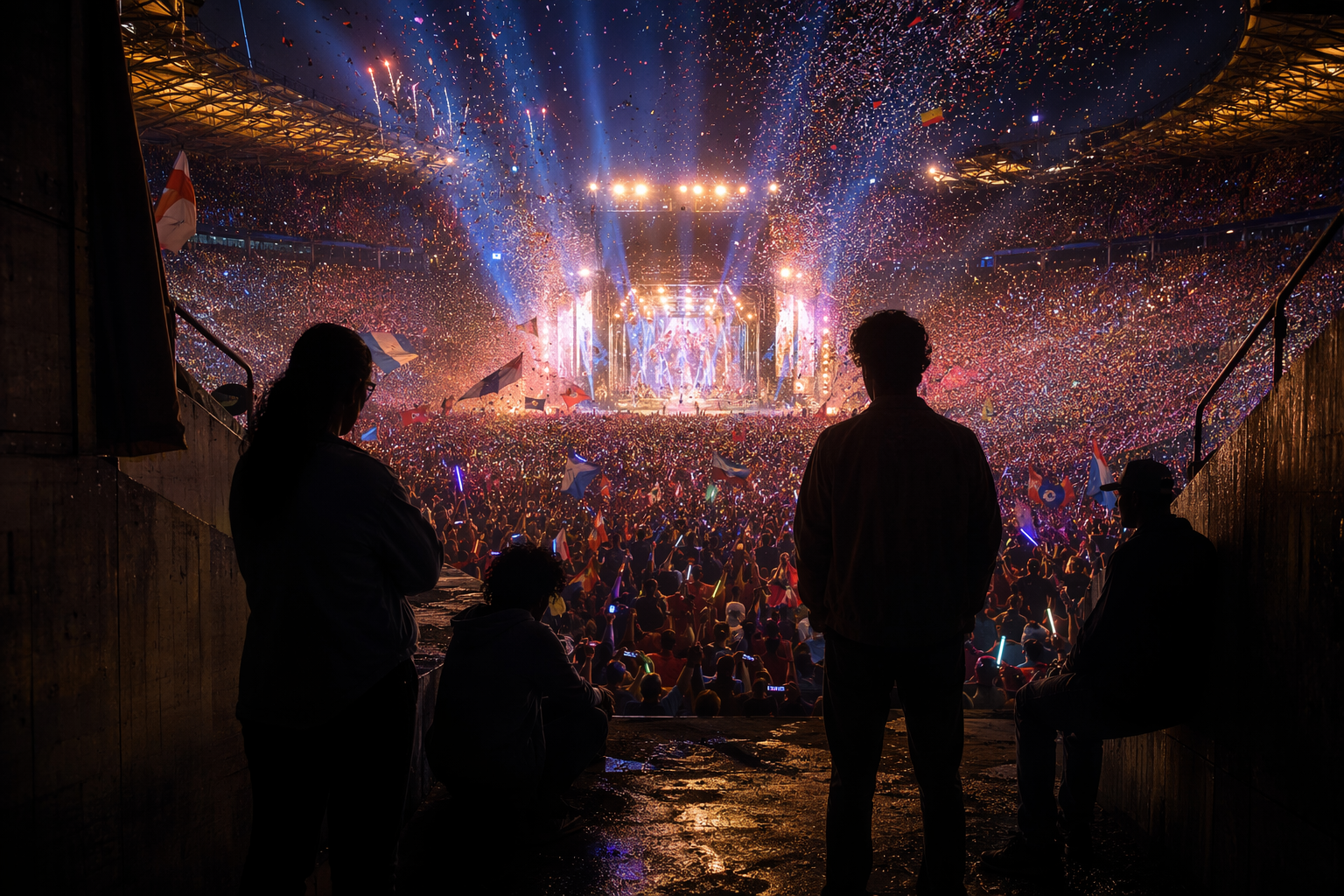
Calling a World Cup song “silent” sounds almost perverse. These songs are built to be unavoidable: choruses shouted in fan zones, clips repeated in broadcast packages, hooks designed to survive language barriers and weak hotel Wi-Fi. Yet that is the point of Laker’s 2026 study of FIFA World Cup theme songs. The paper calls this contradiction “loud silence”: the songs loudly perform a euphoric dream of global unity while leaving inequality, rights abuses, and cultural extraction outside the singalong.[1]
That makes the study useful for thinking about World Cup halftime music, but with one important boundary. Laker’s peer-reviewed article, published in March 2026 in Soccer & Society, examines FIFA World Cup theme songs and anthems from 1962 through 2026.[1] It is not a post-event analysis of the July 19, 2026 halftime show. The better use of the paper is as a framework: when the tournament asks pop music to stand for the world, what version of “the world” is being made audible, and what has to disappear for the chorus to feel universal?
What the Study Actually Examines
Laker’s article is presented as the first peer-reviewed academic study devoted to FIFA World Cup theme songs.[1] Its archive runs across more than six decades, from 1962 through 2026, and it treats official songs not as decorative extras but as cultural texts attached to one of the most commercially powerful sporting events on the planet.[1]
The study’s central finding is historical. Before 1994, World Cup songs tended to be more directly attached to football itself: the match, the crowd, the nation, the tournament. After 1994, the language shifts toward more universal human values: dreams, togetherness, celebration, hope, and unity.[1] That does not mean the newer songs are meaningless. It means their meanings travel better. A lyric about “football” points to an event; a lyric about “dreaming together” can be sold as a feeling.
This is where the study gets more interesting than the familiar complaint that global pop is commercial. Laker argues that these songs perform a “liberal international utopia,” a world imagined through cheerful cooperation, multicultural visibility, and affective consensus.[1] The songs do not usually deny conflict. They simply make conflict hard to hear. The result is not silence in the literal sense, but a silence produced by volume, repetition, and pleasure.
The Turn From Football Songs to Universal Feeling
The post-1994 shift matters because it changes what the song is asked to do. A football-focused anthem can intensify an event already happening on the pitch. A universal-values anthem can help FIFA and its commercial partners frame the tournament as proof that global togetherness is not only possible but already present. The crowd becomes evidence. The hook becomes atmosphere. The broadcast turns affect into scale.
UCLA’s discussion of World Cup music makes a similar point in more public-facing terms: music and performance have become part of the event’s draw, not merely entertainment wrapped around sport.[2] That evolution helps explain why the songs deserve academic attention. They are not background noise to the tournament. They are one of the ways the tournament tells viewers what kind of global event they are watching.
The Columbia Chronicle’s coverage of why some World Cup songs last beyond the final whistle also helps clarify the stakes.[3] A song that outlives the tournament keeps carrying the event’s preferred emotions after the trophy presentation has ended. When people remember the summer through a chorus, they may also remember a polished version of the host nation, the sponsor ecosystem, and the tournament’s promised community.
| Period | Dominant lyrical tendency | Political effect |
|---|---|---|
| Pre-1994 World Cup songs | More directly football-focused language | The song points listeners back toward the match and tournament |
| Post-1994 World Cup songs | More universal language about dreams, unity, hope, and shared humanity | The song helps transform the tournament into a global moral mood |
The distinction is not between honest old songs and cynical new ones. Older World Cup music could also flatter institutions and nations. The important change is the scale of the claim. Once the song promises the world to itself, it has to smooth over a great deal to keep the promise singable.
“Waka Waka” and the Problem of Borrowed Joy
Shakira’s “Waka Waka (This Time for Africa),” attached to the 2010 World Cup in South Africa, is one of the study’s clearest examples because the song’s pleasure is not incidental to the problem. Its chorus is memorable, bodily, and communal. It works exactly the way a tournament anthem is supposed to work: by making participation feel easy. You do not need to know the politics of FIFA, South African history, or global cultural markets to join in.
Laker’s analysis focuses on cultural appropriation, connecting “Waka Waka” to music associated with the Cameroonian group Golden Sounds.[1] That source history complicates the song’s official fantasy of pan-African celebration. The problem is not that a global pop star touched African musical material; popular music has always moved through borrowing, quotation, and translation. The sharper issue is what happens when a place-specific cultural source becomes raw material for a FIFA-ready symbol of “Africa” as mood.
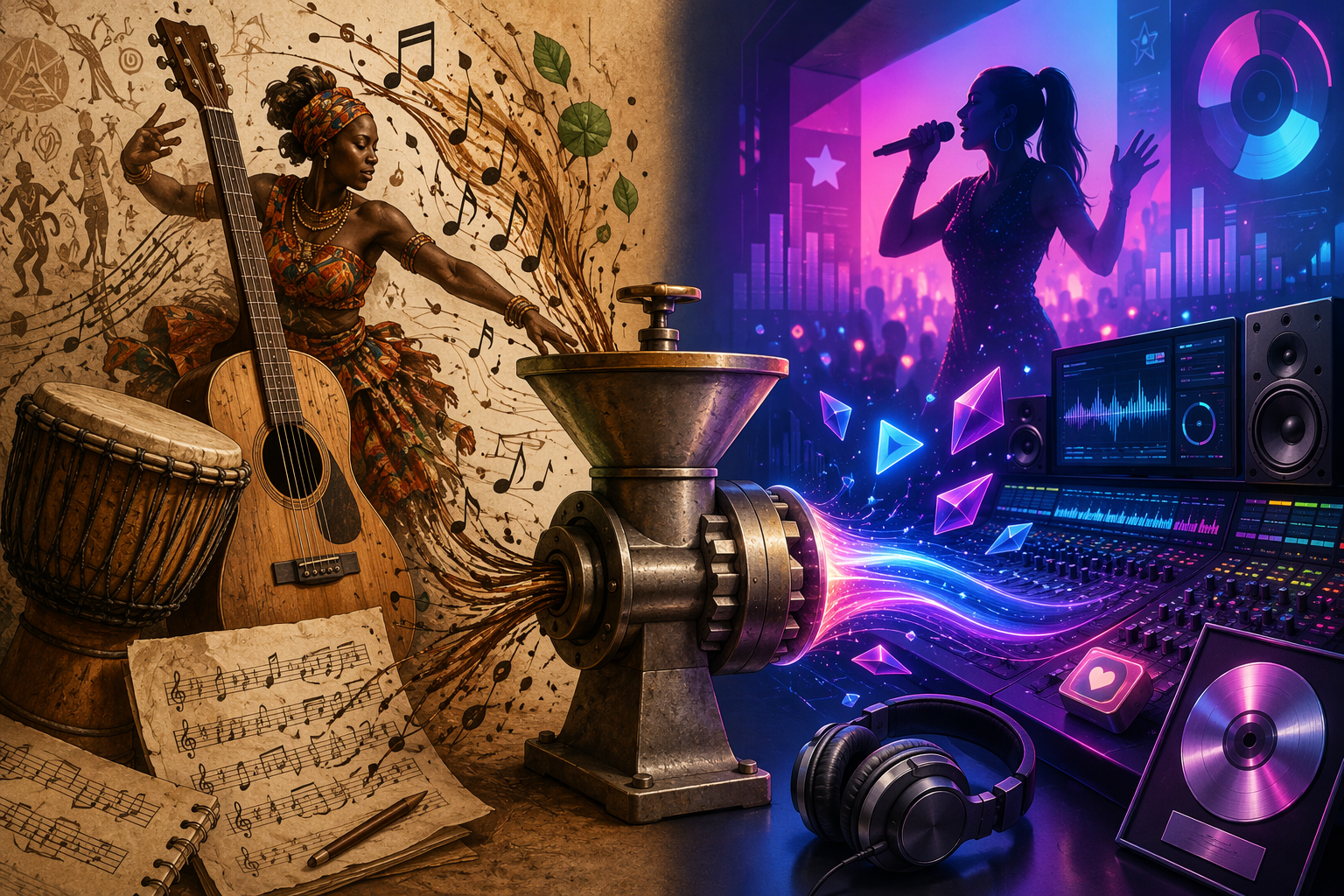
In that transformation, the song gains portability. It can circulate through stadiums, commercials, opening packages, playlists, and classroom memory. But portability has a cost. The more easily the sound stands for continental celebration, the less pressure there is to ask whose musical labor made that feeling available, who received recognition, and how much historical specificity was traded for an instantly legible global smile.
This is also why sneering at the song’s fans misses the point. The chorus is not effective because listeners are foolish. It is effective because it offers a real sensory pleasure while organizing that pleasure around a simplified cultural image. The political work happens through enjoyment, not despite it.
“Wavin’ Flag” and Commercial Neutralization
K’naan’s “Wavin’ Flag” gives the study a different mechanism. Here the issue is not only where the music comes from, but what happens to lyrical meaning when a song is prepared for a corporate-tournament environment. Laker identifies the Coca-Cola version as a case in which lyrics were stripped for commercial neutrality.[1]
That phrase, “commercial neutrality,” is worth sitting with. It does not mean the song becomes apolitical. It means the politics become safer for circulation. Rough edges are softened. Specific histories are thinned. The song is made more compatible with advertising, broadcast repetition, and a global audience that is invited to feel uplifted without being asked to sit with the conditions that made the original voice politically charged.
For students of media and music industries, this is the case that makes the production process visible. A tournament anthem is not just written; it is cleared, edited, branded, synchronized, localized, and repeated. Each step can expand a song’s reach while narrowing what the song is allowed to mean. By the time the chorus arrives as an international celebration, part of the labor has already been subtraction.
The result is not a fake emotion. People really do attach memories to songs like this. They remember who they watched with, which team they supported, how a city sounded during the tournament. The study’s point is colder and more useful: the institutions around the song can preserve the emotion while managing the politics.
“Dreamers” Beside the Qatar 2022 Rights Context
Jungkook’s “Dreamers,” performed in connection with Qatar 2022, brings Laker’s “euphoric utopia” framework into especially tense contact with host-nation realities. The song belongs to the World Cup’s post-1994 language of aspiration: dreaming, gathering, believing, moving together. In a stadium setting, those words do not merely describe feeling; they organize it.
Laker reads “Dreamers” against the migrant worker rights abuses surrounding Qatar 2022.[1] The contrast is not subtle, but it is also not solved by saying the performance should have been joyless. A World Cup ceremony depends on joy. The question is what kind of joy can be officially amplified while other realities remain outside the frame.
This case shows why “loud silence” is a more precise phrase than simple hypocrisy. A utopian song can be sincere in its affect and selective in its politics at the same time. The performance can produce genuine excitement for fans, pride for some viewers, and valuable visibility for artists, while also helping the event move attention away from labor conditions that made the spectacle possible.
In classroom terms, “Dreamers” is the case that keeps interpretation from becoming a game of decoding hidden messages. The politics are not hidden inside a lyric waiting to be exposed. They appear in the relation between lyric, stage, sponsor, host nation, labor, and broadcast context. The song says “dream.” The event decides which dream gets lights, cameras, and replay.
Why These Songs Last
Some World Cup songs vanish almost immediately; others become shorthand for an era. The Columbia Chronicle’s article on why certain songs last after the final whistle is useful here because durability is not only a musical question.[3] A lasting tournament song has usually attached itself to more than a match. It has attached itself to a remembered public feeling.
That public feeling is built through form. Repetition matters. So does multilingual accessibility, a chorus that can be shouted by people who do not share a first language, and production that reads as festive before anyone has parsed the lyrics. These are musical choices, but they are also political technologies. They help make a crowd appear as a temporary world community.
The study’s historical claim helps explain why memory so often favors the universalized songs. A track about the technical drama of football may date beautifully for fans of the tournament. A track about unity can detach from the fixture list and return whenever global sport wants to feel innocent again.
The 2026 Frame: Useful Pressure, Not Post-Event Evidence
Because Laker’s article was published before the July 19, 2026 halftime show, it cannot tell us what that specific performance did.[1] That boundary matters. A responsible reading should not pretend the study analyzed a show that had not yet happened. What it can do is give students and instructors a disciplined way to watch it.
The paper’s 2026 discussion identifies three political pressures around the tournament: Trump-era MAGA politics in the United States, Canada’s Indigenous reconciliation crisis, and Mexico’s homophobia in football.[1] These are not decorative examples. They remind us that a North American World Cup does not arrive in a neutral space. Any official music of unity will be heard beside national histories and present conflicts that the event may prefer to soften.
UCLA’s commentary connects the broader framework to the growing importance of World Cup performance spectacle, including the 2026 halftime-show context.[2] That connection is helpful precisely because halftime music is even more condensed than a theme song. It has minutes to assemble a world: stars, cameras, flags, choreographed bodies, sponsor-safe language, and an emotional arc that can move across platforms almost instantly.
A useful viewing question is therefore not whether the show is “political.” It will be. The useful question is how its politics are arranged. Which cultures appear as sound, costume, guest feature, or backdrop? Which conflicts are translated into vague resilience? Which national tensions are made compatible with a language of welcome? Which pleasures are real enough to make the omissions feel impolite to mention?
What Students Can Do With the Framework
The strongest classroom use of Laker’s study is not to turn every World Cup song into a guilty object. It is to slow down the path from sound to feeling to institution. Instead of asking only whether a song is catchy, students can ask what kind of catchiness it uses and what that catchiness makes easier to accept.
- Track the lyric scale: does the song name football, a host nation, a people, or a generalized world of dreams and unity?
- Identify the musical sources: are specific cultural sounds credited, contextualized, or converted into a broad global texture?
- Watch the commercial version: what has been edited, softened, translated, or repeated for sponsor-safe circulation?
- Place the performance beside the host context: which labor, rights, racial, gender, or national conflicts remain unsung?
- Separate audience pleasure from institutional benefit: fans can feel something real while the event uses that feeling strategically.
That last distinction matters most. The easy mistake is to imagine only two positions: either the songs are harmless fun, or anyone who enjoys them has been fooled. Laker’s study points to the more uncomfortable middle. The songs work because they are pleasurable enough to carry politics without sounding like an argument.
The Chorus and What It Leaves Out
World Cup music is at its most powerful when it feels least like persuasion. A chorus about unity does not need to mention FIFA, sponsors, host-state image management, labor systems, or cultural extraction. It only needs to make togetherness feel briefly self-evident. That is why the “loud silence” framework is valuable: it listens to what the song amplifies and to what its amplification covers.
The 2026 halftime-show question should be approached in that spirit. The study does not give a verdict on that performance. It gives a way to watch it without flattening pleasure into propaganda or politics into a scavenger hunt for scandal. When global sport asks music to symbolize unity, the sharper questions are what kind of unity is being performed, who benefits from that feeling, and what had to be left out for the chorus to work.
References
- The loud silence — performing liberal international utopia and dystopia: an intersectional analysis of FIFA World Cup theme songs, Soccer & Society, 2026, link
- The World Cup's other draw: Music, performance and an evolution beyond just entertainment, UCLA Newsroom, link
- Why some World Cup songs last long after the final whistle, Columbia Chronicle, link
Comments
Join the discussion with an anonymous comment.