
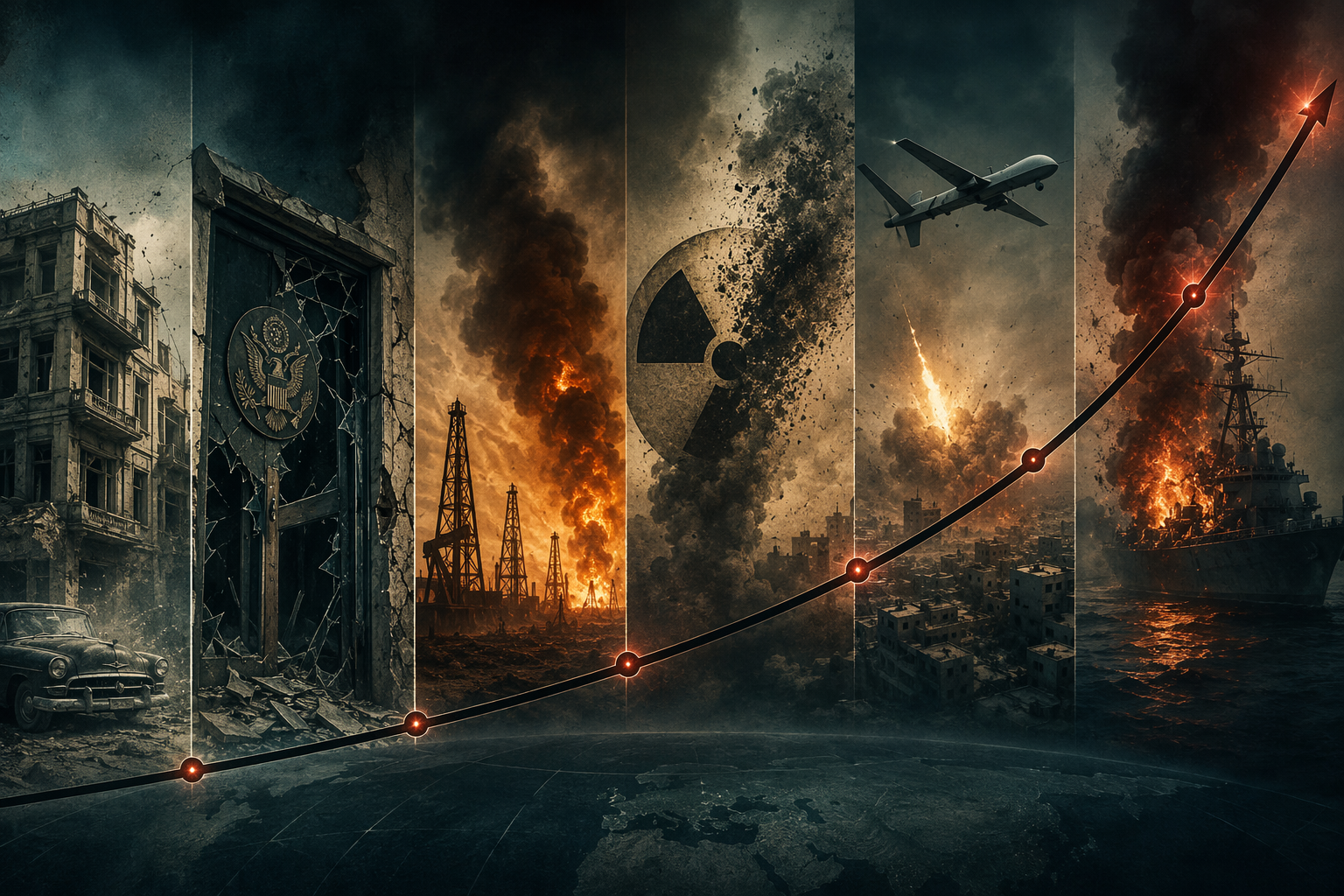
US-Iran Conflict Timeline Study Guide (1953–2026)
This study guide organizes the US-Iran conflict from 1953 to 2026 into seven chronological eras, with key dates, event descriptions, causal linkages, and exam-review formatting to help AP and college history students understand the arc of escalation.
Updated:
Start With the Spine: Seven Eras, 1953–2026
If you are using this as a US-Iran conflict timeline study guide, the first job is not to memorize every crisis. The first job is to keep the sequence straight: 1953 creates a lasting Iranian grievance; 1979 turns that grievance into a revolutionary break with the United States; the 1980s harden both states through war, sanctions, and regional militarization; the 2000s and 2010s move the conflict into nuclear diplomacy; the collapse of that diplomacy helps explain the direct military escalations that followed.
| Era | Core Dates | What To Remember Under Exam Pressure |
|---|---|---|
| 1. Coup and Cold War partnership | 1953–1978 | The CIA- and British-backed overthrow of Prime Minister Mohammad Mossadegh restored the shah’s power and became the foundational Iranian grievance against U.S. interference.[1] |
| 2. Revolution and hostage crisis | 1979–1981 | The Islamic Revolution replaced the shah, the U.S. Embassy was seized, and 52 American hostages were held for 444 days.[2] |
| 3. Iran-Iraq War and sanctions hardening | 1980–1988 | The war devastated Iran and pushed the United States deeper into Gulf security politics, sanctions, and confrontation over oil routes.[1][3] |
| 4. Containment, proxies, and sanctions architecture | 1989–2002 | After the war, U.S. policy treated Iran as a regional threat through sanctions, isolation, and concern over support for armed groups. |
| 5. Nuclear standoff and JCPOA diplomacy | 2002–2018 | Iran’s nuclear program became the central dispute; the 2015 JCPOA limited that program, and the U.S. withdrawal in 2018 reopened escalation.[4] |
| 6. Maximum pressure and direct strikes | 2019–2025 | Sanctions, Gulf incidents, proxy attacks, and the 2020 killing of Qassem Soleimani made direct U.S.-Iran military action easier to imagine.[5] |
| 7. Operation Epic Fury and fragile ceasefire | 2026 | The 2026 war is still a current-events chapter as of July 20, 2026; casualty and diplomatic claims remain disputed, and the Islamabad Memorandum ceasefire is fragile.[6][7] |
A good exam answer usually needs fewer dates than students fear, but it needs stronger arrows between them. The arrow from 1953 to 1979 matters more than an isolated description of either year. The arrow from 2015 to 2018 to 2020 to 2026 matters more than a list of acronyms. The pattern is not that war was inevitable from the beginning. It is that each phase left behind memories, institutions, sanctions, and precedents that narrowed the room for trust in the next one.
Era 1: 1953–1978, Operation Ajax and the Cold War Alliance
The timeline begins in 1953 because that is where modern Iranian mistrust of U.S. power becomes attached to a specific event. Prime Minister Mohammad Mossadegh had nationalized Iran’s oil industry, challenging British economic interests. In August 1953, a coup backed by the CIA and British intelligence helped remove Mossadegh and strengthened Mohammad Reza Shah Pahlavi’s rule.[1]
For the United States, the coup belonged to the Cold War logic of anti-communism, oil security, and keeping Iran aligned with the West. For many Iranians, it became evidence that Washington would override Iranian sovereignty when Iranian politics threatened Western interests. That distinction is exam-useful: one side remembered a strategic operation; the other remembered foreign intervention against constitutional government.
After 1953, the shah became a close U.S. ally. U.S. support flowed through military aid, intelligence cooperation, and modernization projects, while the shah’s domestic repression created growing opposition inside Iran. The point is not that the United States controlled every decision in Tehran. The point is that U.S. backing tied Washington’s image to the shah’s rule. When revolution came in 1979, anger at the shah and anger at the United States were already connected.
- Key date: 1953 — Operation Ajax helps remove Mossadegh and restore the shah’s authority.[1]
- Why it matters: It becomes the foundational grievance behind later Iranian suspicion of U.S. intentions.
- What it sets up: The 1979 revolution can be understood partly as a revolt against both the shah and the foreign power seen as protecting him.
Era 2: 1979–1981, Revolution and the 444-Day Hostage Crisis
In 1979, the shah fell and Ayatollah Ruhollah Khomeini became the central figure of the Islamic Revolution. The new Islamic Republic rejected the U.S.-backed monarchy and framed itself as anti-imperial, Islamic, and revolutionary. Then came the event that fixed Iran in U.S. public memory for a generation: on November 4, 1979, Iranian students seized the U.S. Embassy in Tehran.[2]

The hostage crisis lasted 444 days and involved 52 American hostages.[2] Those numbers matter because they explain why the crisis became more than a diplomatic dispute. It entered American living rooms through nightly news coverage and turned Iran into a symbol of humiliation, danger, and revolutionary hostility. For students, this is the moment when U.S.-Iran conflict stops being mainly a Cold War alignment story and becomes a mass public memory story.
The Iranian side of the crisis also has to be placed in sequence. The embassy takeover happened after the United States admitted the deposed shah for medical treatment, which many revolutionaries feared could become the first step toward another U.S.-backed restoration.[2] That fear only makes sense if 1953 is still on the page. Without 1953, the embassy seizure can look like a sudden eruption. With 1953, it becomes part of a revolutionary argument that the United States might again interfere in Iranian politics.
The immediate consequences were severe: diplomatic relations broke, U.S. sanctions expanded, and distrust moved from elite policy circles into popular politics. The hostage crisis also damaged President Jimmy Carter’s administration and shaped U.S. electoral politics in 1980. For Iran, the crisis helped consolidate revolutionary power by discrediting moderates and elevating anti-American credentials inside the new state.
- Key date: November 4, 1979 — U.S. Embassy seized in Tehran.[2]
- Key number: 444 days — the length of the hostage crisis.[2]
- Why it matters: It rewired U.S. public attitudes toward Iran and made diplomatic repair politically difficult.
- What it sets up: Sanctions, no formal diplomatic relations, and a U.S. tendency to view Iran through crisis management.
Era 3: 1980–1988, Iran-Iraq War and the Gulf Becomes a Battlefield
In 1980, Iraq under Saddam Hussein invaded Iran, beginning the Iran-Iraq War. The war lasted until 1988 and killed or wounded enormous numbers of people, though casualty estimates vary by source and should be handled carefully in exam writing.[1][3] What matters for the U.S.-Iran timeline is that the war militarized the Persian Gulf, tied oil security to U.S. strategy, and deepened Iran’s sense of encirclement.
The United States did not become Iran’s partner during the war. Washington’s policy tilted against Iran, even while the conflict produced complications such as the Iran-Contra affair. The Gulf also became a place where tanker traffic, oil prices, and naval protection could pull the United States into confrontation. DaveManuel’s historical overview highlights the role of oil price shocks and economic strain across the conflict, but those figures should be treated as scale indicators rather than as a single explanation for policy.[3]
The most important exam consequence is that Iran emerged from the war with a security worldview shaped by invasion, chemical attacks, isolation, and great-power maneuvering. That does not excuse later Iranian actions, but it helps explain why Iranian leaders invested in asymmetric tools: missiles, regional partners, and deterrent capabilities that could impose costs without matching U.S. conventional power.
- Key dates: 1980–1988 — Iran-Iraq War.[1]
- Why it matters: The war turns regional security, oil routes, and U.S. naval power into recurring parts of the conflict.
- What it sets up: Iran’s later reliance on missiles, regional armed partners, and deterrence outside conventional military parity.
Era 4: 1989–2002, Containment, Proxies, and Sanctions Become Normal
After the Iran-Iraq War, the conflict did not reset. The United States increasingly treated Iran as a state to be contained through sanctions and regional alliances. Iran, meanwhile, built influence through relationships with armed groups and political movements in the region. This era is easy to skip because it lacks one single dramatic date like 1979, but it is where the machinery of long-term confrontation becomes ordinary.
For an exam, do not turn this period into a list of every militia, sanctions law, or regional incident. Keep the main development clear: the conflict became institutionalized. Sanctions created legal and economic pressure that could outlast any one president. Regional alliances and proxy relationships meant U.S.-Iran competition could play out in Lebanon, Iraq, the Gulf, and elsewhere without always becoming direct U.S.-Iran war.
This period also sets up the later nuclear dispute. Once mistrust is embedded in sanctions, intelligence assessments, and regional threat perceptions, a nuclear program is not judged in isolation. It is judged through the memory of 1953, 1979, the Iran-Iraq War, hostage-taking, oil shocks, and proxy conflict.
Era 5: 2002–2018, Nuclear Standoff, JCPOA, and Collapse
The nuclear era is the hinge students often mishandle. The Joint Comprehensive Plan of Action, or JCPOA, did not appear out of nowhere in 2015. It came after years of concern over Iran’s nuclear activities, sanctions pressure, negotiations, and international monitoring. The Council on Foreign Relations’ Global Conflict Tracker identifies the nuclear issue and regional confrontation as central parts of the U.S.-Iran conflict in this period.[4]
In 2015, Iran and world powers reached the JCPOA. In broad terms, Iran accepted limits on its nuclear program in exchange for sanctions relief.[4] For exam purposes, the key is to separate adoption from final success. The deal was adopted, implemented, and defended by supporters as a way to lengthen Iran’s pathway to a nuclear weapon. That does not mean it resolved all disputes with Iran. It did not settle Iran’s missile program, regional activity, human rights issues, or the deeper political memory on either side.
In 2018, the United States withdrew from the JCPOA and reimposed sanctions under a maximum pressure strategy.[4] That withdrawal is one of the most important arrows in the modern timeline. It weakened the diplomatic framework that had organized the nuclear dispute, increased economic pressure on Iran, and helped move the conflict toward more direct military risk.
| Date | Event | Exam Link |
|---|---|---|
| 2015 | JCPOA reached | Shows diplomacy could temporarily constrain the nuclear dispute, but not resolve the whole conflict.[4] |
| 2018 | United States withdraws from JCPOA | Reopens escalation by combining sanctions pressure with a weakened diplomatic channel.[4] |
| 2019 onward | Maximum pressure and regional incidents intensify | Turns the nuclear issue into a wider confrontation involving oil routes, proxies, and U.S. forces. |
A clean short-answer formulation would be: the JCPOA was a nuclear agreement, not a peace treaty. Its collapse mattered because it removed a major restraint from a relationship already loaded with sanctions, proxy competition, and mutual distrust.
Era 6: 2019–2025, Maximum Pressure and the Soleimani Precedent
After the U.S. withdrawal from the JCPOA, the conflict moved through sanctions, maritime tensions, attacks involving regional partners, and threats against U.S. forces. The most important single event in this phase was the January 2020 U.S. killing of Qassem Soleimani, the Iranian commander of the Islamic Revolutionary Guard Corps’ Quds Force.[5]
Soleimani’s killing matters because it broke a line that had usually kept U.S.-Iran conflict indirect. The United States had fought Iranian-backed groups, sanctioned Iranian officials, and confronted Iranian influence, but killing such a senior Iranian military figure created a precedent for direct targeting at the top of Iran’s security structure. Iran responded with missile attacks on bases housing U.S. troops in Iraq, another reminder that Iraq had become one of the main theaters where U.S.-Iran confrontation played out.[5]
This is also where students should be careful with the word “proxy.” It is useful, but it can become lazy. Iran-backed groups do not all act like remote-control devices. They have local goals, local constituencies, and their own calculations. Still, from the U.S. perspective, attacks by such groups can become part of the U.S.-Iran conflict when Washington sees Tehran as sponsor, enabler, or strategic beneficiary.
- Key date: January 2020 — U.S. strike kills Qassem Soleimani.[5]
- Why it matters: It makes direct U.S. targeting of a senior Iranian military figure part of the precedent bank.
- What it sets up: Later leaders inherit a conflict where direct strikes no longer seem unthinkable.
Era 7: 2026, Operation Epic Fury and an Unfinished Chapter
The 2026 section has to be written differently from the earlier eras because it is not closed history. As of July 20, 2026, the conflict’s newest phase includes Operation Epic Fury, a fragile Islamabad Memorandum ceasefire dated June 14, and continuing accusations of violations by both sides.[6][7] That makes this part useful for a current-events essay, but dangerous if treated as settled.
CNN’s 2026 timeline and AP’s coverage provide granular sequencing for the war and ceasefire period, while the Wikipedia timeline can help cross-check order of events rather than supply final interpretation.[6][7][8] The responsible study move is to distinguish sequence from outcome. You can describe what happened in order; you should not claim to know the war’s final diplomatic settlement, leadership consequences, or long-term military balance.
Casualty figures and damage assessments are especially unstable. The research record flags significant variation among HRANA, the Iranian Health Ministry, and CENTCOM, with no independent verification available. In an exam or paper, write “reported” or “according to” when using such figures, and date the claim. The same caution applies to oil price and economic impact data: use the snapshot date, because markets and claims can shift quickly during an active crisis.
What can be said with confidence is narrower but important: the 2026 escalation did not begin from a blank slate. It inherited the 2018 JCPOA rupture, the maximum pressure campaign, the Soleimani precedent, regional proxy warfare, and decades of sanctions. That is why the 2026 war belongs in the same timeline as 1953 and 1979 rather than in a separate breaking-news box.
| 2026 Fact Type | How To Use It |
|---|---|
| Operation Epic Fury | Treat as the name of the most recent military escalation described in 2026 coverage; connect it to the post-JCPOA escalation arc.[6] |
| Islamabad Memorandum | Describe as a fragile ceasefire dated June 14, 2026, not as a settled peace agreement.[7] |
| Casualties | Use only with attribution and date because sources vary and independent verification is unavailable. |
| Oil and economic effects | Use as time-stamped snapshots, not permanent totals or final outcomes. |
| Leadership and diplomacy | Avoid final claims; the trajectory may shift after July 20, 2026. |
Causal Arrows To Memorize
The easiest way to lose the thread is to treat the timeline as trivia. The more useful version is a chain of causes and consequences. These are the arrows that make later events intelligible:
- 1953 → 1979: The coup against Mossadegh becomes part of the revolutionary memory that makes U.S. support for the shah politically explosive.[1][2]
- 1979 → sanctions and isolation: The hostage crisis breaks formal relations and makes anti-Iranian pressure politically durable in the United States.[2]
- 1980s war → asymmetric strategy: Iran’s experience of invasion and isolation helps explain later emphasis on missiles, regional partners, and deterrence.
- 2015 → 2018: The JCPOA shows a negotiated nuclear framework was possible, while U.S. withdrawal helps explain why later escalation accelerated.[4]
- 2020 → 2026: The Soleimani killing creates a precedent for direct military action against high-level Iranian targets before the 2026 escalation.[5][6]
Exam Takeaways by Theme
Sovereignty and Memory
Iranian mistrust of the United States cannot be explained only by revolutionary ideology or later nuclear disputes. The 1953 coup gave Iranian politics a durable example of foreign intervention. That memory did not determine every later choice, but it gave later Iranian leaders and publics a ready explanation for why U.S. pressure looked threatening rather than neutral.
Public Opinion and Political Constraint
The hostage crisis did for American public memory what 1953 did for Iranian grievance. It made Iran a symbol of danger and humiliation in U.S. politics. Once that image existed, presidents had less freedom to compromise without appearing weak, especially during crises involving hostages, troops, nuclear facilities, or oil routes.
Sanctions as Structure
Sanctions are not just punishments that appear after a crisis. Over time, they become structure: laws, enforcement offices, banking restrictions, business risk calculations, and political expectations. That is why removing sanctions can be harder than imposing them, and why nuclear diplomacy after 2015 was vulnerable to domestic politics in both countries.
Diplomacy and Its Limits
The JCPOA is best understood as a limited diplomatic achievement. It addressed nuclear restrictions and sanctions relief, but not the whole conflict. That limitation does not make the agreement meaningless. It explains why its collapse was so consequential: when the nuclear framework weakened, all the unresolved non-nuclear disputes were still there.
Direct and Indirect Conflict
For decades, much of the conflict was indirect: sanctions, covert action, naval pressure, regional allies, and armed partners. The Soleimani strike and the 2026 war show why the line between indirect and direct conflict matters. Once direct strikes become part of the precedent bank, later crises start from a more dangerous baseline.
Quick Reference: Easily Confused Facts
| Fact | Correct Use |
|---|---|
| Operation Ajax | 1953 coup operation associated with CIA and British support for removing Mossadegh and strengthening the shah.[1] |
| Islamic Revolution | 1979 overthrow of the shah and creation of the Islamic Republic; do not treat it as only a hostage-crisis backdrop.[2] |
| Hostage crisis length | 444 days; useful because it explains long-term American public memory.[2] |
| Iran-Iraq War | 1980–1988; central for understanding Iranian security fears and Gulf militarization.[1][3] |
| JCPOA | 2015 nuclear agreement limiting Iran’s nuclear program in exchange for sanctions relief; not a full peace settlement.[4] |
| U.S. JCPOA withdrawal | 2018; a major bridge from nuclear diplomacy to renewed escalation.[4] |
| Soleimani killing | January 2020 U.S. strike against a senior Iranian commander; important as a direct-targeting precedent.[5] |
| Operation Epic Fury | 2026 escalation; use current coverage carefully because the chapter remains open as of July 20, 2026.[6] |
| Islamabad Memorandum | June 14, 2026 ceasefire framework described as fragile, with mutual accusations of violations.[7] |
| 2026 casualties and damage | Do not present as final or independently verified; attribute and date any figures used. |
How To Turn the Timeline Into an Exam Answer
A strong paragraph does not need to name every president or every sanctions package. It needs to show that later events inherit earlier ones. For example, a compact answer might argue that the conflict developed from a Cold War intervention into a revolutionary rupture, then into a sanctions-based and regionally militarized confrontation, and finally into a nuclear and direct-strike crisis after the JCPOA collapsed.
If the exam question asks about causes, begin with 1953 and 1979. If it asks about recent escalation, begin with the JCPOA, the 2018 withdrawal, maximum pressure, the Soleimani strike, and then 2026. If it asks why the conflict is hard to resolve, write about accumulated grievances and institutions: memory of foreign intervention, hostage-crisis politics, sanctions architecture, regional armed networks, nuclear verification disputes, and precedents for direct force.
The safest final sentence for the current period is also the most historically honest: as of July 20, 2026, the Islamabad Memorandum ceasefire leaves the conflict paused rather than solved. The 73-year pattern is clearer than the outcome. Quick resolution is unlikely not because either side is irrational by definition, but because every era has left something behind for the next one to fight over.
References
- U.S.-Iran Relations: A Timeline, Britannica, https://www.britannica.com/topic/US-Iran-Relations-A-Timeline
- 7 Key Moments in the U.S.-Iran Conflict, History.com, https://www.history.com/articles/us-iran-conflict-key-moments
- History of the US-Iran Conflict, DaveManuel.com, https://www.davemanuel.com/history-of-the-united-states-iran-conflict.php
- Confrontation Between the United States and Iran, Council on Foreign Relations, https://www.cfr.org/global-conflict-tracker/conflict/confrontation-between-united-states-and-iran
- US, Israel bomb Iran: A timeline of talks and threats leading up to attacks, Al Jazeera, https://www.aljazeera.com/news/2026/2/28/us-israel-bomb-iran-a-timeline-of-talks-and-threats-leading-up-to-attacks
- Iran war key moments, CNN, https://www.cnn.com/interactive/2026/05/politics/iran-war-key-moments-vis/
- Iran-US timeline: Trump, Hormuz, war, ceasefire, AP News, https://apnews.com/article/iran-us-timeline-trump-hormuz-war-ceasefire-04da58cbae991183f8b52ef5bf615963
- Timeline of the 2026 Iran war, Wikipedia, https://en.wikipedia.org/wiki/Timeline_of_the_2026_Iran_war
Comments
Join the discussion with an anonymous comment.