
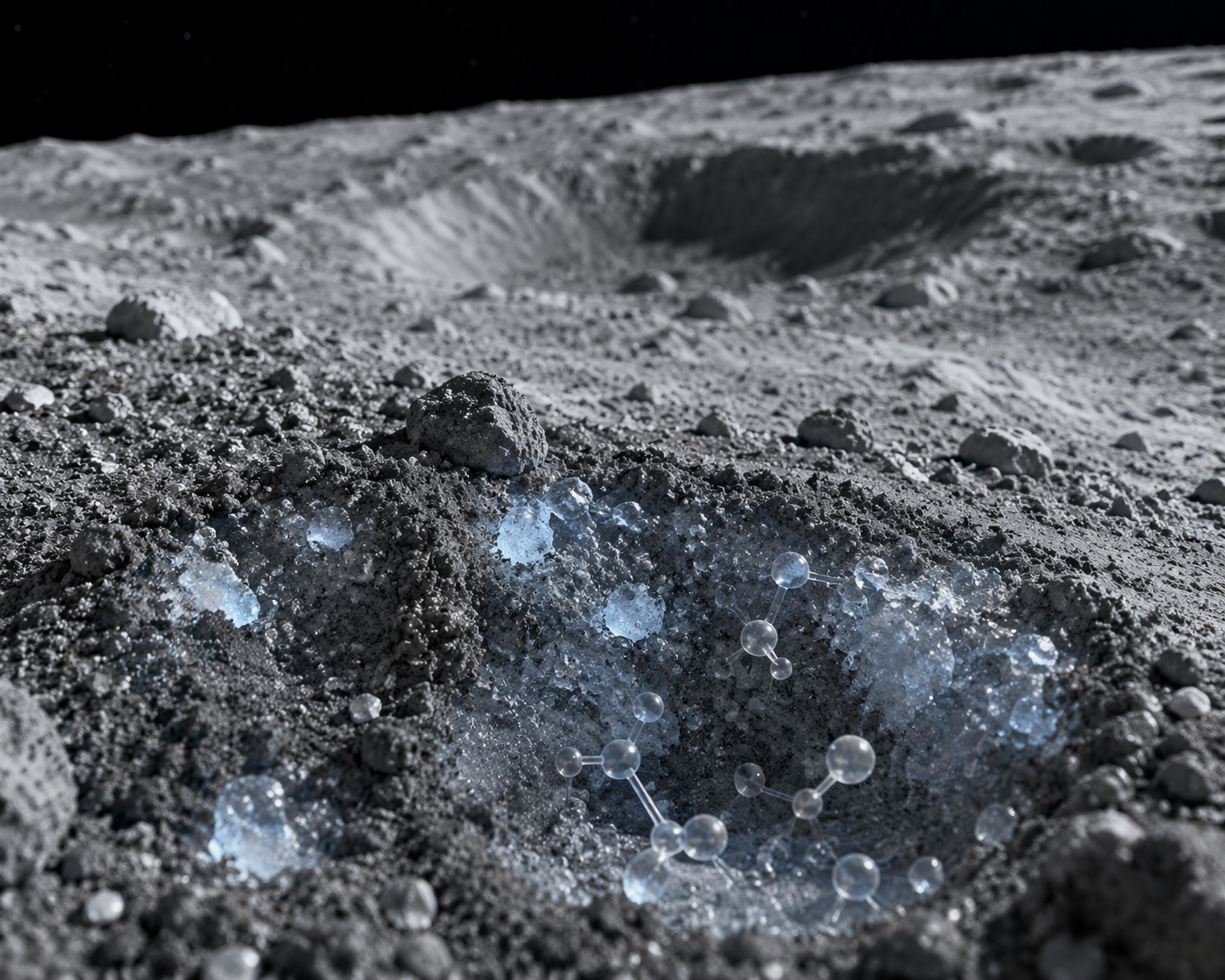
A Student Study Guide to Water in Lunar Dust
This study guide traces the key missions and discoveries that overturned the dry-Moon paradigm, from Apollo to Chang'e-5 and the 2026 Chandrayaan-2 findings. Students will learn the critical data points—LCROSS ice fraction, SOFIA sunlit water detection, Chang'e-5 mineral water storage—and understand the new picture of a wet lunar surface.
Updated:
This study guide starts with the main correction: there was no single “water found on the Moon” moment. The old Apollo-era picture treated the Moon as essentially bone-dry, and the newer picture was assembled by missions that measured different things in different places: hydroxyl, molecular water, polar ice, and water stored inside tiny pieces of impact glass. Keeping those categories separate is the difference between a useful study guide and a headline.
The Old Starting Point: Apollo and the Dry-Moon Paradigm
Apollo did not end the water question; it set the assumption that later missions had to undo. The Apollo landings from 1969 to 1972 returned lunar samples that were generally interpreted as evidence for a volatile-poor, extremely dry Moon, and that interpretation became the classroom version for decades.[1]
That older conclusion was not irrational. The Moon has no thick atmosphere, its surface is exposed to solar radiation and micrometeorite impacts, and Apollo samples did not obviously announce “water” in the way a wet terrestrial rock might. The problem was that the absence of obvious water in one set of sample interpretations became too tidy. Later work had better instruments, wider orbital coverage, and a reason to look for weaker signatures.
| Period or mission | What changed | Why it matters for students |
|---|---|---|
| Apollo, 1969–1972 | Samples supported the long dry-Moon interpretation. | This is the paradigm later evidence revised. |
| Clementine and Lunar Prospector, 1994–1998 | Remote-sensing results suggested possible polar hydrogen or ice-related signatures. | These were hints, not the clean modern answer. |
| Chandrayaan-1, 2009 | The Moon Mineralogy Mapper detected water/hydroxyl signatures from orbit. | This is the first decisive orbital turn in the story. |
| LCROSS, 2009 | An impact into Cabeus crater measured water ice in ejecta. | This gave a direct polar-crater confirmation. |
| SOFIA, 2020 | Molecular H₂O was detected on a sunlit lunar surface region. | This separated molecular water from a vague hydration claim. |
| Chang’e-5, 2020–2025 | Returned samples showed water in impact glass beads and water-bearing minerals. | This moved part of the evidence from remote sensing into laboratory samples. |
| Chandrayaan-2-led study, 2026 | A reported polar-stability result suggested many permanently shadowed regions remain undisturbed. | This updates the ice-preservation question, with a citation caveat. |
Early Hints: Clementine and Lunar Prospector
Clementine and Lunar Prospector belong in the timeline because they made the old dry-Moon picture less secure before the stronger detections arrived. Clementine operated in the 1990s and produced radar-related evidence that was discussed as a possible sign of polar ice, while Lunar Prospector mapped hydrogen signatures that supported the possibility of hydrogen-rich material near the poles.[1][2]
The important caveat is that hydrogen is not the same thing as a photographed block of ice, and a polar signal does not automatically describe the whole Moon. These missions made the water question scientifically serious again, but they did not by themselves settle where the hydrogen was stored, what chemical form it took, or how much was present.
Chandrayaan-1: The Orbital Detection That Changed the Baseline
The first major turn came with India’s Chandrayaan-1 mission. Its Moon Mineralogy Mapper, usually shortened to M3, detected absorption features consistent with water and hydroxyl across parts of the lunar surface, including sunlit and polar regions.[2]
That wording matters. M3 did not simply say “lakes,” “frost everywhere,” or “drinkable lunar soil.” It detected spectral signatures associated with H₂O and OH. Hydroxyl is one oxygen atom bonded to one hydrogen atom; molecular water is H₂O. They can be related in surface chemistry, but they are not interchangeable labels.
For an exam answer, Chandrayaan-1 is the mission that moves the story from suggestive polar hints to a broader orbital detection. It also complicates the idea that lunar water is only a permanently shadowed polar-crater issue. The Moon’s surface chemistry was beginning to look active enough that hydration signatures could appear outside the simplest “ice hiding in darkness” model.
LCROSS: A Polar Impact With a Number Attached
Later in 2009, LCROSS tested the polar-ice idea in a more dramatic way. NASA sent an impactor into Cabeus crater near the Moon’s south pole, then observed the ejecta plume. The analysis found water ice at 5.6 ± 2.9% by mass in the material thrown up by the impact.[2]
That number is one of the cleanest study-guide facts in the whole sequence. It is not a statement about all lunar dust. It is not even a statement about every polar crater. It is a measurement from the ejecta of Cabeus crater, a permanently shadowed cold-trap environment where ice can survive far better than it can on sunlit regolith.
LCROSS closed a gap left by earlier remote sensing. Clementine and Lunar Prospector had made polar ice plausible; LCROSS sampled a specific shadowed site by impact and found water-bearing ejecta. The confidence level of the story changed because the measurement was tied to a location, a method, and a mass fraction.
SOFIA: Molecular Water on a Sunlit Surface
SOFIA added a different kind of correction in 2020. Using the flying observatory’s infrared capability, researchers detected molecular H₂O in Clavius Crater, a sunlit region of the Moon, at concentrations of 100 to 412 parts per million. NASA compared that amount to roughly a 12-ounce bottle of water trapped in a cubic meter of lunar soil.[3]
The useful part is not the bottle image by itself; it is what the bottle image prevents. It blocks the exaggerated mental picture of wet lunar dirt while still making clear that the detection was not zero. SOFIA was measuring trace molecular water, not a resource map and not visible dampness.
SOFIA also matters because “sunlit” changes the chemistry problem. If water or water-like signatures exist only in permanently shadowed regions, the explanation can lean heavily on cold trapping. A sunlit detection requires a broader account: how H₂O is created, protected, trapped, or replenished in surface materials despite solar heating and radiation.
Chang’e-5: Water Stored in Returned Lunar Dust
Chang’e-5 shifted part of the discussion back into the laboratory. The mission returned lunar samples in 2020, and later analyses reported water stored in impact glass beads, with measured values ranging from 0 to 1,909 micrograms of H₂O per gram in those beads.[1]
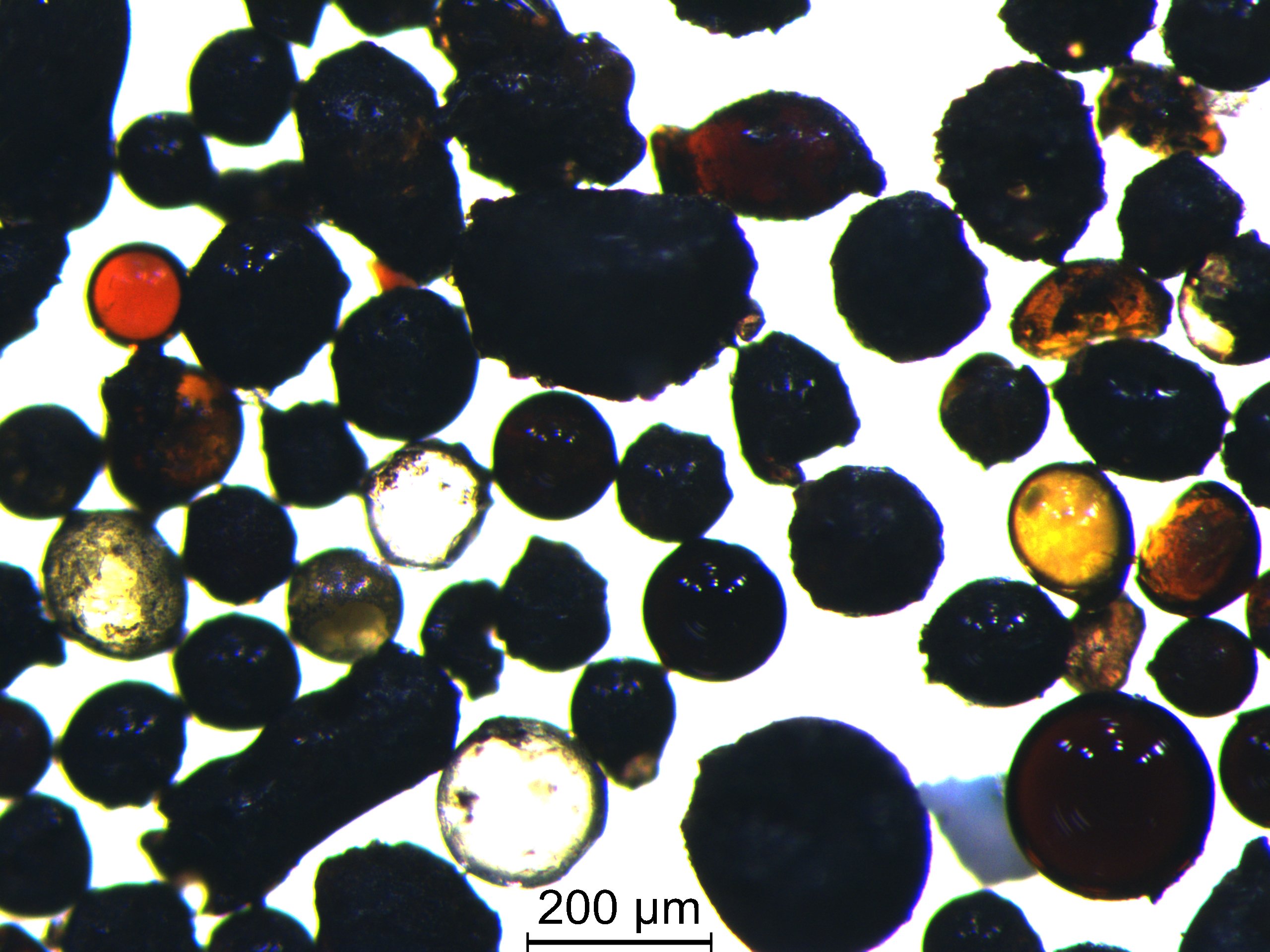
Impact glass beads are small glassy particles produced when impacts melt lunar material and it cools into tiny rounded grains. Their importance is not that they turn lunar dust into a hidden aquifer. Their importance is that they offer a storage mechanism. Water or hydroxyl related to solar-wind hydrogen can become incorporated into small regolith grains, which means the surface may participate in a cycling process rather than only preserving ancient ice in dark craters.
Chang’e-5 sample work also widened the mineral story. Reports associated with the returned material include a hydroxyl-bearing mineral called novograblenovite and ULM-1, described with more than 40% water by mass.[1]
Those are not the same claim. Water in glass beads, hydroxyl-bearing minerals, and a highly hydrated mineral phase each answer a different question about storage. If the exam prompt asks “what did Chang’e-5 add,” the safest answer is that returned samples showed lunar water can be stored in specific dust components and minerals, giving laboratory support to a more chemically varied lunar surface.
The 2026 Polar-Ice Update From Chandrayaan-2 Data
The newest item belongs at the end of the evidence chain, with a caution label. A 2026 summary in the lunar water literature reports a Chandrayaan-2-led PRL/IISER study finding that more than 74% of permanently shadowed polar regions remain undisturbed by impacts, which would make some ice deposits potentially billions of years old.[1]
That finding is about stability, not a fresh detection of water. It addresses whether cold-trap regions have remained physically protected enough for ancient ice to persist. In the study-guide timeline, it updates the polar-ice part of the story after LCROSS; it does not replace LCROSS, SOFIA, or Chang’e-5.
It also should be treated differently from the older mission results here because it is cited through Wikipedia’s account of the PRL/IISER study rather than through an independently checked original paper. The narrow supported takeaway is still useful: current work is no longer asking only whether lunar water exists, but how long polar reservoirs can survive and how disturbed their cold-trap settings are.
What Counts as “Water” in This Timeline
The easiest way to lose the plot is to flatten the evidence into one word. In this subject, “water” can refer to several related but distinct observations.
- Hydroxyl, or OH, is not molecular water, though both can appear in hydration-related spectral signatures.
- Molecular water, H₂O, was specifically reported by SOFIA on the sunlit surface in Clavius Crater.
- Water ice in polar ejecta was measured by LCROSS at Cabeus crater.
- Water stored in impact glass beads came from Chang’e-5 returned samples, not from an orbital map alone.
- Polar stability studies ask whether icy deposits can survive over long timescales; they do not automatically measure new water abundance.
A strong student answer names the mission and the form of evidence together: M3 for orbital water/hydroxyl signatures, LCROSS for Cabeus ejecta ice fraction, SOFIA for sunlit molecular H₂O, and Chang’e-5 for returned-sample storage in glass beads and minerals.
A Clean Exam-Ready Sequence
If the question asks how scientists discovered water in lunar dust, the answer should not start with Chang’e-5 as if the subject began with sample beads. Chang’e-5 is powerful because it comes after three earlier turns: polar hints, orbital detection, and impact confirmation.
- Apollo samples shaped the dry-Moon paradigm from 1969 to 1972.
- Clementine and Lunar Prospector raised the possibility of polar ice or hydrogen-rich deposits in the 1990s.
- Chandrayaan-1’s M3 instrument detected water/hydroxyl signatures from orbit in 2009.
- LCROSS confirmed water ice in Cabeus crater ejecta at 5.6 ± 2.9% by mass in 2009.
- SOFIA detected molecular H₂O on the sunlit surface at 100–412 ppm in 2020.
- Chang’e-5 samples showed water stored in impact glass beads, with bead measurements ranging from 0 to 1,909 μg/g H₂O.
- The 2026 Chandrayaan-2-led stability finding suggests many permanently shadowed polar regions may have remained undisturbed long enough to preserve ancient ice.
Chang’e-7 belongs only as a forward-looking note in this version of the timeline. It is described as planned for August 2026, so it should not be used as evidence for the current water record until mission results exist.[1]
The current picture is not a wet Moon in the everyday sense. It is a Moon with water-related material in multiple forms and settings: polar ice in cold traps, trace molecular water on at least some sunlit surfaces, hydroxyl and hydration signatures in the regolith, and water stored inside tiny returned sample grains. The revision worked because no single mission had to carry the whole claim.
References
- Lunar water, Wikipedia
- Moon Water and Ices, NASA
- NASA’s SOFIA Discovers Water on Sunlit Surface of Moon, NASA, October 26, 2020
Comments
Join the discussion with an anonymous comment.