
A Political Science Comparison of Trump and Carter
This article provides a political science framework for comparing the Trump and Carter presidencies, using approval data, legislative records, and foreign policy crises to explain why both became rare one-term presidents. Readers will gain a structured understanding of the parallels between these two presidencies and the factors that led to their electoral defeats.
Updated:
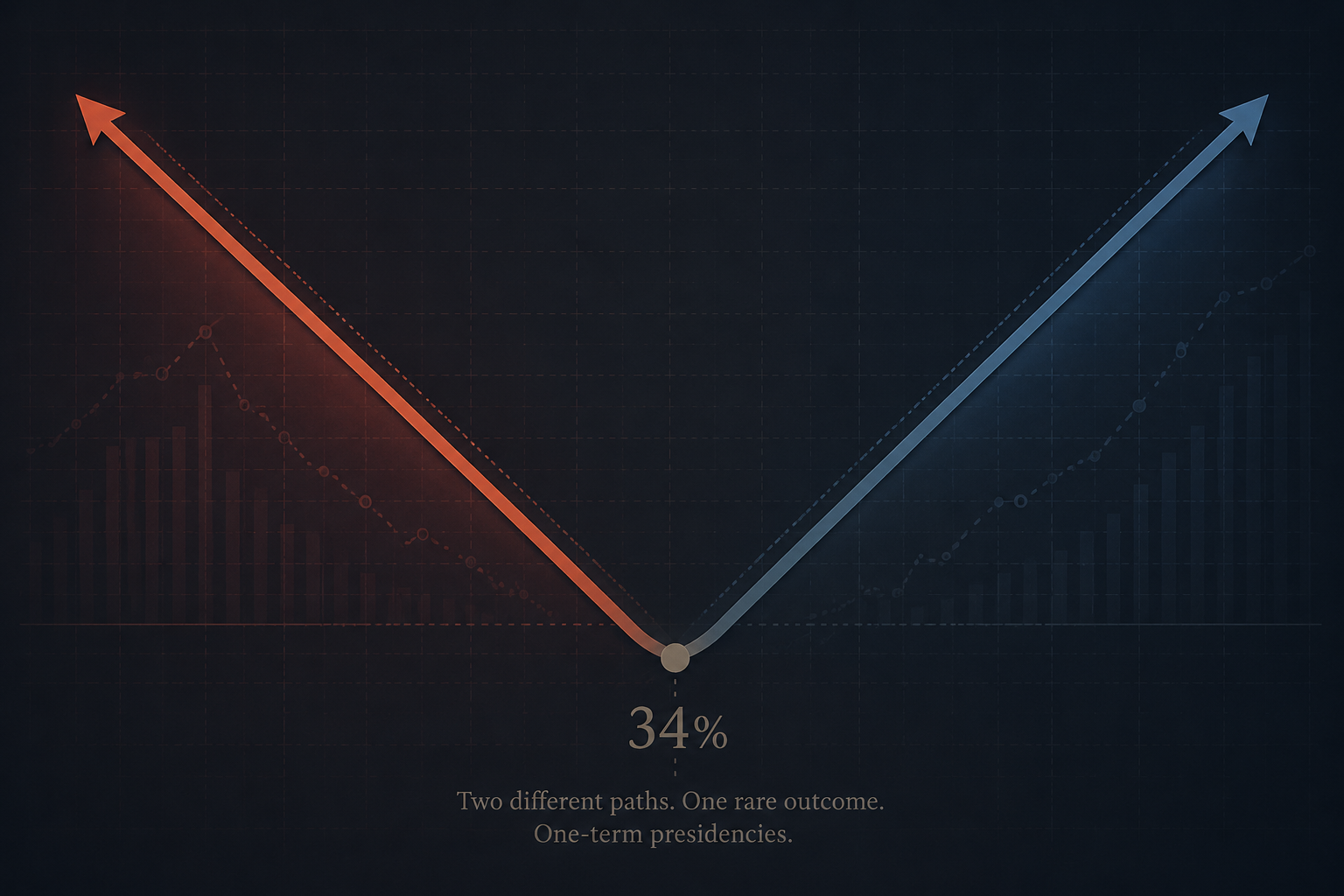
A useful Trump vs Carter comparison study in politics should start with the least poetic fact: both presidencies ended, in Gallup’s final job-approval series, at 34% approval. That puts Jimmy Carter and Donald Trump in the small post-World War II category of elected presidents who were denied immediate reelection and left a term with badly damaged public standing.[1]
The number matters because it prevents the comparison from floating away into temperament. Carter and Trump were not similar presidents in style, ideology, party position, or public language. Yet the same final approval rating invites a narrower political science question: how did two presidents who won as disruption candidates, governed with initial unified party control, and became trapped by Iran-linked crises reach the same first-term endpoint?
The Approval Comparison Is Sharper Than the Personality Comparison
Approval data make the Carter-Trump comparison both stronger and more limited. Carter’s approval peak was much higher: 75%, compared with Trump’s 49%. Carter’s average approval across his presidency was also higher, at 45.5%, compared with Trump’s 41.1% first-term average.[2] If the question is who enjoyed a broader initial reservoir of public goodwill, Carter is the clear answer.
That is exactly why the shared 34% endpoint is analytically interesting. Carter fell farther. Trump started from a more polarized and lower ceiling. Carter’s collapse looks like the erosion of an initially broad trust; Trump’s looks more like the hardening of a narrow coalition presidency that never broke through majority approval in the same way. The same endpoint does not imply the same path.
| Measure | Jimmy Carter | Donald Trump | Why it matters |
|---|---|---|---|
| Final Gallup approval | 34% | 34% | Creates the core comparison: different presidencies ending at the same low public rating |
| Approval peak | 75% | 49% | Shows Carter began with a much larger approval ceiling |
| Term average | 45.5% | 41.1% first-term average | Shows Trump’s support was lower and more consistently constrained |
The retrospective evidence complicates any quick ranking. Gallup’s 2023 retrospective assessment placed Carter at 57% approval, 11.5 points above his term average.[3] That does not prove that Carter was secretly successful in office. It does show that public judgment of a presidency can detach over time from the immediate performance coalition that defeated it. Trump cannot yet be assessed on the same post-presidential timescale, especially because his later political career is still part of the live record rather than a completed afterlife.
Both Won as Outsiders, but Their Coalitions Were Not the Same Kind of Outsider Coalition
Carter’s 1976 victory and Trump’s 2016 victory both rewarded candidates who ran against Washington, but the coalitional mechanics differed. Carter won 297 electoral votes to Gerald Ford’s 240 and pulled Southern Democrats back into a national Democratic victory after the shocks of Vietnam, Watergate, and Republican realignment pressures. Trump won 304 electoral votes to Hillary Clinton’s 227 by flipping key Rust Belt states and reshaping Republican strength around working-class, culturally conservative, and anti-establishment appeals.
The shared feature is not that Carter and Trump mobilized the same voters. They did not. The shared feature is that each built a winning coalition that was more difficult to govern with than to campaign with. Carter’s outsider posture helped him after Watergate, but it did not make congressional Democrats into an obedient governing machine. Trump’s insurgency gave him command over Republican voters, but it also exposed the distance between campaign promises and the institutional requirements of lawmaking.
That distinction is useful in an exam answer because it separates coalition formation from coalition maintenance. Carter and Trump both proved that a candidate can win a national election by exploiting regime fatigue. Neither proved that an insurgent victory automatically produces a durable governing majority.
Unified Government Did Not Solve the Governing Problem
The legislative comparison is more damaging than a simple divided-government explanation would be. Carter and Trump each began with unified party control. In theory, that should have created a window for major governing commitments. In practice, both presidencies exposed the difference between partisan control and legislative capacity.
Carter struggled to move parts of his domestic agenda through a Democratic Congress, including welfare reform and his fight over water projects. The Miller Center’s assessment emphasizes that Carter’s presidency suffered from weak relations with Congress and from his difficulty translating personal independence into institutional power.[4] Carter’s problem was not simply that conservative opponents blocked him. It was that many Democrats did not treat him as the natural leader of their own coalition.
Trump’s first-term version of the problem appeared in the failed effort to repeal and replace the Affordable Care Act and in the struggle to secure full funding for a border wall. These were not peripheral campaign ornaments. They were central promises in the 2016 Republican campaign. Unified government gave Trump agenda access, but it did not eliminate intraparty disagreement, Senate constraints, or the difficulty of converting symbolic issues into statutory wins.
For comparison purposes, this is where Carter and Trump begin to resemble each other structurally rather than personally. Each had enough electoral authority to claim a mandate, enough party control to be judged responsible, and enough institutional friction to disappoint supporters who expected more direct translation from campaign victory to policy outcome.
The Disjunctive Presidency Frame Helps, If It Is Kept on a Short Leash
Stephen Skowronek’s political-time framework gives the comparison a cleaner academic vocabulary. In that framework, a disjunctive president governs near the end of a weakening political regime and cannot hold together the inherited order. Carter can be read as a late-stage New Deal coalition president; Trump can be read as a late-stage Reagan coalition president.[5]
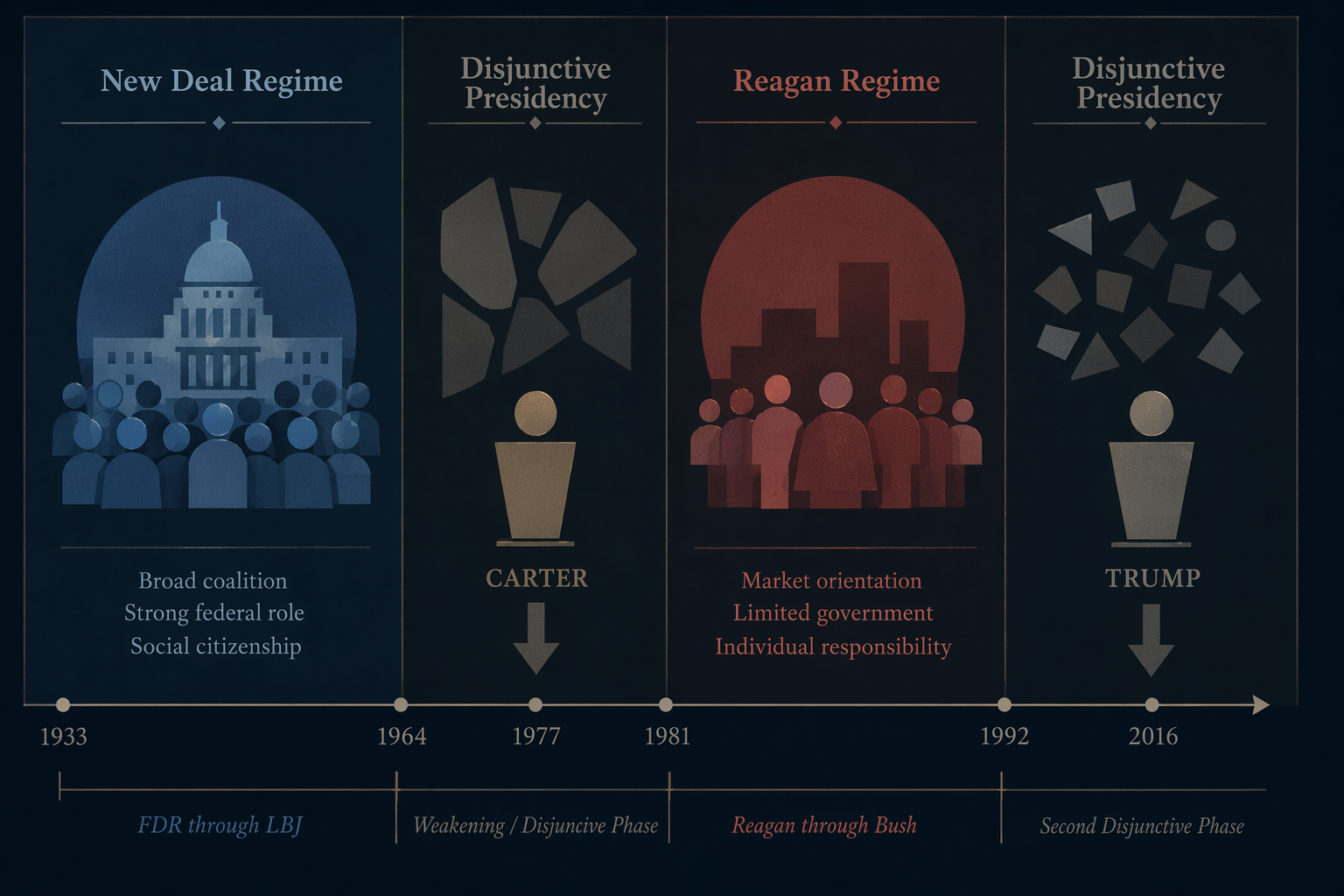
The attraction of the model is obvious. Carter inherited a Democratic order whose older components no longer fit comfortably together: Southern conservatism, labor liberalism, civil rights politics, and post-Watergate reform all pulled in different directions. Trump inherited a Republican order built around tax cuts, deregulation, social conservatism, national security hawkishness, and market-oriented globalization, then campaigned through a revolt against parts of that same settlement.
The warning label is just as important. Skowronek’s categories are interpretive tools, not polling instruments. Some analysts have treated Trump as a possible disjunctive figure, while others have argued that he might fit better as a preemptive or even reconstructive actor depending on how Republican politics develops after him.[6] The framework is strongest when it helps explain why existing coalitions stopped working. It is weakest when it is used to declare the meaning of a presidency before the political order that follows it has fully formed.
Iran Turns Domestic Frustration Into a Test of Presidential Control
Foreign policy gives the Carter-Trump comparison its sharpest historical edge, but also its biggest evidentiary risk. Carter’s Iran hostage crisis lasted 444 days and became the central symbol of American weakness in the final phase of his presidency.[7] It did not create every problem Carter faced. Inflation, energy politics, and public distrust were already punishing him. But the hostage crisis concentrated those frustrations into a daily image of presidential incapacity.
Trump’s second-term Iran comparison is necessarily less settled. Reporting in 2026 has already framed the 2025–2026 Iran conflict as a major test of Trump’s foreign policy legacy and as a point of comparison with Carter’s Iran crisis.[7] That comparison should be handled as a live analytical category, not as a completed historical verdict. Carter’s crisis has a known duration, electoral aftermath, and retrospective place in presidential history. Trump’s later Iran record is still unfolding in Q3 2026.
Still, the Iran layer matters because it links performance legitimacy to presidential control. Voters do not need to believe that a president personally caused every foreign crisis to punish him for seeming unable to master it. Carter’s failed rescue attempt and the continuing captivity of American hostages turned policy difficulty into visible humiliation. Trump’s Iran conflict raises the comparable question of whether a president elected on strength and disruption can prevent foreign crisis from becoming the measure by which strength is judged.
What the Comparison Can Support
The strongest Carter-Trump comparison has three linked parts. First, both were insurgent winners who benefited from dissatisfaction with the existing political order. Second, both had unified government yet failed to deliver key legislative promises that would have validated their governing coalitions. Third, both became associated with Iran-related crises that sharpened public doubts about presidential competence.
The approval data then give that structure a measurable endpoint. Carter’s path ran from a high early ceiling to a 34% final Gallup rating. Trump’s first-term approval operated within a narrower range and also ended at 34% in Gallup’s final job-approval series.[1][2] The identical endpoint is not proof that the presidencies were equivalent. It is evidence that both produced a comparable collapse in public confidence by the time voters rendered judgment on their claim to continued tenure.
The weakest version of the comparison is the one that turns Carter into a generic symbol of weakness and Trump into either his mirror image or his correction. That misses the more useful point. Carter’s presidency shows how moral reform, outsider status, and technocratic seriousness can fail under inflation, congressional distrust, and foreign humiliation. Trump’s record shows how populist disruption, partisan intensity, and personal command over a party can still run into institutional limits, legislative disappointment, and foreign-policy exposure.
The Caveat Belongs Inside the Thesis
This comparison is strongest where structure, approval collapse, and governing failure overlap. It is weaker wherever it asks Trump’s still-developing second-term record to carry the same weight as Carter’s completed presidency. The source series are also not perfectly interchangeable: Carter’s presidency can be followed through a completed Gallup historical record, while later Trump assessments involve a more fragmented contemporary polling environment.
A disciplined answer should therefore avoid both exaggeration and false modesty. Carter and Trump belong together in a serious comparison because they share a rare immediate reelection defeat, the same 34% final Gallup approval rating, insurgent coalition problems, legislative underperformance under unified government, and Iran-centered foreign-policy burdens. They do not belong together as interchangeable presidents, and the Trump side of the comparison remains less historically closed.
References
- Final Presidential Job Approval Ratings, The American Presidency Project, University of California, Santa Barbara
- Presidential Approval Highs and Lows, Roper Center for Public Opinion Research
- Jimmy Carter: Retrospective, Gallup
- Jimmy Carter: Impact and Legacy, Miller Center
- Skowronek Views the Trump Win Through Political Time, Yale Institution for Social and Policy Studies
- Donald Trump and the Republican Party, Jacobin
- Donald Trump, Iran War, Oil Legacy, Carter, TIME, March 26, 2026
Comments
Join the discussion with an anonymous comment.