

How Air Quality Affects Studying on Exam Day
Research shows that the air you breathe on test day can measurably affect your exam scores. Learn how pollution and CO2 impact cognitive performance, and what practical steps you can take to optimize your testing environment.
Updated:
On exam day, air quality is one of the few performance variables that can look invisible right up until it costs points. A room can be quiet, well lit, and officially acceptable while still exposing students to elevated fine particulate pollution or stale indoor air. That matters because the best evidence on how air quality affects studying and testing does not stop at comfort. It links short-term exposure to measurable score changes.
A 2026 systematic review and meta-analysis of 28 causal studies found that air pollution decreases student achievement by 0.022 standard deviations on average, and that each 1 µg/m³ increase in PM2.5 is associated with a 0.011 standard-deviation drop in achievement. The same working paper estimated that the effect was about 33% larger for males than females, though the paper is still a preprint and should be treated as preliminary rather than settled consensus.[1]
The useful part of that finding is not that students should panic about every imperfect room. It is that exam-day air is not just a background condition. PM2.5 is small enough to enter indoor spaces and linger, and the exposure window that matters for a test-taker can be short: the morning commute, the waiting area, the testing room, or the wildfire-smoke afternoon when the exam happens to be scheduled.
The strongest exam-day signal comes from pollution
The cleaner claim is about particulate pollution and test performance. A Yale-led study published in JAMA Network Open examined 2.8 million students in North Carolina and found adverse test-score impacts from PM2.5 even when concentrations were below the current EPA annual standard of 12 µg/m³. The study also reported disproportionate impacts on ethnic minority and female students.[2]
That last detail deserves more than a token mention. Air-quality effects are not distributed evenly, and they do not land on a neutral testing system. If some students are more likely to attend schools or testing sites near pollution sources, or to sit exams in older buildings with weaker ventilation, then the same nominal exam can carry different environmental penalties before the first question appears.
The within-student evidence from Israel makes the mechanism harder to dismiss as a simple neighborhood or school-quality story. As reported by the Hechinger Report, the same students scored lower on high-pollution test dates and higher on cleaner dates, which supports a causal exam-day effect rather than merely showing that students in polluted areas tend to score differently.[3]
For a student preparing for the MCAT, GRE, SAT, finals, or a licensure exam, the practical translation is modest but real: pollution is unlikely to explain your score by itself, but it can add drag on the exact day when small margins matter. That is enough to treat air quality like noise, temperature, commute risk, or sleep timing: not the whole game, but a variable worth removing when you can.
CO2 is a different problem: stale indoor air
PM2.5 and CO2 should not be collapsed into one vague idea of “bad air.” PM2.5 is particulate pollution. CO2 is usually a ventilation signal: when people sit in a closed room and exhale for hours, CO2 rises, and that often means the room is not exchanging indoor and outdoor air quickly enough.
The CO2 evidence most often cited for cognitive performance comes from controlled indoor-environment studies, many of them involving office workers rather than students. Harvard’s CogFx work reported that response time slowed by 0.8% to 0.9% per 10 µg/m³ increase in PM2.5 and by 1.4% to 1.8% per 500 ppm increase in CO2. The tested domains included decision speed, information usage, and crisis response, which are not identical to standardized testing but are close enough to deserve attention when a student is trying to protect working memory and processing speed.[4]
This is where overclaiming gets tempting. A CO2 monitor reading is not a score predictor. It will not tell you whether you are about to miss a geometry question or misread a passage. Its value is narrower: it can reveal that a remote-testing room or study room is becoming poorly ventilated while you still have time to open a window, run ventilation, or move.
| Exam-day factor | What it tells you | What you can usually control |
|---|---|---|
| PM2.5 | Fine particulate pollution that can rise during wildfire smoke, traffic pollution, or other outdoor pollution events | Test date when rescheduling is possible, center location, indoor filtration for remote exams |
| CO2 | A practical signal that indoor air is getting stale in an occupied room | Ventilation, window use, room choice, breaks before the exam begins |
| Temperature | A separate source of cognitive strain that often travels with poor room control | Clothing layers, seat choice when allowed, remote-room setup |
Choose the testing room before you are stuck in it
The best time to think about air quality is before registration, not while you are sitting under fluorescent lights with a clock running. If you have several testing centers within reach, the choice is not only about distance. A modern academic building with maintained HVAC is usually a better bet than a temporary classroom, basement room, or older site with poor airflow. You may not be able to inspect the ventilation system, but you can still make a more informed selection.
- Prefer permanent buildings over portable classrooms or improvised testing spaces when you have a choice.
- Look for centers in buildings likely to have central HVAC, especially universities, newer schools, or professional testing sites.
- Avoid adding a long commute through heavy traffic if a comparable center is available closer or in a cleaner area.
- Check whether the exam allows test-center changes or rescheduling before the deadline, because flexibility matters during wildfire season or pollution spikes.
Wildfire smoke deserves special handling because it can turn a normally acceptable testing plan into a poor one with little warning. If the exam sponsor allows rescheduling and your region is under a serious smoke event, it is rational to compare the cost of rescheduling against the cost of sitting for a high-stakes exam in degraded air. The evidence does not say every smoky day ruins performance. It says elevated PM2.5 is a plausible and measurable penalty, which is enough to avoid it when the administrative cost is low.
Temperature belongs in the same decision, not in a separate wellness bucket. The Hechinger Report cites Jisung Park’s work on New York City Regents exams, reporting that students were about 10% more likely to fail an exam at 90°F than at 72°F.[3] That figure comes through a secondary source, so it should not be stretched beyond its context. Still, it matches what test-takers already know from experience: a too-hot room burns attention on discomfort, and a too-cold room slows hands and concentration.
The practical move is simple: dress in layers even if the forecast looks normal. A testing room is its own climate. You cannot assume the proctor will adjust it, and you may not be allowed to leave for extra clothing once the exam starts.
Remote exams give you more control, and more responsibility
For remote and online exams, air quality moves from something you mostly select to something you actively set up. The room should be treated like test equipment. You would not wait until the proctor check-in to discover that your webcam fails; do not wait until the exam begins to discover that your room has been sealed for three hours.
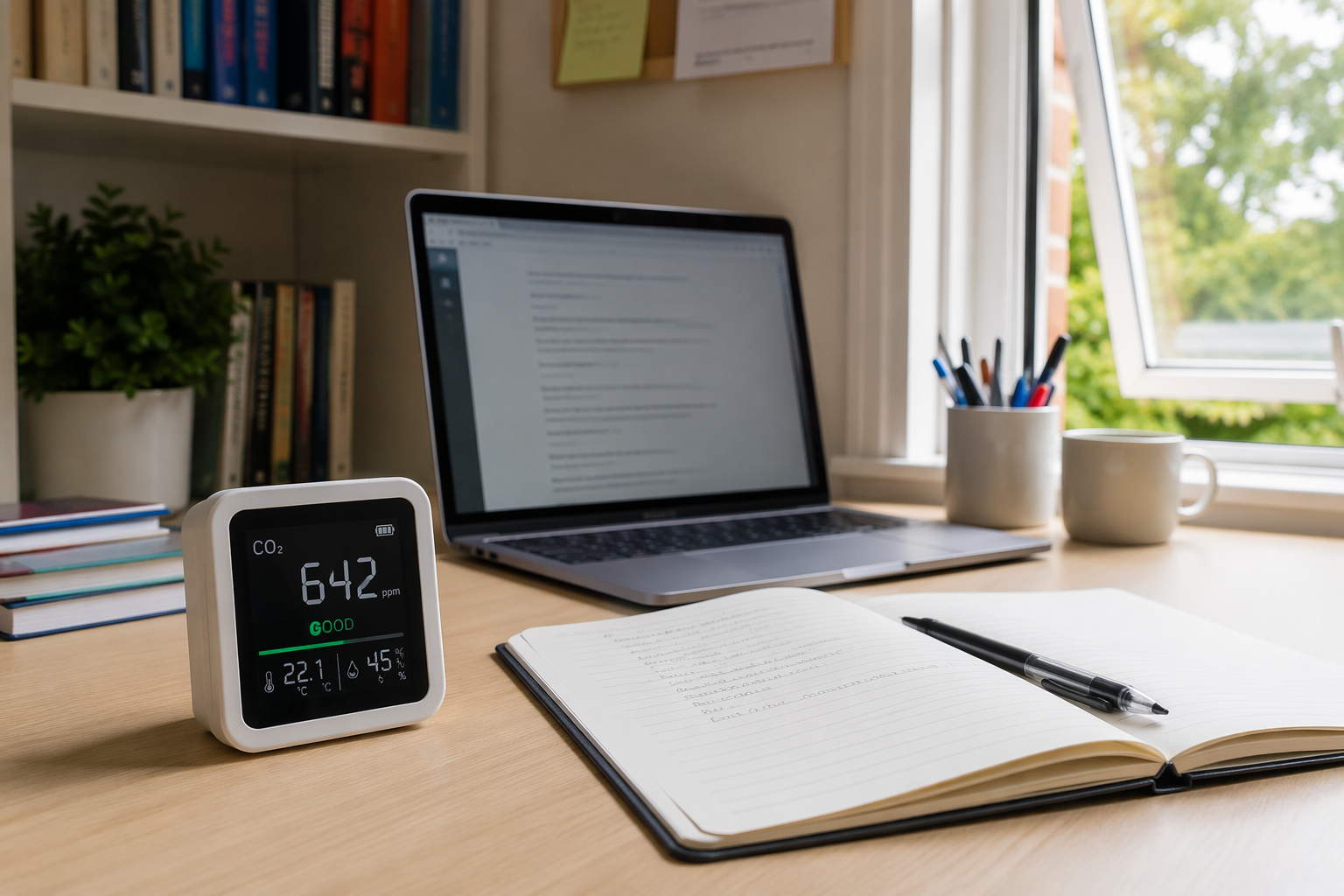
A useful remote setup does not need to become a product-shopping project. It needs three decisions: how fresh air enters, how particles are filtered, and how you will know whether the room is drifting out of range.
- Ventilation: air out the room before the exam, and keep a window cracked if outdoor air is clean, noise is manageable, and exam rules allow the setup.
- Filtration: use a HEPA purifier sized for the room rather than a small decorative unit; the relevant specification is clean-air delivery for the room size.
- CO2 monitoring: if you use a monitor, choose one with an NDIR sensor and place it near the breathing zone, not directly beside an open window or purifier outlet.
- Humidity: keep the room in a reasonable middle range, roughly 30% to 50%, so the setup does not trade stale air for an uncomfortably dry or damp room.
- Temperature: test the room at the same time of day as the exam, because afternoon sun, closed doors, and running equipment can change the room quickly.
The rehearsal matters more than the device. A student taking a remote exam in a bedroom should run a full-length practice block in the same room with the door closed, laptop on, permitted materials arranged, and any purifier or fan already operating. If CO2 climbs quickly, the room needs more ventilation before the real exam. If the purifier is loud enough to distract, it needs a different placement or setting. If opening the window brings traffic noise, the better answer may be pre-ventilating the room, filtering continuously, and using the quietest allowed setup during the exam.
Noise control still matters, but it should not erase air control. If you are allowed to use earplugs or approved noise reduction, combine that with ventilation rather than choosing a sealed, silent room by default. For regular studying rather than official exams, tools like noise-cancelling headphones can help protect focus, but formal test rules often restrict what you can wear, so check the policy before building a plan around them.
A practical exam-week air-quality check
The goal is not to monitor the atmosphere like a lab technician. It is to catch the preventable failures. A quick check during exam week is enough for most students.
- Check the outdoor air forecast for the testing location, especially PM2.5 and wildfire-smoke conditions.
- Confirm the test center and travel route; avoid unnecessary time near heavy traffic if an easy alternative exists.
- If testing remotely, run the room exactly as you will use it: door position, window position, purifier, computer, lighting, and temperature control.
- If you use a CO2 monitor, observe the trend during a practice block rather than reacting to one isolated reading.
- Prepare clothing layers and any allowed comfort items before test day, because room temperature is rarely under the student’s control.
That checklist is deliberately short. The student who has not slept, reviewed, or practiced under timing pressure has bigger problems than CO2. But the student who has already handled the obvious parts of preparation can lose performance to a bad room, a smoke spike, or a sealed remote-testing space. Those are not character flaws. They are environmental variables.
The evidence is strongest for short-term pollution exposure and test scores, and more context-specific for CO2 and cognitive performance. That is enough to be precise without overreading the findings. Air quality is not the main thing students need to worry about on exam day, but it is real enough to change how a careful student chooses a room, watches a forecast, or sets up a remote exam.
References
- The Effects of Air Pollution on Student Achievement: A Systematic Review and Meta-Analysis, EdWorkingPapers, 2026.
- Yale Study: Polluted Air Can Negatively Impact Children’s Test Scores, Yale School of Public Health, 2024.
- The learning effect of air quality in classrooms, Hechinger Report.
- The Impacts of Indoor Air Quality on Cognitive Function, Harvard T.H. Chan School of Public Health.
Comments
Join the discussion with an anonymous comment.