
What a Tornado Watch and Warning Mean for Students at School
Knowing whether a tornado watch or warning is in effect changes what you do during the school day. Learn the key difference and exactly what actions each alert requires, from staying in class to immediately moving to your designated shelter.
Updated:
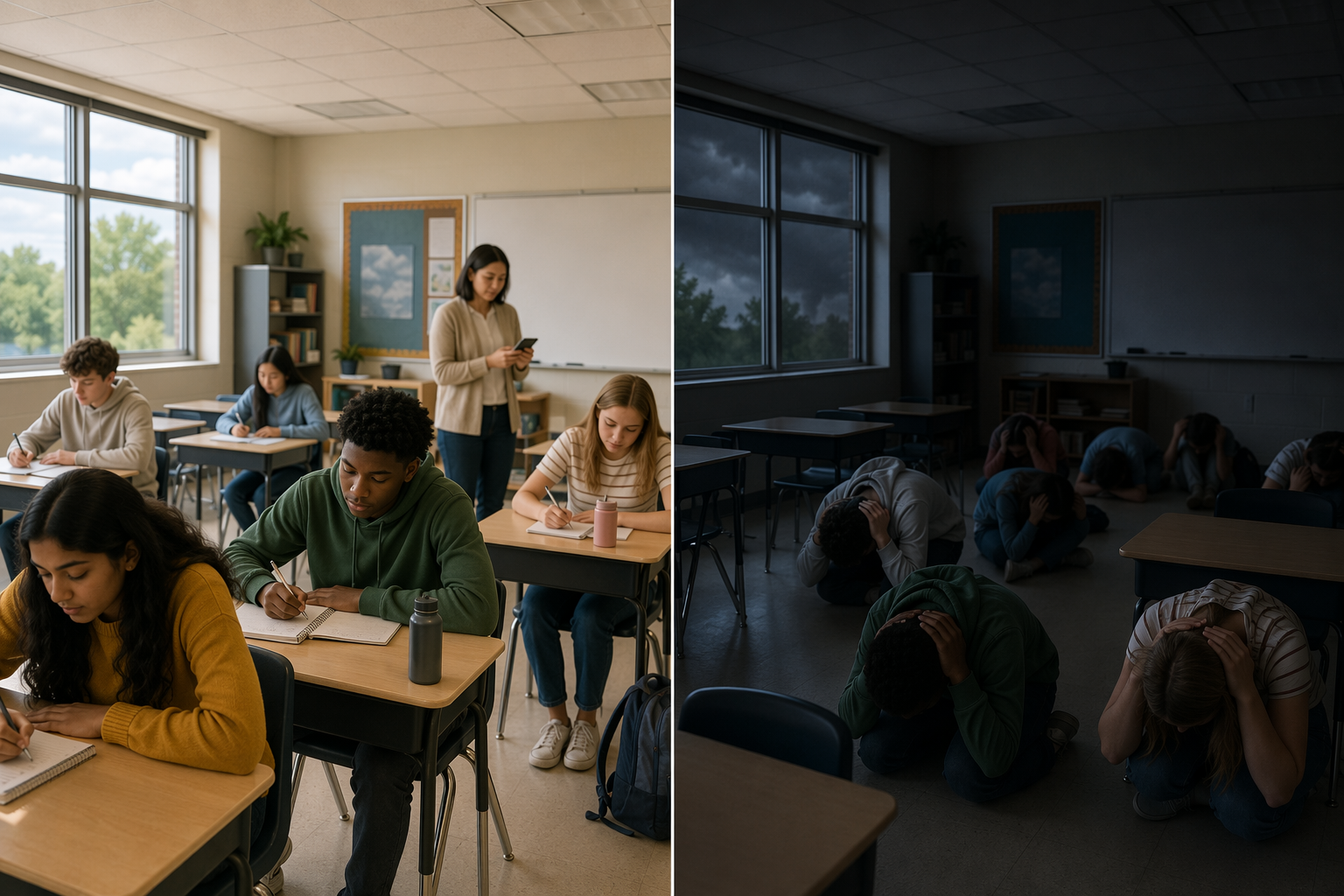
Imagine you are halfway through fourth period when the office announcement clicks on. The words are familiar from science class: tornado watch. Or maybe the announcement says tornado warning. The difference between tornado watch and warning for students is not just vocabulary. At school, a watch usually means class continues while adults monitor the weather. A warning means you stop what you are doing, move immediately to your designated shelter area, and stay there until the school gives an official all-clear.
That is the school-day version worth remembering: watch means wait and prepare; warning means act now. The first one changes how alert everyone is. The second one changes where your body needs to be.
The Quick Difference During a School Day
| Alert | What it means | What a student usually does at school |
|---|---|---|
| Tornado watch | Conditions are favorable for tornadoes in and near the watch area. | Stay in class, listen for instructions, and let school staff monitor updates. A watch can cover multiple counties or states and last several hours. [1] |
| Tornado warning | A tornado has been reported by spotters or indicated by weather radar. | Move immediately to the assigned shelter area, get into protective position, and wait for the official all-clear. A warning is smaller and more urgent, often covering an area around the size of a city or small county. [1] |
Schools do not usually send every class to shelter for every tornado watch because the watch area can be large and the time window can be several hours. During a watch, administrators may check National Weather Service updates, delay outdoor activities, keep buses under review, or prepare to move people in the building quickly if conditions get worse. From a student seat, it may look like nothing is happening. That does not mean nobody is paying attention.
A warning is different. It is not a long, general heads-up. It is the alert that tells the school to use its shelter plan now. The National Weather Service warns people not to wait until they see or hear the tornado, because by then it may be too late to reach a safe place. [1]
During a Tornado Watch: Stay Ready Without Stopping School
If a tornado watch is announced while you are in class, the safest student response is usually boring on purpose: stay where you are, keep listening, and follow the teacher’s directions. You might continue taking notes, working on a lab sheet, eating lunch, or finishing a quiz. What changes is that the adults in charge are now watching the weather more closely and preparing to move the building if a warning is issued.
A watch is also the time to quietly notice practical things. Where is your class’s shelter area? Which door does your teacher use during drills? If you are in the cafeteria, gym, art room, band room, or a portable classroom, where does that space go during severe weather? Your school’s plan may not match another school’s plan, so the useful answer is the one your own teachers and administrators have taught you.
This is not the time to crowd windows, check the sky for yourself, or ask to go outside because the weather “doesn’t look that bad.” Tornadoes can be hidden by rain, darkness, buildings, or distance. At school, your job during a watch is to be reachable, calm, and ready to move if the announcement changes.
During a Tornado Warning: Move Now
A tornado warning interrupts the school day. If you are writing, stop writing. If you are eating, stop eating. If you are changing classes, stop treating the hallway like passing period. Listen for the nearest adult’s directions and go to the shelter location your school has assigned.
The route matters because shelter is not just “inside.” The National Weather Service school guidance says schools should put as many walls as possible between students and the storm and recommends designated shelter areas that students can reach within 3 minutes. [2] That is why drills often feel strict about lines, doors, corners, and timing. The goal is not a perfect-looking line. The goal is to get everyone out of weak spaces and into stronger ones before the dangerous part of the storm arrives.
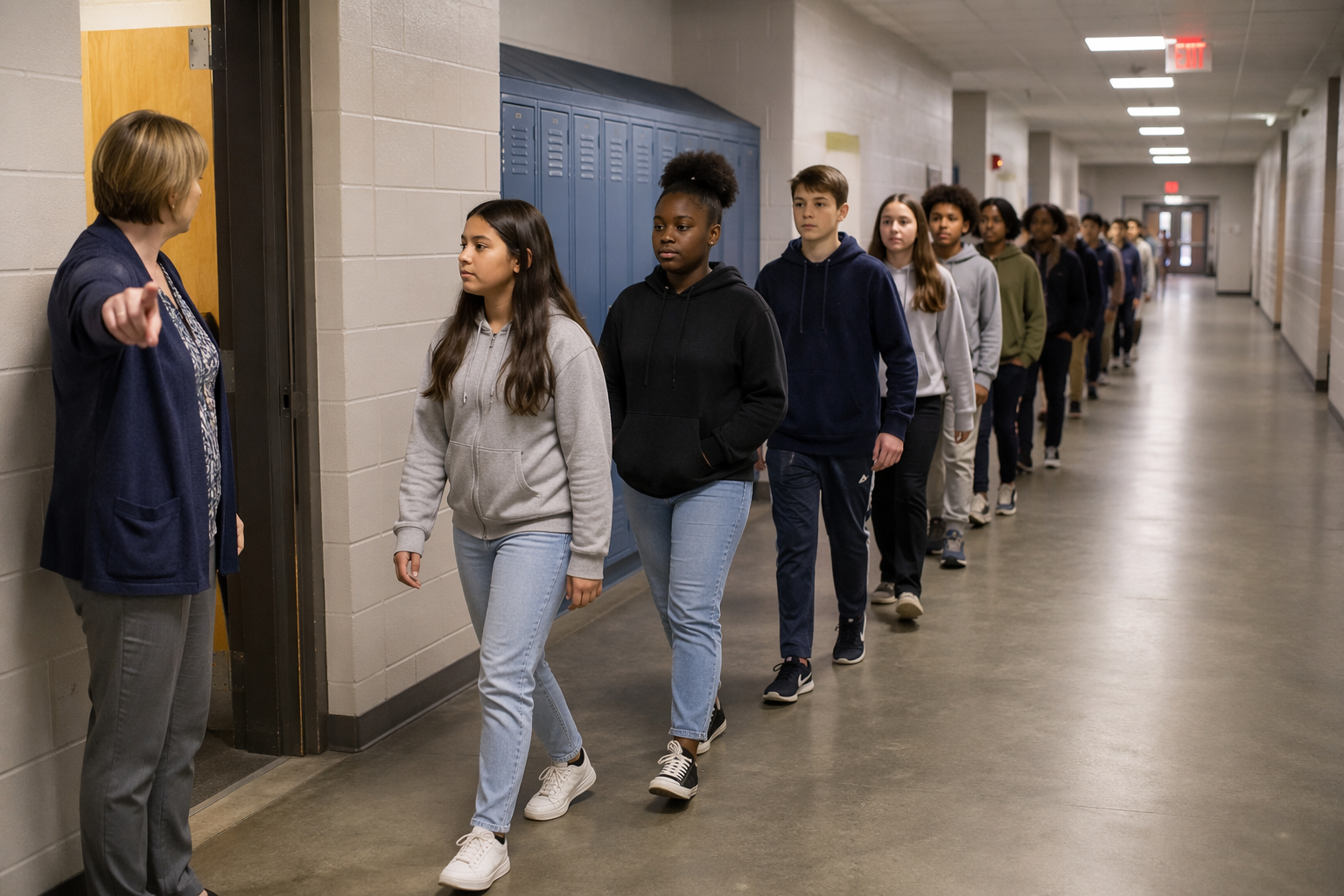
In many school buildings, safer areas are interior rooms or hallways on the lowest practical level, away from windows and exterior doors. Less safe areas include rooms with lots of glass, outside walls, or wide open ceilings. Your school may use interior corridors, restrooms, locker rooms, or other assigned spaces depending on the building. The important part for a student is not to invent a shelter location in the moment. Use the one your school has practiced.
Why gyms, auditoriums, and cafeterias are usually avoided
Large-span rooms are a problem during tornado warnings because they often have wide roofs with fewer interior supports. The NWS school guide specifically warns schools to avoid large-span areas such as gyms, auditoriums, and cafeterias for tornado sheltering. [2] Those rooms may be useful for assemblies, lunch, concerts, and basketball games, but they are not the place to remain during a warning if your school has a safer interior shelter route.
If you are in one of those spaces when the warning is announced, do not freeze because you are not in a normal classroom. Follow the adult leading that area. Cafeteria staff, coaches, substitute teachers, aides, and administrators are part of the response, too. Move with the group to the assigned shelter area instead of trying to return to your regular classroom.
What to do once you reach shelter
Once your class reaches the shelter area, get low. Kid-friendly tornado safety guidance describes the protective position this way: crouch on your knees, face down, and cover the back of your neck with your hands. Weather Wiz Kids also notes that a bike helmet can add head protection, and UCAR’s Center for Science Education gives similar guidance to protect your head and neck in a safe shelter space. [3][4]

This position is not comfortable, especially when a hallway is crowded or the floor is cold. It is still the position that protects the parts of you most vulnerable to flying or falling debris. Keep your head down. Keep your hands over your neck. If your school allows backpacks or books to be used for added cover, follow that instruction, but do not delay moving to shelter just to collect belongings.
Warnings can feel longer than students expect. Tornado warnings commonly last 30 to 60 minutes, and the safe response is to remain sheltered until an official all-clear is given. [5] Do not stand up because the hallway got quiet, because your friend says the warning is over, or because you want to check your phone. The all-clear needs to come from the school’s procedure, not from a guess.
If You Are Not Sitting in a Regular Classroom
Tornado alerts do not wait for a neat moment in the schedule. A warning can happen while students are in a restroom, between classes, at lunch, in a portable classroom, or loading buses. The same rule still applies: do not go looking for your favorite teacher or your backpack. Get to the nearest assigned shelter location under adult direction.
| Where you are | What changes during a warning |
|---|---|
| Hallway or passing period | Stop treating it like passing time. Follow the nearest adult to the closest assigned shelter area. |
| Gym, auditorium, or cafeteria | Leave the large-span room if your school’s plan directs you to a safer interior area. These spaces should be avoided for tornado sheltering. [2] |
| Portable classroom | Do not assume the portable is safe because it is part of school. NWS school guidance says portable classrooms should be avoided during tornado warnings. [2] |
| Restroom or office area | Follow the nearest staff member’s directions. If you are alone, move to the shelter location your school has taught you. |
| School bus | If a warning is issued during transportation, NWS school guidance says students should be moved from the bus to a sturdy building or, if none is available, to a low-lying ditch away from the bus. [2] |
Portable classrooms deserve special attention because they can trick students. They have desks, whiteboards, passes, and lesson plans, so they feel like any other classroom. During a tornado warning, they are not treated like a safer interior room. If your school uses portables, learn the severe-weather route before a warning day. That route may be the most important drill path you have.
The bus situation is also different from a normal building drill. Students may be used to fire drills, evacuation lines, and school entrances, but a tornado warning during transportation depends on where the bus is. The driver and school transportation plan matter. The student part is to listen, move quickly when told, and get away from the bus if the driver directs an evacuation under the school’s severe-weather procedure.
Why a Watch Can Feel Calm and a Warning Cannot
The size and timing of the alerts explain the different school response. A tornado watch is broad. It can include many counties or even parts of several states, and it can last for hours. A tornado warning is narrower and more urgent because a tornado has been reported or indicated by radar in a specific area. [1]
If schools sent everyone into shelter position for every watch, students in some regions could spend long stretches crouched in hallways when the immediate danger is still uncertain. That would not make the warning response stronger. It could make students tired, distracted, and less likely to react sharply when the alert changes. So during a watch, the school prepares and monitors. During a warning, the preparation turns into movement.
Students may hear alerts from different places: school announcements, weather radios, phone alerts, local emergency systems, or staff communication. The National Weather Service explains that tornado watches are issued by the Storm Prediction Center, while tornado warnings come from local NWS forecast offices. [1] You do not need to memorize office names to stay safe at school. You do need to understand why one alert creates readiness and the other creates immediate action.
What If the Warning Seems Like a False Alarm?
Students notice patterns. If your school has sheltered before and no tornado hit the building, it is easy to think the next warning might not matter. Weather.com, using National Weather Service data from 2016 through 2020, reported that about 70% of tornado warnings were false alarms, while 87% of deadly tornadoes were warned ahead of time. [6]
Those two facts belong together. A warning can be “false” for your exact location and still be the right alert to take seriously. Tornadoes can shift, weaken, strengthen, or pass nearby instead of directly over a school. Forecasters warn conservatively because missing a dangerous tornado is much worse than sending people to shelter for a storm that does not hit their building.
For a student, the job is not to calculate whether this warning will be the one. The job is to respond the same safe way every time: move, get low, protect your head and neck, and wait.
The Part to Know Before the Announcement
Every school building is different. A one-story elementary school, a high school with several wings, a campus with portables, and a rural school with long bus routes will not all use the same shelter map. That is why the most useful tornado preparation for students is specific: know where your class goes, know where lunch or gym goes, know what to do if you are between classes, and know whether your school has a different plan for dismissal.
The vocabulary matters because it tells you what to do next. A tornado watch means stay in class, stay alert, and be ready for instructions. A tornado warning means move immediately to shelter, avoid unsafe spaces, crouch and cover, and stay there until the all-clear. The terms are not just words on a science test. They change what your body does during the school day.
References
- Understand Tornado Alerts, National Weather Service.
- Severe Weather Preparedness Guide for Schools, National Weather Service.
- Weather Safety: Tornadoes, Weather Wiz Kids.
- Tornado Safety, UCAR Center for Science Education.
- Tornado Watches vs. Warnings, Vermilion County.
- Why So Many Tornado Warnings Don't Verify, The Weather Channel.
Comments
Join the discussion with an anonymous comment.