
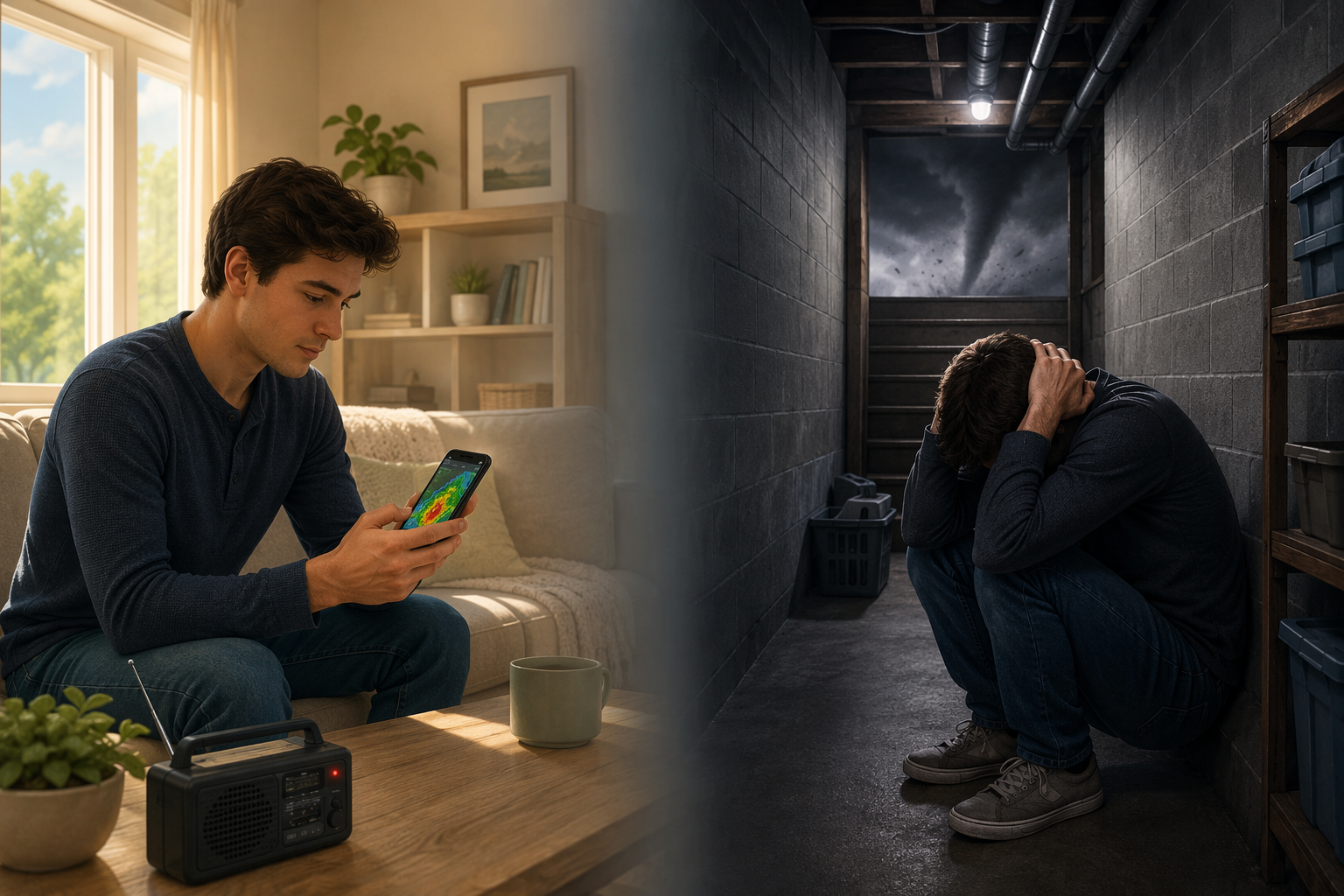
How a Tornado Watch Differs From a Warning
Learn the key differences between a tornado watch and a tornado warning, and get a clear set of actions to take for each so you can respond quickly and safely.
Updated:
The difference between a tornado watch and a tornado warning is not a vocabulary quiz. It is the difference between getting ready and getting down. NOAA performance data puts average tornado warning lead time at about 13 minutes, and that average is not a promise for your town, your storm, or your building.[1] In parts of the Southeast, lead times can be shorter. When the alert hits, the useful question is not "How bad does it look outside?" It is: "Which alert is active, and what does it require me to do now?"
The National Weather Service gives the cleanest rule: a watch means be prepared; a warning means take action.[2] For safety purposes, keep it that blunt. A tornado watch means conditions could produce tornadoes, so you should monitor alerts, charge your phone, know where you will shelter, and stay close enough to move quickly. A tornado warning means a tornado has been indicated by radar or reported by trained spotters, so you should go to shelter immediately.
The Difference That Matters First
| Alert | What it means | Who issues it | Typical area | Typical duration | What you do |
|---|---|---|---|---|---|
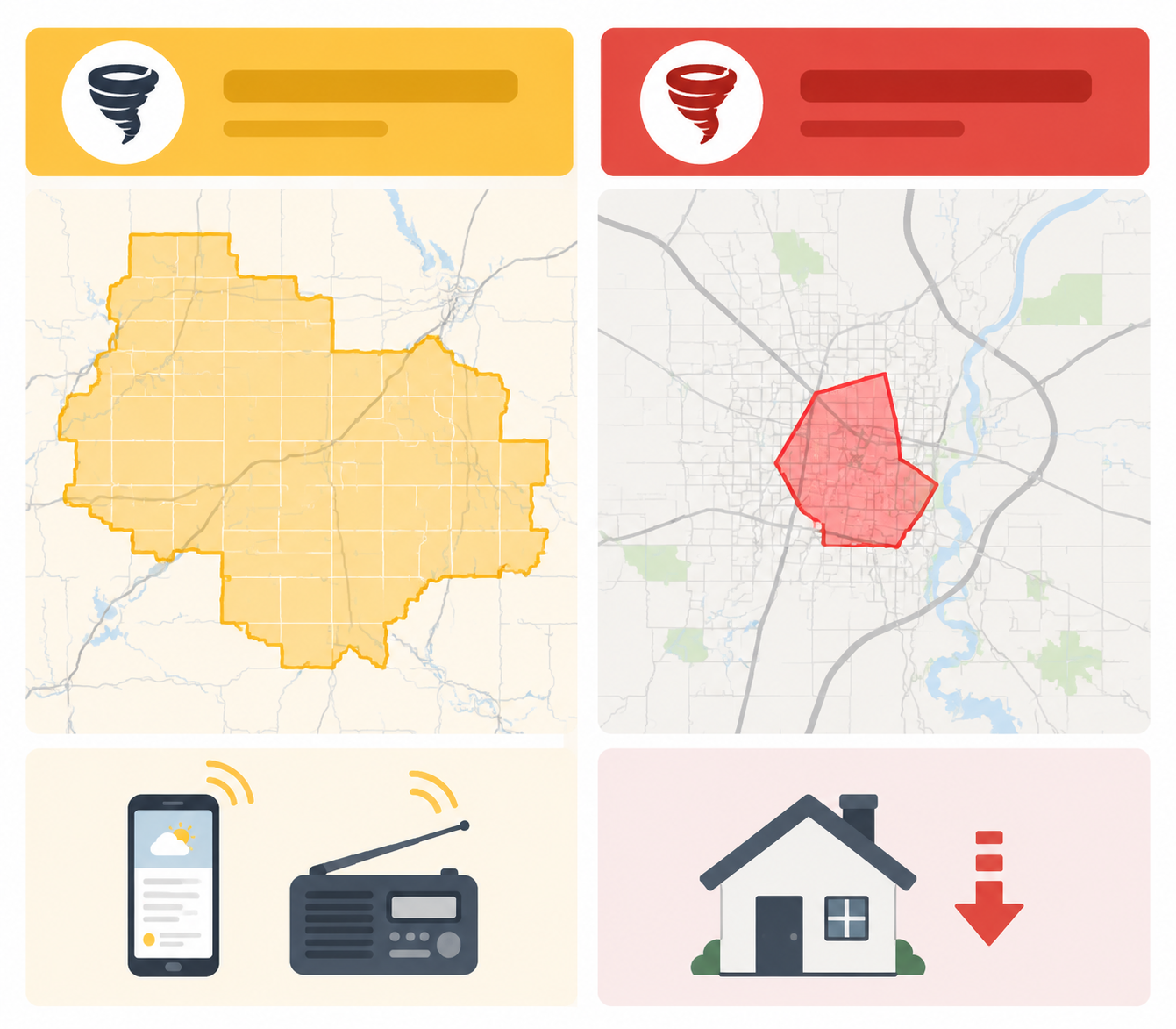
| Tornado Watch | Conditions are favorable for tornadoes | Storm Prediction Center | Broad region, often around 25,000 square miles | Usually 4 to 8 hours | Prepare and monitor |
| Tornado Warning | A tornado is occurring or likely based on radar or reports | Local National Weather Service office | Smaller polygon, often city-sized | Often around 30 minutes | Shelter immediately |
A watch is intentionally broad. The National Weather Service says a tornado watch commonly covers about 25,000 square miles, roughly the size of half of Iowa, and often lasts 4 to 8 hours.[2] That does not mean every block inside the watch is in equal danger at every minute. It means the atmosphere is capable of producing tornadoes, and you should not be surprised if a warning follows.
A warning is narrower because it is tied to a specific storm threat. It is usually issued by a local National Weather Service office for a smaller polygon, often closer to the size of a city or part of a county, and it may last around 30 minutes.[2] If your phone says you are in the warning polygon, do not wait to see rotation, hear sirens again, or check whether other people in the hallway look worried.
What To Do During A Tornado Watch
A watch is the time to remove friction. You are not diving into the bathtub for the next six hours, but you are making sure you could get there fast. That means choosing the shelter spot before the warning arrives, checking that you can receive alerts indoors, and paying attention to updated warnings instead of treating the watch as background noise.
- Find your shelter location now: a basement if available, or an interior room, bathroom, hallway, or stairwell on the lowest floor.
- Charge your phone and keep it near you, but do not rely on one alert source.
- Turn on Wireless Emergency Alerts, use a trusted weather app, and consider a NOAA Weather Radio.
- Bring shoes, keys, medication, and a flashlight within reach if storms are expected to last into the night.
- Tell roommates, family, or guests where you will go if a warning is issued.
- If you are in class, at work, or in a dorm, learn the nearest posted shelter area before the hallway gets crowded.
Outdoor sirens can help, but they are not a complete indoor warning system. They are designed mainly to warn people outdoors, and walls, distance, wind, rain, sleep, headphones, or a loud window unit can keep you from hearing them clearly. Treat sirens as one layer, not the plan.
What To Do During A Tornado Warning
A warning is not the moment to confirm the forecast with your own eyes. Tornadoes can be rain-wrapped, hidden by darkness, or blocked by buildings and trees. If the warning includes your location, move immediately to the safest place you can reach.
- Go to a basement if one is available.
- If there is no basement, go to a small interior room on the lowest floor.
- Stay away from windows, glass doors, exterior walls, and large open rooms.
- Get low, cover your head and neck, and use a mattress, heavy blanket, pillow, bike helmet, or sturdy furniture for extra protection.
- Keep shoes on if you can, because broken glass and debris are common after damage.
- Stay sheltered until the warning expires or official guidance says the immediate threat has passed.
Ready.gov's tornado guidance is direct: go to a basement or an inside room without windows on the lowest floor, protect your head and neck, and keep listening for emergency information.[3] The point is not to find a perfect place. The point is to quickly put as many walls as possible between you and flying debris.

If You Are In A Dorm, Apartment, Or Shared Building
A lot of tornado advice assumes a single-family house with a basement. Many students and renters do not have that. In a dorm or apartment building, the safer choice is usually the lowest floor you can reach quickly, away from windows. Interior bathrooms, interior hallways, laundry rooms, stairwells, and designated shelter areas are usually better than bedrooms with exterior windows.
If you live on an upper floor, do not stay there because your lease, laptop, or pet carrier is there. Move down as soon as the warning is issued. If you have a roommate who freezes or a neighbor who did not hear the alert, use one sentence: "Tornado warning - lowest interior hallway now." Under stress, that is more useful than explaining the radar.
If You Are In A Car Or Outside
A vehicle is a bad place to wait out a tornado. If there is a sturdy building nearby, get inside and go to the lowest interior area. If you cannot reach shelter, follow official emergency guidance for the conditions around you rather than driving toward or across the storm path. Do not park under an overpass. The National Weather Service explicitly warns against taking shelter under overpasses, and it also warns against opening windows before a tornado.[2]
Common Mistakes That Cost Time
The most dangerous mistake is treating a warning like a stronger watch. A watch allows you to keep doing some things while staying alert. A warning interrupts the room. Class stops. The video pauses. The shower waits. The delivery run ends. You move.
- Do not go outside to look for the tornado.
- Do not open windows; it wastes time and increases exposure to glass and debris.
- Do not shelter under a highway overpass.
- Do not assume you are safe because the sky looks calm; tornadoes can be hidden by rain or darkness.
- Do not wait for sirens if your phone or weather radio says your location is in the warning.
- Do not stand near windows to film; flying debris is the main threat in many tornado injuries.
Where Watches And Warnings Fit In The Larger Alert Ladder
You may also see terms around the main watch-warning split. National Weather Service offices describe a broader ladder that can include a Convective Outlook, Tornado Watch, Particularly Dangerous Situation watch, Tornado Warning, Particularly Dangerous Situation warning, and Tornado Emergency.[4][5] Those labels can matter, especially on high-end outbreak days, but they do not change the basic response: watch means prepare; warning means shelter.
A Tornado Emergency is the highest tier and is reserved for an especially serious, confirmed threat to life and property. A 2026 Student Life guide notes that the first Tornado Emergency was issued during the May 3, 1999 Bridge Creek-Moore F5 tornado and that the label has been used about 300 times since its introduction.[6] If you ever see that wording for your location, it is not a prompt to compare alerts. It is a prompt to already be in shelter.
Warnings Are Not Perfect, But They Are Not Optional
Some people hesitate because not every tornado warning ends with a confirmed tornado at their address. That is true, and it is exactly why the decision has to be made before the storm is overhead. The same Student Life guide cites a FiveThirtyEight analysis finding that around 25% of tornado warnings preceded a confirmed touchdown, while also noting that false alarms have improved over time.[6] That number is not an invitation to gamble. It is a reminder that the warning system is trying to protect people in fast-changing, uncertain conditions.
A warning polygon can include people who never see damage and people who have only minutes before debris hits their street. From inside an apartment, dorm, classroom, or office, you do not know which group you are in soon enough to make a better decision than the warning itself. The safe move is to spend those minutes getting lower, farther inside, and covered.
Keep the rule short enough to use when the alert sound cuts through the room: tornado watch means prepare and keep monitoring; tornado warning means stop debating and shelter immediately.
References
- NOAA Tornado Warning Lead Time (minutes), NOAA, https://performance.commerce.gov/KPI-NOAA/NOAA-Tornado-Warning-Lead-Time-minutes-/53km-gj97
- Tornado Watch vs. Warning, National Weather Service, https://www.weather.gov/safety/tornado-ww
- Tornadoes, Ready.gov, https://www.ready.gov/tornadoes
- Severe Weather Definitions, National Weather Service Binghamton, https://www.weather.gov/bgm/severedefinitions
- Warnings Defined, National Weather Service Baltimore/Washington, https://www.weather.gov/lwx/warningsdefined
- A beginner's guide to tornado safety, Student Life, April 30, 2026, https://www.studlife.com/scene/2026/04/30/a-beginners-guide-to-tornado-safety
Comments
Join the discussion with an anonymous comment.